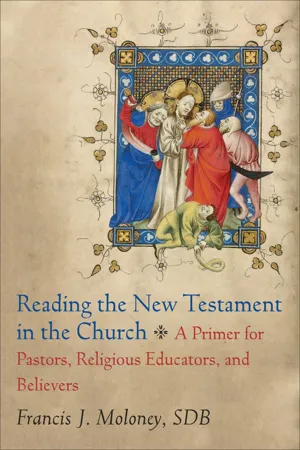
eBook - ePub
Reading the New Testament in the Church
A Primer for Pastors, Religious Educators, and Believers
- 240 pages
- English
- ePUB (mobile friendly)
- Available on iOS & Android
eBook - ePub
Reading the New Testament in the Church
A Primer for Pastors, Religious Educators, and Believers
About this book
Internationally respected scholar Francis Moloney offers a Catholic introduction to the New Testament that shows how to read it both faithfully and critically. The opening chapter and an epilogue directly address the theological requirements of, and historical challenges for, ecclesial reading. The remaining chapters give exemplary readings of the figure of Jesus and of the various divisions of the New Testament canon. Conceived as a resource for religious educators, deacons, and other ministers in the Catholic Church, this book will serve Catholics and others as an ideal supplement to a conventional New Testament introduction or as a companion to reading the New Testament itself.
Information
1
Catholic and Critical
The Challenge of Scripture in the Catholic Tradition
The Bible is known “by name.” It can be seen in bookshops, in hotel rooms, at church services. Indeed, the Bible remains the best-selling book in the world. It contains passages that have become part of everyday use in English. Proverbial sayings such as “do unto others as you would have them do unto you” (see Luke 6:31), “go the extra mile” (see Matt. 5:41), “wash your hands” of something (see Pilate’s action in Matt. 27:24), “eat, drink, and be merry” (see Luke 12:19), “it is more blessed to give than to receive” (see Acts 20:35), and “the powers that be” (see Rom. 13:1) are a tiny sample of the many well-known phrases that have their origins in the Bible.1 Some will be familiar with a “family Bible,” in which all the births, baptisms, marriages, and deaths have been recorded for several generations.
But once the book is opened and read, difficulties emerge. The language is archaic, and the world from which the various stories come is distant from the one we inhabit. The experience becomes more critical when we seek answers to pressing contemporary issues in the pages of the Bible. It is helpful to know that one of the greatest figures from the Christian tradition, the young Augustine, found that the Bible “seemed to me unworthy in comparison with Cicero. My inflated conceit shunned the Bible’s restraint, and my gaze never penetrated to its inwardness.”2 This “inwardness” is one of the reasons the Church regards the Bible as its Sacred Scripture.
Reading the Bible
The Bible is not a book. It is a collection of many books, starting from the book of Genesis on its first page and ending with the Apocalypse, or Revelation, on its last. The origin of the English word “bible” is a Greek word, biblia. It is a plural word that simply means “books.” The biblia (Bible) is not a book but a collection of books. The older section of the Bible, most of which was established as the Sacred Scripture of Israel before the time of Jesus of Nazareth, is traditionally called “the Old Testament.”3 This name is sometimes challenged today, as calling the Christian Sacred Scriptures “the New Testament” can generate a distinction between what is old (and therefore outdated) and what is new (demanding more of our attention). Sometimes the names “First and Second Testament” or “the Hebrew Scriptures and the Christian Scriptures” are used to avoid the danger of that possible distinction. But that is not necessarily the case, and these alternatives also generate difficulties. For example, parts of the “Hebrew Bible” are in Aramaic, and the Greek version of the Hebrew, called the Septuagint (LXX), was for the majority of New Testament authors the text used as Scripture, and this continued to be the case in the early Church’s use of “the Bible.” In this book I will continue to use the traditional terminology, as the Old Testament is the older of the two testaments. This does not make it any less important. Indeed, it is impossible to understand Jesus, early Christianity, and the New Testament unless we see both Old and New Testament as one divinely revealed Word of God. They are both “testament,” a precious “gift,” and one is older than the other.4
Within these “books” we find stories that look like narrative history. Some texts in the Old Testament are called “the historical books.” This expression is applied especially, but not only, to the two books of Samuel and the two books of Kings. There are also books in the New Testament that look like narrative history: the Gospels of Matthew, Mark, Luke, and John and the Acts of the Apostles tell the story of Jesus’ birth, his life and teaching, his death and resurrection (Gospels), and the subsequent spread of the Christian community from Jerusalem to Rome (Acts). They look like “history books” to a reader living in the third Christian millennium, and most churchgoers understand them as such. But these impressions can be deceiving. There is also a great deal of poetry in the Old Testament, especially, but not only, in the book of Psalms. Poetry is also found in the New Testament. Two well-known “poems,” most likely early Christian hymns, can be found in the Prologue to the Gospel of John (John 1:1–18) and Paul’s Letter to the Philippians (Phil. 2:5–11), the latter of which describes Jesus’ descent from equality with God, through death on a cross, to an ascent into exaltation at the right hand of God, where every knee will bow at his name. There are other such “hymns” scattered across the New Testament, especially in the Apocalypse.
The prophets wrote oracles that accuse, cajole, encourage, condemn, and punish. There is also a lot of “teaching” in the Old Testament, including in the great law books of Israel—Genesis, Exodus, Leviticus, Numbers, Deuteronomy—and in the Prophets and books that come from what we call the Wisdom tradition—Ben Sirach (also called Ecclesiasticus and found only in Catholic Bibles), Qoheleth (Ecclesiastes in Protestant Bibles), the book of Wisdom of Solomon (also only found in Catholic Bibles), and Proverbs. There is even a very beautiful love song, the Canticle of Canticles (also called Song of Songs or Song of Solomon), that affirms the beauty and importance of sexual love in an interpretation that runs side by side with a long Catholic tradition that this song is about the soul’s desire for union with God. A challenging form of literature called “apocalyptic” also appears from time to time, especially in the book of Daniel. It seeks to explain current suffering and the apparent lack of any possible human resolution of that suffering as part of God’s design, pointing to God’s intervention as the Lord of all history.
The same variety is found in the New Testament. Paul’s letters contain the earliest written “teaching” of the Christian Church. But in these letters, side by side with letters from other figures from the early Church, one can also find accusing oracles, cajoling, condemnation, and the threat of punishment. One can also find indications of affection and close fellowship. The teaching tradition continues in the practice of writing theological tracts (Letter to the Hebrews). The practice of apocalyptic writing brings the New Testament and the Bible to an end (the Apocalypse).
These many “books” come from very different times; have their own historical, religious, and social background; and were written to address different issues across those centuries. The oldest of the literary traditions in the Old Testament probably reaches back to about 1000 BCE (Before the Common Era). Although we can only speculate about dates, about the antiquity of the traditions, and about whether they came from family or tribal origins, these ancient traditions may have had their origins in a very ancient culture that told its “stories” in familiar family and tribal settings, and these stories were eventually committed to writing. From that earliest period, almost every period of Israel’s history until 165–70 BCE (the book of Daniel) is represented by a book or section of a book in the Old Testament.
The time span behind the New Testament is much briefer. We cannot be certain, but Jesus of Nazareth lived from about 4 BCE until the early 30s of the Common Era (CE). The earliest subsequent document that we have (Paul’s First Letter to the Thessalonians) was written about 50 CE. The most recent of the Gospels probably appeared about 100 CE (John), but later documents that continued the Pauline traditions appeared early in the second Christian century (1–2 Timothy, Titus). While the Old Testament reflects almost one thousand years of Israel’s history and response to God’s initiative, the New Testament appeared across less than one hundred years. In itself this says something about the explosive nature of the story of Jesus of Nazareth’s life, teaching, death, and resurrection and the subsequent emergence of a powerful group of believers who wanted to tell that story and reflect upon its meaning. But it does not take away from the majesty of a national story of a God-chosen people and the record of its problematic relationship with its God across a thousand years, found in the pages of the Old Testament. One of the reasons the early Christians began to think of a “Sacred Scripture” associated with the life, death, resurrection, and subsequent heritage of Jesus was that they already accepted the Old Testament, the Sacred Scripture of Israel, as part of their heritage. The New Testament continued that heritage in the light of the event of Jesus Christ.
The variety of types of literature and the great span of historical and socioreligious settings within which the books of the New Testament were eventually produced are significant challenges to any interpreter. Added to these is the fact that all the books were written in a popular late form of Greek known as koinē. As outsiders looking into the world of Greek-speaking authors, we will always be limited in what we can catch of the original sense of those foreign words, even if we know some Greek.
Necessary or Not?
Week by week we listen to biblical texts read in church services. Bible-study groups and prayer groups that rely on the Bible as the Word of God for their inspiration and guidance are found all over the world. Some Catholics claim that one only needs to hear what they think the Pope, bishops, and priests have to say.5 They claim that there is no need for the interpretation of the New Testament in the Church. It is irrelevant at best or damaging to the Christian and Catholic Church at worst. Another approach to reading the New Testament is “fundamentalism.” These believers claim that no “mediation” is required between the Word of God articulated in the biblical text and the reader or hearer of that text. All one needs to do is hear or read the biblical Word proclaimed or read in an English translation. This must be taken as an infallible Word of God. Rigid groups found across all Christian confessions follow this interpretative practice. They run the danger of yielding to fanaticism and often lack tolerance of any point of view other than their own. This approach to the Word of God and to others is hard to accept within a more universal understanding of Jesus Christ and those who follow him.
Nevertheless, Catholic interpretation wears its presuppositions on its sleeve. It is part of an interpretative tradition that has gone on for almost two thousand years. God’s word is available to us in other places, not only in the holy book of the Bible. It must be so, as no book can hope to contain all that God has made known in the past, continues to communicate today, and will reveal in the future. Interpreting the New Testament in the Church calls for openness to the guidance provided to the interpreter by the Tradition to which she or he belongs. This process is not a restrictive imposition or a loss of academic freedom. It often proves to be a way into unexpected and exciting developments of the Tradition itself.
Catholics and the Bible: A Brief History
Beginnings
Prior to the Protestant Reformation in the sixteenth century, the Christian Church, although divided within itself among Eastern churches and thus not without its sinfulness, always regarded the Gospels and the Epistles as the “apostolic preaching,” the foundation of Christian faith. In the earliest Church the authors of the New Testament books looked back to the Old Testament as their Scripture, as they began to articulate what the God of Israel had done for humankind through the life, teaching, death, and resurrection of Jesus. In the time of the so-called apostolic fathers, Christian authors continued to use the Old Testament as their Scripture and steadily began to recognize many early Christian writings as authoritative. As we will see later, the eventual acceptance of the New Testament as part of the Church’s Scripture emerged in the third century. The apostolic fathers of the second century strained to articulate the message of the Bible, and especially the message of Jesus Christ, in a new world that had little or no understanding of either the Jewish matrix that had given birth to Jesus or the subsequent early reflection on what God had done in and through him. This task was undertaken, in different ways, by all these early interpreters, especially Clement of Alexandria (150–215), who bridged from the apostolic fathers and apologists of the second century to the patristic tradition of the third and later centuries.
The great fathers of the Church constantly used the Scriptures to develop and understand the Christian mysteries and the life and practice of the Church. There was no single interpretation of the Bible. Different methods of interpretation were used in the West and in the East, and in the East between Antioch and Alexandria. The great councils that determined the Christian community’s teaching and practice (Nicaea [325], Constantinople I [381], Ephesus [431], Chalcedon [451], Constantinople II [553]) are awash with reflections on the Word of God. Indeed, debate over the many possible meanings of the one text was at the heart of the heated conciliar disputes and generated “parties,” schisms, and even persecutions among Christian peoples. The results of this widespread, contested, and varied interpretation of the Bible can still be traced in the richness of that heritage. It is found in the writings of such figures in the West as Tertullian (ca. 160–ca. 225), Saint Ambrose (340–97), Saint Jerome (347–420), Saint Augustine (354–430), Leo the Great (ca. 391–461), and Saint Gregory the Great (540–604), and in the East, Origen (184–254), Saint Athanasius (ca. 296–373), Saint John Chrysostom (347–407), Saint Basil (329–79), and Saint Gregory of Nyssa (335–95), to mention only a few of the giants from that era.
Many of these biblically inspired traditions were forced into the background in the eleventh century as papal authority struggled with the secular princes. A more juridical and less biblical, theological, and sacramental self-understanding of Christianity began to develop.6 In the medieval period significant women emerged, such as Margaret of Scotland (1045–93), Hildegard of Bingen (1098–1179), Elizabeth of Hungary (1207–31), and Julian of Norwich (1342–ca. 1419). The great theological synthesis of Thomas Aquinas (1225–74) appeared. He had been preceded by Saint Anse...
Table of contents
- Cover
- Title Page
- Copyright Page
- Endorsements
- Epigraph and Dedication
- Contents
- Preface
- 1. Catholic and Critical
- 2. Historical Context
- 3. The Origins of the New Testament
- 4. Jesus of Nazareth
- 5. Paul
- 6. The Four Gospels
- 7. The Acts of the Apostles
- 8. Later Writings of the New Testament
- 9. The Revelation to John
- Epilogue
- Bibliography
- Index of Subjects
- Index of Authors
- Index of Scripture and Other Ancient Sources
- Back Cover
Trusted by 375,005 students
Access to over 1.5 million titles for a fair monthly price.
Study more efficiently using our study tools.
Frequently asked questions
Yes, you can cancel anytime from the Subscription tab in your account settings on the Perlego website. Your subscription will stay active until the end of your current billing period. Learn how to cancel your subscription
No, books cannot be downloaded as external files, such as PDFs, for use outside of Perlego. However, you can download books within the Perlego app for offline reading on mobile or tablet. Learn how to download books offline
We are an online textbook subscription service, where you can get access to an entire online library for less than the price of a single book per month. With over 1.5 million books across 990+ topics, we’ve got you covered! Learn about our mission
Look out for the read-aloud symbol on your next book to see if you can listen to it. The read-aloud tool reads text aloud for you, highlighting the text as it is being read. You can pause it, speed it up and slow it down. Learn more about Read Aloud
Yes! You can use the Perlego app on both iOS and Android devices to read anytime, anywhere — even offline. Perfect for commutes or when you’re on the go.
Please note we cannot support devices running on iOS 13 and Android 7 or earlier. Learn more about using the app
Please note we cannot support devices running on iOS 13 and Android 7 or earlier. Learn more about using the app
Yes, you can access Reading the New Testament in the Church by Francis J. Moloney in PDF and/or ePUB format, as well as other popular books in Theology & Religion & Biblical Criticism & Interpretation. We have over 1.5 million books available in our catalogue for you to explore.