- 208 pages
- English
- ePUB (mobile friendly)
- Available on iOS & Android
eBook - ePub
About this book
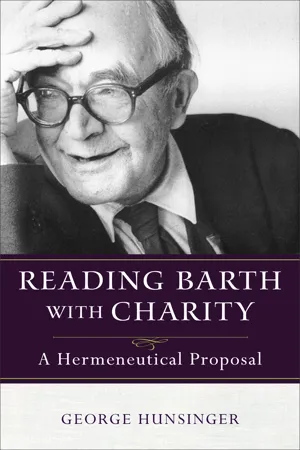
Karl Barth and his legacy have dominated theology circles for over a decade. In this volume George Hunsinger, a world-renowned expert on Barth's theology, makes an authoritative contribution to the debate concerning Barth's trinitarian theology and doctrine of election. Hunsinger challenges a popular form of Barth interpretation pertaining to the Trinity, demonstrating that there is no major break in Barth's thought between the earlier and the later Barth of the Church Dogmatics. Hunsinger also discusses important issues in trinitarian theology and Christology that extend beyond the contemporary Barth debates. This major statement will be valued by professors and students of systematic theology, scholars, and readers of Barth.
Information
Topic
Theology & ReligionSubtopic
Christian Theology1
Grace and Being
The Charter Document
The elements of the revisionist argument call for careful attention. The place to begin is the essay by Bruce McCormack titled “Grace and Being: The Role of God’s Gracious Election in Karl Barth’s Theological Ontology.”1 Although revisionism has evolved to some extent since this essay was written, “Grace and Being” still stands out, in effect, as the manifesto of the revisionist movement.2
Ontology
Let’s begin with the idea of “ontology.” It is assumed without argument that Karl Barth operates with an ontology. We have recently witnessed a veritable explosion of writings connecting “ontology” with Barth. He is said to have a “theological ontology,” as in the title of this essay, but elsewhere in contemporary discussion we find him operating with a moral ontology, an eschatological ontology, a soteriological ontology, a social ontology, and—most highly prized of all—an “actualistic ontology.” Of ontologies in Barth, it would seem, there is no end. But what does all this “ontology talk” really mean? I’m sure it would have astonished Barth, and I’m not sure it would have pleased him.
The word ontology is ambiguous, having more than one possible meaning. Roughly speaking, there is a proper sense and an extended sense. In the philosophical or proper sense, “ontology” refers to the study of being. It is a branch of metaphysics that deals comprehensively with the nature of being and of beings. In the extended sense, on the other hand, the term refers to something looser. It signifies only a field of inquiry pertaining to the material covered and the sorts of things and relations one finds in it—to a general area of action, inquiry, or interest. It is descriptive with no claims of being systematic or explanatory. Following the literary conventions of the philosopher Charles Taylor, I will call the proper sense “ontology1” and the extended sense “ontology2.”3
It seems that the revisionists do not take sufficient pains to distinguish ontology1 from ontology2. Too often they seem to trade on the ambiguity, appearing to speak of ontology2 while slipping into ontology1. The slippage can have unfortunate consequences, as will be seen. But first we need to recall that while occasionally allowing for ontology2, Barth always polemicized against ontology1.
An early indication of Barth’s attitude can be found in his letter to Rudolf Bultmann from June 12, 1928.4 “I have come to abhor profoundly,” Barth wrote, “the spectacle of theology constantly trying above all to adjust to the philosophy of the age, thereby neglecting its own theme” (41). This was said in response to Bultmann’s urging him to leave behind outmoded Platonic and Aristotelian thought forms in favor of Heidegger’s ontology. Barth continued,
The Platonism and Aristotelianism of the orthodox was not a hindrance to my . . . perceiving what was at issue and therefore to adopting the older terminology into my own vocabulary without identifying myself with the underlying philosophy. (41)
With reference to matters that I saw to be at issue in the Bible and the history of dogma, I have reached out on the right hand and the left for terms or concepts that I found to be most appropriate . . . because my hands were already full trying to say something very specific. (41)
My own concern is to hear at any rate the voice of the church and the Bible, and to let this voice be heard, even if in so doing, for want of anything better, I have to think somewhat in Aristotelian terms. (42)
By the late 1920s Barth’s lifelong approach to various philosophies was already in place. It was eclectic, unsystematic, and ad hoc. He had no desire to adopt a thoroughgoing Heideggerian framework, which was, of course, a quintessential version of ontology1.
For Barth ontology1 represented a danger for dogmatic theology. No ontology ought to become a systematic framework within which theology was constrained to operate. For example, if an ontological system were set up that embraced both God and the creature, an impossible situation would arise where the creature posed “conditions for God” (II/1, 583). Barth argued that philosophical criteria, such as ontology1 would introduce, have no direct role to play in dogmatic reflection. Those who believe otherwise, he suggested, should be quietly asked to desist from doing theological work, where they “can only cause confusion with these and other standards” (I/1, 285).
There can be, Barth wrote, no “ontology of the created totality. . . . The Word of God does not contain any ontology of heaven and earth themselves” (III/2, 6). Dogmatic theology should never hold fast to any comprehensive ontology “as if it were uniquely true and biblical and orthodox” (III/2, 7). “Any attempt at an independent [or explanatory] ontology . . . would at once estrange us” from the proper knowledge of God (III/3, 442). Christology in particular must avoid taking on “the appearance of an ontology and dramatics arbitrarily constructed from Scripture and tradition” (IV/1, 757). The event of the incarnation “cannot . . . be perceived or understood or deduced from any ontology which embraces God himself and the world, God himself and humankind, or from any higher standpoint whatever” (IV/2, 41, rev.).
As long as such stipulations are in place, the looser sense of ontology2 is acceptable. Barth could describe Christian discipleship, for example, as “not so much a matter of morals as ontology” when it came to the saying that no disciple was above his or her master (Matt. 10:24). Here “ontology” is a matter of pointing to the proper order and status of particulars in a limited case.
To sum up: the important thing to see is that Barth’s approach to ontology1 was both negative and positive. Negatively, he always rejected it as a controlling system, while positively, his approach was eclectic. ontology1 could be raided for concepts to be used in an ad hoc and nonsystematic way, but no more. As a consequence, Barth would have harbored no intention to construct a thoroughly actualistic concept of God’s being if that meant God’s being was merely a consequence of God’s actions, as required by prior ontological commitments. His emphasis was always on the a posteriori nature of theological reflection as based on revelation. A dogmatic theology that respected God as Wholly Other, and so as incommensurable with the world, precluded any kind of comprehensive ontological agenda.
Moreover, no ontology—in the sense of ontology1—could be allowed to bracket together the creature and the Creator. The doctrine of God could not be absorbed into a doctrine of being—not even an actualistic doctrine of being. As Eberhard Jüngel has written, “Barth’s Dogmatics makes ontological statements all the way through. But this dogmatics is not an ontology; at least not in the sense of a doctrine of being drawn up on the basis of a general ontological conception within which the being of God (as highest being, being-itself, etc.) would be treated in its place.”5
This means, I believe, that Barth would have been averse to constructing a “postmetaphysical” theology. He would have opposed it for theological reasons. It would have carried a danger he always sought to avoid, namely, that of setting up a conceptual scheme in which God was conditioned by the world. Under no circumstances did he want that to happen. Whether revisionist Barthianism can avoid this outcome remains to be seen.
According to Professor McCormack, Barth’s doctrine of election involves an implied ontology (107). This ontology is said to arise because for Barth the death of Christ is an event in the divine life (98). Whether to adopt some sort of ontology is not in question. The only choice is between an “actualistic ontology” and an “essentialist ontology” (98). “None of the above” is not an option.
For the revisionists, anyone who demurs from adopting an “actualistic ontology” is automatically saddled with an “essentialist ontology.” No provision is made that this might be a Hobson’s choice. By the same token, anyone who rejects the revisionists’ “actualistic ontology” is ipso facto entangled in “classical metaphysics.” If “classical metaphysics” (a term never defined) is actually a code word for traditional Catholicism and Eastern Orthodoxy, “actualistic ontology” might in turn be a cryptogram for some sort of hyper-Protestantism.6
The possibility that dogmatic theology might be actualistic in some ways while embracing classical metaphysics in other ways—which is what I think Barth actually does—is of course ruled out. The only alternative is to be either “actualistic” or “essentialist,” with no gradations between. Barth’s “actualistic ontology” supposedly committed him to purging all elements of “classical metaphysics” from his theology.7
Not much content is ascribed to Barth’s “actualistic ontology” in the “Grace and Being” essay. That will come later. But we do learn at least two things about it. First, it functions to describe the being of God. It indicates that from all eternity God’s being “is determined, defined, by what he reveals himself to be in Jesus Christ; viz., a God of love and mercy towards the whole human race” (97–98, italics added). Except for the slippery word defined, which we will come back to momentarily (as if the words determined and defined mean the same thing), one does not need anything like an ontology to say this—certainly not in the sense of ontology1. It would be more accurate to say that for Barth God reveals himself as a God of love and mercy toward the human race, that he is already a God of love antecedently in himself, and that in his pretemporal act of election God determines himself also—the word also is important here—to be a God of love and mercy for the world.
According to revisionism’s “actualistic ontology,” the act by which God’s being is constituted is not first of all trinitarian. It is not the primordial act by which God is who he is, as Father, Son, and Holy Spirit to all eternity. It seems that there can be no such thing as this primordial trinitarian act. If God is really going to be a God who “acts,” the divine activity must occur first in relation to the world. No other possibility can be entertained.
God’s decision of pretemporal election is of course an action in relation to the world. Election is said to mean that “what God is essentially is itself constituted by an eternal act of Self-determination for becoming incarnate in time—in which case eternal divine action would ground divine essence” (96–97, italics added). This electing act in relation to the world is “constitutive of the divine essence” (a momentous claim; 96, italics original). God has no being in and of himself that is not “constituted” by God’s relationship to the world through election. God has no perfect and determinate being in eternity prior to the decision of election.8
Professor McCormack’s way of stating this more positively is to say that in the pretemporal decision of election, God “gives himself being” (e.g., 104, italics added). I do not find this to be a clear idea, but in any case it is puzzling. Even in the traditional view that the Father begets the Son eternally, so that the eternal being (ousia) of God just is the Father begetting the Son (as we find for example in Athanasius), no one would ever have thought to claim that God is thereby giving himself being. Would he be doing so ex nihilo? How does one give oneself something that one does not have, even if one is God?
Professor McCormack’s statement means that he has to explain who (or what) this beingless “God” is prior to election and the Trinity, something I ...
Table of contents
- Cover
- Title Page
- Copyright Page
- Contents
- Acknowledgments
- Abbreviations
- Introduction
- 1. Grace and Being
- 2. Seek God Where He May Be Found
- Interlude
- 3. Being in Action
- 4. Two Disputed Points
- 5. Revisionism Scaled Back
- Conclusion
- Appendix: Analogia Entis in Balthasar and Barth
- Author Index
- Subject Index
- Back Cover
Trusted by 375,005 students
Access to over 1.5 million titles for a fair monthly price.
Study more efficiently using our study tools.
Frequently asked questions
Yes, you can cancel anytime from the Subscription tab in your account settings on the Perlego website. Your subscription will stay active until the end of your current billing period. Learn how to cancel your subscription
No, books cannot be downloaded as external files, such as PDFs, for use outside of Perlego. However, you can download books within the Perlego app for offline reading on mobile or tablet. Learn how to download books offline
Perlego offers two plans: Essential and Complete
- Essential is ideal for learners and professionals who enjoy exploring a wide range of subjects. Access the Essential Library with 800,000+ trusted titles and best-sellers across business, personal growth, and the humanities. Includes unlimited reading time and Standard Read Aloud voice.
- Complete: Perfect for advanced learners and researchers needing full, unrestricted access. Unlock 1.5M+ books across hundreds of subjects, including academic and specialized titles. The Complete Plan also includes advanced features like Premium Read Aloud and Research Assistant.
We are an online textbook subscription service, where you can get access to an entire online library for less than the price of a single book per month. With over 1.5 million books across 990+ topics, we’ve got you covered! Learn about our mission
Look out for the read-aloud symbol on your next book to see if you can listen to it. The read-aloud tool reads text aloud for you, highlighting the text as it is being read. You can pause it, speed it up and slow it down. Learn more about Read Aloud
Yes! You can use the Perlego app on both iOS and Android devices to read anytime, anywhere — even offline. Perfect for commutes or when you’re on the go.
Please note we cannot support devices running on iOS 13 and Android 7 or earlier. Learn more about using the app
Please note we cannot support devices running on iOS 13 and Android 7 or earlier. Learn more about using the app
Yes, you can access Reading Barth with Charity by George Hunsinger in PDF and/or ePUB format, as well as other popular books in Theology & Religion & Christian Theology. We have over 1.5 million books available in our catalogue for you to explore.