eBook - ePub
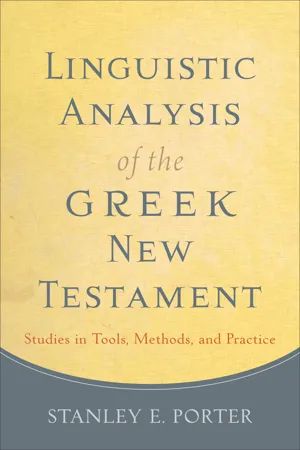
Linguistic Analysis of the Greek New Testament
Studies in Tools, Methods, and Practice
- 448 pages
- English
- ePUB (mobile friendly)
- Available on iOS & Android
eBook - ePub
Linguistic Analysis of the Greek New Testament
Studies in Tools, Methods, and Practice
About this book
In this volume, a leading expert brings readers up to date on the latest advances in New Testament Greek linguistics. Stanley Porter brings together a number of different studies of the Greek of the New Testament under three headings: texts and tools for analysis, approaching analysis, and doing analysis. He deals with a variety of New Testament texts, including the Synoptic Gospels, John, and Paul. This volume distills a senior scholar's expansive writings on various subjects, making it an essential book for scholars of New Testament Greek and a valuable supplemental textbook for New Testament Greek exegesis courses.
Information
Part 1
Texts and Tools for Analysis
1
Who Owns the Greek Text of the New Testament?
Issues That Promote and Hinder Further Study
Introduction
Let me begin by making one point very clearly: I am not a lawyer of any kind, much less a copyright lawyer, nor the son of a lawyer. But I am a scholar who is very interested in the Greek text of the New Testament, and so I am unavoidably interested in the accessibility of that text, as are all of us who have a share in New Testament studies. This interest and concern has prompted my investigation into this issue. I do not pretend that what I have discovered is in any way legally sound, or that anything I say here would stand up in any legal context, such as a courtroom. Please do not take what I write here as in any way offering legal advice. It is not meant as that. What I intend to offer is a preliminary exploration of the issue of copyright and how it relates to the Greek text of the New Testament.
There has been much controversy over the years regarding the issue of who owns an ancient text. One of the most well known of these recent confrontations has concerned the so-called Qumran text 4QMMT.1 To summarize a complex set of events, let me offer the following précis. Access to many of the Dead Sea Scrolls was limited for a number of years and for a variety of reasons, which need not be discussed in this essay. A number of scholars were concerned about what they perceived to be an inordinate delay in getting the scrolls published, and they were trying in various ways to force those who had access to the scrolls to open up that access. During this time, a number of scholars were purportedly working on various scrolls, or fragments of them, and sometimes their results were discussed at conferences or made available in various ways to other scholars—all without indicating or implying publication. One such text was the so-called 4QMMT. This manuscript, or set of fragments, had originally been assigned to the American scholar John Strugnell, who then had brought in the Israeli scholar Elisha Qimron to work on it with him. It appears that through the course of their working together, the major burden of the work had shifted from Strugnell to Qimron, who had created and made available in limited fashion copies of the text, including an assemblage of the fragments and reconstruction of readings for lacunae. An anonymous copy of this document apparently came into the hands of the editor of a journal in Poland, who proceeded to publish it, but with a disclaimer regarding knowledge of its provenance, or even its authenticity. It seems that, when Qimron found out that this document had been published, through legal means he was able to get the journal to cease distribution, and the editor apologized for promulgating the text without permission or acknowledgment of its editor or editors. Through a subsequent series of fortuitous events, the American publisher Herschel Shanks came into possession of copies of photographs showing the Dead Sea Scrolls. In conjunction with the American scholars Robert Eisenman and James Robinson as editors of the volume, in 1991 Shanks published a facsimile edition of these plates. He also apparently included publication of a photocopy of 120 of the 132 lines of 4QMMT, a copy of the page that had appeared in the Polish journal. As a result, in 1992 Qimron filed suit in an Israeli court for copyright violation, contending that he owned the copyright on this edition of the text of 4QMMT and that the publication by someone else had denied him what was legally his right and resulted in serious financial and other consequences. This court case was heard, and a verdict was rendered in 1993 by an Israeli district court, finding for the plaintiff, Qimron, and assigning damages. This verdict was appealed to the Israeli Supreme Court, which in 2000 issued its verdict upholding the district court’s decision.
These legal cases raised a series of intriguing questions regarding jurisdiction (the edition was published in the United States, but the suit was filed in Israel), which laws are applicable and on what basis (as I will note below, copyright laws vary from country to country, but in this case the Israeli district court deemed that the laws were considered the same, even though the United States does not appear to recognize droit moral [see below] in the same way that Israel does), what type and level of proof are required with regard to matters of copyright, and how damages are decided. But the most important issue that remained central to the case, and that is central to my discussion here, is what constitutes copyrightable material. How does copyright relate to the editor of an edited document, and what is the relation of the editorial task to the handling of ancient texts? One can clearly see that these questions are relevant for those who work with the Greek text of the New Testament. To put the matter more succinctly, the question for New Testament scholars is this: can a modern edited edition of the ancient Greek text of the New Testament be copyrighted? This is the issue I address here. A number of important considerations must be discussed.
What Is the Purpose of Copyright?
As I noted above—and I understand that this is a fairly common legal procedure in such cases—even though the facsimile edition of Shanks was published in the United States, because several copies were sold or distributed in Israel, the Israeli courts decided that they had jurisdiction. In such cases, however, it is not uncommon for a court to also make reference to or introduce the laws of the other jurisdiction. In fact, as I understand it, in many legal systems there is a provision for an understanding that the laws of the respective countries are deemed to be equivalent under “the ‘presumption of equal laws’ doctrine”2 and to enshrine the same principles of justice, and that one of the parties would need to show that this is not the case.3
I state this because the first question that must be raised concerns the purpose of copyright, and it seems to me that the purpose of copyright is one area where US law is different from that of other countries. In fact, the US legal position on copyright not only appears to be different from that of other countries, but also appears to be different from the popular understanding of it. Most people think of copyright as a means of protecting their work and defending against that work being misappropriated by others. It also appears that this is the understanding of copyright in some other countries, such as Britain. However, the US law on copyright is explicitly designed for a very different purpose: the promotion and dissemination of knowledge. In discussions of copyright in US law, a distinction is made between the facts and the expression of them. What copyright protects is an individual’s creative expression, not the facts that are being conveyed. The facts are considered to be in the public domain, and these cannot be copyrighted. This type of positivistic approach to facts versus their interpretation may rankle some, but it seems to be one that US law makes. What is more, even an individual’s expression is not copyrightable if that expression is thought to be the only way that something could be expressed; that is, it does not demonstrate the requisite creativity. Thus the names in a phone book cannot be copyrighted, and neither can the choice of putting them in alphabetical order, since this is the most self-evidently logical way to display them. If one were to display them upside down and according to the second letter of the first name, I suppose that would arguably be copyrightable, since it is a unique form of expression.
My experience indicates that many people have a consistent, but perhaps a consistently wrong, idea of what copyright means, at least in the United States. In the light of the emphasis in the United States upon freedom of speech and information, as well as a reticence toward other forms of restraint on expression, it is not surprising to find out that the US copyright law promotes the spread and dissemination of ideas. The goal is for as much information as possible to be made available so that as many people as can make use of it have access without being unduly hindered in their use of this information. In fact, it has been pointed out that this understanding of copyright finds its basis in the US Constitution, which states that copyright is “to promote the progress of science and useful arts, by securing for limited times to authors and inventors the exclusive right to their respective writings and discoveries.” European law, and in particular British law, does not have anything equivalent to this. According to H. L. MacQueen, British and European copyright laws are “founded much more on the basis of respect for the personality of the author and its expression in his or her work.”4 However, US copyright provides for a wider dissemination of human knowledge.5
What Is Copyrightable?
The second question that must be raised concerns the definition of copyrightable material. What is it that can or cannot be copyrighted? In this area we encounter another fundamental difference of opinion. I will leave aside the issue of Israeli copyright law and will deal in particular—though admittedly in a superficial and nonprofessional way—with copyright law in Britain, Germany, and the United States. On the basis of what I have said above, it is perhaps not surprising that there are differences among the various countries. In Britain, to a large extent copyright law has been governed by a statement made in 1916 by Mr. Justice Peterson to the effect that “what is worth copying is worth protecting.”6 From that statement, as far as what I have read indicates, in England copyrightability is dictated upon the fact that someone has in essence invested skill and labor in whatever task has been undertaken.7 This provides for a broad definition of what constitutes copyrightability, so that virtually any product of one’s efforts becomes copyrightable. Germany and most of the rest of Europe, by contrast, require that the work created be “the author’s own personal or intellectual creation” in order to be covered by copyright.8 Here the emphasis is upon the intellectual component in the creation, rather than simply the author having demonstrated that a certain amount of skill and labor were invested in the task. The US copyright law is the most narrow and restrictive: it grants copyright “only in original works of authorship which have been fixed in a tangible medium of expression.”9 Or, expressed otherwise, “The limited monopoly granted by copyright applies only to the expression of ideas, not the ideas themselves.”10 The emphasis in US copyright law is upon the originality of the works involved.
One can see that there are a number of potential conflicts over what can be copyrighted on the basis of these distinctions. Although most countries are now signatories of a general copyright law (the Berne Convention, signed in 1886), there are still apparent discrepancies. According to what I have read, apparently pressure is being exerted upon Britain to change its law so it is in more general conformity with the laws elsewhere in Europe regarding copyright. This would bring the law into closer relation to the law in the United States, but the US law is still more restrictive.
Application of Copyright Law to the Task of Editing
Now I wish to raise several questions regarding how what I have said above relates to the task of editing a text. Let me begin by saying a couple of things about what I have summarized above in relation to the Qimron-versus-Shanks case. Again, my opinion is not that of a lawyer, but from what I have read, I get the clear impression that if the case had been tried in Britai...
Table of contents
- Cover
- Title Page
- Copyright Page
- Dedication
- Contents
- Preface
- Abbreviations
- Introduction
- Part 1: Texts and Tools for Analysis
- Part 2: Approaching Analysis
- Part 3: Doing Analysis
- Bibliography
- Index of Ancient Sources
- Index of Modern Authors
- Back Cover
Trusted by 375,005 students
Access to over 1.5 million titles for a fair monthly price.
Study more efficiently using our study tools.
Frequently asked questions
Yes, you can cancel anytime from the Subscription tab in your account settings on the Perlego website. Your subscription will stay active until the end of your current billing period. Learn how to cancel your subscription
No, books cannot be downloaded as external files, such as PDFs, for use outside of Perlego. However, you can download books within the Perlego app for offline reading on mobile or tablet. Learn how to download books offline
Perlego offers two plans: Essential and Complete
- Essential is ideal for learners and professionals who enjoy exploring a wide range of subjects. Access the Essential Library with 800,000+ trusted titles and best-sellers across business, personal growth, and the humanities. Includes unlimited reading time and Standard Read Aloud voice.
- Complete: Perfect for advanced learners and researchers needing full, unrestricted access. Unlock 1.5M+ books across hundreds of subjects, including academic and specialized titles. The Complete Plan also includes advanced features like Premium Read Aloud and Research Assistant.
We are an online textbook subscription service, where you can get access to an entire online library for less than the price of a single book per month. With over 1.5 million books across 990+ topics, we’ve got you covered! Learn about our mission
Look out for the read-aloud symbol on your next book to see if you can listen to it. The read-aloud tool reads text aloud for you, highlighting the text as it is being read. You can pause it, speed it up and slow it down. Learn more about Read Aloud
Yes! You can use the Perlego app on both iOS and Android devices to read anytime, anywhere — even offline. Perfect for commutes or when you’re on the go.
Please note we cannot support devices running on iOS 13 and Android 7 or earlier. Learn more about using the app
Please note we cannot support devices running on iOS 13 and Android 7 or earlier. Learn more about using the app
Yes, you can access Linguistic Analysis of the Greek New Testament by Stanley E. Porter in PDF and/or ePUB format, as well as other popular books in Theology & Religion & Biblical Criticism & Interpretation. We have over 1.5 million books available in our catalogue for you to explore.