- 266 pages
- English
- ePUB (mobile friendly)
- Available on iOS & Android
eBook - ePub
About this book
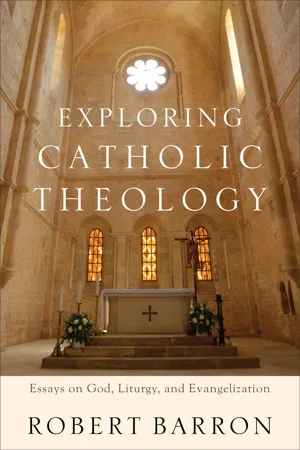
Robert Barron is one of the Catholic Church's premier theologians and author of the influential The Priority of Christ. In this volume, Barron sets forth a thoroughgoing vision for an evangelical catholic theology that is steeped in the tradition and engaged with the contemporary world. Striking a balance between academic rigor and accessibility, the book covers issues of perennial interest in the twenty-first-century church: who God is, how to rightly worship him, and how his followers engage contemporary culture. Topics include the doctrine of God, Catholic theology, philosophy, liturgy, and evangelizing the culture. This work will be of special interest to readers concerned about the so-called "new atheism."
Information
Topic
Theology & ReligionSubtopic
Christian Denominations
1
Augustine’s Questions
Why the Augustinian Theology of God Matters Today
In the end, it all comes down to a correct description of God. Everything else—culture, politics, nature, human relationships—is properly understood only in the measure that ultimate reality is grasped with at least a relative adequacy. Like all the other great theologians of the tradition, St. Augustine struggled with this central question his entire life. Though his restless mind ranged over innumerable issues, from human psychology, to Roman history, to Christology and eschatology, his primary preoccupation was determining the meaning of the word God. And he found answers. Though he was one of the greatest searchers in the Western tradition, Augustine did not have a romantic attitude regarding the search as an end in itself. Here I think John Caputo, reading Augustine through the lens of Derridean undecidabilty, has misconstrued his subject.1 At the end of his questioning, Augustine found a truth in which he could rest, a truth that, he was convinced, had set him free. And this was none other than the conviction that ultimate reality is the Trinitarian God revealed in the life, death, and resurrection of Jesus Christ. I believe that Augustine’s questions and answers are remarkably relevant to our time, and that finding for ourselves the truth that he found is important not only for our personal spiritual fulfillment but also for the health of our church and culture.
What I would like to do in this chapter is to follow, in a necessarily sketchy way, the Augustinian path toward the understanding of God, thinking with him and after him. And I would like to demonstrate throughout the analysis how Augustine’s questions and solutions matter for us, especially for those committed to carrying on and making effective the intellectual heritage of Catholicism. I will undertake this task by looking at three key arguments that Augustine had at different points in his intellectual journey, the first with the Manichees and the Platonists when he was a comparatively young man, the second with the Arians when he was in mid-career, and the third with the Romans as he approached the end of his life. What emerges, as Augustine wrestles with these various opponents, is that very distinctive understanding of ultimate reality that we Christians call belief in the God who is Father, Son, and Holy Spirit.
Augustine’s Argument with the Manichees and the Platonists
The work of St. Augustine that has exercised most fascination and given rise to most commentary over the ages is, of course, his great autobiography, The Confessions. Relying implicitly on the double sense of the Latin term confessio, Augustine uses this text as a means both to confess his sins and to profess his praise of God. In fact, those two moves are, in his mind, inextricably linked: the more he becomes aware of his sins, both intellectual and moral, the more he is able to acknowledge and thank the true God—and vice versa. Nowhere is this link between contrition and praise more clearly on display than in the seventh book of The Confessions. In this densely textured section of his autobiography, Augustine recounts the tortuous process by which he wriggled free from the influence of Manichaeism, the dualist, quasi-Gnostic system of which he had been, for nine years, a faithful adept. The principal allure of Manichaeism—both in Augustine’s day and in ours—is the simple and elegant way that it handles the problem of evil. If the world is, at the most basic level, a struggle between a force of good and a force of evil, then we are not obliged to blame God for suffering. Instead, we should simply side with him in his just and worthwhile enterprise, even as we hate the principle responsible for evil. Manichaeism solves the problem of theodicy by dissolving it.
Now what is the conception of God associated with this Manichaean philosophy? It would not be quite right to say, as most popular accounts have it, that God is, on the Manichaean reading, purely spiritual, set radically apart from the realm of matter. Here is how Augustine expresses the theory: “I thought of you as a vast reality spread throughout space in every direction: I thought that you penetrated the whole mass of the earth and immense, unbounded spaces beyond it on all sides, that earth, sky, and all things were full of you.”2 What is being described here is a kind of materialistic panentheism, God as a force or power running through and uniting all material creation. This view of God is extremely old and remarkably enduring. We can find versions of it in ancient Stoicism, in the peculiarly modern metaphysics of Spinoza, as well as in the mystical religious philosophy of Friedrich Schleiermacher.
And we can very clearly discern it in contemporary conceptions of God, mediated to us by the popular culture. In his many books and especially in his series of interviews with the journalist Bill Moyers, the comparative mythologist Joseph Campbell expressed a notion of God remarkably similar to the one outlined at the beginning of book seven of The Confessions. When asked by Moyers whether he believed in a personal God, Campbell replied “No,” and when pressed to elaborate, he said, “I think that God is the ‘transcendent ground or energy in itself.’”3 He explained, furthermore, that the Hindu meditative exercise of pronouncing the syllable “Om” is nothing other than an attempt to harmonize with this fundamental power.4 Needless to say, this conception of God has had a massive influence on the development of various “New Age” philosophies and spiritualities. Joseph Campbell exercised perhaps his most pervasive influence through the efforts of his disciple, the filmmaker George Lucas. In many ways, the Star Wars movies are, by Lucas’s own admission, an elaborate narrative and pictorial representation of the worldview espoused by Campbell. And nowhere is this clearer than in the master idea of the Star Wars religion, namely, the Force. Borrowing consciously from the Catholic liturgy, Lucas’s Star Wars characters regularly greet one another with the phrase “May the Force be with you.” It becomes eminently clear in the course of the narrative that the Force is a sort of energy field that runs through and unites all material things and that it can be exploited in either a positive or negative direction, appearing thereby as either dark or light. Here the connection to Manichaeism is quite clear. The young Augustine was devoted to roughly the same idea of God that adepts of the New Age find amenable today: a notion of God as impersonal, intimately tied to the material world, and manipulable through the human will.
Now this idea might delight Star Wars aficionados, but the more he considered it, the more it puzzled and bothered Augustine, for it seemed sorely inadequate to the perfection of God. If God were a kind of quintessential physical energy, then it would appear that he is divisible and measurable. Here is the way Augustine expressed his puzzlement: “A larger part of the earth would contain a larger portion of you, and a smaller a lesser portion, and all things would be full of you in such a way that an elephant’s body would contain a larger amount of you than a sparrow’s.”5 Anything as quantifiable and worldly as that, he concluded, couldn’t possibly be the perfect One. But when he tried to think of God as utterly perfect, thoroughly good, he faced the dilemma of explaining the provenance of evil. If God is the creator of all things and God is infinitely good, there should be no evil. And blaming evil on the free will of angels and men doesn’t solve the problem; it only postpones it, for God is himself the author of the will. Similarly, claiming that corruption flows from a flaw in nature only leads us to wonder how the utterly good Creator could have given rise to a flawed nature.
And so he found himself stuck. “Such thoughts as these was I turning over in my miserable soul, weighed down as it was by the gnawing anxieties that flowed from my fear that death might overtake me before I had found the truth.”6 And then God showed him a way out. “You provided me with some books by the Platonists, translated from Greek into Latin.”7 These pivotal texts were most likely treatises by Plotinus and his secretary Porphyry wherein was exposed the great middle Platonic theory of the One and its emanations. According to this philosophy, the immense, unknowable, unsurpassable power of the One gave rise by an automatic emanation to a second hypostasis, Intellect, in which are found all the forms that Plato spoke of. Then, by a further emanation, Soul separated itself from Intellect, and from Soul came the lower regions of mutable materiality. The goal of the spiritual life, on this reading, was the gradual escape from the material and ascension through the levels of the spiritual emanations until reaching the point of union with the One, becoming, in Plotinus’s famous phrase, “alone with the Alone.” This peculiar theory seemed so attractive to the young Augustine precisely because it extricated him from the horns of the dilemma on which he had been stuck. By articulating God as the distant and perfect One, it allowed Augustine to think of ultimate reality apart from materialistic and this-worldly categories. Further, by removing God from this obviously ambiguous realm through a series of ontological buffers, it allowed Augustine to see how God is not directly implicated in evil. He could breathe easy again.
Just as the quasi-Gnostic Manichaean notion of God finds a contemporary resonance, so this Plotinian doctrine remains, mutatis mutandis, as an intellectual option on the table today. In the early modern period, just after the Reformation, a view of God emerged that was neither classical theism nor pantheism nor panentheism but rather Deism, that is to say, the construal of God as the creator and designer of the world, who exists at a remove, both spatial and chronological, from the world that he has ordered. Serious intellectual players—from Locke and Leibniz to Newton and Benjamin Franklin—entertained some version of Deism, and many religious people today, especially in the West, hold to it in one form or another. It still exercises the charm that beguiled the youthful Augustine, the capacity to account for the godliness of God and, at the same time, to keep God free from too much involvement with the messiness and ambiguity of the world. An extremely important side effect of Deism—and another reason for its attractiveness—is the opening up of a properly secular realm, that is to say, a dimension of being that remains essentially untouched by God. This secular space permits people to be vaguely religious, even as they keep God far away from the arena where they actually live, work, and make moral decisions.
Though it has, in its various forms, intrigued people over the ages, this Plotinian doctrine convinced Augustine only for a short time. He certainly tried to follow the Platonic exercises designed to liberate him from matter and facilitate the ascent through the emanations to the One, but he never succeeded in affecting closeness with Plotinus’s God. Though the intellectual idea proposed by Plotinus was clearer and truer than that entertained by the Manichees, it didn’t seem to move Augustine appreciably closer to God. “I knew myself to be far away from you in a region of unlikeness.”8 Augustine realized that to solve the problem of evil by distancing God from the world is to create a far greater problem: the alienation of the seeker from the God that he desires. And he knew that to preserve the godliness of God by sequestering him in a zone of pure transcendence is to strand the religious person in the disenchanted space of secularity, the “region of unlikeness.” So Plotinianism, that proto-Deism, would not do.
What rescued Augustine at this anxious stage of his quest was not something that he read in the books of the Platonists but rather something that he found in a letter written by the first-century rabbi Saul, who had become, through an extraordinary experience of conversion, the Christian apostle Paul. In his letter to the tiny Christian community at Philippi, Paul wrote this concerning Jesus: “Though he was in the form of God, [Jesus] did not count equality with God a thing to be grasped, but emptied himself, taking the form of a servant, being born in the likeness of men” (Phil. 2:6–7). While remaining in the form of God, which is to say, utterly unlike any worldly thing, the Logos, Paul maintained, emptied himself out of love and entered radically into the world. In the wake of reading Paul, a question grew in Augustine’s mind—namely, who precisely is the God capable of such a feat, a God who retains his transcendence and perfection (the form of God) even as he displays, in the most dramatic way possible, his immanence? He cannot be the imperfect God of the Manichees, and he cannot be the distant God of the Platonists. He must be a God who can become a creature without compromising his own divinity or the integrity of the creature he becomes, and this means he must be the creator of all things. If God were a being in or alongside the universe, he would be, necessarily, in competition with other worldly objects. There is a mutual exclusivity about worldly natures, one thing maintaining its ontological integrity only in the measure that it is not anything else.9 Therefore, if God is capable of true incarnation—becoming a creature without ceasing to be himself—then God cannot be a worldly nature, a thing, one being among many, even the supreme being. God must be other but, if I can put it this way, otherly other, enjoying a transcendence that is not contrastive to the world. Nicholas of Cusa would express this notion many centuries after Augustine by saying that God, while absolutely other, is the non-aliud, the “non-other.”
What Augustine found, through Paul, was a way of combining and overcoming the tension between the Manichees and the Platonists. He found the creator God who, in his perfection and godliness, is not the world and who, in his love, becomes one with the world. He found, in a word, the God of Jesus Christ.
Augustine’s Argument with the Arians
We now turn to from The Confessions to the De Trinitate, a doctrinal tour de force that preoccupied Augustine for nearly twenty years. Here, as always, the central concern is a correct description of God. Augustine wants to make plain that the God of creation and incarnation, whom he described in book seven of The Confessions, is also the Trinitarian God, the God whose very unity is constituted by a set of relations. The best-known sections of the De Trinitate are undoubtedly the eighth and ninth books, wherein Augustine lays out his psychological analogies for the Trinitarian persons: mind, self-knowledge, and self-love. But I would like to concentrate on an earlier section of the great opus, specifically the fifth book, where Augustine takes on what he considers a very serious challenge to the orthodox teaching concerning the Trinity. The Arian heresy, which arose in the early fourth century, was debated at a number of local synods in Egypt and then definitively addressed and condemned at the Council of Nicaea in 325. Nevertheless, it continued to exert a strong influence in both the East and the West, drawing under its sway any number of bishops and theologians. Accordingly, by Augustine’s time, there had arisen a sophisticated intellectual tradition surrounding the central claim of Arian Christology that the Logos present in Jesus was not fully divine but rather the highest of creatures. And Augustine feels that, before he enters into a detailed account of the Trinity, he must wrestle with a pointed argument that emerges from that tradition. This debate is the centerpiece of book five of the De Trinitate.
The book begins with an extraordinary observation: “From now on I will be attempting to say things that cannot altogether be said as they are thought by a man—at least as they are thought by me.”10 Augustine knows that he is entering that paradoxical space where there is a sharp distinction between—to use Aquinas’s terms—the res significata and the modus significandi, between the thing to be signified and the manner in which it is signified. He will say what he ta...
Table of contents
- Cover
- Title Page
- Copyright Page
- Dedication
- Contents
- Foreword
- Preface
- Part 1: Doctrine of God
- Part 2: Theology and Philosophy
- Part 3: Liturgy and Eucharist
- Part 4: A New Evangelization
- Notes
- Index
- Back Cover
Trusted by 375,005 students
Access to over 1.5 million titles for a fair monthly price.
Study more efficiently using our study tools.
Frequently asked questions
Yes, you can cancel anytime from the Subscription tab in your account settings on the Perlego website. Your subscription will stay active until the end of your current billing period. Learn how to cancel your subscription
No, books cannot be downloaded as external files, such as PDFs, for use outside of Perlego. However, you can download books within the Perlego app for offline reading on mobile or tablet. Learn how to download books offline
Perlego offers two plans: Essential and Complete
- Essential is ideal for learners and professionals who enjoy exploring a wide range of subjects. Access the Essential Library with 800,000+ trusted titles and best-sellers across business, personal growth, and the humanities. Includes unlimited reading time and Standard Read Aloud voice.
- Complete: Perfect for advanced learners and researchers needing full, unrestricted access. Unlock 1.5M+ books across hundreds of subjects, including academic and specialized titles. The Complete Plan also includes advanced features like Premium Read Aloud and Research Assistant.
We are an online textbook subscription service, where you can get access to an entire online library for less than the price of a single book per month. With over 1.5 million books across 990+ topics, we’ve got you covered! Learn about our mission
Look out for the read-aloud symbol on your next book to see if you can listen to it. The read-aloud tool reads text aloud for you, highlighting the text as it is being read. You can pause it, speed it up and slow it down. Learn more about Read Aloud
Yes! You can use the Perlego app on both iOS and Android devices to read anytime, anywhere — even offline. Perfect for commutes or when you’re on the go.
Please note we cannot support devices running on iOS 13 and Android 7 or earlier. Learn more about using the app
Please note we cannot support devices running on iOS 13 and Android 7 or earlier. Learn more about using the app
Yes, you can access Exploring Catholic Theology by Robert Barron in PDF and/or ePUB format, as well as other popular books in Theology & Religion & Christian Denominations. We have over 1.5 million books available in our catalogue for you to explore.