- 304 pages
- English
- ePUB (mobile friendly)
- Available on iOS & Android
eBook - ePub
About this book
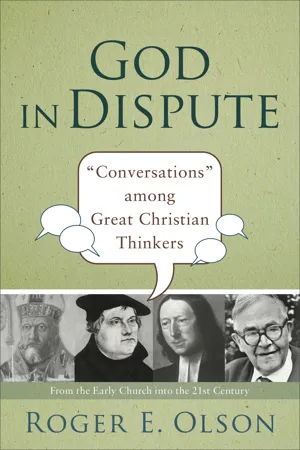
This volume creatively explores the history of Christian thought by imagining a series of twenty-nine dialogues and debates among key figures throughout church history. It traces the history of theology via such conversation partners as Augustine and Pelagius, Calvin and Arminius, Barth and Brunner, and Bultmann and Pannenberg. Each imagined dialogue includes a brief summary that introduces the figures under consideration, a more detailed assessment of the thinkers and theological issues presented, and a guide for further reading. This approach offers readers an entertaining, informative, and concise history of Christian thought.
Information
Topic
Theology & ReligionSubtopic
Christian Theology1
Second-Century Critic Celsus Queries
Polycarp, Valentinus, and Montanus
about the Christian Sect
Second-Century Critic Celsus Queries
Polycarp, Valentinus, and Montanus
about the Christian Sect
Setting
Little is known about the personal life of the Roman philosopher Celsus. He may have been a Christian early in life, but by the time he wrote his anti-Christian polemic commonly known as The True Doctrine in about 175 or 180, he was Christianity’s leading critic in the empire. His knowledge of Christianity was limited, but he seems to have gone to some trouble to find out what Christians believed even if he sometimes got it wrong. In his book he states quite unequivocally that Christians worship Jesus as God, which for him is a mark against them. Contemporary critics of orthodox Christology—belief that Jesus is fully God and fully human—often claim that this doctrine, known as the “hypostatic union,” was “invented” by fourth-century Christian bishops under the influence of the half-Christian, half-pagan emperor Constantine. They have obviously never read Celsus or the early church fathers.
It is highly unlikely, if not impossible, that Celsus ever met the early Christian bishop and martyr Polycarp, who was burned at the stake and killed by a dagger in Smyrna in about 155. Nor would he have met or talked to the so-called heretics (considered so by leading Christian bishops of the Roman Empire) Valentinus and Montanus (second century, though their exact dates are unknown). Little is known about either man’s personal life or even their teachings, other than from what their more orthodox Christian opponents said about them. Valentinus lived in Rome and led a group of Gnostic Christians, who considered matter evil and denied both the true humanity of Jesus and his bodily resurrection.
Montanus lived in Asia Minor (now Turkey) and led a group of Christians who called their movement “The New Prophecy.” They were the extreme charismatics of the middle of the second century. The group believed not only in the supernatural gifts of the Holy Spirit (like contemporary Pentecostals and charismatics) but also that the Holy Spirit spoke through Montanus, and his sayings were considered equal in authority with those of the apostles and their writings.
Scholars looking back at the infancy of the Christian movement often consider Valentinus and Montanus to be archheretics, who led many innocent Christians astray. Polycarp is usually held up as a great representative of orthodox Christianity, who gave up his life rather than bow to the emperor. Like other so-called Apostolic Fathers, he likely knew at least one of the original apostles—probably John.
In this imaginary conversation, Celsus encounters Polycarp, Valentinus, and Montanus on a ship sailing to Rome. He queries them about Christianity for his research, which will lead to the book he plans to write: The True Doctrine. The ensuing debate reflects the diversity of Christianity in the second century; Celsus’s three new Christian acquaintances agree about little.
In a way, Polycarp, Valentinus, and Montanus respectively represent three impulses within historic Christianity: the orthodox impulse for theological correctness, the Gnostic impulse for higher knowledge and wisdom, and the enthusiastic impulse for transformative experience.
The Conversation
CELSUS: How interesting to find us all together on this Rome-bound ship! You know, I’ve been preparing a new talk for the Rotary Clubs around the empire. It’s about you Christians and what I call “the true doctrine.” By that I mean the hybrid of Platonic and Stoic ideas that forms the consensual worldview of sophisticated, educated people throughout our great empire. Compared with that, what you Christians teach seems to be sheer superstition. It’s a wonder that anyone could or would believe it—except ignorant people, I suppose. I’m on my way to Rome now to deliver the first draft of my speech to an elite club that includes members of the Roman Senate. Eventually I plan to write a book about the Christian movement, showing that its beliefs are not only false but also pernicious: it leads people away from true philosophy, which forms the basis of our great culture.
POLYCARP: Roman senators, did you say? I hope you’ll encourage them to recognize Christianity as a legitimate religion separate from the Jewish religion and to stop persecuting us. I’m on my way to Rome to appeal to its leaders to lift the laws against practicing our faith. I also hope to meet some senators and members of the emperor’s household. Back home in Smyrna, where I am the bishop of the Christians and thus their leading minister, we are under tremendous pressure these days. And there’s no good reason for it. We’re good citizens, and we don’t harm anyone, contrary to rumors about eating babies and engaging in incestuous orgies. But it sounds as though you’re not going to be our ally, are you?
MONTANUS: Excuse me, Bishop Polycarp, but what do you mean by saying you don’t harm anyone? You bishops are constantly criticizing and even condemning our New Prophecy movement as if we weren’t authentically Christian, as you think you are. I am, after all, the mouthpiece of the Holy Spirit, and you bishops have no right to persecute me or my followers—no more right than you say the empire has to persecute you and your followers. I’m on my way to Rome to establish a new church there—one that will follow what the Spirit is saying through me today. Our New Prophecy churches are going to spread throughout the empire and sweep away your dead, dry-as-dust bishops’ churches.
VALENTINUS: Celsus, don’t listen to either one of them! We Gnostics (as some call us) are the true Christians with the higher spiritual wisdom that is in many ways similar to what you call the true doctrine. We’re more philosophically minded than the bishop and his followers, and we’re certainly more intellectual than fanatics like Montanus and his ilk. Surely you’ve heard of us! We Gnostics are thriving in Egypt, especially in and around Alexandria, the great cultural capital of the empire. Many wealthy, educated, and highly cultured people attend our meetings. Please tell the Roman senators to regard us as the true Christians. Oh, by the way, I’m on my way to Rome to visit our group there. They meet in several villas around the city and engage in study of higher spiritual wisdom and in meditation.
CELSUS: Now this is a perfect example of what I’m intending to tell my audiences in Rome and around the empire. You Christians can’t even agree among yourselves about what you believe! You’re divided into many quarreling sects and factions. When you talk, you sound like a bunch of babbling animals fighting over scraps of food! But the glue that holds the empire together is the true doctrine: an ethical-spiritual philosophy based on nature and reason. It’s one true doctrine without variations, and it doesn’t approve of all kinds of weird, mystical beliefs or authoritative pronouncements of bishops.
POLYCARP: No, you’re wrong, Celsus—at least about Christian unity. And, I suspect, one could find many different versions of your precious true doctrine. After all, it is an unstable compound of the teachings of Plato and the Stoics! Tell your audiences that we Christians are united. We do believe the same things. We believe exactly what the apostles taught us. We bishops of the true Christian churches, which we call both “catholic” and “orthodox,” are all heirs of the apostles. They appointed us. For example, when I was a boy, I learned Christian truth from Christ’s youngest and most beloved disciple, John, who was very old at that time. He was the bishop of the Christians in Ephesus, where I grew up. From him I know exactly what Christ was all about.
These other so-called Christians can’t make such a claim of apostolic succession. John warned us against false prophets like Valentinus and Montanus. Valentinus is a false prophet and not a true Christian because he denies that God became flesh in Jesus Christ. Montanus is a false prophet because he claims to be the exclusive mouthpiece of the Holy Spirit and sets his authority over that of the apostles! The apostles left behind a tradition of truth, the rule of faith, which forms the foundation of what true Christians believe and teach. These others are interlopers and false brethren. Don’t even listen to them on the subject of Christianity.
MONTANUS: Wait! Listen! I feel the Holy Spirit moving over my vocal cords like a breeze over the strings of a harp. Be quiet. Yes . . . yes . . . listen. “I am the Spirit of God, and I speak through this man. Listen to him. He is my chosen mouthpiece, . . . not the so-called bishops who have led my people astray by imprisoning my Spirit in writings. Here now is true counsel: Do not marry or engage in any lustful thoughts or relationships. Avoid strong drink, and spend most of your time in prayer and waiting for the Savior Jesus to return. Above all, listen to and obey my prophets . . . and prophetesses. Do not quench my Spirit among you. For I am the Lord your God!”
Did you hear that? Celsus, tell the Roman senators that Christ is alive and well and speaks through me and that our New Prophecy movement is the true Christianity. And tell them that we mean no harm to the Roman government. We are just gathering in various places to praise God and wait for Jesus to return. If they do decide to extend peace to Christians, make sure that includes our congregations in Rome and throughout the empire.
VALENTINUS: Celsus, please pay no attention to these men. One is a pompous you-know-what, and the other is a raving religious fanatic. There’s no chance that the Roman Senate or the emperor is going to recognize them or their followers as legal and legitimate. Now we Gnostics are different. We’re not stuffy, dogmatic, hellfire-and-brimstone preachers like Polycarp and the other bishops. We’re not intolerant as they are. We welcome into our circles anyone with special spiritual insight and abilities. Our job as Gnostic teachers is merely to encourage spiritual seekers to search beyond the physical-material realm and find the pure cosmic Christ-spirit that dwells in the temple of the human.
We teach that Christ-wisdom and not some set of dogmas. And what we teach is not so different from what some of your own Greek philosophers teach. Matter is a prison of the soul-spirit. True wisdom comes from above the material realm. This wisdom is knowledge of the inner divinity of the soul-spirit; it is a spark of the divine light and fire from above. Seek that which is above, and you will find it within. Didn’t Plato say as much in his allegory of the cave?
CELSUS: Actually, I think you’re all nuts. You all agree on one thing that we philosophers find just stupid: that God appeared in a man in the most backwater region of the whole empire, suffered and died on a Roman cross, then rose again, and is the savior of the whole world. No matter how you polish it, that central Christian belief, what you call the “gospel,” conflicts with our true doctrine of Greek philosophy. It is simply absurd. God, you see, cannot enter flesh or appear within time or suffer, let alone die! And dead bodies do not rise. Who would want his body after death? All these things are not only mysteries; they’re also superstitions. That’s what I’ll tell my audiences.
POLYCARP: Well, then, Celsus, I don’t hold out much hope for changing your mind unless the Spirit of God works in your heart and mind. But I will say this: your “true doctrine” of Greek philosophy is partly right. God is pure spirit, eternal, true, and perfect in every way. But your doctrine goes wrong in thinking that he cannot also take on a human form in order to identify with his wretched human creatures and teach them how to obey God. Jesus Christ is God’s Son. I say “is” because Jesus still lives. But he’s not all of God that there is. You seem to think that if God became flesh, there would then be no God running the universe. But that’s not what we believe. The Logos was who became man in Jesus—God’s Word and God’s Son. The Father remained in heaven and cannot suffer or die.
VALENTINUS: Um, Celsus, may I say you’ve got us Gnostic Christians all wrong? We don’t believe that God entered into human flesh or suffered or died. And we don’t believe that Jesus Christ rose bodily from death. What we believe is what a few of Christ’s own disciples learned secretly from him and passed down to us. Christ is a spirit messenger sent from the high and heavenly God, whom Jesus called Father and who is pure Spirit and cannot come into direct contact with matter. After all, matter is not only corrupting; it is also evil.
This redeemer Christ-spirit took over the body of Jesus when he was about thirty years old. Through Jesus, this spirit taught wisdom and then left Jesus just before he died. On the cross Jesus uttered, “Father, into your hands I commit my spirit.” That was when the Christ-spirit left Jesus to return to the Father. But the Christ-spirit came back to teach a few of the disciples the secret wisdom that most mortals cannot handle: that the human soul is a spark of God. It has lost its way in the universe and has fallen into bondage to matter. Through prayer, knowledge, and meditation, we can help people release the soul from matter and return to its heavenly home.
MONTANUS: That’s the biggest bunch of pseudo-intellectual, spiritual nonsense I’ve ever heard. Wait, wait . . . I feel something happening. Listen! “I am the Spirit of God speaking through this man. Listen to him. The Spirit says that in these last days many false teachers will come and lead people astray from the truth. These Gnostics are the worst of them. Shun them and don’t listen to them. But the bishops aren’t much better. Listen only to my mouthpiece and his two prophetesses. Lo, I come quickly, says Christ. Leave all behind and move to Pepuza and await my coming with my people of the New Prophecy.” Amen! You heard the Spirit. Valentinus and his followers are false teachers and learners. They do not know the truth.
POLYCARP: Oh, brother! What a bunch of heresy and fanaticism we have here parading as “Christian.” Listen, Celsus, you can see for yourself that these men are charlatans. They are not true teachers of Jesus Christ or mouthpieces of the Holy Spirit. The church of Jesus Christ believes exactly what the apostles taught and wrote. We have many of their writings, you see—
MONTANUS(interrupting Polycarp): Stop! The Spirit is about to speak again!
POLYCARP (to Montanus sharply): Be quiet! Before I smite thy “spirit” on the snout!
MONTANUS(to Polycarp sharply): Ah, Brother Polycarp, you seem to have the gift of quenching the Spirit, don’t you? I believe the apostle Paul warned against that. Would you chase the Holy Spirit back into the last century and into the writings of the apostles? Why won’t you accept that the Spirit still speaks today?
POLYCARP: The Spirit does still speak today, but only through the apostolic teachings as interpreted by the bishops appointed by the apostles or their successors. The true Christian church is where the bishop is.
MONTANUS: No, you’re wrong. The true Christian church is where the Spirit is!
VALENTINUS: You’re both ignorant of the truth. “Christ” remains above us in the Spirit world; our spirits, our souls, must ascend out of o...
Table of contents
- Cover Page
- Title Page
- Copyright Page
- Table of Contents
- Introduction
- 1. Second-Century Critic Celsus Queries Polycarp, Valentinus, and Montanus about the Christian Sect
- 2. Second-Century Critic Celsus Interviews Tertullian, Irenaeus, and Clement about Christianity
- 3. Second- and Third-Century Leaders Irenaeus, Tertullian, and Clement Discuss Beliefs Necessary to Be a True Christian
- 4. Second- and Third-Century Origen and Tertullian Debate Faith’s Relationship to Reason and the Nature of the Eternal Godhead
- 5. Third-Century Bishop Cyprian of Carthage is Interviewed about the Church and Salvation
- 6. Fourth-Century Alexandrians Deacon Athanasius and Presbyter Arius are Interviewed about the Council of Nicaea
- 7. The Fourth-Century Cappadocian Fathers Meet to Settle on the Orthodox Doctrine of the Trinity
- 8. Prominent Fifth-Century Thinkers Cyril, Apollinaris, Nestorius, and Eutyches Discuss the Humanity and Divinity of Jesus Christ
- 9. Fifth-Century Bishop Augustine of Hippo and British Monk Pelagius Argue about Sin and Salvation
- 10. Medieval Abbot-Archbishop Anselm of Canterbury and Monk-Philosopher Abelard Debate Faith, Reason, and Atonement
- 11. Medieval Scholastic Philosopher-Theologian Thomas Aquinas and Tree-Hugger Francis of Assisi Enthuse on how to Know God
- 12. Sixteenth-Century Bucer Convenes Luther, Karlstadt, Erasmus, Zwingli, Grebel, Calvin, and Servetus on Church Reform
- 13. Reformer Luther and Roman Catholic Theologian Eck Dispute the Nature of Salvation, Grace, Faith, and Justification
- 14. Reformers Luther, Hubmaier, Zwingli, and Calvin Debate the Lord’s Supper and Baptism
- 15. Sixteenth-Century Reformer Calvin and Seventeenth-Century Theologian Arminius Contest Divergent Views of Salvation
- 16. Eighteenth-Century Evangelical Revivalists-Theologians Wesley and Edwards Compare Differing Views of Salvation
- 17. Eighteenth-Century Irish Deist Toland and English Evangelist Wesley Debate Faith and Reason, God and Miracles
- 18. Enlightenment Philosophers Locke, Kant, and Hegel Deal with Issues Impinging on Christian Theology
- 19. Father of Modern Theology Schleiermacher and Philosophers Kant and Hegel Debate the Essence of Religion and Christianity
- 20. Theologians Liberal Rauschenbusch and Conservative Machen Argue about True Christianity, the Bible, Evolution, and Doctrine
- 21. Twentieth-Century Barth and Brunner Discuss Theological Method with Nineteenth-Century Liberal Schleiermacher
- 22. Barth and Brunner Contest their Differences on Natural Theology and Whether All Will be Saved
- 23. Twentieth-Century Theological Giants Barth and Tillich Discuss Crucial Issues, Christ and Culture
- 24. Twentieth-Century Ethicists Rauschenbusch, Niebuhr, Gutiérrez, Yoder, and Olasky Dispute the Meaning of Justice
- 25. Twentieth-Century Theologians Bultmann and Pannenberg Debate Faith, Myth, and Jesus’s Resurrection
- 26. Twentieth-Century Theologians Henry and Ramm Dispute Evangelical Theology, Modernity, and the Enlightenment
- 27. Twentieth-Century Roman Catholic Theologian Rahner is Interviewed about his Controversial but Influential Theories
- 28. Three Liberation Theologians Debate about Humanity’s Worst Oppression and How Liberation Should Happen
- 29. Two Postmodern Theologians Discuss the Meaning of Theology in Postmodern Culture
- Conclusion
Trusted by 375,005 students
Access to over 1.5 million titles for a fair monthly price.
Study more efficiently using our study tools.
Frequently asked questions
Yes, you can cancel anytime from the Subscription tab in your account settings on the Perlego website. Your subscription will stay active until the end of your current billing period. Learn how to cancel your subscription
No, books cannot be downloaded as external files, such as PDFs, for use outside of Perlego. However, you can download books within the Perlego app for offline reading on mobile or tablet. Learn how to download books offline
Perlego offers two plans: Essential and Complete
- Essential is ideal for learners and professionals who enjoy exploring a wide range of subjects. Access the Essential Library with 800,000+ trusted titles and best-sellers across business, personal growth, and the humanities. Includes unlimited reading time and Standard Read Aloud voice.
- Complete: Perfect for advanced learners and researchers needing full, unrestricted access. Unlock 1.5M+ books across hundreds of subjects, including academic and specialized titles. The Complete Plan also includes advanced features like Premium Read Aloud and Research Assistant.
We are an online textbook subscription service, where you can get access to an entire online library for less than the price of a single book per month. With over 1.5 million books across 990+ topics, we’ve got you covered! Learn about our mission
Look out for the read-aloud symbol on your next book to see if you can listen to it. The read-aloud tool reads text aloud for you, highlighting the text as it is being read. You can pause it, speed it up and slow it down. Learn more about Read Aloud
Yes! You can use the Perlego app on both iOS and Android devices to read anytime, anywhere — even offline. Perfect for commutes or when you’re on the go.
Please note we cannot support devices running on iOS 13 and Android 7 or earlier. Learn more about using the app
Please note we cannot support devices running on iOS 13 and Android 7 or earlier. Learn more about using the app
Yes, you can access God in Dispute by Roger E. Olson in PDF and/or ePUB format, as well as other popular books in Theology & Religion & Christian Theology. We have over 1.5 million books available in our catalogue for you to explore.