eBook - ePub
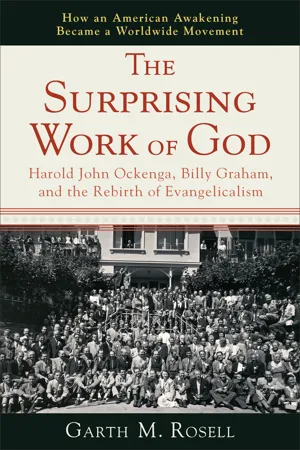
The Surprising Work of God
Harold John Ockenga, Billy Graham, and the Rebirth of Evangelicalism
- 288 pages
- English
- ePUB (mobile friendly)
- Available on iOS & Android
eBook - ePub
The Surprising Work of God
Harold John Ockenga, Billy Graham, and the Rebirth of Evangelicalism
About this book
There is growing interest in the story of mid-twentieth-century evangelicalism. One of the central leaders of that era was Harold John Ockenga. He was pastor of the historic Park Street Congregational Church in Boston and cofounder of Fuller Theological Seminary, Gordon-Conwell Theological Seminary, the National Association of Evangelicals, and Christianity Today. The Surprising Work of God examines the birth and development of modern American evangelicalism--its history, personalities, and institutions. The history of that time is seen through the window of the life, ministry, and writings of Ockenga and his long friendship with Billy Graham. This lively, engaging story will be of value to anyone with an interest in the American church of the last century.
Information
Topic
Theology & ReligionSubtopic
History of Christianity1

THE SURPRISING WORK OF GOD
On a crisp New England morning, hundreds of friends and family gathered at the First Congregational Church in Hamilton to bid farewell to Harold John Ockenga.[1] There to deliver the eulogy was an old friend. “He was a giant among giants,” reflected Billy Graham. “Nobody outside of my family influenced me more than he did. I never made a major decision without first calling and asking his advice and counsel. I thank God for his friendship and for his life.”[2]
The friendship between Ockenga and Graham is of more than passing significance for the study of contemporary evangelicalism.[3] For thirty-five years, from the Boston Revival of 1950 to Ocken-ga’s death in 1985, these two men—perhaps more than any others—embodied, symbolized, and guided a burgeoning and increasingly worldwide evangelical movement. By mid-century, Harold John Ockenga was widely known as “Mr. Evangelical,” and during the 1950s and 1960s, as historian George Marsden suggests, the broadest and perhaps most universally accepted definition of an evangelical was simply “anyone who likes Billy Graham.”[4]
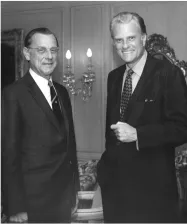
Harold John Ockenga and Billy Graham (courtesy of Gordon-Conwell Libraries)
The distinctive shape and direction of contemporary evangelicalism owes more than a little to the unique blending of geographical regions, theological perspectives, collegial networks, personal styles, and ministerial experiences of these two remarkable individuals. Born and raised in Chicago, educated in the Midwest and Northeast, and based for most of his professional life in New England, Ockenga became the embodiment of what the old Puritans would have called the “learned pastor.”[5] Born in Charlotte, educated in the South and Midwest, and based for most of his professional life in the mountains of North Carolina, Graham came to embody not only the gracious piety of Southern evangelicalism but also the revival fervor and fresh enthusiasm of the great youth movements of the 1930s and 1940s.[6]
The combination of these two much older religious cultures, forged in the fires of the powerful spiritual awakening that swept across America and around the world during the mid-twentieth century, helped give shape and substance to a movement that many contemporary Christians identify as “evangelicalism.” It is this story, pictured in microcosm by the friendship between Harold John Ockenga and Billy Graham, that this book attempts to tell. Linking the steepled church with the revival tent, the aroma of candles with the smell of sawdust, the passion for personal holiness with the love of truth, the quest for purity with the yearning for unity, the comfort of structure with the fresh winds of the Spirit, the majestic organ with the singing saxophone, the three-piece suit with the blue denim jacket, and the first-world with the Global South, the contemporary evangelical movement, as Alister McGrath suggested more than a decade ago, “seems set to continue its upswing into the next millennium.”[7]
Understanding the Evangelical Movement
Before we can begin this story, however, we need to take a moment to look back to the beginnings of the movement.[8] There is a sense in which all genuine followers of Jesus Christ—from every corner of the earth and throughout every era of Christian history—can appropriately call themselves “evangelical.” After all, the term is taken directly from the Bible. The Greek noun euangelion simply means “good news,” “glad tidings,” or “gospel,” and the Greek verb euangelizesthai is usually translated “to announce good news” or “to proclaim the gospel.”[9] All true followers of Jesus Christ—whose lives have been claimed by the sovereign God, whose sins have been forgiven through the atoning work of Jesus Christ, whose behavior is being transformed by the power of the Holy Spirit, and whose deepest desire is to proclaim in word and deed the good news that “God was in Christ reconciling the world unto Himself”—can rightly call themselves a “gospel woman,” a “born-again man,” or an “evangelical Christian.”
But not everyone who might properly lay claim to the term evangelical has done so. Of the approximately six and a half billion people alive in the world today, slightly more than two billion identify themselves as Christians. Of those two billion Christians, according to some estimates, at least two hundred fifty million can properly be identified as evangelical.[10] The total number may be significantly higher, however, since many Pentecostals, charismatics, and neocharismatics also claim to be evangelical.[11] Whatever figures are used, there is little question that evangelicals make up a substantial and rapidly increasing percentage of world Christianity.[12]
What seems equally clear to those who study global trends is the fact that a growing number of evangelicals now live outside the Western world. “Recent decades have shown the beginning of a major shift in the Christian center of gravity,” observed Winston Crawley.
It is not yet complete and may not be so for many more decades—but it is well under way and appears irreversible. The heartland of Christianity, located in Europe for more than a millennium (with North America recently added), seems sure in the 21st century to be found in what we have called the Third World (or Two-Thirds World). On the most superficial level, numbers themselves reflect the change: the majority of Christians now live outside Europe and North America.”[13]
While most historians trace the origins of the modern evangelical movement to sources in either Europe or North America, it should come as no surprise that the movement would spread so quickly to other parts of the world. One of the most distinctive features of evangelicalism has been its passion for world evangelization, the missionary mandate to spread the gospel to each individual and every culture around the globe.[14] So successful were evangelicals’ efforts, in fact, that the geographical center of world Christianity has moved from Europe to Africa, and the profile of a typical evangelical Christian now reflects cultures, languages, and patterns of behavior that are largely unknown in the West.[15] It would seem safe to assume, if these trends continue, that the future character and direction of the evangelical movement will be determined largely by the younger churches in what Philip Jenkins calls the Global South.[16] The days of Western hegemony seem to be over. “If I were to buy stock in global Christianity,” historian Martin Marty once said, “I would buy it in Pentecostalism.”[17]
Although it is difficult to predict with any certainty the future direction of evangelicalism, it is possible to discover a great deal about its past. While the beginnings of the modern evangelical movement can be elusive, most historians now agree that its origins can be found in the great religious revivals that swept across England, Scotland, Ireland, Wales, and, most especially, the American colonies during the eighteenth century.[18] This “series of revivals,” historian Mark Noll argues, “marked the origin of a distinctly evangelical history.”[19] Known as the Great Awakening in America and the Evangelical Revival in Britain, the work of George Whitefield, John and Charles Wesley, William and Gilbert Tennent, Samuel Davies, Jonathan Edwards, and a host of others provided the rich soil in which the new movement could begin to grow.[20]
To understand evangelicalism, therefore, one must first understand the religious revivals in which the movement was born and from which it continues to draw its primary nourishment.[21] Simply stated, when the revival fires have burned most brightly, the evangelical movement has tended to be the strongest and most unified.[22] When religious revivals have waned, evangelicals have tended to become fractious and fragmented. The historical connections between the two, to paraphrase Len Sweet’s delightful line, make it as impossible to distinguish evangelicalism from the American revival tradition as it would be “to unscramble a mixed omelette.”[23]
The Great Awakening of the Eighteenth Century
“There has been near unanimity across the theological spectrum,” Roger Finke and Rodney Stark note, “that something extraordinary happened” in the American colonies during the 1730s and early 1740s.[24] Labeled the Great Awakening by most historians, these were the revivals that helped to launch the modern evangelical movement.[25] We see these beginnings most clearly in the “debates” between Jonathan Edwards[26] and Charles Chauncy[27] over the nature of the revivals that were breaking out in towns and villages throughout the Massachusetts Bay Colony.[28] Like many New England pastors, Chauncy had watched the spread of religious revivals with both fascination and growing alarm. Soon convinced that this new wave of “enthusiasm” would do significant damage to the more orderly and reasonable style of congregational life that he clearly preferred, the pastor of Boston’s First Church set out on a tour of New England to observe firsthand what was taking place. Far from allaying his fears, his travels prompted him to write a lengthy treatise titled Seasonable Thoughts on the State of Religion in New England. Documenting what he believed to be the “many and great Mistakes” of the revivals, Seasonable Thoughts established Chauncy as the leader of the Old Lights, an emerging anti-revival party within New England congregationalism, and it provided the movement with its “first comprehensive statement of the new American rationalism.”[29]
The Emergence of New Light Evangelicalism
While admitting that some “errors” had accompanied the revivals, Jonathan Edwards was convinced that “the surprising work of God” in Northampton, where he was serving as pastor of the Congregational Church, and throughout the American colonies was fundamentally genuine.[30] In his Some Thoughts Concerning the Present Revival of Religion in New-England, Edwards criticized those who used as their primary authority something other than the Holy Scriptures. “The error of those who have had ill thoughts of the great religious operation on the minds of men, that has been carried on of late in New England (so far as the ground of such an error has been in the understanding, and not in the disposition), seems fundamentally to lie in three things: first, in judging of this work a priori; secondly, in not taking the Holy Scriptures as an whole rule whereby to judge of such operations; thirdly, in not justly separating and distinguishing the good from the bad.”[31]
Edwards had taken up this final “error,” as he phrased it, in his 1741 commencement address at Yale College. Using as his scriptural text the instructions in 1 John 4:1 (“Beloved, believe not every spirit, but try the spirits whether they are of God; because many false prophets are gone out into the world” KJV), Edwards argued that even during the apostolic age, an era of Christian history that was marked by “the greatest outpouring of the Spirit of God that ever was,” the “counterfeits did also then abound.” Because “the Devil” has always been “abundant in mimicking both the ordinary and extraordinary influences of the Spirit of God” it was “necessary that the church of Christ should be furnished with some certain rules, and distinguishing and clear marks by which she might proceed safely in judging of spirits, and distinguish the true from the false, without danger of being imposed upon.” Consequently, the “Apostle here, of set purpose, undertakes to supply the church of God with such marks of the true Spirit as may be plain and safe, and surely distinguishing, and well accommodated to use and practice.”[32]
Taking his cue from the text, Edwards then listed nine “negative signs,” or “evidences,” that might actually occur during the revivals but did not of themselves either validate or invalidate the revivals as a genuine work of God: (1) that the revival is carried on in a way that is “unusual or extraordinary”; (2) that the revival produces unusual “effects” on the body (i.e., “tears, trembling, groans, loud outcries, agonies of body or the failing of bodily strength”); (3) that the revival “produces a great deal of noise about religion”; (4) that the revival creates “many impressions” on the participants’ “imaginations”; (5) that “means are made use of in producing” the revival (i.e. godly example, the use of reason, the preaching of God’s Word, observation of others who have been awakened, including one’s spouse, etc.); (6) that “many that ...
Table of contents
- Cover
- Title Page
- Copyright Page
- Endorsements
- Dedication
- Contents
- Table of Illustrations
- Preface
- 1: The Surprising Work of God
- 2: The Lone Wolf
- 3: The Grand Vision
- 4: A Band of Brothers
- 5: A Mid-Twentieth Century Awakening
- 6: The Floodtide of Revival
- 7: Reclaiming the Culture
- 8: Renewing the Mind
- 9: Reaching the World
- Acknowledgments
- Bibliography
- Index
Trusted by 375,005 students
Access to over 1.5 million titles for a fair monthly price.
Study more efficiently using our study tools.
Frequently asked questions
Yes, you can cancel anytime from the Subscription tab in your account settings on the Perlego website. Your subscription will stay active until the end of your current billing period. Learn how to cancel your subscription
No, books cannot be downloaded as external files, such as PDFs, for use outside of Perlego. However, you can download books within the Perlego app for offline reading on mobile or tablet. Learn how to download books offline
Perlego offers two plans: Essential and Complete
- Essential is ideal for learners and professionals who enjoy exploring a wide range of subjects. Access the Essential Library with 800,000+ trusted titles and best-sellers across business, personal growth, and the humanities. Includes unlimited reading time and Standard Read Aloud voice.
- Complete: Perfect for advanced learners and researchers needing full, unrestricted access. Unlock 1.5M+ books across hundreds of subjects, including academic and specialized titles. The Complete Plan also includes advanced features like Premium Read Aloud and Research Assistant.
We are an online textbook subscription service, where you can get access to an entire online library for less than the price of a single book per month. With over 1.5 million books across 990+ topics, we’ve got you covered! Learn about our mission
Look out for the read-aloud symbol on your next book to see if you can listen to it. The read-aloud tool reads text aloud for you, highlighting the text as it is being read. You can pause it, speed it up and slow it down. Learn more about Read Aloud
Yes! You can use the Perlego app on both iOS and Android devices to read anytime, anywhere — even offline. Perfect for commutes or when you’re on the go.
Please note we cannot support devices running on iOS 13 and Android 7 or earlier. Learn more about using the app
Please note we cannot support devices running on iOS 13 and Android 7 or earlier. Learn more about using the app
Yes, you can access The Surprising Work of God by Garth M. Rosell in PDF and/or ePUB format, as well as other popular books in Theology & Religion & History of Christianity. We have over 1.5 million books available in our catalogue for you to explore.