eBook - ePub
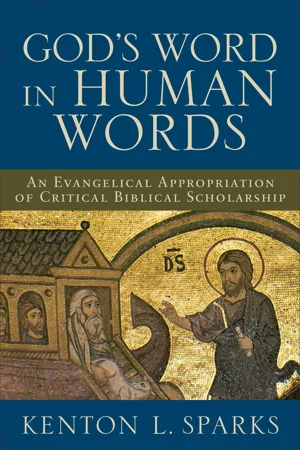
God's Word in Human Words
An Evangelical Appropriation of Critical Biblical Scholarship
- 416 pages
- English
- ePUB (mobile friendly)
- Available on iOS & Android
eBook - ePub
God's Word in Human Words
An Evangelical Appropriation of Critical Biblical Scholarship
About this book
The conclusions of critical biblical scholarship often pose a disconcerting challenge to traditional Christian faith. Between the two poles of uncritical embrace and outright rejection of these conclusions, is there a third way? Can evangelical believers incorporate the insights of biblical criticism while at the same time maintaining a high view of Scripture and a vital faith? In this provocative book, Kenton Sparks argues that the insights from historical and biblical criticism can indeed be valuable to evangelicals and may even yield solutions to difficult issues in biblical studies while avoiding pat answers. This constructive response to biblical criticism includes taking seriously both the divine and the human aspects of the Bible and acknowledging the diversity that exists in the biblical texts.
Information
1
EPISTEMOLOGY
AND HERMENEUTICS
EPISTEMOLOGY
AND HERMENEUTICS
I PROPOSE TO BEGIN with the problem of interpretation. Not with biblical interpretation only, but with interpretation in the widest possible sense, in terms of its history and philosophy. Some friends and colleagues who have read this manuscript have suggested that this part of my discussion ought to be presented later in the book, or even left out altogether. Their arguments in this direction have been uniform: that evangelical readers might be put off by some of the points that I make here; that they might as a result either put the book down or, barring that, continue reading with suspicion toward all that I say. Indeed, this advice reflects a concern that I have, and because of it I have toyed with all sorts of rhetorical options. But in the end I have decided that what we are about to discuss fits precisely here in our deliberations together. The reason for this is straightforward. I believe that the rise of modern biblical criticism, and the various responses to it that dot the intellectual landscape, cannot be understood very well apart from the history of interpretation sketched in this chapter. If this is so, if what we are about to discuss is truly prerequisite and prolegomenon to all else that will be said, then we have little choice but to tackle the matter right now—even if doing so is less than ideal.
Epistemology and hermeneutics are two closely related fields of academic study. Epistemology is the branch of philosophy that studies human knowledge. It attempts to answer fundamental questions like: What is knowledge? How do we acquire it? How do we know (or can we know) that what we believe is true? As for hermeneutics, this field of study originated with a methodological focus on how to interpret texts, but during the nineteenth century it quickly transitioned from a focus on method to a focus on the event of understanding itself. Hermeneutics in this modern sense has to do with understanding the conditions that make interpretation and knowledge possible. Its interests are not only in interpreting texts, like the Bible, but also in the interpretation of human experiences, from the phenomena that pass before our eyes to the very thoughts that pass through our heads. In other words, very little in life escapes the interest of hermeneutics. To be human is to interpret. Or, to put it in the brash words of Jacques Derrida, “In the beginning is hermeneutics.”1
Although the history of Western epistemology and hermeneutics is complex, I would like to offer a brief historical overview of developments in these fields over the past few centuries. In doing so, I will refer to the major periods of development in this history as the premodern, modern, and postmodern periods. The differences between these three periods hinge, in many respects, on the concept of tradition. “Tradition” comes from the Latin term traditio, meaning that which is transmitted or “handed on.” In scholarly parlance, it is “the recurrence of the same structures of conduct and patterns of belief over several generations.”2 In every society, whether ancient or modern, “primitive” or “advanced,” most of what passes as knowledge comes from tradition. Individuals tend to receive their view of the world passively, as they grow up in and are acculturated to their native family and society. Knowledge in such cases is not something that one discovers so much as something that happens to us in culture and experience. As Michael Polanyi has expressed it, most of our knowledge is “tacit” knowledge—knowledge that we have unconsciously inherited from experience and tradition.3 Although tradition is for this reason an essential source of knowledge in every culture, this does not mean that all societies are equally disposed toward tradition. While simple (or “primitive”) societies tend to accept tradition without much reflection, in some cultures tradition is questioned pretty rigorously. Our quest to appreciate the history of Western epistemology and hermeneutics, and its import for our discussion, will have to attend carefully to how each era responded to tradition.
The Premodern Period
The historical period that interests me presently runs from the early church to the dawn of the Renaissance, that is, from the first to the fourteenth century. Historians of interpretation sometimes refer to this period as the “precritical” period, but I prefer “premodern” for reasons that will become clear. How did premodern scholars respond to tradition? It is commonly asserted that the modes of inquiry that prevailed during this period were very traditional, that people tended simply to embrace whatever tradition said. Now to some extent this is how it was, particularly respecting religion. The church’s authority on matters of faith was generally accepted without serious question. Consequently, while scholars from Augustine to Aquinas raised all sorts of critical questions about theological and philosophical issues, these questions tended to assume the church’s Rule of Faith and so moved within its orbit. This traditional posture foreclosed certain questions and options, even for brilliant and critical thinkers like Aquinas.4 Of course, some scholars openly challenged church dogmas, but they usually reaped trouble for their effort. Heretics were generally removed from their posts, exiled, or sometimes executed.
I suspect that premodern scholars sometimes submitted to the authority of church tradition more out of duty than intellectual conviction, but this response to tradition needn’t imply an exercise in duplicity, in which scholars merely pretended to accept church doctrine. Even when their minds suggested alternatives to tradition, premodern scholars tended to follow the church’s judgment because they were profoundly aware of the great gulf that separated divine knowledge from human knowledge. The early fathers believed that God was ultimately mysterious and incomprehensible, so that his revelation in Christ and in the Bible was an accommodation or condescension to our level.5 God spoke to us in baby talk, as it were, because human beings are simply unable to understand anything as God understands it.6 So premodern scholars were theoretically and theologically committed to humility in matters of interpretation and human knowledge. In general, they thought it better to trust the judgments of tradition more than the impulses of their private individual judgments. Whether they always lived out this humility is another matter, but they were certainly aware of the limitations of human knowledge.
Premodern methods of interpreting Scripture reflect this concept of divine mystery. Biblical interpretation in this early period was deeply influenced by Greek philosophy, especially by Platonism and Platonic exegesis. One result is that early Christians found multiple levels of meaning in Scripture, not only its literal sense but also its figurative senses, that is, its allegorical, tropological (moral), and anagogical (eschatological) meanings. These mysterious figurative senses of Scripture were not discernible to everyone, but only to those with the necessary theological and spiritual qualifications.7 Contrary to a common modern misconception, this multilevel hermeneutic did not involve ignoring the intentions of the biblical author. For the ancients, God himself was the author of Scripture, of both its literal and figurative senses. So biblical allegories were no less “intended” than the literal sense of Scripture.
As I said, allegories reflected the mystery of Scripture and so enhanced the perception that the Bible was a divine book. But the utility of allegory for early Christians went beyond this. One of the chief difficulties faced by early Christians involved the apparent conflicts and contradictions in the Bible, especially the tensions between the Old and New Testaments. How could God command us to love our enemies in the New Testament when, in the Old Testament, he was praised for dashing Babylonian infants against rocks (Ps. 138:8–9)? For Augustine and the other early fathers, Old Testament texts like this did not have literal or plain meanings at all. They were allegories from the ground up. In this particular case Augustine believed that the “infants” of Babylon were not literal children but rather the “vices” of the Babylonians.8 Even Jerome, who was much less prone to allegories, resorted to them when necessary. Upon reading the account in 1 Kings 1:1–4, in which the aged and decrepit David was warmed by placing a beautiful young lady in his bed, Jerome concluded that this story could not be historical. After all, David had many wives who could have provided this support. For him to turn aside after this young woman would have been wholly immoral. From this Jerome surmised that in 1 Kings we have instead an allegorical tale, in which David was warmed not by a literal woman named Abishag but by “Lady Wisdom” (cf. Prov. 4:5–9).9 Patristic exegesis employed this method extensively, for it was the primary means for resolving the ostensible contradictions in Scripture. Gregory the Great expressed it this way: “Undoubtedly the words of the literal text, when they do not agree with each other, show that something else is to be sought in them. It is as if they said to us, ‘When you see us apparently embarrassed and contradictory, look within us for that which is coherent and consistent.’”10
While just about everyone in the early church allegorized Scripture, tolerance for allegories varied from scholar to scholar and place to place. Allegories were all the rage in North Africa and the Christian West (e.g., Augustine, Gregory the Great), but scholars in the Christian East, such as Theodore of Mopsuestia and Theodoret of Cyrus, were suspicious of these figurative meanings.11 In theory they allowed for allegories, but only when these seemed genuinely compatible with Scripture’s plain meaning, which they preferred. So there were great differences in the hermeneutical temperaments of Christian scholars in the East and West. Nevertheless, they shared at least one important quality: they deeply respected the Christian tradition.
Premodern commitment to the church and its traditions began to unravel during the modern era, but this more skeptical view of traditional authority did not appear out of thin air. Two premodern developments paved the way for this new view of tradition, both of them suitably represented by the work of Thomas Aquinas. Aquinas was an avid student of Greek philosophy and discovered that the works of Aristotle were chock-full of valuable philosophical insights. His great work, Summa Theologica, was an effort to enhance traditional Christian theology by joining it with Aristotle’s insights. Naturally, it was important for Aquinas to explain the philosophical success of this pagan philosopher, to explain how one without Christ could uncover so many truths that were compatible with Scripture. Aquinas’s answer to this question was straightforward: because God created the natural world and also human reason, it followed that all rational pursuits of truth would lead inexorably to conclusions that were compatible with those taught by the church and in the Bible. Scholars in the modern period would eventually understand this to mean that philosophical reflection could be safely and profitably unmoored from traditional theological assumptions. Aquinas is often blamed for this development, but as a philosophical move it was utterly foreign to his thinking.12 Nevertheless, it is true that these developments eventually led to conclusions that flew in the face of traditional Christian dogmas.
The other premodern development that prepared the way for modern thinking was the rise of technical philology. Scholars were able to notice that languages have histories and, hence, that texts could be dated to some extent by their linguistic characteristics. Such was the case when Aquinas realized that De Spiritu et Anima (“On the Spirit and Soul”) was composed not by Augustine, as the text alleged, but rather in the time of Aquinas himself (12th century).13 Scholars gradually realized that the import of these philological observations went far beyond language. Culture itself was an evolving reality, and many important things— including theological traditions and even the Bible itself—were inextricably tied to the changing tides of culture. So philology was pointing the way to historical consciousness, and because of that, to historical criticism.
One result of this historical impulse was that medieval scholarship became increasingly interested in the Bible’s literal and historical meanings, and increasingly uncomfortable with traditional allegorical interpretations. Aquinas especially worked to resolve the conflict between the new and old methods.14 He reasoned that the divine and human meanings of Scripture did not wholly correspond because of the great difference between God and humans. While the words of the Bible were signs through which both God and the human author could speak, for God the things about which Scripture spoke could also serve as signs. The phenomenon could be illustrated like this: Moses spoke for God when he referred to the literal place called Mount Sinai, yet for God that mountain allegorically signified the law (as we see in Gal. 4:21–31). So the plain sense of Scripture was from both God and the human author, and this plain sense in turn provided the foundation or basis for God’s divine discourse, for his allegorical (as well as tropological and anagogical) messages. One result of Aquinas’s approach was that the literal or plain meaning of the biblical text gained special privilege toward the end of the premodern period. Another result is that the divine and human levels of biblical discourse were theoretically separated, so that the Bible could bear a “fuller sense” (sensus plenior) than its human author intended. Modern scholars would eventually do away with this fuller sense, leaving as important only the human author’s intention, as understood in its historical context.
To summarize, we may say that premodern scholars generally trusted tradition and worked within the theological boundaries established by church authority. They lived in the “Age of Faith.” At the same time, particularly toward the end of the period, premodern scholars became increasingly aware that tradition is far more historically contingent than first strikes the eye. The recognition that tradition changes in response to the vagaries of historical and cultural circumstances engendered a profoundly new mode of thinking, which set the stage for the rise of modern interpretation.
The Modern Period
The chief characteristic of the modern age is that it went beyond the premodern critique of tradition to a full-blown suspicion of tradition. As I have noted already, the seeds of suspicion were already being sown during the premodern period, but we shall not go far wrong if we locate the real taproot of suspicion in the Renaissance, a period beginning in the late fourteenth century and ending in the sixteenth century, during which the political, literary, artistic, and philosophical resources from ancient Greece and Rome were recovered and studied by scholars in the West.15 Exposure to these classical texts made Renaissance scholars more aware of the radical changes that transpire in matters of religion and culture during the course of history. This awareness of historical change—commonly r...
Table of contents
- Cover Page
- Title Page
- Copyright Page
- Table of Contents
- Preface
- Abbreviations
- Introduction
- 1. Epistemology and Hermeneutics
- 2. Historical Criticism and Assyriology
- 3. The Problem of Biblical Criticism
- 4. “Traditional” Responses to Biblical Criticism
- 5. Constructive Responses to Biblical Criticism
- 6. The Genres of Human Discourse
- 7. The Genres of Divine Discourse
- 8. The Context of the Whole and Biblical Interpretation
- 9. Negotiating the Context of the Whole
- 10. Biblical Criticism and Christian Theology
- Conclusions: Biblical Criticism and Christian Institutions
- Bibliography
Trusted by 375,005 students
Access to over 1.5 million titles for a fair monthly price.
Study more efficiently using our study tools.
Frequently asked questions
Yes, you can cancel anytime from the Subscription tab in your account settings on the Perlego website. Your subscription will stay active until the end of your current billing period. Learn how to cancel your subscription
No, books cannot be downloaded as external files, such as PDFs, for use outside of Perlego. However, you can download books within the Perlego app for offline reading on mobile or tablet. Learn how to download books offline
We are an online textbook subscription service, where you can get access to an entire online library for less than the price of a single book per month. With over 1.5 million books across 990+ topics, we’ve got you covered! Learn about our mission
Look out for the read-aloud symbol on your next book to see if you can listen to it. The read-aloud tool reads text aloud for you, highlighting the text as it is being read. You can pause it, speed it up and slow it down. Learn more about Read Aloud
Yes! You can use the Perlego app on both iOS and Android devices to read anytime, anywhere — even offline. Perfect for commutes or when you’re on the go.
Please note we cannot support devices running on iOS 13 and Android 7 or earlier. Learn more about using the app
Please note we cannot support devices running on iOS 13 and Android 7 or earlier. Learn more about using the app
Yes, you can access God's Word in Human Words by Kenton L. Sparks in PDF and/or ePUB format, as well as other popular books in Theology & Religion & Biblical Criticism & Interpretation. We have over 1.5 million books available in our catalogue for you to explore.