eBook - ePub
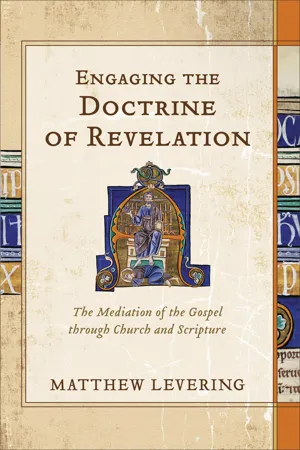
Engaging the Doctrine of Revelation
The Mediation of the Gospel through Church and Scripture
- 384 pages
- English
- ePUB (mobile friendly)
- Available on iOS & Android
eBook - ePub
Engaging the Doctrine of Revelation
The Mediation of the Gospel through Church and Scripture
About this book
How do human beings today receive divine revelation? Where and in what ways is it mediated so that all generations can hear the fullness of the gospel? In this volume, distinguished theologian Matthew Levering shows that divine revelation has been truthfully mediated through the church, the gospel, and Scripture so that we can receive it in its fullness today. Levering engages past and present approaches to revelation across a variety of traditions, offering a comprehensive, historical study of all the key figures and perspectives. His thorough analysis results in an alternative approach to prevailing views of the doctrine and points to its significance for the entire church.
Information
Topic
Theology & ReligionSubtopic
Christian TheologyOne
Church
Dei Verbum anchors its treatment of divine revelation in the Father’s sending (missio) of the Son: “For he sent his Son, the eternal Word who enlightens all men, to dwell among men and to tell them about the inner life of God. Hence, Jesus Christ, sent as ‘a man among men,’ ‘speaks the words of God’ (John 3:34), and accomplishes the saving work which the Father gave him to do.”1 Dei Verbum specifies that the mission of the Son “completed and perfected revelation,” not only by his words and deeds but also by his “sending the Spirit of truth.”2 According to Dei Verbum, then, the theology of the divine missions provides the basis for all reflection on divine revelation and its human mediation.3 As a theological term, however, “mission” can mean various things. First, it can signify the Father’s sending of the Son and the Holy Spirit for the salvation of the world, as in the above passage from Dei Verbum. In this sense, “mission” describes the salvific activity of the Son and the Spirit, and includes not only their visible missions in the incarnation and Pentecost but also their invisible missions in human souls at all places and times. Second, “mission” can signify a particular “vocation” in God’s economy of salvation. Jesus Christ preeminently receives a mission, the mission of the Messiah. But the patriarchs, prophets, and leaders of Israel, as well as the whole people of God, also receive a mission, as do the apostles and indeed each and every Christian. All human beings are called to a “mission” inscribed within the salvific mission of Christ.4
Third, “mission” can be taken in the sense of the Church’s evangelizing mission, rooted not least in the risen Jesus’s command, “Go therefore and make disciples of all nations” (Matt. 28:19), and embodied by Paul’s remark to the Corinthians, “Woe to me if I do not preach the gospel!” (1 Cor. 9:16). It is in this sense that the Second Vatican Council’s Decree on the Church’s Missionary Activity, Ad Gentes, proclaims, “The Church on earth is by its very nature missionary since, according to the plan of the Father, it has its origin in the mission of the Son and the Holy Spirit.”5 As Ad Gentes says, the Church’s missionary task “unfolds the mission of Christ, who was sent to evangelize the poor.”6
The task of this chapter is to elucidate these three senses of “mission” and to show how they illumine the Church’s mediation of divine revelation. For each of the three senses of “mission”—the missions of the Son and the Spirit, Christ’s mission and ours, and evangelization—I concentrate upon the work of one theologian for whom the particular sense of “mission” has an especially central role. With respect to the trinitarian missions, I focus upon the theology of Thomas Aquinas. As Gilles Emery observes, the doctrine of the trinitarian missions is “the pivot, indeed a real key, of St. Thomas’s Trinitarian theology: the revelation of the Trinity and the gift of salvation consist in the missions of the divine persons.”7 Regarding Christ’s mission and ours, I examine Hans Urs von Balthasar’s theology of Christ’s supreme mission-consciousness (kenotic love) and our participation in Christ by embracing our missions of love. I then move on to the biblical scholar Christopher Wright, who emphasizes God’s saving mission of mercy with a particular reference to the evangelizing mission to the nations. He interprets God’s revelation to Israel as already including in nuce the Church’s mission as a light to all nations, to proclaim and imitate Christ.
The distinctive perspectives of Aquinas, Balthasar, and Wright agree on this: through the missions of the Son and Spirit, the Church is enabled to share in and make present for the whole world the salvific, revelatory mission of Jesus Christ, both as regards its content and as regards its kenotic form (charity). In this way, divine revelation can be said to include the active participation of the Church, without imagining that the Church gives to itself the revelation that God, in Christ and the Spirit, has given to the Church once and for all.8
Thomas Aquinas: Revelation and the Missions of the Son and Holy Spirit
Does “mission” name something in God? It might seem that even granting the reality of processions in God, “mission” would be an inappropriate word to denote the salvific activity of the Son and Holy Spirit in the world. “Mission” seems to describe moving from one place/condition to another place/condition, as if the Son and the Holy Spirit, leaving behind their eternal existence with the Father, parachuted into the world. “Mission” also seems to suggest that the Son and Holy Spirit are distinct from the Father and from each other not solely in terms of their eternal relations but also on the basis of distinct missions. If this were so, then the distinction of missions would produce new real “relations” in God, thereby producing new divine Persons. Mission might also seem unreal when applied to the Son and Holy Spirit. If the Triune God had not freely created the world, then there would have been no missions, but there would still have been eternal divine Persons. These eternal divine Persons—the Son and Holy Spirit—are supremely who they are, and they cannot be changed by anything. If the historical missions do not change the Son and Spirit, then it appears that the missions are simply metaphorical, naming something that does not really involve the actual divine Persons.
By Thomas Aquinas’s time, of course, the theology of divine missions was part of the Church’s heritage.9 But he presents this theology in a way that is particularly helpful for understanding the relationship between divine revelation and the Church. He builds his case for the missions of the Son and Holy Spirit on the basis of biblical texts from the Gospels and Paul, with Isaiah and the Wisdom of Solomon in the background. Specifically, in the eight articles of Summa theologiae I, question 43, he cites the following passages of Scripture to elucidate the missions:
Matthew 3:16–17: “When Jesus was baptized, he went up immediately from the water, and behold, the heavens were opened and he saw the Spirit of God descending like a dove, and alighting on him; and lo, a voice from heaven, saying, ‘This is my beloved Son, with whom I am well pleased.’”
Matthew 17:5: “A bright cloud overshadowed them, and a voice from the cloud said, ‘This is my beloved Son, with whom I am well pleased; listen to him.’”
John 1:10: “He was in the world, and the world was made through him, yet the world knew him not.”
John 7:39: “Now this he said about the Spirit, which those who believed in him were to receive; for as yet the Spirit had not been given, because Jesus was not yet glorified.”
John 8:16: “My judgment is true, for it is not I alone that judge, but I and he who sent me.”
John 14:23: “If a man loves me, he will keep my word, and my Father will love him, and we will come to him and make our home with him.”
Acts 2:4: “They were all filled with the Holy Spirit and began to speak in other tongues, as the Spirit gave them utterance.”
Romans 5:5: “Hope does not disappoint us, because God’s love has been poured into our hearts through the Holy Spirit which has been given to us.”
Galatians 4:4–5: “When the time had fully come, God sent forth his Son, born of woman, born under the law, to redeem those who were under the law, so that we might receive adoption as sons.”
Hebrews 2:3: “How shall we escape if we neglect such a great salvation? It was declared at first by the Lord, and it was attested to us by those who heard him.”
Isaiah 48:16: “And now the Lord God has sent me and his Spirit.”
Wisdom 9:10: “Send her forth from the holy heavens, and from the throne of your glory send her, that she may be with me and toil, and that I may learn what is pleasing to you.”
Aquinas presents these biblical texts within an interpretative context shaped by Augustine’s On the Trinity.10 He quotes from books 2, 3, 4, 9, and 15 of On the Trinity, with book 4 being the most frequently cited. In book 4 Augustine carefully defends the claim that the Father is not superior to the Son or Holy Spirit even though the Father is not sent. Augustine has in view both the visible missions of the Son and Spirit (the incarnation and Pentecost) and their invisible missions in the souls of believers. Aquinas makes much of Augustine’s statement that the Son is “sent to anyone when he is known and perceived by him, as far as he can be perceived and known according to the capacity of a rational soul either making progress toward God or already made perfect in God.”11 Aquinas also quotes more than once Augustine’s assertion that the Father is not sent. Among the texts quoted by Aquinas in question 43, Augustine in book 4 cites John 7:39; Galatians 4:4; and Wisdom 9:10. In the same book, Augustine also cites cognate passages such as Wisdom 7:25–27 and John 14:26; 15:26; and 16:28.
When one canvasses the other books of Augustine’s On the Trinity from which Aquinas quotes in question 43, it becomes clear that rather than trying to break new ground in the biblical passages that he cites, Aquinas is selecting certain texts that already enjoy a central place in Augustine and in the theological tradition. In the objections of the first two articles of question 43, Aquinas also quotes Jerome, Hilary of Poitiers, and Gregory the Great, but he quotes these fathers in order to rule out potential misunderstandings, not in order to ground or advance his own arguments. This is a sharp contrast to his use of Augustine in question 43: quotations of Augustine appear in the objections, sed contra, respondeo, and answers to the objections, and these quotations of Augustine play a major role in determining Aquinas’s own position. This is so especially in four respects: the Father is not sent; the Son and Holy Spirit are invisibly sent when a person is enlightened by faith and is sanctified; the purpose of the Spirit’s mission is our sanctification in charity, a purpose that involves and presumes the Son’s mission, which vivifies our faith; and the visible mission of the incarnate Son differs in kind from the visible mission of the Spirit at Christ’s baptism and at Pentecost.
Rooted in Scripture as interpreted by Augustine, Aquinas’s theology of the missions of the Son and Holy Spirit emphasizes that the revelation of God in the mission of the Son is inseparable from the mission of the Holy Spirit. It is in the visible mission of the incarnate Word that God fully reveals the truth of salvation, the truth about himself and about us. This visible mission is received as revelation through the visible mission of the Holy Spirit at Pentecost, and through the invisible missions of the Word inspiring faith and of the Holy Spirit healing and sanctifying us in charity.12
Against misconceptions of these missions, Aquinas observes that the change is in the creature rather than in the divine Person to whom the creature is united. In technical language, Aquinas explains that “mission not only signifies procession from the principle [the Father], but also determines the temporal term of the procession. . . . Hence the procession may be called a twin procession, eternal and temporal, not that there is a double relation to the principle, but a double term, temporal and eternal.”13 The procession of the Son coming forth from the Father is not combined with a second procession in which the Father sends the Son into the world. Rather, there is only one procession constitutive of the Son, but the Son is nevertheless rightly said to be “sent” into the world because the procession has two terms: the Son’s eternal subsistence and his temporal subsistence as Jesus Christ. The visible mission of the Son is not a change in the Son, but a change that occurs on the side of the creature that is united to the Son in the incarnation.14 Likewise, the mission of the Holy Spirit is not a second procession of the Holy Spirit but a temporal “term” whereby creatures are sanctified by the Holy Spirit. Sanctifying grace makes the Holy Spirit present to creatures in this way.
Among the biblical verses quoted by Aquinas in question 43, perhaps the mos...
Table of contents
- Cover
- Title Page
- Copyright Page
- Dedication
- Contents
- Acknowledgments
- Introduction
- 1. Church
- 2. Liturgy
- 3. Priesthood
- 4. Gospel
- 5. Tradition
- 6. Development
- 7. Inspiration
- 8. Philosophy
- Conclusion
- Bibliography
- Subject Index
- Name Index
- Notes
- Back Cover
Trusted by 375,005 students
Access to over 1.5 million titles for a fair monthly price.
Study more efficiently using our study tools.
Frequently asked questions
Yes, you can cancel anytime from the Subscription tab in your account settings on the Perlego website. Your subscription will stay active until the end of your current billing period. Learn how to cancel your subscription
No, books cannot be downloaded as external files, such as PDFs, for use outside of Perlego. However, you can download books within the Perlego app for offline reading on mobile or tablet. Learn how to download books offline
Perlego offers two plans: Essential and Complete
- Essential is ideal for learners and professionals who enjoy exploring a wide range of subjects. Access the Essential Library with 800,000+ trusted titles and best-sellers across business, personal growth, and the humanities. Includes unlimited reading time and Standard Read Aloud voice.
- Complete: Perfect for advanced learners and researchers needing full, unrestricted access. Unlock 1.5M+ books across hundreds of subjects, including academic and specialized titles. The Complete Plan also includes advanced features like Premium Read Aloud and Research Assistant.
We are an online textbook subscription service, where you can get access to an entire online library for less than the price of a single book per month. With over 1.5 million books across 990+ topics, we’ve got you covered! Learn about our mission
Look out for the read-aloud symbol on your next book to see if you can listen to it. The read-aloud tool reads text aloud for you, highlighting the text as it is being read. You can pause it, speed it up and slow it down. Learn more about Read Aloud
Yes! You can use the Perlego app on both iOS and Android devices to read anytime, anywhere — even offline. Perfect for commutes or when you’re on the go.
Please note we cannot support devices running on iOS 13 and Android 7 or earlier. Learn more about using the app
Please note we cannot support devices running on iOS 13 and Android 7 or earlier. Learn more about using the app
Yes, you can access Engaging the Doctrine of Revelation by Matthew Levering in PDF and/or ePUB format, as well as other popular books in Theology & Religion & Christian Theology. We have over 1.5 million books available in our catalogue for you to explore.