- 192 pages
- English
- ePUB (mobile friendly)
- Available on iOS & Android
eBook - ePub
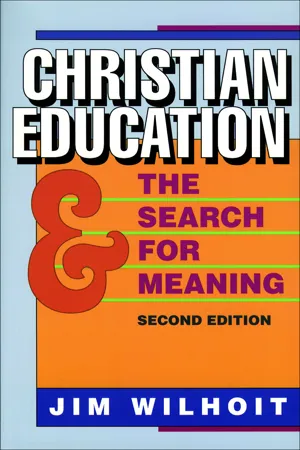
Christian Education and the Search for Meaning
About this book
James Wilhoit explores how Christian education can go beyond mere activity to instill a solid perspective and make sense of a perplexing world. He envisions the ideal model of Christian education and integrates the discipline with the social sciences. In the final chapter Wilhoit presents an evangelical theory of biblical instruction.
Information
Topic
Teología y religiónSubtopic
Religión1
Purpose in Christian Education
Christian education is in crisis. It is not healthy and vital; as a discipline, it is bankrupt. To say that a discipline is bankrupt is not to claim that it is worthless or that its scholars are not diligently working, but rather that the discipline is not doing what it is supposed to do (see Wink 1973, p. 1). Christian education maintains a façade of viability. It employs a host of trained workers and supports an impressive variety of workshops, conferences, and other activities. Yet all too often it exhibits the fatal flaw of having no clear purpose.
The Current Lack of Purpose
The current crisis in Christian education stems, in large measure, from a lack of clear purpose at the grassroots level. The people most directly involved in Christian education—Sunday-school teachers, youth counselors, and Bible-study leaders—often have no idea of the ultimate purpose of their educational endeavors. The teacher of an adult class may be told that the curriculum for the next quarter is a study of the Book of Acts. Yet the reason for selecting Acts—or for studying Isaiah during the current quarter—may be clear to no one. Or consider a children’s department where most of the time is spent on crafts and workbooks that have only an incidental relationship to the Bible passage of the week. The teachers believe that they should not bore the children, so they do their best to make the class a lot of fun. Often, however, no one knows the ultimate purpose for the class. Such a lack of purpose can devastate the personnel in ministries where the results are slow in coming and where faithful work often goes unnoticed.
Directors of Christian education are typically pressed for time and consequently tend to focus their energies on immediate problems, ignoring the need for long-range goals. For the average director, cultivating a sense of purpose among the lay workers is an item of low priority. Education directors may say that a vision for the teachers will become clear if the Christian-education program sticks with the Bible, or they may claim that teachers need methods, not clear purposes. But these program directors do not seem to realize that the question of how to teach can be adequately answered only after settling the question of the goal of teaching. Method is no substitute for purpose; indeed, if method becomes the primary focus, Christian education is reduced to a mere technique. A sense of purpose is no needless luxury. Yet the current focus on the urgent and the immediately relevant has too often deprived Christian educators of a needed sense of direction.
There are several ways in which having a common purpose and vision greatly enhances the effectiveness of educational ministries:
A sense of purpose acts as a sentinel guarding the resources of the educational team from being siphoned off into areas of ministry that are worthwhile, but secondary.
Team members come to see that what they are doing, however simple and mundane it may appear, is vitally important work—changing lives, healing souls, helping people discover meaning in life.
The team is alerted to and thus can avoid inappropriate ministry practices.
Encouraged to ask the question, “What method and strategy best fit our common purpose?” the team is freed from a mentality that would merely maintain the status quo to develop ministries that are on the cutting edge.
A common purpose helps maintain a truly Christ-centered and educationally effective ministry.
Regrettably, some evangelicals have considered themselves exempt from being concerned about purpose. “After all,” they say, “we teach the Bible.” “Teaching the Bible,” however, means many different things to different people. It may entail a variety of sub-Christian and humanistic educational orientations which well-meaning Christians adopted during their school days and later imposed unconsciously on their “Bible teaching.” Other educators are content simply to pour Bible facts into their students’ heads. It is thus inadequate to define the purpose of Christian education as merely to “teach the Bible.”
The effects of purposelessness plague Christian-education programs. Many programs, for example, face a lack of volunteers. Often, moreover, a veneer of activity only partially hides a lack of direction that has demoralized both lay and professional staff. Why should people volunteer for a job that seems purposeless? Christian educators have failed to see that programs and activities in themselves are worthless. There must be a purpose for the efforts that lay workers put forth. Good communication skills, engaging methods, and well-conceived curricula should serve the basic purpose, not replace it.
The Business of Christian Education
Christian education is dedicated to helping people discover God’s meaning for life. It aims to enable them to gain a liberating perspective and lifestyle. Two points call for special attention here: (1) Christian education is a people-intensive ministry; and (2) it focuses on the meaning of life.
In the work of Christian education, the greatest resource is the people who teach and disciple others. To maintain effective ministry, we must learn, as the best corporations have already learned, that the key to any business is its people, and our leadership must focus on shaping their values. “Every excellent company . . . is clear on what it stands for, and takes the process of value shaping seriously” (Peters and Waterman 1982, p. 280). In the most successful companies certain values permeate the corporate structure, giving direction to employees and programs. The executives know that the future of their corporation is largely dependent upon the values that their employees hold toward the customer and their work. One of the important tasks of a director of Christian education is to shape the values of the people who make up the Christian-education team. The values that teachers carry into the classroom matter far more than the curriculum they follow. A director cannot “teacher-proof” an educational program, because a teacher’s values will be caught by the student, even if they are not overtly taught. The teacher’s values control the “hidden curriculum”—the shape, feel, and hidden agenda of the class, which may confirm or deny the material being explicitly taught. The primary leadership function of the director of Christian education, then, is to shape the values of those who teach.
At Disney World great efforts are made to have every employee understand the purpose of the business—to make people happy. From the first day on the job, that theme is driven home, and the employees come to share the vision. The same should be true in Christian education, which aims at helping people gain a comprehensive view of God’s world and the meaning and purpose of life. If program directors can communicate their commitment to helping people find meaning in life, then teachers and other workers will catch the vision.
Program directors can take several steps to ensure that an appropriate emphasis will be placed on people:
Make use of what is available. Teachers want to improve education by somehow getting better students, and students want to improve their schooling by getting better teachers. But we must start with the resources we have been given. Consequently, we should focus on teacher development rather than teacher replacement.
Give teacher training and affirmation top priority.
Nurture the character and spiritual lives of the teachers.
Take modeling seriously. Encourage teachers to be open with their students about how they seek to live their life faithfully before God in the midst of difficulties and setbacks.
Choose a curriculum for its ability to help teachers teach rather than for its eye appeal or ease of use.
In addition to being people-intensive, Christian education helps students make sense out of life. The English word educate can be traced back to the Latin word educere, “to lead out.” This etymology reminds us that education is the process of leading students from where they are to a place where they can see the world—including the spiritual and the natural dimensions—in a more accurate way. To lead students to a more Christian view of life and the world, the Christian educator must understand students as they are, the goals they should be guided toward, and the best means to achieve these goals. Above all, he or she should be guiding them in the search for meaning.
Modern men and women, particularly in our secular and humanistic society, deeply yearn for a sense of purpose. Not just philosophers but all adults earnestly seek the purpose of life. Some people may never phrase the precise question “What is life about?” but their experimentation with various lifestyles, their use of drugs, their preoccupation with sex, power, and money, show that they are asking the question. The common query “What are you into?” is a question about meaning. People who were desperately searching for personal meaning have asked me this question, hoping, I believe, that my answer might both provide them with something they could “get into” and give them a sense of purpose. In past generations a set of certain common values provided many individuals with a sense of meaning and purpose. Our modern society, however, with its decadent values has no deeply satisfying purpose to offer searching men and women.
After a time of searching in vain for a sense of purpose, people generally tire of asking ultimate questions and settle for any meaning that is at hand in order to get on with life. They declare a moratorium on the search and most often accept the prevailing values of the culture. In the bustle of everyday activities, short-term goals become more important than the search for meaning.
It would be unwise to say that Christian education seeks to give a person meaning or to answer all questions. Rather, Christian education can facilitate the search for personal meaning and, in helping people detect God’s purpose for life, can most certainly suggest answers. Ultimately, however, meaning is found by individuals themselves and not given to them. Viktor Frankl reminds us that “man’s search for meaning is a primary force in his life. . . . The meaning of our existence is not invented by ourselves, but rather detected” (1963, pp. 154, 157).
A Christian-education program that focuses on the meaning of life will display certain distinct characteristics:
There is a constant effort to connect the Bible and life. Concentration on just one alone is insufficient for a meaning-centered Christian education.
Personal meaning is discovered by the students, not given to them. Each individual constructs his or her meaning for life—it can’t just be handed over. The teacher serves as a construction superintendent giving wise and biblical advice, but letting the students discover God’s plan for their own lives.
Faithful Christian living is a higher priority than Bible knowledge or doctrinal precision.
Classes are designed to be a place of safety and grace where people sense that they are part of a caring network.
This book proposes an aim for Christian education that incorporates both biblical insights and key findings from the social sciences. In chapter 2 we will discuss biblical themes that bear on the purpose of Christian education. The next chapter examines the basic theological concepts that must be adopted if Christian education is to achieve its aim. Chapter 4 evaluates three contemporary secular approaches to education; chapter 5 introduces an alternative that attempts to measure up to the biblical standard. The next two chapters discuss the relation of the social sciences to Christian education; after a few general concerns have been identified and recommendations made for relating the two fields, we will look at specific findings from the social sciences and consider how these apply to classroom instruction. Finally, chapter 8 integrates theology, educational theory, and social science into an evangelical theory of biblical instruction.
2
Biblical Foundations: Priesthood, Servanthood, and God’s Transforming Grace
Christian education is in the business of helping people find meaning in life through highly personal teaching ministries. In the “ministry for meaning” it works in conjunction with preaching, counseling, worship, mission, evangelism, and social service, all of which can contribute to a person’s sense of purpose. Ideally, a theory of Christian education should grow out of three biblical themes that relate directly to a Christian’s sense of meaning: the priesthood of all believers, with its privileges and responsibilities; the call to serve others; and the power of God’s grace for personal renewal.
The Priesthood of All Believers
The doctrine of the priesthood of all believers can be called the Magna Carta of Christian education. This doctrine mandates and enables Christian education and serves as its implicit theological foundation. When properly understood, the biblical principle that all believers are priests has infused Christian education with a refreshing vitality and spirit of renewal; at other times, however, it has been used to excuse individualism and intellectual lethargy. A balanced concept of the priesthood of all believers will affirm the personal spiritual responsibility of all Christians, their right and duty to minister in Christ’s name, and the truth that one does not abide in Christ apart from abiding in the body of Christ, the church.
Access to Christ
Martin Luther (1483–1546) saw the doctrine of the priesthood of all believers as being grounded in the finished redemptive work of Christ. In his view, Christ’s death and its benefits, received through grace by faith, are completely available to every contrite believer. Salvation thus comes through personal surrender to Christ and not through sacraments administered by priests. Luther believed that Christ no longer needed to be sacrificed in the mass and that therefore the need for an exclusive priesthood had vanished. The view that the completed work of Christ set aside the sacrificing priesthood was developed by both John Calvin (1509–1564) and Ulrich Zwingli (1484–1531). They argued that Christ’s finished work cannot be repeated by the priests of the church and that his salvific activity is distributed through faith to all persons who trust in him. In a sermon entitled “Of the Clarity and Certainty of the Word of God,” Zwingli explained that the “royal priesthood” of 1 Peter 2 means “that the Lord Jesus has called all Christians to kingly honour and to the priesthood, so that they do not need a sacrificing priest to offer on their behalf” (1953, p. 88). The spiritual accessibility of Christ serves as the bedrock for the doctrine of the priesthood of all believers. Luther, Calvin, and Zwingli all emphasized the truth that Christ’s salvific benefits do not require mediation through a priest but can be received directly by any spiritually receptive and renewed person.
This emphasis on direct access to Christ should not be misconstrued as a license for individualism. Zwingli went on in his sermon to identify the basic implication of the New Testament concept of universal priesthood, namely, the responsibility incumbent upon all believers to exercise their spiritual gifts in ministry for the benefit of the church. He wrote, “They are all priests, offering [their] spiritual gifts, that is, dedicating themselves wholly to God” (1953, p. 88). The vocation of believer-priests is to serve others and to worship God through the gifts God has given them.
The Implication of Spiritual Responsibility
Luther recognized that if all Christians are called to be responsible servants and worshipers, they must be trained and equipped to fulfil this calling. Hence he became involved in Christian education. His famous Small Catechism stands as a reminder of this interest. The Small Catechism was written after he visited nearby country parishes, where he was appalled by the ignorance he found even among the clergy. It is said that after Luther had made a reference to the Decalogue, one minister asked if that was a new book. In the preface to his catechism, Luther expresses his concern about the religious training of the laity:
The deplorable condition in which I found religious affairs during a recent visitation of the congregations has impelled me to publish this Catechism, or statement of the Christian doctrine, after having prepared it in very brief and simple terms. Alas! What misery I beheld! The people, especially those who live in the villages, seem to have no knowledge whatever of Christian doctrine, and many of the pastors are ignorant and incompetent teachers.
Luther was keenly aware that, since all Christians are priests, each individual believer must ultimately answer to Christ concerning his or her own spiritual condition. Thus the sheer ignorance of so many of the Christians of his day shocked him. If these people were accountable for their faith, then, Luther reasoned, they must be instructed in spiritual matters.
Luther and the other Reformers supported education because, in part, they recognized that Christians are called to be far more than just sincerely religious. The pastor is not the only person in the parish who is to study the Scriptures and to seek actively to minister to others. All Christians are called to worship God, utilize their gifts, and minister to others according to God’s principles as set forth in Scripture. Good intentions or ignorance of divine requirements does not absolve the believer of these responsibilities.
Philipp Jacob Spener (1635–1705) and a number of like-minded Lutheran Pietists developed further the ramifications which this doctrine has for Christian education. Spener was a brilliant and sensitive Lutheran pastor who held a doctorate in theology and was fluent in several languages, yet he also firmly believed that a vital faith is more important for ministry than is either ordination or formal training. He did not disparage theological training (although he wanted to reform it), but he deeply felt that in order to be fit for ministry, a renew...
Table of contents
- Cover
- Title Page
- Copyright Page
- Dedication
- Contents
- 1. Purpose in Christian Education
- 2. Biblical Foundations: Priesthood, Servanthood, and God’s Transforming Grace
- 3. Theology and Christian Education
- 4. Contemporary Approaches to Education
- 5. Transformational Christian Education: The Teacher as Guide
- 6. Social Science and Christian Education
- 7. Some Findings of Social-Science Research
- 8. Toward an Evangelical Theory of Biblical Instruction
- Bibliography
- Index
- Back Cover
Trusted by 375,005 students
Access to over 1.5 million titles for a fair monthly price.
Study more efficiently using our study tools.
Frequently asked questions
Yes, you can cancel anytime from the Subscription tab in your account settings on the Perlego website. Your subscription will stay active until the end of your current billing period. Learn how to cancel your subscription
No, books cannot be downloaded as external files, such as PDFs, for use outside of Perlego. However, you can download books within the Perlego app for offline reading on mobile or tablet. Learn how to download books offline
Perlego offers two plans: Essential and Complete
- Essential is ideal for learners and professionals who enjoy exploring a wide range of subjects. Access the Essential Library with 800,000+ trusted titles and best-sellers across business, personal growth, and the humanities. Includes unlimited reading time and Standard Read Aloud voice.
- Complete: Perfect for advanced learners and researchers needing full, unrestricted access. Unlock 1.5M+ books across hundreds of subjects, including academic and specialized titles. The Complete Plan also includes advanced features like Premium Read Aloud and Research Assistant.
We are an online textbook subscription service, where you can get access to an entire online library for less than the price of a single book per month. With over 1.5 million books across 990+ topics, we’ve got you covered! Learn about our mission
Look out for the read-aloud symbol on your next book to see if you can listen to it. The read-aloud tool reads text aloud for you, highlighting the text as it is being read. You can pause it, speed it up and slow it down. Learn more about Read Aloud
Yes! You can use the Perlego app on both iOS and Android devices to read anytime, anywhere — even offline. Perfect for commutes or when you’re on the go.
Please note we cannot support devices running on iOS 13 and Android 7 or earlier. Learn more about using the app
Please note we cannot support devices running on iOS 13 and Android 7 or earlier. Learn more about using the app
Yes, you can access Christian Education and the Search for Meaning by James C. Wilhoit in PDF and/or ePUB format, as well as other popular books in Teología y religión & Religión. We have over 1.5 million books available in our catalogue for you to explore.