- English
- PDF
- Available on iOS & Android
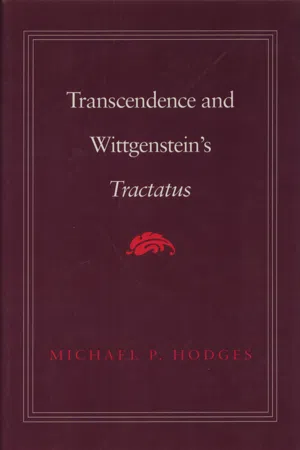
Transcendence and Wittgenstein's Tractatus
About this book
Although Wittgenstein claimed that his first book, the Tractatus Logico-Philosophicus, was essentially an ethical work, it has been viewed insistently as a purely logical one. His later work, Philosophical Investigations, is generally seen as presenting totally different ideas from his earlier writings. In this book, Michael Hodges shows how Wittgenstein's later work emerged from his earlier Tractatus, and he unifies the early philosophy, both its well-known logical aspects and the lesser known ethical dimensions, in terms of the notion of transcendence.
Hodges studies the Tractatus in light of Wittgenstein's own claim that the Philosophical Investigations can only be understood when read against the background of the Tractatus. At the heart of an understanding of the earlier work is the idea of transcendence which structures both Wittgenstein's logical and ethical insights. Seen in terms of this notion, the rigorous unity of Wittgenstein's early thinking becomes apparent and the gestalt shift to the later philosophy comes clearly into focus.
Frequently asked questions
- Essential is ideal for learners and professionals who enjoy exploring a wide range of subjects. Access the Essential Library with 800,000+ trusted titles and best-sellers across business, personal growth, and the humanities. Includes unlimited reading time and Standard Read Aloud voice.
- Complete: Perfect for advanced learners and researchers needing full, unrestricted access. Unlock 1.4M+ books across hundreds of subjects, including academic and specialized titles. The Complete Plan also includes advanced features like Premium Read Aloud and Research Assistant.
Please note we cannot support devices running on iOS 13 and Android 7 or earlier. Learn more about using the app.
Information
Table of contents
- Contents
- List of Abbreviations
- Preface
- 1. Introduction
- 2. The Theory of Language and Logic
- 3. Philosophy, Elucidations, and Showing/Saying
- 4. The Metaphysical Subject
- 5. The Ethical
- 6. Ethics and Happiness
- 7. The Tension between Ethical and Logical Transcendence
- 8. Conclusions
- Notes
- Index