- English
- PDF
- Available on iOS & Android
eBook - PDF
About this book
Philadelphia's Chinatown, like many urban chinatowns, began in the late nineteenth century as a refuge for immigrant laborers and merchants in which to form a community to raise families and conduct business. But this enclave for expression, identity, and community is also the embodiment of historical legacies and personal and collective memories.
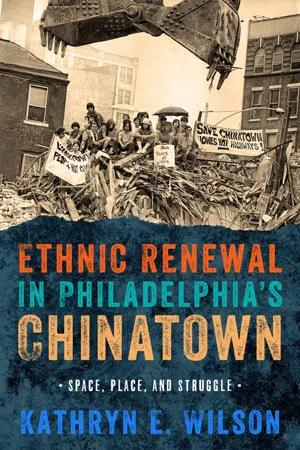
In Ethnic Renewal in Philadelphia's Chinatown. Kathryn Wilson charts the unique history of this neighborhood. After 1945, a new generation of families began to shape Chinatown's future. As plans for urban renewalâranging from a cross-town expressway and commuter rail in the 1960s to a downtown baseball stadium in 2000âwere proposed and developed, "Save Chinatown" activists rose up and fought for social justice.
Wilson chronicles the community's efforts to save and renew itself through urban planning, territorial claims, and culturally specific rebuilding. She shows how these efforts led to Chinatown's growth and its continued ability to serve as a living community for subsequent waves of new immigration.
In Ethnic Renewal in Philadelphia's Chinatown. Kathryn Wilson charts the unique history of this neighborhood. After 1945, a new generation of families began to shape Chinatown's future. As plans for urban renewalâranging from a cross-town expressway and commuter rail in the 1960s to a downtown baseball stadium in 2000âwere proposed and developed, "Save Chinatown" activists rose up and fought for social justice.
Wilson chronicles the community's efforts to save and renew itself through urban planning, territorial claims, and culturally specific rebuilding. She shows how these efforts led to Chinatown's growth and its continued ability to serve as a living community for subsequent waves of new immigration.
Frequently asked questions
Yes, you can cancel anytime from the Subscription tab in your account settings on the Perlego website. Your subscription will stay active until the end of your current billing period. Learn how to cancel your subscription.
No, books cannot be downloaded as external files, such as PDFs, for use outside of Perlego. However, you can download books within the Perlego app for offline reading on mobile or tablet. Learn more here.
Perlego offers two plans: Essential and Complete
- Essential is ideal for learners and professionals who enjoy exploring a wide range of subjects. Access the Essential Library with 800,000+ trusted titles and best-sellers across business, personal growth, and the humanities. Includes unlimited reading time and Standard Read Aloud voice.
- Complete: Perfect for advanced learners and researchers needing full, unrestricted access. Unlock 1.4M+ books across hundreds of subjects, including academic and specialized titles. The Complete Plan also includes advanced features like Premium Read Aloud and Research Assistant.
We are an online textbook subscription service, where you can get access to an entire online library for less than the price of a single book per month. With over 1 million books across 1000+ topics, weâve got you covered! Learn more here.
Look out for the read-aloud symbol on your next book to see if you can listen to it. The read-aloud tool reads text aloud for you, highlighting the text as it is being read. You can pause it, speed it up and slow it down. Learn more here.
Yes! You can use the Perlego app on both iOS or Android devices to read anytime, anywhere â even offline. Perfect for commutes or when youâre on the go.
Please note we cannot support devices running on iOS 13 and Android 7 or earlier. Learn more about using the app.
Yes, you can access Ethnic Renewal in Philadelphia's Chinatown by Kathryn Wilson in PDF and/or ePUB format, as well as other popular books in Social Sciences & North American History. We have over one million books available in our catalogue for you to explore.
Information
Publisher
Temple University PressYear
2015Print ISBN
9781439912157, 9781439912140eBook ISBN
9781439912164Table of contents
- Contents
- List of Figures and Tables
- Preface
- Acknowledgments
- Introduction: Imagining Chinatown
- 1. Claiming Space, Creating Chinatown, 1870â1940
- 2. âChinatown was the safe spaceâ: Community, Memory, and Place, 1940â1980
- 3. âWe want homes, not highwaysâ: Urban Renewal and the âSave Chinatownâ Movement
- 4. âBe part of progress, not its sacrificial lambâ: Community-Development Strategies, 1970â2000
- 5. âA legacy of resistanceâ: Chinatown North and Twenty-First-Century Challenges
- 6. âWe are the ones who should be telling the storyâ: Representing Chinatown
- Epilogue: âIs, was, and will be Chinatownâ
- Appendix: Chinatown Populations
- Notes
- Index