- 296 pages
- English
- PDF
- Available on iOS & Android
eBook - PDF
About this book
"Well written and fascinating to read. This fine book takes a large step in...contributing to the only slowly dawning awareness of the general public, and the health workers too, of the significance of chronic illness."
--Anselm Strauss, University of California, San Francisco
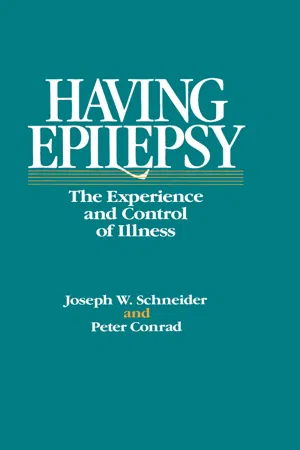
Based on in-depth interviews with eighty people who have epilepsy, this book gives a first-hand account of what it is like to cope with a chronic illness, while working, playing, and building relationships. The authors recount how people discover they have epilepsy and what it means; how families respond to someone labeled "epileptic"; how seizures affect a person's sense of self and self-control.
Epilepsy patients explain what they want from their doctors and why the medication practices they develop may not coincide with "doctor's orders." The variety of experiences of epilepsy is suggested both by the interviews and by the range of terms for seizures--Petit Mal, Grand Mal, auras, fits, absences.
The principal difficulty for many people with epilepsy is not the medical condition but the social stigma. A person with epilepsy has to cope with discrimination in obtaining a job, insurance, or a driver's license, and he or she may be cautious about revealing this "disabling" condition to an employer or even a spouse. People with epilepsy may manage information about themselves and their "lapses" and look for "safe places" like restrooms where they can be alone should a seizure begin. Many of those interviewed complained of overreactions to seizures by colleagues or bystanders: epilepsy patients were embarrassed at having provoked a public crisis or were annoyed at waking up in a hospital emergency room.
This is a book for people who have epilepsy, for their families and friends; for health care professionals who deal with chronic illnesses; and for students of medical sociology and the sociology of deviance.
"For anyone who would like to 'get inside' the experience of having epilepsy, this book is probably as close as one can come."
--Epilepsia
"In dispelling the notion that 'the person is the illness,' these interviews with 80 individuals reveal that those suffering from epilepsy have learned to accept it as merely another facet of their lives. A valuable contribution for those with epilepsy, for their family and friends, for medical personnel, and for the general public."
--Booklist
"...carefully outlined and clearly written.... Those affected by chronic conditions may find the book most helpful.... Family and helping professionals may discover new insights.... Social scientists, especially those interested in chronic illnesses, will benefit from the research conclusions and suggestions for further research."
--Medical Anthropology Quarterly
"It represents an important advance in the medical sociology literature as well as a contribution to qualitative sociology. I think that the book should become a contemporary classic in medical sociology."
--Qualitative Sociology
"...an important contribution.... In focusing on what it is like to have epilepsy in this society, Schneider and Conrad have reversed an earlier concern for the medicalization of deviance, opting in this work for an understanding of the stigmatization of illness."
--Contemporary Sociology
Information
Table of contents
- Contents
- Preface
- ONE The Sociology of Illness
- TWO The Historical andSocial Realities of Epilepsy
- THREE Discovery
- FOUR The Other Side of Care: Parents and Family Life
- FIVE Seizures and Self
- SIX Controlling Seizures, Protecting Face
- SEVEN The Problem of Stigma: Managing Information
- EIGHT Ties That Bind and Free: The Paradox of Medical Care
- NINE The Meaning of Medications
- TEN Having Epilepsy: The Experience and Control of Illness
- Appendix
- References
- Index
Trusted by 375,005 students
Access to over 1.5 million titles for a fair monthly price.
Study more efficiently using our study tools.
Frequently asked questions
Yes, you can cancel anytime from the Subscription tab in your account settings on the Perlego website. Your subscription will stay active until the end of your current billing period. Learn how to cancel your subscription
No, books cannot be downloaded as external files, such as PDFs, for use outside of Perlego. However, you can download books within the Perlego app for offline reading on mobile or tablet. Learn how to download books offline
Perlego offers two plans: Essential and Complete
- Essential is ideal for learners and professionals who enjoy exploring a wide range of subjects. Access the Essential Library with 800,000+ trusted titles and best-sellers across business, personal growth, and the humanities. Includes unlimited reading time and Standard Read Aloud voice.
- Complete: Perfect for advanced learners and researchers needing full, unrestricted access. Unlock 1.5M+ books across hundreds of subjects, including academic and specialized titles. The Complete Plan also includes advanced features like Premium Read Aloud and Research Assistant.
We are an online textbook subscription service, where you can get access to an entire online library for less than the price of a single book per month. With over 1.5 million books across 990+ topics, we’ve got you covered! Learn about our mission
Look out for the read-aloud symbol on your next book to see if you can listen to it. The read-aloud tool reads text aloud for you, highlighting the text as it is being read. You can pause it, speed it up and slow it down. Learn more about Read Aloud
Yes! You can use the Perlego app on both iOS and Android devices to read anytime, anywhere — even offline. Perfect for commutes or when you’re on the go.
Please note we cannot support devices running on iOS 13 and Android 7 or earlier. Learn more about using the app
Please note we cannot support devices running on iOS 13 and Android 7 or earlier. Learn more about using the app
Yes, you can access Having Epilepsy by Joseph Schneider in PDF and/or ePUB format, as well as other popular books in Social Sciences & Sociology. We have over 1.5 million books available in our catalogue for you to explore.