This is not AI-generated content. The contents were written and verified by subject matter experts from Aviation Supplies & Academics, an 85-year-old aviation company. Look for the ASA wings to ensure you are purchasing a reliable publication.
You've mastered the FAA handbooks and wrapped up one of the toughest orals of your flying career. You can now fly and talk at the same time, all from the right seat. You can create lesson plans, enter mysterious endorsements in student logbooks, and actually explain the finer points of a lazy eight. That's everything you'll ever need to know in order to flight instruct…or is it?
This book is designed to help with all those "other" flight instructing questions, like why and how to become a CFI in the first place, and how to get your first instructing job. Where do flight students come from? And once you've got them, how do you keep them flying? How can you optimize your students' pass rate on checkrides? And how do you get flight customers to come back to you for their advanced ratings?
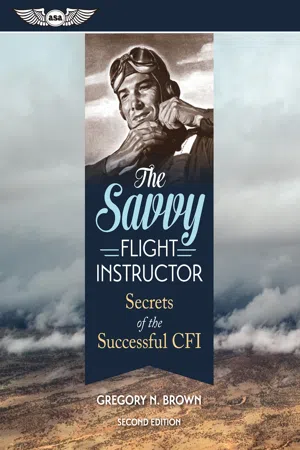
Written by Greg Brown (author of The Turbine Pilot's Flight Manual and Job Hunting for Pilots), this Second Edition of The Savvy Flight Instructor provides nearly 20 years of additional wisdom, experience, and know-how, and includes new "Finer Points" contributed by industry experts. While this edition retains the key marketing, pilot training, and customer support concepts that made the original edition required CFI reading, those areas have been refined and expanded to incorporate the latest industry philosophies and techniques.
Readers will learn how best to sell today's prospects on flying and how to utilize online marketing and social media. Greg Brown lays out tips for offering flight-instructing services with the sophistication of other competitive activities that beckon from just a click away on potential customers' computers and mobile devices. Aspiring flight instructors will learn why and how to qualify, and how to get hired once you earn the certificate. There's extensive coverage of techniques for systematizing customer success and satisfaction policies, strategies for pricing and structuring flight training to fit today's market, integration of affordable simulation technologies into your training programs, and tips for coping with the "CFI shortage."
Along with tips on how to attract and retain flight students, the author examines professionalism in flight instructing. In short, The Savvy Flight Instructor shows you how to use your instructing activities to increase student satisfaction, promote general aviation, and advance your personal flying career all at the same time.
Contributing writers in the new "Finer Points" sections are Heather Baldwin (a commercial pilot and marketing writer), and CFIs Jason Blair (a designated pilot examiner), Ben Eichelberger (a flight training standardization expert), Dorothy Schick (flight school owner and marketing innovator), and Ian Twombly (noted flight-training writer and editor).
Important note from the publisher:
While AI-generated content can be helpful to identify resources for ongoing study, it is not a reliable resource for learning critical, safety-dependent topics such as aviation. AI content is sterile, often lacks important context, and is at risk of errors. ASA publishes only human-generated content to ensure it is accurate, reliable, comprehensive, and presented in context—so you can become a safe and effective aviator.
- 400 pages
- English
- ePUB (mobile friendly)
- Available on iOS & Android
eBook - ePub
About this book
Information
Subtopic
Aviation

Opportunity Knocking: Be a Flight Instructor
Wanted—enthusiastic, knowledgeable pilots for part-time, full-time, or freelance professional flying. Lots of fun and adventure, highly respected position, and great learning experience. Age no factor. Travel as much (or as little) as you like. Get paid to fly!”
Me? An Instructor?
Do you enjoy teaching and encouraging people? Get your kicks recruiting others to aviation? Would a full- or part-time flying job interest you? How about owning your own flying business?
If your answer was yes to any of these questions, you should consider becoming a flight instructor. Opportunities are growing for a new generation of pro CFIs. You know, folks like us who delight in sharing the joy of flight. Aviators who’d love a professional flying career, but don’t necessarily want to live life on the road. And those who delight in professional piloting even while sustaining other full-time careers. Here’s why becoming a flight instructor is a worthy mission for you to pursue.
First, the old adage, “the best way to master a subject is to teach it,” is most certainly true. As an active CFI your knowledge and flight proficiency will rapidly exceed your greatest expectations. By teaching others you will truly learn to fly as a pro.
Next comes the reward of setting goals and achieving them. Many of us find ourselves sitting at home on a given day, thinking, “Gee, I wish there was a reason to go flying today.” Well, there is! Start working toward that CFI and you’ve got a meaningful personal and professional objective to justify the time, effort, and investment in continuing regular flying.
Then there’s the contribution to be made to the aviation community. Not only do CFIs impact the safety and proficiency of pilots they train, but they’re critically important in recruiting new blood to aviation. The vast majority of new pilots sign up through the direct or indirect efforts of active CFIs. Want to increase the number of pilots while lowering flying costs? We need your help carrying the flag!
Perhaps best of all, here’s your opportunity to become an honest-to-goodness pro pilot, even if airline or corporate flying doesn’t fit your plans. Almost every aviator harbors dreams of flying professionally. But for various reasons—age, family, and lifestyle considerations, success in another occupation—only so many people are in position to pursue, say, the captain’s seat in a Boeing, or a Learjet. Well, here’s your opportunity to fly professionally under schedule and conditions more or less of your own choosing, and get paid to do it.
What Does it Take to Qualify?
“Hold on,” you say, “becoming a CFI takes years of study, and thousands of flight hours, right?”
Not at all! With dedication and concentrated effort, one can become a competent CFI with less than 300 total logged flight hours. After earning your Private Pilot certificate, it takes only three more steps to become a primary flight instructor: an Instrument rating, the Commercial Pilot certificate, and then the Flight Instructor certificate itself. That’s certainly not a long path.
Regulations allow new Private Pilots to begin training for the instrument rating as soon as they like. Earning your Instrument rating is roughly comparable in effort and hours to earning your Private Pilot certificate. (All CFI applicants must be instrument rated, even if they never plan to fly IFR. However, instrument proficiency need not be demonstrated on the CFI-Airplane Knowledge or Practical Tests.) As with the Private certificate, FAA Knowledge (written) and Practical (oral and flight) Tests are required. But once earning your instrument rating, the advance to flight instructor can be rapid.
For your Commercial Pilot Certificate you’ll need from 190 to 250 hours total flight experience by checkride time, depending on the nature of your training, including some minimum cross-country and pilot-in-command (PIC) time. Commercial training itself goes quickly compared to the Private or Instrument—often achievable in fifteen hours or less. Again there are Knowledge and Practical tests to pass, and then you’re ready to pursue your Flight Instructor Certificate.
There are no minimum training or aeronautical experience requirements for the Flight Instructor certificate itself, but it will probably take you fifteen to twenty flight hours to earn, plus a good deal of ground instruction. Along with Knowledge and Practical Tests there is an additional FAA written addressing, “Fundamentals of Instruction.” (Qualified school and university teachers can often bypass this “FOI” test.)
The oral portion of the CFI Practical Test is notoriously challenging, but what’s covered there is largely material you’ve seen before. Keep sharp on your Private and Commercial Pilot knowledge, and you’ll have little trouble mastering the CFI tests. Of course teaching technique is an important component of the tests, too. If there’s one certificate where you should seek out a truly outstanding flight instructor to learn from, it’s the CFI.
Flight instructors fall into the most favorable medical status of almost any professional pilot. Only a third-class medical certificate is required, so if you qualify physically to be a student pilot, you can instruct. What’s more, some instruction can even be conducted without a medical.
Finally, there’s no age limit for flight instructors except that you must be eighteen to earn your Commercial and therefore CFI Certificates. This is one activity where experience and maturity are valued. You’re a sixty-year-old student pilot? Fine! Move right along and earn your CFI!
How Quickly Can I Become an Instructor?
Now for a few tips to speed you along.
Many people don’t realize how easily they can become Basic Ground Instructors—teaching ground school and signing off applicants for their written Knowledge tests. Just pass two FAA written tests and head over to the nearest FAA Flight Standards District Office (FSDO) to collect your certificate. You don’t even have to be a Private Pilot to qualify! Not only will teaching ground school help pay for your flying, but it’s great preparation for flight instructing, and may allow you to deduct some flight training expenses from your taxes.
Speaking of written tests, the airplane-category Knowledge Tests are nearly identical for Commercial Pilot, Flight Instructor, and Advanced Ground Instructor. Study for one and knock off all three at once! (Instrument rating, Instrument Flight Instructor, and Instrument Ground Instructor Knowledge Tests are also similar to each other.)
For those who plan to knock off their Commercial and CFI certificates in short order, here’s a little trick to accelerate your progress. After completing the very similar Commercial and Flight Instructor-Airplane writtens, arrange with your CFI and pilot examiner to train for and take your Commercial Pilot Practical Test from the right seat. That way your right-seat flying skills will already be nailed when you dive into CFI training—could save you five or even ten hours of training.
What Should I Expect in Flight Instructor Training?
In training for your flight instructor Practical Test, you will first master flying all private and commercial maneuvers from the right seat (if you haven’t already).
Next, you will learn to write and apply lesson plans to teach every required Private and Commercial maneuver both on the ground and aloft, along with key aeronautical knowledge subjects. Through this process, you’ll get the opportunity to review the required knowledge for each subject area in the course of teaching it. So other than keeping sharp on your flying and aeronautical knowledge, and becoming familiar with the FAA’s Aviation Instructor Handbook, there is little additional preparation required to start flight instructor training.
You’ve likely heard that the initial pass rate for first-time flight instructor applicants is lower than for other pilot certificates and ratings. One reason is that there’s little room for laxity. As a CFI you’ll impact the safety of others outside your own cockpit, and habits you teach will inform other pilots’ operations far into the future.
Also, for the first time you must demonstrate the ability to effectively explain concepts to others, in addition to mastering them yourself. Therefore, applicants who have experience teaching literally anything in- or outside aviation are more likely to pass the first time. This can benefit older CFI applicants, for example, who most often have educated others in the course of life experience.
Here are two preparation tips to increase your chances of passing the CFI checkride on your first attempt. First, volunteer to assist student pilots with their ground school training, either by teaching topics to an organized ground school class (preferred), or through private mentoring. This will not only reinforce your knowledge of the material, but will help you organize your thoughts into logical presentation techniques.
Finally, shortly before taking the Practical Test, I encourage all first-time CFI applicants teach at least one “real lesson.” Find a friend or relative interested in becoming a pilot, schedule an airplane, and teach him or her an entire first lesson including ground briefing, preflight, first flight lesson, and debrief. Of course you can’t charge for this lesson or log it as dual, but your experience in teaching it will be invaluable in sensitizing you to the teaching level required by your students, and will thereby help prepare you to satisfy the examiner or FAA inspector conducting your checkride.
What Are the Privileges and Benefits of Being a CFI?
Your initial Flight Instructor certificate will authorize you to train Private and Commercial pilots, give Flight Reviews, Wings Program training, and various other endorsements. (Imagine, you giving flight reviews!) You’ll also qualify for many other duties including intro flights, aircraft and renter checkouts.
Additional instructor ratings, such as instrument, multiengine, and other aircraft categories like glider and helicopter, are easy to add if you have journeyman skills in the ratings sought.

But wait—there’s more. Did you realize that as a CFI you can log most of the time flown with your students as pilot-in-command? And that instrument instructors can often log approaches flown by their students toward their own currency? What’s more, each rating you earn in the process of becoming a flight instructor—the IFR, the Commercial, and your CFI—counts as a flight review. That’s the money-saving bureaucratic stuff. The important part is that you’ll be sharp far beyond what flight reviews could do for you in themselves, and it all comes in the course of business without the need for lots of currency flights.
Other not-so-obvious instructor benefits include aircraft-rental discounts, lower insurance premiums for aircraft owners, and broader insurability in the planes you fly.
Now for the most compelling reason to become a flight instructor—people! As a CFI you’ll meet individuals from all walks of life who share your dream of flight. It’ll be you who introduces them to the special fraternity of aviators, you who delivers the key to piloting on their own, and you who teaches them to fly safely and enjoyably with their thousands of future passengers. Your words will ride with them forever, and will be remembered when they’re needed the most...
Table of contents
- Copyright
- Preface
- Introduction
- 1. Opportunity Knocking: Be a Flight Instructor
- 2. Flight Instructor Professional Opportunities
- 3. Positive Rate of Climb: Getting Your Career Off the Ground
- 4. Where Do New Students Come From?
- 5. Getting Social, and Modern Marketing
- 6. Converting Prospects into Flight Students
- 7. Sharing the Adventure: That All-Important Introductory Lesson
- 8. A Professional and an Expert
- 9. Tricks of the Trade
- 10. Keeping Your Students Flying
- 11. Priming Your Students to Pass the Test
- 12. Repeat Business: Getting Customers Back for the Next Rating
- 13. The Business of Flight Instructing
- 14. Finer Points: Instructor Specialization, by Jason Blair
- 15. The Savvy Flight School—Framework for Success
- 16. Make Flying Social—Join the Club!
- 17. Systems for Putting Your Flight Customers First
- 18. Flight School Tips for Best Practices
- 19. Flight Training Market Opportunities
- 20. Finer Points—Case Studies: Marketing and Customer Service Innovators, by Heather M. Baldwin
- 21. Finer Points—CRM: Customer Relationship Management, by Dorothy Schick
- 22. Finer Points—Standardize, No Matter Your Size, by Ben Eichelberger
- 23. Finer Points—The Future of Flight Training, by Ian Twombly
- 24. Tomorrow's Lesson
- Epilogue—Legacy of a Flight Instructor: The Privilege and the Glory
- About the Author
Trusted by 375,005 students
Access to over 1.5 million titles for a fair monthly price.
Study more efficiently using our study tools.
Frequently asked questions
Yes, you can cancel anytime from the Subscription tab in your account settings on the Perlego website. Your subscription will stay active until the end of your current billing period. Learn how to cancel your subscription
No, books cannot be downloaded as external files, such as PDFs, for use outside of Perlego. However, you can download books within the Perlego app for offline reading on mobile or tablet. Learn how to download books offline
Perlego offers two plans: Essential and Complete
- Essential is ideal for learners and professionals who enjoy exploring a wide range of subjects. Access the Essential Library with 800,000+ trusted titles and best-sellers across business, personal growth, and the humanities. Includes unlimited reading time and Standard Read Aloud voice.
- Complete: Perfect for advanced learners and researchers needing full, unrestricted access. Unlock 1.5M+ books across hundreds of subjects, including academic and specialized titles. The Complete Plan also includes advanced features like Premium Read Aloud and Research Assistant.
We are an online textbook subscription service, where you can get access to an entire online library for less than the price of a single book per month. With over 1.5 million books across 990+ topics, we’ve got you covered! Learn about our mission
Look out for the read-aloud symbol on your next book to see if you can listen to it. The read-aloud tool reads text aloud for you, highlighting the text as it is being read. You can pause it, speed it up and slow it down. Learn more about Read Aloud
Yes! You can use the Perlego app on both iOS and Android devices to read anytime, anywhere — even offline. Perfect for commutes or when you’re on the go.
Please note we cannot support devices running on iOS 13 and Android 7 or earlier. Learn more about using the app
Please note we cannot support devices running on iOS 13 and Android 7 or earlier. Learn more about using the app
Yes, you can access The Savvy Flight Instructor by Gregory N. Brown in PDF and/or ePUB format, as well as other popular books in Technology & Engineering & Aviation. We have over 1.5 million books available in our catalogue for you to explore.