This is not AI-generated content. The contents were written and verified by subject matter experts from Aviation Supplies & Academics, an 85-year-old aviation company. Look for the ASA wings to ensure you are purchasing a reliable publication.
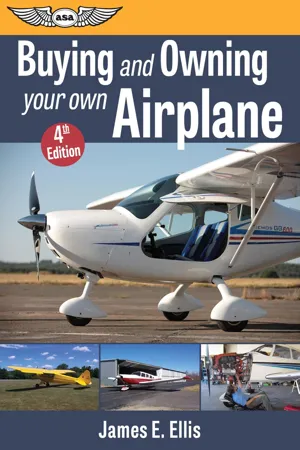
The new Fourth Edition of James E. Ellis' handy and comprehensive guide is now available in eBook format. If you've been flirting with the idea of purchasing a private plane, this book provides key assistance toward helping you make that dream become a reality.
Buying an airplane isn't an easy task, but it doesn't have to be difficult, either. Author Jim Ellis goes over all the information and special considerations for buying your own airplane, including selecting partners and home fields, negotiating sales contracts, and maintaining and upgrading your treasured bird. Learn how to manage the paperwork involved with airplane purchases, obtain insurance coverage, and make smart buys through reviewing projections for long-term trends in the aviation industry. Pertinent internet references are also included to assist readers in finding the right aircraft and guidance through the purchase process.
Includes comprehensive coverage of what first-time owners should consider, with analyses of popular planes, and an examination of complex single-engine aircraft. This new-edition eBook features full-color images, updated pricing and production details, and new chapters for light-sport aircraft (LSA), the glass cockpit revolution, as well as glass panel upgrades and alternatives.
Important note from the publisher:
While AI-generated content can be helpful to identify resources for ongoing study, it is not a reliable resource for learning critical, safety-dependent topics such as aviation. AI content is sterile, often lacks important context, and is at risk of errors. ASA publishes only human-generated content to ensure it is accurate, reliable, comprehensive, and presented in context—so you can become a safe and effective aviator.
- 400 pages
- English
- ePUB (mobile friendly)
- Available on iOS & Android
eBook - ePub
Buying and Owning Your Own Airplane
About this book
Information
1Chapter One
Can I? Should I?
It takes a little while for the reality to sink in. This airplane you are flying is yours! Not a rental, not a club airplane, but yours! It just doesn’t seem possible at first. You look at the older style instrument panel; at the older radios; at the faded, slightly scratched paint on the wings; and it still doesn’t quite sink in. I own this airplane!
You begin to realize it when you see a beautiful valley just beyond the next ridge. Do you have time to fly over it? You check your watch...and then realize that you don’t have to get this plane back until you feel like it! The awareness grows on a warm summer day when you taxi your plane to a tie down along a fence lined with wishful, adoring kids watching with a mixture of reverence and envy. And you remember the pride you felt that day when everyone else was on a tight schedule and you said casually, “Oh, that’s OK, I’ll fly my plane.”
You realize it too when the radio dies, and you receive the $1,500 repair bill. Or when you learn a $5,000 lesson in the meaning of Airworthiness Directive. Every silver lining has its cloud. And that too is yours!
Ownership has become a way of life for you now. It is not exactly what you expected, but you know you wouldn’t trade owning your old bird for a chance to fly a fleet of brand new Cessnas, Pipers, or even Cirruses. This is your airplane, and you wouldn’t have it any other way!
The “Crazy Idea”
Thoughts of owning an airplane probably first occur to the average general aviation pilot during student pilot days. Just a crazy idea though. After all, a Porsche Carrera, or maybe a 36 foot cabin cruiser, or a jet set summer on the Riviera are fun to daydream about too—and probably in the same league financially as those shiny new airplanes the FBO flies and Flying magazine advertises. Oh well, who needs his or her own airplane anyway? The FBO’s airplanes are clean and well maintained and always available for student lessons. Airplane ownership is just another interesting daydream.
You face a different world as a private pilot. Those airplanes you flew as a student never seem to be available when the weather is good. Or they are only available for one hour blocks, or at odd hours. Then there was that day you arrived at the airport only to find the airplane you had scheduled had been “borrowed” by an instructor for a lesson when the radio went out in “his” bird. “Nobody called you? We sure are sorry about that!”
There are airplanes available on a rental or club basis—Cessna Skyhawks and 182s; Piper Warriors, Archers, and Arrows; Diamond DA-20s and DA-40s; and maybe even an occasional Mooney, Bonanza, or Cirrus. A minimum of two hours flying required per day, of course—three hours on Saturdays, Sundays, and holidays. Over three hundred dollars a day! Are you buying the damn thing or just flying it?
By now you have read the bulletin boards at small airports, leafed through a copy or two of Trade-A-Plane, and even checked some websites advertising airplanes for sale. That crazy idea comes back again. Could I really own my very own plane? The idea grows slowly, but it does grow. The impossible dream seems less out of reach, less improbable, and finally, maybe, just maybe, possible!
Can I Afford It?
The most crucial question facing the prospective buyer is, Can I afford it? Surprisingly enough, the average, active private pilot can afford to own an airplane. The emphasis is on “active.” If you fly rental aircraft 50 to 75 hours per year at a typical cost of $100 to $175 per hour, you are spending between $5,000 and over $13,000 per year. You must be able to afford it because you are spending that much!
The cost of an airplane can be divided into two categories: the cost of acquisition and the cost of ownership and operation. The cost of acquiring a good used airplane varies with the sizes and capabilities of the choices. A good 15- to 40-year old, four-seat VFR aircraft of modern construction, such as the Piper Warrior or the Cessna Skyhawk, will cost approximately twice as much as a basic 10-, 20-, 30-, 40-year old or older two seat trainer, such as a Cessna 150 or 152, a Piper Tomahawk, or an Ercoupe. A good 20- to 30-year old, four seat minimum IFR airplane, the Piper Warrior and the Cessna Skyhawk being prime examples, will cost about three times as much as the basic VFR two seater. Trade-A-Plane can be used as a handy guide to estimate what any particular type or category will cost.
Yearly expenses can best be demonstrated by presenting a sample calculation of the cost of owning and operating a typical aircraft. For this purpose an airplane capable of carrying two adults, two children, and a small amount of baggage (such as a Piper Warrior or a Cessna Skyhawk) and costing $50,000 will be assumed. A typical aircraft would have 1,000 hours left before major overhaul on a 2,000 hour time between overhaul (TBO) Lycoming O-320 engine, would burn 9 gallons per hour in cruising flight, would be equipped with a Garmin 430 GPS with comm and one 720/200 channel full capability backup nav/comm and would be capable of limited IFR flying. It is assumed that the aircraft is to be purchased with a $10,000 down payment and five year repayment of a loan for the remaining $40,000. For purposes of simplification, an interest rate of 10 percent is assumed to be paid in equal sums over each of the five years, with no allowance being made for factors such as interest charges going down as the loan is paid off.
The cost of owning and operating an airplane is further broken down into two categories. The first (indirect expense) is independent of the number of hours flown. The second (direct expense) is the actual cost of operation. There would be no direct expenses if the plane were never flown.

Figure 1-1. If you are an active pilot, aircraft ownership is the “possible dream.”
Indirect Expenses
The indirect expenses that might be encountered in a typical year fall into two groups. The first includes expenses that would be typical after the aircraft loan was paid off, such as insurance, tie down, annual inspection, unscheduled maintenance, taxes, and fees. The second includes costs directly attributable to those associated with the loan, such as interest, repayment of principal, and additional insurance.
Insurance costs are estimated at $1,000. This assumes liability coverage of $1 million and hull coverage for ground incidents or accidents only (including those in motion). This means that the owner could not recover any losses suffered between the start of the takeoff roll and the completion of the landing roll. The cost of in flight hull coverage is substantial, however, and many owners choose to fly without it. (More detailed information on aircraft insurance is presented in Chapter 6.)
Tie down costs may be $1,200, or $100 per month. This is typical of a tie down on a paved surface at a medium-size, tower-controlled field. Grass tie downs at smaller fields may run as low as $50 per month. In most cases, hangar fees will be too high for the average individual owner, running from $175 per month for an unheated hangar with a dirt floor at a small field to over $500 per month for a heated, lighted hangar at medium-size, tower-controlled fields.
An annual inspection, required yearly by the FAA for all active registered aircraft, generally costs approximately $7.50 per horsepower for the basic inspection—for our example, $1,125. The repair of any problems found during inspection will be at the shop rate, and costs are in addition to the charge for basic inspection. While annuals can be obtained more cheaply at less reputable shops, this is not the time or the place to look for cut rate deals. Shoddy maintenance practices will cost you more in the long run at best, and at worst they could kill you. This is probably a good time to have any marginal items taken care of as well, since the aircraft will already be in the shop and opened up for inspection. Repairs and marginal items may cost about $1,000, for a total annual inspection cost of $2,125.
Oil changes, which are scheduled by engine tach time rather than by the calendar, and unscheduled maintenance are assumed to cost $2,000. Unscheduled maintenance consists of those nasty surprises associated with aircraft operation, like sticking or broken carburetor or cabin heat control cables, burned out rotating beacon bulbs, rapidly deteriorating nosewheel shimmy dampeners, or any number of other things capable of wiping away your smile. Twenty hours of labor at $75 per hour and $500 for parts and supplies combine to make up the $2,000 figure. This would probably be adequate for a typical year. However, the first year of ownership of a used airplane is generally a time for correcting numerous inherited problems, large and small. It is also a time of making minor modifications to make it “yours.” A wise buyer of a used aircraft probably should set aside 10 percent of the purchase price for correction of real and imagined first year problems.
State and local registration fees and taxes will probably cost at least $250 per year.
Total yearly indirect operating expenses, not including loan repayment and associated charges, come to $6,575. Repayment of the $40,000 loan and interest, plus $500 to cover the cost of additional in flight hull insurance (which a lending institution would insist on), adds $12,500 per year. Total yearly indirect expenses, to be paid before the prop ever turns, come to $19,075. These costs are summarized below:
| Insurance (ground hazards only) | $1,000 |
| Tie down ($100/month) | $1,200 |
| Annual inspection | $2,125 |
| Unscheduled maintenance | $2,000 |
| Taxes, fees | $250 |
| Subtotal | $6,575 |
| Interest on loan (10%) | $4,000 |
| Repayment on principal | $8,000 |
| Additional insurance (hull) | $500 |
| Subtotal | $12,500 |
| Total | $19,075 |
Direct Expenses
Direct expenses for the...
Table of contents
- Copyright
- Dedication
- About the Author
- Author's Note
- Preface
- 1. Can I? Should I?
- 2. Partnerships, Clubs, Fractional Ownership, and Leasebacks
- 3. Selecting a Home Field
- 4. Selecting Your Airplane
- 5. Taking Possession: Paper and Red Tape
- 6. Insurance: the Expensive Enigma
- 7. Maintenance and Miscellany
- 8. Engine Operating Practices and Overhauls
- 9. The Glass Cockpit Revolution
- 10. Glass Panel Upgrades and Other Alternatives
- 11. Good Aircraft for the First-Time Owner
- 12. Taildraggers and Other Traditional Airplanes
- 13. Light Sport Aircraft
- 14. High-Performance Singles
- Appendix A: Where the Aircraft are Advertised
- Appendix B: Aircraft Classified Ad Abbreviations
- Appendix C: Owner-Performed Maintenance Allowed by FAR Part 43, Appendix A, Subpart (c)
- Appendix D: Autofuel STCs
- Appendix E: Type Clubs
- Appendix F: Aircraft Manufacturers
Trusted by 375,005 students
Access to over 1.5 million titles for a fair monthly price.
Study more efficiently using our study tools.
Frequently asked questions
Yes, you can cancel anytime from the Subscription tab in your account settings on the Perlego website. Your subscription will stay active until the end of your current billing period. Learn how to cancel your subscription
No, books cannot be downloaded as external files, such as PDFs, for use outside of Perlego. However, you can download books within the Perlego app for offline reading on mobile or tablet. Learn how to download books offline
Perlego offers two plans: Essential and Complete
- Essential is ideal for learners and professionals who enjoy exploring a wide range of subjects. Access the Essential Library with 800,000+ trusted titles and best-sellers across business, personal growth, and the humanities. Includes unlimited reading time and Standard Read Aloud voice.
- Complete: Perfect for advanced learners and researchers needing full, unrestricted access. Unlock 1.5M+ books across hundreds of subjects, including academic and specialized titles. The Complete Plan also includes advanced features like Premium Read Aloud and Research Assistant.
We are an online textbook subscription service, where you can get access to an entire online library for less than the price of a single book per month. With over 1.5 million books across 990+ topics, we’ve got you covered! Learn about our mission
Look out for the read-aloud symbol on your next book to see if you can listen to it. The read-aloud tool reads text aloud for you, highlighting the text as it is being read. You can pause it, speed it up and slow it down. Learn more about Read Aloud
Yes! You can use the Perlego app on both iOS and Android devices to read anytime, anywhere — even offline. Perfect for commutes or when you’re on the go.
Please note we cannot support devices running on iOS 13 and Android 7 or earlier. Learn more about using the app
Please note we cannot support devices running on iOS 13 and Android 7 or earlier. Learn more about using the app
Yes, you can access Buying and Owning Your Own Airplane by James E. Ellis in PDF and/or ePUB format, as well as other popular books in Technology & Engineering & Aviation. We have over 1.5 million books available in our catalogue for you to explore.