This book helps you prepare for the FAA oral and practical exam to earn the FAA's Aircraft Dispatcher certificate. Aircraft dispatchers are a critical link in air safety and a viable career option for many aviators. This exciting career path is experiencing tremendous growth, placing dispatchers in high demand as the worldwide increase in air travel continues.The FAA Practical Exam for Aircraft Dispatcher is equivalent in size and scope to the Air Transport Pilot oral exam that an airline captain must successfully complete. The Aircraft Dispatcher Oral Exam Guide by Dr. David C. Ison prepares applicants for the exam with an explanation of the certification process, knowledge requirements in a question-and-answer format, and reference materials for further study. It covers the aircraft dispatcher Practical Test Standard subject areas such as route planning, regulations, training and currency requirements, certification, responsibilities and authority, aviation weather, manuals and documents, as well as practical applications of all topics.The Aircraft Dispatcher Oral Exam Guide also provides current dispatchers with a thorough review for their annual proficiency checks, and is beneficial to airmen and aspiring airline pilots seeking a better understanding of dispatch flight operations. Author David C. Ison has been involved in the aviation industry for over 24 years, as a flight instructor and as an ATP for both regional and major airlines flying domestic and international routes. Dr. Ison is an Associate Professor of Aviation at Rocky Mountain College.
eBook - ePub
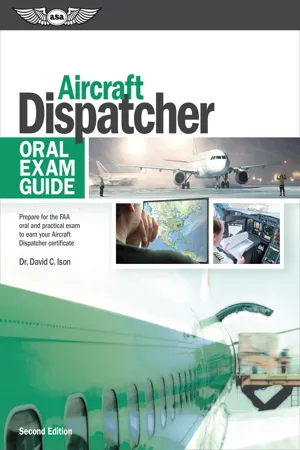
Aircraft Dispatcher Oral Exam Guide
Prepare for the FAA oral and practical exam to earn your Aircraft Dispatcher certificate
- English
- ePUB (mobile friendly)
- Available on iOS & Android
eBook - ePub
Aircraft Dispatcher Oral Exam Guide
Prepare for the FAA oral and practical exam to earn your Aircraft Dispatcher certificate
About this book
Information
1
Dispatch Resource Management
1. What is “dispatch resource management” (DRM)? (AC 121-32)
DRM is described by the Federal Aviation Administration (FAA) as an operational philosophy meant to address “the challenge of optimizing communication between diverse groups within an airline and the related interpersonal issues while using available resources. This includes effective teambuilding, conflict resolution, situational awareness, information transfer and dissemination, problem solving, decisionmaking, and dealing with automated systems. DRM has evolved because of the joint responsibility for the preflight planning, delay, and dispatch release of a flight between the pilot in command (PIC) and aircraft dispatcher.”
2. What are the various interactions with the operational environment that dispatchers must make? (AC 121-32)
To successfully maximize the positive effects of DRM, dispatchers should effectively and openly interact with the following:
• Pilots
• Other dispatchers
• Maintenance personnel
• Load planners
• Crew schedulers
• Aircraft routers
• Air traffic controllers
• Managers
• Station personnel
• Communications systems and personnel
• Flight planning systems and personnel
• Meteorological systems, sources, and personnel
• Written documents such as operations specifications, operations manuals, regulations, company procedures, etc.
• Any other sources that may be helpful to the safe and efficient conduct of flights
3. How does the FAA define “dispatcher situational awareness”? (AC 121-32)
The FAA defines this as “the ability to absorb information in a dynamic environment, to evaluate and refine that information, to anticipate contingencies, and to initiate appropriate actions as necessary.”
4. When dispatchers communicate with the various available resources, special emphasis should be made in what three areas? (AC 121-32)
• Inquiry—don’t be afraid to ask questions.
• Advocacy—try to work together in a positive manner.
• Assertion—do not be afraid to bring up concerns or to be proactive.
5. Why is conflict resolution so important for dispatchers? (AC 121-32)
There will come a time when dispatchers encounter conflict when communicating with available resources. For example, pilots might want to carry more fuel, or maintenance personnel might want a flight dispatched even in light of an aircraft with an inoperative component that could negatively affect operations. Dispatchers often have to serve as negotiators and diplomats. While there is something to be said for being as tactful and non-abrasive as possible, this doesn’t mean dispatchers have to be pushovers. Remember that as a dispatcher, you are legally responsible for safety of flight—it’s your neck on the line. No matter how much a pilot wants to do something or how much a maintenance manager tries to convince you how things should be done, you must decide that it is safe and agree to “sign your name” to the result.
6. What types of briefings are dispatchers required to conduct? (AC 121-32)
Dispatchers are responsible for briefing flight crews on the applicable items associated with a flight, such as weather, route, and operational considerations. Dispatchers must also brief the other dispatchers replacing them concerning the flights for which they will be responsible. All normal and abnormal circumstances should be conveyed, including weather conditions, aircraft status, and air traffic control system status.
7. What should dispatchers consider regarding interpersonal relationships when dealing with available human resources? (AC 121-32)
Dispatchers should consider the following:
• Diversity among personality styles
• Diversity among operating styles
• Sensitivity to coworker personalities and styles
• Maintaining a relaxed, friendly, yet task-oriented workplace environment
8. How can dispatchers best prioritize tasks when workload is high? (AC 121-32)
Generally, safety oriented tasks should be first and foremost, followed by (in order of priority) regulatory tasks, operational tasks, and convenience. For example, assume a flight needs to be diverted because of an emergency. The safest course of action might be to land at the nearest airport, timewise; however, if the weather is extremely poor at this airport, it might be wise to go to a different airport. If a diversion is due to a non-emergency issue, it might be helpful to choose an airport that is a company station to ensure proper and inexpensive aircraft and passenger handling. Lastly, if the passengers will need to be disembarked, it would be convenient to land at an airport with services available to handle them.
9. Use the list of typical resources available to the dispatcher to work through the following example maximizing DRM: An aircraft you are responsible for dispatching must divert to an alternate airport following the inability to conduct an approach to the destination airport.
• Pilots
The dispatcher will need to coordinate with the pilots to determine the current fuel status of the aircraft. Once this is verified, the best alternative destination should be determined and discussed. The closest suitable airports should be considered, not just the alternate listed on the flight plan. This will require the dispatcher to check the weather conditions at the alternate as well as enroute weather. This information should be passed on to the flight crew. Once a new destination is agreed upon, the release will need to be amended. Flight crews should request the new destination and then convey the new route and estimated time of arrival to the dispatcher. The dispatcher should also provide the pilot with any other pertinent information such as Notices to Airmen (NOTAMs), where they can expect to park, station servicing/handling capabilities, and how to secure maintenance services (if applicable).
The dispatcher will need to coordinate with the pilots to determine the current fuel status of the aircraft. Once this is verified, the best alternative destination should be determined and discussed. The closest suitable airports should be considered, not just the alternate listed on the flight plan. This will require the dispatcher to check the weather conditions at the alternate as well as enroute weather. This information should be passed on to the flight crew. Once a new destination is agreed upon, the release will need to be amended. Flight crews should request the new destination and then convey the new route and estimated time of arrival to the dispatcher. The dispatcher should also provide the pilot with any other pertinent information such as Notices to Airmen (NOTAMs), where they can expect to park, station servicing/handling capabilities, and how to secure maintenance services (if applicable).
• Other dispatchers
In a high workload situation such as a diversion, it is helpful to have the assistance of other dispatchers. These individuals can help collect resources needed to make the diversion possible, make phone calls, coordinate services, or help handle other flights for which you are responsible.
In a high workload situation such as a diversion, it is helpful to have the assistance of other dispatchers. These individuals can help collect resources needed to make the diversion possible, make phone calls, coordinate services, or help handle other flights for which you are responsible.
• Maintenance personnel
If a maintenance issue exists, maintenance should be notified so they can coordinate with personnel at the new destination to handle the problem.
If a maintenance issue exists, maintenance should be notified so they can coordinate with personnel at the new destination to handle the problem.
• Load planners
Load planners can be notified to begin new calculations for the departure of the flight from the alternate airport.
Load planners can be notified to begin new calculations for the departure of the flight from the alternate airport.
• Crew schedulers
Crew schedulers should be notified so that they can coordinate the schedules of the crews affected by the diversion. Depending upon the duty and flight time experienced by the crew up to this point, a diversion may entail sending the flight crew to rest, which will cause a major delay or possible cancellation of the flight. Schedulers could work on securing a replacement crew, rescheduling crews expected to use the delayed aircraft, or simply reworking the schedule of the affected crewmembers.
Crew schedulers should be notified so that they can coordinate the schedules of the crews affected by the diversion. Depending upon the duty and flight time experienced by the crew up to this point, a diversion may entail sending the flight crew to rest, which will cause a major delay or possible cancellation of the flight. Schedulers could work on securing a replacement crew, rescheduling crews expected to use the delayed aircraft, or simply reworking the schedule of the affected crewmembers.
• Aircraft routers
If an aircraft does not arrive where it is supposed to, this obviously disrupts the air carrier’s schedule. These individuals should be notified of the diversion and the expected delay so that they can begin to shuffle aircraft as necessary to cover any gaps in the day’s schedule.
If an aircraft does not arrive where it is supposed to, this obviously disrupts the air carrier’s schedule. These individuals should be notified of the diversion and the expected delay so that they can begin to shuffle aircraft as necessary to cover any gaps in the day’s schedule.
• Air traffic controllers
The pilots should handle the communications with air traffic control, although some consultation on routing or delays could be requested from air traffic control or related resources.
The pilots should handle the communications with air traffic control, although some consultation on routing or delays could be requested from air traffic control or related resources.
• Managers
Your manager should be notified of the diversion as soon as practical. They may even help in the alternate decision process and/or with relieving some of your workload.
Your manager should be notified of the diversion as soon as practical. They may even help in the alternate decision process and/or with relieving some of your workload.
• Station personnel
Station personnel at the new destination should be contacted immediately following the decision to use the station. This is particularly important if your airline does not normally serve the airport, as it will require the use of the employees and gate of another air carrier. The availability of both may play a part in the alternate decision-making process. Most air carriers will service their own aircraft first, which might cause delays for your aircraft. Ideally, the aircraft can be diverted to a mainline airport. Lastly, any required services (such as fuel) should be coordinated to prepare for the arrival of the diverted aircraft.
Station personnel at the new destination should be contacted immediately following the decision to use the station. This is particularly important if your airline does not normally serve the airport, as it will require the use of the employees and gate of another air carrier. The availability of both may play a part in the alternate decision-making process. Most air carriers will service their own aircraft first, which might cause delays for your aircraft. Ideally, the aircraft can be diverted to a mainline airport. Lastly, any required services (such as fuel) should be coordinated to prepare for the arrival of the diverted aircraft.
• Communications systems/personnel
Various communications systems may be used, including Aircraft Communications Addressing and Reporting System (ACARS), selective calling (SELCAL), radio, and phone.
Various communications systems may be used, including Aircraft Communications Addressing and Reporting System (ACARS), selective calling (SELCAL), radio, and phone.
• Flight planning systems and personnel
Flight planning systems can be referenced to assist in routing and fuel planning to the diversionary airport. You will need to work on the flight planning for the aircraft’s departure from the alternate airport. This should be done following completion of all the tasks required to get the aircraft to the alternate and handled once on the ground.
Flight planning systems can be referenced to assist in routing and fuel planning to the diversionary airport. You will need to work on the flight planning for the aircraft’s departure from the alternate airport. This should be done following completion of all the tasks required to get the aircraft to the alternate and handled once on the ground.
• Meteorological systems, sources, and personnel
Obviously, you will need to reference various weather reports, forecasts, and images to select the diversionary airport and to re-dispatch the aircraft to its final destination later.
Obviously, you will need to reference various weather reports, forecasts, and images to select the diversionary airport and to re-dispatch the aircraft to its final destination later.
• Written documents such as operations specifications, operations manuals, regulations, company procedures, etc.
The selection of an alternate will require you to reference Ops Specs for the airports authorized for use as alternates. Other manuals may have established procedures for dealing with this type of situation. Station manuals may be helpful in providing information about available services, radio frequencies, phone numbers, etc.
The selection of an alternate will require you to reference Ops Specs for the airports authorized for use as alternates. Other manuals may have established procedures for dealing with this type of situation. Station manuals may be helpful in providing information about available services, radio frequencies, phone numbers, etc.
• Any other sources that may be helpful to the safe and efficient conduct of flights
Any other available persons or references should be utilized to prioritize tasks, maintain situational awareness, and maintain a manageable workload.
Any other available persons or references should be utilized to prioritize tasks, maintain situational awareness, and maintain a manageable workload.
10. Use the list of typical resources available to the dispatcher to work through the following example maximizing DRM: An aircraft you are responsible for dispatching just had an engine failure while enroute. The engine is shutdown a...
Table of contents
- Introduction: What to Expect for Your ADX Practical Test
- 1. Dispatch Resource Management
- 2. Aeronautical Decision Making
- 3. Regulatory Requirements
- 4. Weather Theory and Hazards
- 5. Weather Reports and Charts
- 6. Aircraft Systems, Performance, and Limitations
- 7. Navigation and Aircraft Navigation Systems
- 8. Practical Dispatch Applications
- 9. Manuals, Handbooks, and Other Written Materials
- 10. Airports, Crew, and Company Procedures
- 11. Routing, Rerouting, and Flight Plan Filing
- 12. Air Traffic Control and Navigation Procedures
- 13. Communication Procedures and Requirements
- 14. Abnormal and Emergency Procedures
Trusted by 375,005 students
Access to over 1.5 million titles for a fair monthly price.
Study more efficiently using our study tools.
Frequently asked questions
Yes, you can cancel anytime from the Subscription tab in your account settings on the Perlego website. Your subscription will stay active until the end of your current billing period. Learn how to cancel your subscription
No, books cannot be downloaded as external files, such as PDFs, for use outside of Perlego. However, you can download books within the Perlego app for offline reading on mobile or tablet. Learn how to download books offline
Perlego offers two plans: Essential and Complete
- Essential is ideal for learners and professionals who enjoy exploring a wide range of subjects. Access the Essential Library with 800,000+ trusted titles and best-sellers across business, personal growth, and the humanities. Includes unlimited reading time and Standard Read Aloud voice.
- Complete: Perfect for advanced learners and researchers needing full, unrestricted access. Unlock 1.5M+ books across hundreds of subjects, including academic and specialized titles. The Complete Plan also includes advanced features like Premium Read Aloud and Research Assistant.
We are an online textbook subscription service, where you can get access to an entire online library for less than the price of a single book per month. With over 1.5 million books across 990+ topics, we’ve got you covered! Learn about our mission
Look out for the read-aloud symbol on your next book to see if you can listen to it. The read-aloud tool reads text aloud for you, highlighting the text as it is being read. You can pause it, speed it up and slow it down. Learn more about Read Aloud
Yes! You can use the Perlego app on both iOS and Android devices to read anytime, anywhere — even offline. Perfect for commutes or when you’re on the go.
Please note we cannot support devices running on iOS 13 and Android 7 or earlier. Learn more about using the app
Please note we cannot support devices running on iOS 13 and Android 7 or earlier. Learn more about using the app
Yes, you can access Aircraft Dispatcher Oral Exam Guide by Dr. David C. Ison in PDF and/or ePUB format, as well as other popular books in Technology & Engineering & Aviation. We have over 1.5 million books available in our catalogue for you to explore.