Essentials of Advanced Composite Fabrication & Repair
eBook - ePub

Essentials of Advanced Composite Fabrication & Repair

  1. 456 pages
  2. English
  3. ePUB (mobile friendly)
  4. Available on iOS & Android
eBook - ePub

Essentials of Advanced Composite Fabrication & Repair

About this book

Advanced composite technology is constantly changing and embracing new developments daily, yet most of the basics needed to successfully design, fabricate and repair composite structures remain the same. Essentials of Advanced Composite Fabrication & Repair works as the perfect introductory textbook for beginners yet is also functional for the composite professional. It teaches the concepts and methods in a simple and straightforward way for a wide array of composite fundamentals, including fiber and matrix selection, molding methods, curing and achieving desired properties, tooling, testing and non-destructive inspection, step-by-step repair instructions and troubleshooting, key environmental, health and safety issues, and much more.

New for this Second Edition are an introduction to nanomaterials in composites, and improved molding methods, adhesive bonding, joining and fastening coverage. Also updated with the advances in matrix technology and fiber reinforcements, as well as tooling, filament winding and various testing and inspection method improvements.

Based on the authors' combined 110 years in the industry, this textbook is also a compendium of industry information, presented with full-color illustrations and photography. Fabric styles, core types, design guides, and detailed product information in the industry, and more, makes this book essential to anyone working in composite—from material and process engineers, to repair technicians and maintenance mechanics. Including bibliographic information, a glossary and index, it also serves as the companion textbook to most Abaris Training basic courses.
Trusted byĀ 375,005 students

Access to over 1.5 million titles for a fair monthly price.

Study more efficiently using our study tools.

Chapter 1:
Composite Technology Overview
Composites vs. Advanced Composites
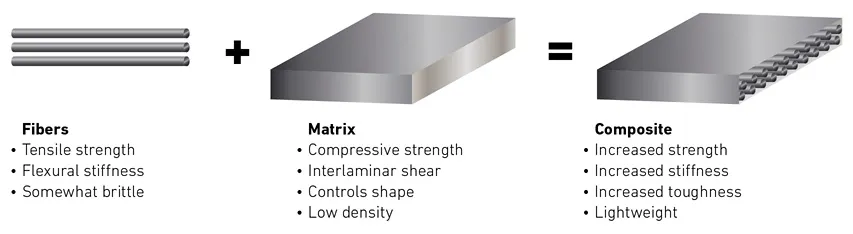
Composites are comprised of two or more materials working together, where each constituent material retains its unique identity within the composite and contributes its own structural properties, yet upon combination the resulting material has superior properties to those of its constituents. A good example of an everyday composite material is concrete. Concrete is made with select amounts of sand, aggregate, and perhaps even glass fiber mixed with cement to bind it together. If the concrete were broken open, the individual constituents would be visible. The type and quantities of these individual constituents can also be adjusted to give the resulting concrete different properties depending on the application.
This textbook is focused on composite laminates, which combine fibers and a matrix material that binds the fibers together. There are many different types of composite materials in use today. One example is fiber-reinforced plastic (FRP) composites made with short glass fibers in a polymer resin or plastic matrix. These materials are used in bath tubs, showers, pools, doors, car fenders, and a variety of construction materials including wall panels, corrugated sheet, profiles, and skylights. (Figure 1-1)
Figure 1-1. Fiber-reinforced composite
Highly loaded composite structures typically use continuous or long-fiber reinforcement that transfers load along bundles or layers (plies) of fibers arranged to run the length and width of the structure, much like the layers in a sheet of plywood. This type of composite laminate is used in the manufacture of boats, bridges, snowboards, bicycle frames, race cars, aircraft and spacecraft structures, to mention a few.
ā± Advanced Composites
ā€œAdvanced compositesā€ are generally considered to be those that use advanced reinforcements such as carbon, aramid and S2 glass fibers that exhibit high strength-to-weight ratios.1 They are typically more expensive, with more precisely tailored properties to achieve a specific objective.
1ASM Handbook Volume 21, Composites (pg. 1113) defines ā€œadvanced compositesā€ as: ā€œComposite materials that are reinforced with continuous fibers having a modulus higher than that of fiberglass fibers. The term includes metal matrix and ceramic matrix composites, as well as carbon-carbon composites.ā€ Material Park, Ohio; ASM International, 2001.
Fiberglass vs. Advanced Composites
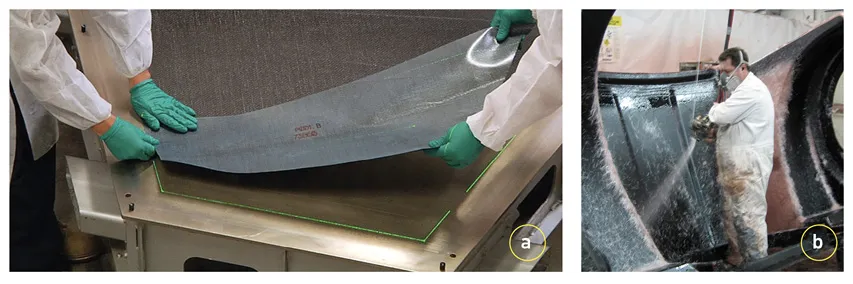
Some composites are generally referred to as ā€œfiberglassā€ due to their use of randomly-oriented, chopped glass fiber (E-glass) and polyester resin, whereas most aerospace structural parts are made using precisely-laid plies of carbon fiber/epoxy prepreg, an example of advanced composites. (Figure 1-2)
Figure 1-2. Fiberglass vs. advanced composites
[a] To fabricate an aerospace structural component, technicians carefully lay down each ply of carbon-fiber prepreg prior to vacuum bagging and autoclave cure. Green ā€œtemplates of lightā€ are accurately projected from a 3D laser projector to ensure precise positioning of the ply. (Photo courtesy of Assembly Guidance)
[b] Chopped fiberglass and resin are sprayed onto a gel-coated mold to form the outer shell of a Class 8 truck hood. However, this is a more advanced and higher performance example of spray-up fiberglass because the shell is cured in an oven at 130°F and then reinforced with structural members made using RTM, which are secondarily bonded in-place using methacrylate adhesive. (Photo courtesy of Marine Plastics Ltd.)
Examples of Typical Applications
Large components of commercial airliners — such as the vertical and horizontal tail plane (stabilizer) on the Airbus A320, A330/340, A380 and Boeing 777, the wing, center wing b...

Table of contents

  1. Title
  2. Copyright
  3. Preface
  4. About the Authors
  5. Editor’s Note
  6. Chapter 1: Composite Technology Overview
  7. Chapter 2: Matrix Technology
  8. Chapter 3: Fiber Reinforcements
  9. Chapter 4: Nanocomposites
  10. Chapter 5: Sandwich Core Materials
  11. Chapter 6: Basic Design Considerations
  12. Chapter 7: Molding Methods and Practices
  13. Chapter 8: Liquid Resin Molding Methods and Practices
  14. Chapter 9: Introduction to Tooling
  15. Chapter 10: Inspection and Test Methods
  16. Chapter 11: Adhesive Bonding and Joining
  17. Chapter 12: Machining, Drilling and Fastening Composites
  18. Chapter 13: Repair of Composite Structures
  19. Chapter 14: Health and Safety Considerations
  20. Glossary
  21. Bibliography and Acknowledgments
  22. Index

Frequently asked questions

Yes, you can cancel anytime from the Subscription tab in your account settings on the Perlego website. Your subscription will stay active until the end of your current billing period. Learn how to cancel your subscription
No, books cannot be downloaded as external files, such as PDFs, for use outside of Perlego. However, you can download books within the Perlego app for offline reading on mobile or tablet. Learn how to download books offline
Perlego offers two plans: Essential and Complete
  • Essential is ideal for learners and professionals who enjoy exploring a wide range of subjects. Access the Essential Library with 800,000+ trusted titles and best-sellers across business, personal growth, and the humanities. Includes unlimited reading time and Standard Read Aloud voice.
  • Complete: Perfect for advanced learners and researchers needing full, unrestricted access. Unlock 1.5M+ books across hundreds of subjects, including academic and specialized titles. The Complete Plan also includes advanced features like Premium Read Aloud and Research Assistant.
Both plans are available with monthly, semester, or annual billing cycles.
We are an online textbook subscription service, where you can get access to an entire online library for less than the price of a single book per month. With over 1.5 million books across 990+ topics, we’ve got you covered! Learn about our mission
Look out for the read-aloud symbol on your next book to see if you can listen to it. The read-aloud tool reads text aloud for you, highlighting the text as it is being read. You can pause it, speed it up and slow it down. Learn more about Read Aloud
Yes! You can use the Perlego app on both iOS and Android devices to read anytime, anywhere — even offline. Perfect for commutes or when you’re on the go.
Please note we cannot support devices running on iOS 13 and Android 7 or earlier. Learn more about using the app
Yes, you can access Essentials of Advanced Composite Fabrication & Repair by Louis C. Dorworth,Ginger L. Gardiner,Dr. Greg M. Mellema in PDF and/or ePUB format, as well as other popular books in Technology & Engineering & Materials Science. We have over 1.5 million books available in our catalogue for you to explore.