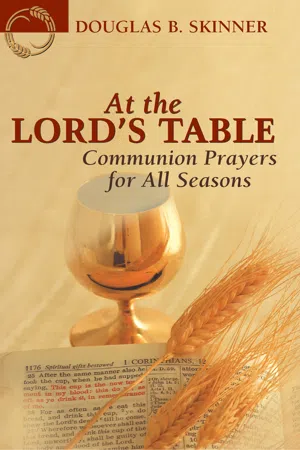
Following the advice of Alexander Campbell to steep prayers in scripture, author Douglas Skinner anchors this collection of nearly 200 prayers with biblical references. Prayers for the bread and for the cup are linked with special Sundays, church seasons, hymns, special occasions, and communion themes. Whether you are nervous about praying in public or experienced and confident, these inspired prayers from a respected pastor will resound in the hearts and mind of the congregation as they come to The Table in humility and celebration. For praying aloud or for personal meditation as you prepare to lead in worship, this book of "prayed theology" will encourage its users to expand their vocabularies and their imaginations as they offer prayers at the communion table.
- 128 pages
- English
- ePUB (mobile friendly)
- Available on iOS & Android
eBook - ePub
About this book
Information
Topic
Theology & ReligionSubtopic
Christian Rituals & Practice1
So, You’re an Elder
Introduction
It is the question that gets asked every year when the church’s nominating committee approaches an individual with the wonderful news that he or she has been recommended for a position of spiritual leadership within the life of a local congregation. When asked to serve as an elder, the inevitable question gets asked: “So, just exactly what does an elder do?”
To answer this perennial question of church life, we typically direct people to the appropriate biblical passages and the congregation’s relevant organizational documents. There the qualifications and responsibilities of an elder in the church get spelled out in some detail. But I am not naive. I know that there is also an unofficial oral tradition that typically accompanies the church’s official answer to the question of what elders do, and it goes something like this: “Elders pray…Elders pray the communion prayers at the Lord’s table on Sunday mornings.” Nominees who have learned how to manage their fear of public speaking usually answer, “Well, that’s easy enough. I can do that. I can pray.” This resource is written with the person in mind who has ever said or thought those words.
The Communion Prayer
An elder is someone who has been recognized by a specific congregation as having a representative degree of spiritual maturity within that community of faith. The office of elder does not require moral perfection or the status of a capital “S” Saint, but it does require men and women who are spiritually alive and still growing. It is no accident that men and women who give evidence of a vital prayer life are the ones who are routinely asked to serve as the elders of their congregations—women and men who display the fruit of the Spirit (Gal. 5:22–23), who exhibit a process of being actively conformed to the image of Jesus Christ (Rom. 8:29), and who display the mind of Christ (Phil. 2:5–8). People become elders because they are known to be people who are abiding in Christ (Jn. 15:4), and that does not happen apart from a life of vital prayer. But elders need to know that they will be asked to pray at the Lord’s table a special kind of prayer.
The communion prayer is neither a prayer of general intercession nor a prayer of private devotion. The communion prayer is not the right vehicle for the voicing of your own personal hurts and hopes, just as it should not be a substitute for the church’s morning prayer or an imitation of the minister’s weekly pastoral prayer. God clearly cares about our dreams and fears, and wants to hear all about them. God should certainly be thanked for the beauty and blessings of the day. The needs of the sick, the wounds of the grieving, the fears of the troubled, and the joys of the faithful should all be given prayerful expression in the gathered community of faith—but not at the Lord’s table. The communion prayer has a different purpose and a governing content.
In the 1991 Word to the Church on the Lord’s Supper from the Committee on Theology of the Council on Christian Unity of the Christian Church (Disciples of Christ), these instructions were given in the section entitled “Prayers at the Table” (150):
The communion prayers…should include as a basic element the offering of thanksgiving. Christians here express gratitude for God’s love, for the life and death of Jesus Christ, and for the gift of salvation…
The prayers at the Table are also to include a petition for the presence of the Holy Spirit, through whose power the bread and wine provide spiritual nourishment for the refreshing of our faith, the upbuilding of the body of Christ, and our living as faithful servants of Jesus Christ in the world…
It is also appropriate in communion prayers to focus on our remembrance of the sacrifice of Jesus Christ, our anticipation of God’s ultimate victory, our awareness of the presence of Jesus Christ among us, and our appreciation for the richness of meaning conveyed by the Lord’s Supper.
A word of thanksgiving, a petition for the presence of the empowering and enlivening Spirit, a remembrance of the sacrifice of Christ, a nod in the direction of Christian hope and an acknowledgement of the real presence of the Risen Christ—that’s a big assignment for a little prayer.
You can easily access some helpful guides to learn more about the constitutive elements of a communion prayer. Thomas Toler’s The Elder at the Lord’s Table (1954) and several of Keith Watkins’s books—especially The Feast of Joy (1977) and Celebrate with Thanksgiving (1991)—are denominational standards worth becoming familiar with as an elder. You will detect the pattern they identify in many of the prayers I have written for this book:
- A spiritually appropriate naming of God
- A communal rather than private tone of expression
- The identification of some particular aspect of the biblical meaning of communion appropriate to the season of the church year or the theme of the day
- A reference to the institution of the Lord’s supper and the event of the crucifixion of Jesus Christ
- A word of thanksgiving for the benefit of salvation appropriate to the particular meaning of communion earlier identified
- An invocation of the Holy Spirit’s indwelling and empowering presence
Most of these elements of a communion prayer are familiar to us. The one exception is the explicit petition for the presence of the Holy Spirit. Called the epiclesis in the history of Christian worship (from the Greek word for “invocation”), this petition is essential in a communion prayer because it is the action of the Holy Spirit that makes the dynamic connection between the outward signs of bread and wine and the inward reality of God’s presence, power, and provision in Jesus Christ in our hearts. For the communion service to be more than just a taste of bread and a sip of wine, the Holy Spirit must be involved.
“Brief and Pertinent”
In The Christian System (1836), Alexander Campbell, one of our denominational founders, provided a detailed description of the communion service, which, in his judgment, “furnishes the nighest approach to the model which we have in our eye of good order and Christian decency in celebrating this institution.” He noted that “the thanksgiving before the breaking of the loaf, and the distributing of the cup, were as brief and pertinent to the occasion, as the thanks usually presented at a common table for the ordinary blessings of God’s bounty.”
What Alexander Campbell really liked about the communion prayers he heard in that service were that they were “brief and pertinent.”
Brevity as one of the criteria of a good communion prayer has a clear biblical foundation. Part of the criticism that Jesus had for the public praying of his day was that it was just too long and drawn-out. “When you are praying, do not heap up empty phrases as the Gentiles do;” Jesus said, “for they think that they will be heard because of their many words” (Mt. 6:7). Think of some of the New Testament’s most powerful prayers. This sampling is from the gospel of Luke:
“Here I am, the servant of the Lord; let it be with me according to your word.” (1:38)
“Master, now you are dismissing your servant in peace, according to your word; / for my eyes have seen your salvation.” (2:29–30)
“God, be merciful to me, a sinner!” (18:13b)
“Father, if you are willing, remove this cup from me; yet, not my will but yours be done.” (22:42)
“Father, into your hands I commend my spirit!” (23:46)
Clearly, the length of a prayer says nothing about its power. Perhaps the very best prayers are short and frequent, and so brevity is something we value in our prayers at the Lord’s table, as is pertinence.
Unfocused communion prayers tend to ramble, and so an elder must understand what he or she stands at the Lord’s table to do when it is time to pray over the bread and cup. At the Lord’s table an elder never stands alone. Two calls combine in that moment at that place: (1) to carefully represent the gathered community of faith as the designated spiritual leader who has been asked to give voice to their highest aspirations and deepest convictions; and (2) to faithfully “hand on” to that community of faith the rich tradition of Christianity’s varied understandings of the meaning of the Lord’s supper. This is why James White called communion prayers “prayed theology” (1989, 60). The elder who prays in the awareness of these two calls is most likely to offer a pertinent prayer when he or she presides at the Lord’s table.
A third criterion for our communion prayers that can be legitimately derived from Alexander Campbell’s observations of the worship service, is the celebration of communion in simplicity of expression. Alexander Campbell preferred plain and unaffected language when praying. I have heard this described as conversational praying. It is prayer without pretense.
A “Disciple” Way of Praying?
This is why simplicity and straightforwardness are hallmarks of the kind of authenticity that we Disciples prize so highly in our spirituality. We like prayers that come from the heart and connect with the spirit. As in most things, we Disciples prefer freedom over form. And at the Lord’s table this has meant a real fondness for prayers that are offered spontaneously on the spot rather than ones that are read from a book. It is part of our Reformed theological heritage to be suspicious of set forms of prayer.
Rightly or wrongly, many Disciples believe that extemporaneous praying is less inclined to become the kind of formal, wooden praying that Jesus Christ criticized as “heap[ing] up empty phrases” in his Sermon on the Mount (Mt. 6:7). The average people in the pews of a typical church will tell you that their preference is for spontaneous, heartfelt, Spirit-filled prayers offered simply rather than exactly worded, pre-prepared, and carefully read compositions.
Opposed to both creeds and liturgies as unnecessary and even spiritually illegitimate attempts to standardize Christian faith and practice on the basis of something other than the New Testament, the ideal for communion prayers in our churches is that they be characterized by an engaging simplicity, a personal quality, a biblical faithfulness, and a heartfelt authenticity. So, why bother with this book? Our spiritual heritage would seem to argue persuasively against its existence and use. Well, before throwing it aside, let me make a case for its legitimacy by introducing you to something from our spiritual heritage called “conceived prayer.”
An “Acceptable Combination”
Alexander Campbell was troubled by the way that the genuine spirit of Christian devotion could degenerate so quickly into cold formalism, and degrade so easily into lifeless ceremony. He knew that extemporaneous praying could be sloppy, silly, scrambled, self-indulgent, and even spiritually dangerous, especially when it was offered in a representative way at the defining moment of public worship from behind the Lord’s table in the communion prayer.
In his 1831 essay “On Prayer” in the Millennial Harbinger, Alexander Campbell sought to remedy the most common defects he heard in the public praying of the spiritual leaders of our churches by urging them to spend more time with the prayers found in scripture. He created a lectionary of twenty-two biblical prayers and benedictions, twelve from the Old Testament and ten from the New Testament, which he then encouraged church leaders to use to learn how to pray for themselves. (See the Appendix for the titles of these texts.) This approach to praying was part of Alexander Campbell’s Reformed roots.
The Reformed tradition had taught Alexander Campbell three basic ways to approach prayer: (1) Read set prayers from a book, but this could become spiritually inauthentic; (2) pray spontaneously from the heart, but not everyone has the gift to do this intelligently or intelligibly; (3) use book-read prayers and offer spontaneous prayers. The Reformed tradition taught people that there was some important spiritual middle ground. They called it “conceived prayer,” and they viewed it as an “acceptable combination” of form and freedom, structure and spontaneity (Watkins 1966, 73).
In conceived prayer, a Christian was taught to “stock” one’s heart and head with appropriate thoughts and phrases drawn from scripture and the Christian tradition, which could then be used to construct prayers of one’s own. I have heard this approach to praying compared to the girders that are fastened together in the building of a bridge, or the ingredients that are mixed together in the baking of a cake. Conceived prayer takes seriously the concern for content by its habitual reference to scripture, and the concern for vitality and relevance in our praying by pushing that content through the processor of our individual hearts and the life of our communities of faith. The hymn writer Isaac Watts, a big proponent of this kind of praying, described conceived prayer as “clothing the sense of our hearts in fit expressions” (1730). It is one of the best ways for a Christian to grow in his or her capacity for, and expression in, public praying.
How to Use This Resource
Perhaps the best way to think of this resource is as training wheels for your ministry of prayer at the Lord’s Table as an elder of the church. Some readers will choose to use prayers from this book verbatim when they go to the Lord’s table. That’s a perfectly acceptable option. The assurance I can give to those of you who will take this approach is that each prayer you’ll find here has been composed from my heart in response to the deep stirrings of the Word and the Spirit.
I like the story told about Peter Marshall, the chaplain of the United States Senate from 1947 to 1949. When he was first asked to serve as the Senate chaplain, he was told that one of the requirements of the job was to have a copy of the prayer that he would offer at the opening of each session turned in before it was actually prayed so that it could be entered into the Congressional Record. But Peter Marshall was a “pray-from-the-heart” kind of Christian leader. His first instinct was to turn down the job offer because he felt that the requirement of pre-prepared prayers would hinder the work of the Holy Spirit in and through his heart. Then one of Peter Marshall’s friends pointed out that a pre-prepared prayer could be just as heartfelt and Spirit-prompted composed at his desk the night before as it could be being spontaneously offered on the spot. I trust that these prayers can be too.
Other readers will turn to this book and flip through it rather quickly, maybe on the night before they are scheduled to pray at the Lord’s table. More inclined to “pray-from-the-heart” and “on-the-spot,” this reader is only interested in seeing how somebody else has done it. What I hope this kind of reader will find in what they read here is a model of faithfulness that they can then imitate. Hippolytus (c. 170—c. 236), the church father whose writings provide us with some of our most important insights into the worship practices of the early church, noted that “it is not at all necessary to recite the same words” in a communion prayer. He explained that “in giving thanks to God” at the Lord’s table each elder is free to “pray according to his ability.” He added th...
Table of contents
- Cover
- Title Page
- Copyright
- Dedication
- Contents
- Chapter 1 - So, You’re an Elder
- Chapter 2 - Communion Prayers Based on Meanings of Communion
- Chapter 3 - Communion Prayers Based on Communion Hymns
- Chapter 4 - Communion Prayers for the Church Year
- Chapter 5 - Communion Prayers for Special Sundays
- Chapter 6 - Communion Prayers for Special Occasions
- Conclusion: Scripting the Moment
- Appendix: “On Prayer”—Alexander Campbell
- Sources Cited
Trusted by 375,005 students
Access to over 1.5 million titles for a fair monthly price.
Study more efficiently using our study tools.
Frequently asked questions
Yes, you can cancel anytime from the Subscription tab in your account settings on the Perlego website. Your subscription will stay active until the end of your current billing period. Learn how to cancel your subscription
No, books cannot be downloaded as external files, such as PDFs, for use outside of Perlego. However, you can download books within the Perlego app for offline reading on mobile or tablet. Learn how to download books offline
Perlego offers two plans: Essential and Complete
- Essential is ideal for learners and professionals who enjoy exploring a wide range of subjects. Access the Essential Library with 800,000+ trusted titles and best-sellers across business, personal growth, and the humanities. Includes unlimited reading time and Standard Read Aloud voice.
- Complete: Perfect for advanced learners and researchers needing full, unrestricted access. Unlock 1.5M+ books across hundreds of subjects, including academic and specialized titles. The Complete Plan also includes advanced features like Premium Read Aloud and Research Assistant.
We are an online textbook subscription service, where you can get access to an entire online library for less than the price of a single book per month. With over 1.5 million books across 990+ topics, we’ve got you covered! Learn about our mission
Look out for the read-aloud symbol on your next book to see if you can listen to it. The read-aloud tool reads text aloud for you, highlighting the text as it is being read. You can pause it, speed it up and slow it down. Learn more about Read Aloud
Yes! You can use the Perlego app on both iOS and Android devices to read anytime, anywhere — even offline. Perfect for commutes or when you’re on the go.
Please note we cannot support devices running on iOS 13 and Android 7 or earlier. Learn more about using the app
Please note we cannot support devices running on iOS 13 and Android 7 or earlier. Learn more about using the app
Yes, you can access At the Lord's Table by Douglas B Skinner in PDF and/or ePUB format, as well as other popular books in Theology & Religion & Christian Rituals & Practice. We have over 1.5 million books available in our catalogue for you to explore.