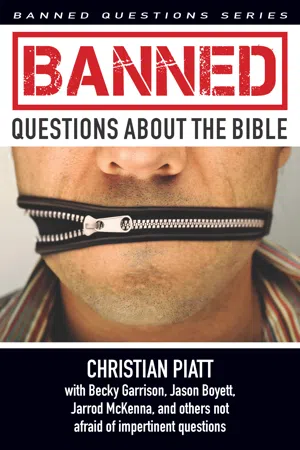
From Christian Piatt: "When I was a teenager, my youth minister threw a bible at my head for asking questions." Too often, for various reasons, people don't have the opportunity to ask the hard questions they have about faith, religion, salvation and the bible. And when questions are left unanswered in communities of faith, people either seek answers elsewhere or lose interest all together. The purpose of the series is to collect the most compelling and challenging questions from various theological areas and pose them to a panel of "experts" who are challenged with responding in two hundred words or less in plain English. This volume addresses challenging or controversial questions about scripture collected from people on Facebook, MySpace, Twitter and other social networking media. Respondents include theology professors, clergy, lay leaders, liberals, conservatives and voices representing a spectrum of views. The idea behind the books is not so much to provide definitive answers as it is to stimulate thought, reflection and discussion. By offering multiple perspectives, readers have the opportunity to arrive at their own questions. Better, they come to understand that questioning faith is not taboo, but rather that it can be at the foundation of a strong and growing faith. The directive given to each respondent guided them to be concise and to speak in plan language, but also not to rely exclusively on "the Bible says it" justifications, or to wax abstract or overly intellectual. Instead, they write from personal experience as much as possible, and provide real-life contexts that will allow the average seeker or churchgoer to apply such ideas to their daily lives.
- 224 pages
- English
- ePUB (mobile friendly)
- Available on iOS & Android
eBook - ePub
Banned Questions About the Bible
About this book
Information
Can I be a Christian if I don’t believe the Bible is perfect, handed down directly from God to humanity without error?
Craig Detweiler
Who is…?
Craig Detweiler
I skipped second grade.
A.Absolutely. Scientific principles have only been applied to the Bible for a couple hundred years. An earlier era understood divine inspiration as a different kind of truth. Shoehorning the Bible into scientific standards may actually reduce the profound gifts that the Bible provides. Shakespeare is not intended to be crammed into a test tube. Surely the Bible operates on an entirely different plane and claim to authority.
For example, we know that love is a powerful, elusive, but tangible reality. Artists and musicians have given us countless ways to describe such a profound truth. Drugs have enhanced the physical side of sexual performance. Yet medical breakthroughs cannot make us more loving. Becoming more loving is a lifelong quest, rooted in prayer, perseverance, and careful attention to others.
Following Jesus (the core Christian route) involves so much more than the minutiae of the Bible. We may memorize countless verses, but we are still called to put them into practice. Jesus seemed so interested in how our convictions turned into tangible differences for our communities. He gave little time or attention to those who tried to trap him into semantic arguments about obscure interpretations of the Torah. The Bible speaks into our hearts and minds with both veracity and variety. It is meant to woo, to persuade, to challenge, not by nailing down the details but pushing us toward applying timeless truths for today.
Jason Boyett
Who is…?
Jason Boyett
I can play the hammered dulcimer.
A. Of course. Belief in the inerrancy of scripture—inerrancy is the theological word for the idea that the Bible is without error—is not a requirement for salvation. Let me be clear: A Christian is not someone who believes in the perfection of scripture. A Christian is someone who follows Jesus Christ.
Remember, the earliest Christians didn’t even have the Bible as we know it. They had the Law and the Prophets on ancient scrolls. Certain churches had letters written by Paul. A few may have had the gospel accounts to read (and many certainly had other noncanonical gospels available, such as the gospel of Thomas). But they most likely wouldn’t have made a big deal about whether or not these texts were free from chronological or scientific errors because they just didn’t think that way.
The idea that the Bible’s authority is tied to its lack of mistakes is an Enlightenment idea. In the grand arc of history, that’s a pretty recent concept.
That’s not to say the Bible isn’t inspired or authoritative. It certainly is inspired in that it tells us the story of Jesus, from Genesis to Revelation. It is authoritative in that it is God’s primary means of communicating with us. But the Bible is not part of the Trinity; to exalt it above the Christ whose story it tells, and whose salvation it reveals, is a bad idea.
José F. Morales Jr.
Who is…?
José F. Morales Jr.
I’m a techno/house DJ.
A.Nowhere in the Bible does it say that one must believe in the Bible (let alone believe it’s perfect) to be saved. Moreover, the Bible doesn’t claim authority for itself within its pages. That’s why I contend with my fellow Christians who say that one must believe in the “authority of the Bible.” For me, the awesomeness of the Bible is that it points beyond itself.
And to what does it point?
First, the Bible points to the authority of God—not of the Bible! God is supreme above all, creator and sustainer of all life—life now and beyond the grave. I always say that the most important words in scripture are the first four: “In the beginning, God . . .”
Second, the Bible points to the good news of salvation. Now, salvation is defined in many different ways throughout scripture. So we should become familiar with the broad stroke with which the Bible paints salvation: God saves in creation, in gathering a community, in political liberation, in acquiring wisdom, in healing, and in the washing away of sin. In his book Salvation, Joel Green summarizes it best: Salvation is “God drawing near”—drawing near in creation, in the Temple, in Christ.
And we draw near to the Bible, the written word, because in doing so, the Living Word, whom Christians know as Jesus Christ, draws near to us (see Lk. 24:13–32). “They said to each other, ‘Were not our hearts burning within us while he [Jesus] was talking to us on the road, while he was opening the scriptures to us?’” (Lk. 24:32).
God indeed has drawn near to save us—believe it!
Nadia Bolz-Weber
Who is…?
Nadia Bolz-Weber
I have four chickens in my backyard.
A. A World Religions professor of mine in seminary told a story about New Testament scholar John Dominic Crossan being asked what it takes to be a Christian. His answer? “If you’re dipped, you’re in.” What Crossan was saying is that your baptism makes you Christian. And when we are baptized, it is in the name of the Father, and of the Son, and of the Holy Spirit.
Notice that we are not baptized in the name of the Bible. Why is this? Because the Bible is not the fourth person of the Trinity, even though it is often treated as such.
Again, this is where Lutherans get in trouble with some of our other Christian brothers and sisters. We believe that God claims us and names us as God’s own in the waters of baptism. The action is from God toward us, not from us toward God.
For a really great treatment on the difference between viewing the Bible as Divine Reference Manual and viewing the Bible as Living Word, see Making Sense of Scripture by David J. Lose.
Christian Piatt
Who is…?
Christian Piatt
I once had a job cleaning out condemned apartment buildings.
A. There are two things to consider when dealing with this question: church history and human nature. One of the biggest reasons that Martin Luther resisted the authority of the Catholic Church the way he did, ultimately sparking the Protestant Reformation, was because he believed that people should not be beholden to the church in claiming what they believe about God.
So at the foundation of every non-Catholic Christian church is this value of the individual freedom of belief, at least in theory. But in reality, we humans aren’t big fans of letting go of control, and church is certainly no exception. Although Baptists, Methodists, Lutherans, and all other Protestants supposedly have the liberty to interpret scripture without organized religion interceding and telling them what to think, we find plenty of examples where this still happens.
You know that old saying about those who don’t learn from history being doomed to repeat it? For all the benefits of the church, we sometimes have selective amnesia when it comes to remembering where we came from.
Some religious leaders will say you can’t be a Christian without claiming the perfect, inerrant authority of scripture. The good news is that you get to decide for yourself whether you agree with them or not.
Joshua Toulouse
Who is…?
Joshua Toulouse
I am currently pursuing my lifelong goal of spending the rest of my life in school. I really, really love school, and I hate the idea of living in the “real world.”
A. The Bible says that all scripture is inspired by God, or it can be translated as “breathed” or “spirited” by God. But nowhere do the scriptures claim to be handed down directly from God without possibility for error. While some traditions have understood scripture this way, it is certainly not a requirement for Christianity.
I choose to see the idea that scripture is inspired by God to mean that God inspired the writing of the scripture but also respected the humanity of those who were doing the writing. God recognizes that we are not perfect, and therefore nothing we create will be perfect either.
It is helpful to consider too that the inspiration of God regarding scripture doesn’t end when the writing is complete. God is also inspiring those of us who hear or read scripture today. With this understanding, God is kept active in scripture, in that scripture can speak to us in new ways and on different levels now as opposed to when it was written.
The breathing or spiriting of God in scripture occurs today, just as much in our receiving of scripture as it was in the writing.
Becky Garrison
Who is…?
Becky Garrison
Since 1996, I’ve been studying improv theater with Gary Austin, founder of the Groundlings.
A.This concept of reading the Bible line by line is a relatively new way of interpreting scripture that wo...
Table of contents
- Cover
- Title
- Copyright
- Contents
- Introduction: Why a Book about Banned Questions?
- 1. Can I be a Christian if I don’t believe the Bible is perfect, handed down directly from God to humanity without error?
- 2. If Adam and Eve were the first (and only) people on Earth, where did their kids’ spouses come from? Did they marry each other? And if everyone on Earth but Noah’s family was killed in a great flood, did Noah’s kids sleep with each other? Isn’t this a sin?
- 3. Aren’t women treated poorly throughout the Bible? Why would any intelligent modern woman today even want to read the Bible?
- 4. How can a God be all-loving yet allow people to be thrown into hell?
- 5. What does “apocalypse” mean, and does the Bible predict one?
- 6. What does the Bible really say about homosexuality?
- 7. What are the Apocrypha, the Gnostic Gospels, and the Dead Sea Scrolls, and why are they considered holy or sacred by some and not by others?
- 8. Doesn’t the Bible condone slavery?
- 9. Was the book of Revelation written in code? Or had the author gone crazy? Was he hallucinating? Were the images portrayed to be taken literally?
- 10. Why haven’t any new books been added to the Bible in almost two thousand years? Is there a chance that any new books will ever be added? Why or why not?
- 11. Is it true that the Ten Commandments found in the Bible are almost a copy of the Code of Hammurabi, which has been around longer? Why not just include the Code of Hammurabi instead of having a whole new set of rules?
- 12. Did God write the Bible? If so, why didn’t God simply create it miraculously, rather than using so many people over thousands of years to write it down?
- 13. Do Christians need to read the Old Testament? Why?
- 14. Does the Bible ever refer to itself as “the Bible”? If not, where did the name “Bible” come from?
- 15. How do we reconcile the Old Testament command for vengeance (eye for an eye) with Jesus’ command to turn the other cheek and love our enemies?
- 16. Is there a right or wrong way to read the Bible?
- 17. How do we reconcile the two different “creation stories” presented in Genesis chapters one and two?
- 18. Since the Bible isn’t in alphabetical or chronological order, how did it get in its current order?
- 19. Is there a scriptural basis for God changing God’s mind? Why?
- 20. Does God justify violence in scripture? What about genocide?
- 21. Why is the gospel of John so different from the other three gospels?
- 22. Hell, Sheol, Hades, Gehenna, and Tartarus are all labeled as “hell” by most Christians. Are they really the same? Are they all places of fiery torment? Are such things to be taken literally, metaphorically, or as myth?
- 23. Are there secret codes embedded in scripture? What are they?
- 24. How can we begin to take the Bible literally when it seems to contradict itself so often?
- 25. If I don’t believe every word of the Bible is literally true, how do I know what to consider in context and what to set aside?
- 26. In the Old Testament, God seems to be actively involved in world events. In the New Testament, God is portrayed as less interventionist but still directly involved. Now, it seems God is much more abstract. What happened, and is this a good or a bad thing?
- 27. Why would a merciful God allow Job’s family and fortune to be taken away, and why would God ask Abraham to kill his own son?
- 28. Is it true that both the gospel of John and the book of Revelation almost weren’t canonized (included in the Bible)? Why? Who got to decide which books would be included in the Bible, and what rules did they use to decide?
- 29. Are Lucifer, the Adversary, Satan, the Beast, and the Antichrist all the same? If so, why use so many names? If not, what are their different roles, and who is in charge?
- 30. Was Mary Magdalene a prostitute?
- 31. Where are all the miracles today? If they were so prevalent in biblical times, why don’t any happen today? Or do they, and we just don’t notice?
- 32. Are there any mistakes in the Bible? Like what?
- 33. In some cases, Paul (the purported author of many New Testament books) seems to support women in leadership roles in church, and in others, he says they have no place. Which is it? And why the seeming contradiction?
- 34. Is God “in control”? If so, does that mean God made (insert horrible thing here) happen to pull off a greater plan? Why doesn’t God intervene in a disaster?
- 35. Why do so many religions seem to have such similar fundamental stories, like the flood and creation stories? Are they from a common source?
- 36. Is it true that the word “Satan” is never used in the Bible to refer to an evil spirit? If so, where did the word come from?
- 37. Why is it considered immoral to get married or to have sex before age eighteen today, yet in biblical times, people (including Mary) did this all the time?
- 38. Does the Bible call for sexual purity? If so, what qualifies as pure and impure?
- 39. What is the sin of Onan, and why is it bad?
- 40. Are some sins worse or better than others?
- 41. Who gets to decide which laws in the Bible are irrefutable, which laws are out of date, and which laws should be applied only in certain situations?
- 42. Were there gay couples in the Bible? What about Jonathan and David?
- 43. If people have to be Christians to go to heaven, what happens to all of the people born before Jesus or who never hear about his ministry?
- 44. There are many stories recorded throughout scripture in which only one or two people were around. If so, did they write down their own stories? If not, how do we know that what is written is what happened?
- 45. Why would an all-knowing God begin the process of creation knowing that it would be corrupted by evil and lead to so much heartache?
- 46. Why would stories about a father murdering his daughter (Judg. 11) or handing his daughters over to a crowd to be raped and killed (Gen. 19) be included in the Bible?
- 47. Why are there so many completely different interpretations of the same scripture passages?
- 48. Do women need to follow the commands of 1 Peter and submit to their husbands? Why? What does it mean to submit?
- 49. What is the thorn in his side that Paul describes?
- 50. Why are (or were) the Jewish people God’s chosen people? Why not someone else? Are Christians now God’s chosen people?
- Contributors List, Biographies, and Suggested Resources
- God Image Survey
Trusted by 375,005 students
Access to over 1.5 million titles for a fair monthly price.
Study more efficiently using our study tools.
Frequently asked questions
Yes, you can cancel anytime from the Subscription tab in your account settings on the Perlego website. Your subscription will stay active until the end of your current billing period. Learn how to cancel your subscription
No, books cannot be downloaded as external files, such as PDFs, for use outside of Perlego. However, you can download books within the Perlego app for offline reading on mobile or tablet. Learn how to download books offline
Perlego offers two plans: Essential and Complete
- Essential is ideal for learners and professionals who enjoy exploring a wide range of subjects. Access the Essential Library with 800,000+ trusted titles and best-sellers across business, personal growth, and the humanities. Includes unlimited reading time and Standard Read Aloud voice.
- Complete: Perfect for advanced learners and researchers needing full, unrestricted access. Unlock 1.5M+ books across hundreds of subjects, including academic and specialized titles. The Complete Plan also includes advanced features like Premium Read Aloud and Research Assistant.
We are an online textbook subscription service, where you can get access to an entire online library for less than the price of a single book per month. With over 1.5 million books across 990+ topics, we’ve got you covered! Learn about our mission
Look out for the read-aloud symbol on your next book to see if you can listen to it. The read-aloud tool reads text aloud for you, highlighting the text as it is being read. You can pause it, speed it up and slow it down. Learn more about Read Aloud
Yes! You can use the Perlego app on both iOS and Android devices to read anytime, anywhere — even offline. Perfect for commutes or when you’re on the go.
Please note we cannot support devices running on iOS 13 and Android 7 or earlier. Learn more about using the app
Please note we cannot support devices running on iOS 13 and Android 7 or earlier. Learn more about using the app
Yes, you can access Banned Questions About the Bible by Christian D Piatt in PDF and/or ePUB format, as well as other popular books in Theology & Religion & Biblical Criticism & Interpretation. We have over 1.5 million books available in our catalogue for you to explore.