In an easy-to-use workbook format, students learn tools for understanding the structure of Hebrew phonology and morphology, nouns, pronouns, adjectives, verbs, and syntax, and gain a reading knowledge of the Hebrew Bible that will last beyond seminary. Spiral Bound. REVISED EDITION
Hebrew is a member of the Semitic family of languages. Cognate languages include Akkadian, Arabic, Aramaic, Syriac, Ethiopic, Phoenician, Ugaritic, and others.
Biblical Hebrew is the name given to the Hebrew of the Jewish Scriptures (the Tanakh), the Christian Old Testament. All of the Old Testament, except for 268 Aramaic verses—Jeremiah 10:11, Daniel 2:4–7:28, Ezra 4:8–6:18, and Ezra 7:12–26—was written in biblical Hebrew. Biblical Hebrew was written from right to left on the page and consisted only of consonants. In the Middle Ages, Masoretic scribes added vowels, accents, and other notations to the text in order to preserve the traditional, rabbinic pronunciation of the text for a Jewish population increasingly removed from its Hebrew homeland and roots.
In this book, we will study biblical Hebrew with the Masoretic vowels, accents, and notations. The manuscript of the Bible to which we will refer and that we will use is the Leningrad Codex, a Masoretic manuscript in the ben Asher tradition that dates to the eleventh century C.E. and is the foundational text of Biblia Hebraica Stuttgartensia.1
The Alphabet of the Hebrew Language
The Alphabet
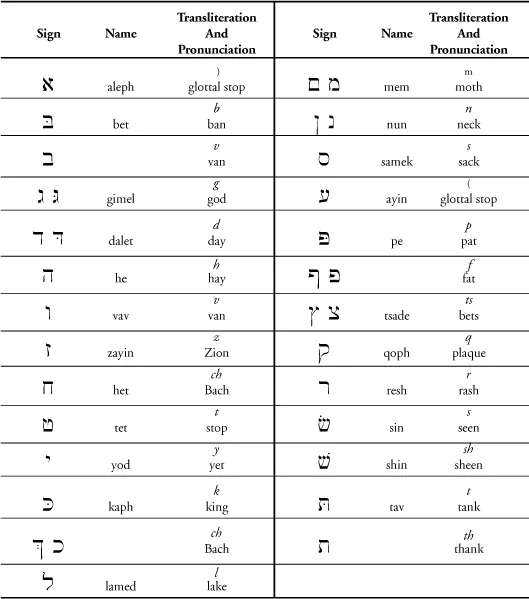
The Hebrew alphabet consists of twenty-three consonants.
Five of the consonants
are shaped differently when they appear at the end of a word
Note:
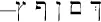
is always written with a vowel (see p. 5). The vowel is usually sheva
, but qamets often occur
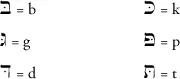
Six of the letters
called the begad kepat letters—had, at one point in the transmission of biblical Hebrew, two pronunciations:
A hardened (or stopped) pronunciation was indicated by a dagesh (a dot) in the letter.
A softened (or spirantized) pronunciation was indicated by the letter written without a dagesh.
In this textbook, we will distinguish hardened and softened pronunciations only for
The Vowels of Biblical Hebrew
The Vowels
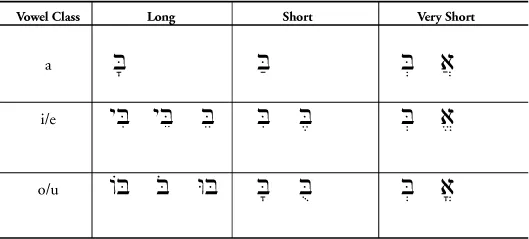
The vowels of biblical Hebrew may be categorized into three vowel classes:
There are three types of vowels in each vowel class:
Writing Hebrew Letters
Writing Hebrew Letters with Vowels
Chapter 1 Exercises
Copy each letter of the Hebrew alphabet (including the sp...
Table of contents
Cover
Title Page
Copyright
Contents
Preface
Acknowledgments
Chapter One - Writing Hebrew Letters with Vowels
Chapter Two - Layout of a Hebrew Verse
Chapter Three - Adding the Definite Article, Prepositions, and the Conjunction
Chapter Four - Noun Formation; Absolute and Construct Forms
Chapter Five - Pronouns
Chapter Six - The Maqqef
Chapter Seven - Patah Furtive
Chapter Eight - Verb Roots, Aspects, and Person, Gender, Number
Chapter Nine - Identifying Verbal Stems
Chapter Ten - The Definite Direct Object
Chapter Eleven - The Verb Location Chart
Chapter Twelve - Sign of the Definite Direct Object with Pronoun Suffixes Attached
Chapter Thirteen - Infinitive Construct and Infinitive Absolute
Chapter Fourteen - Pronoun Suffixes Added to Verbs
Chapter Fifteen - Introduction to Weak Verbs
Chapter Sixteen - Verb Roots Beginning with Gutturals
Chapter Seventeen - Verbs Beginning with and Hollow Verbs
Chapter Eighteen - Verbs Beginning with, Double Consonant Verbs, Some Unusual Forms
Chapter Nineteen - Reading Hebrew
Chapter Twenty - Reading More Hebrew
Appendix One: Strong Verbs
Appendix Two: Vocabulary
Appendix Three: Index
Trusted by 375,005 students
Access to over 1.5 million titles for a fair monthly price.
Study more efficiently using our study tools.
Frequently asked questions
Yes, you can cancel anytime from the Subscription tab in your account settings on the Perlego website. Your subscription will stay active until the end of your current billing period. Learn how to cancel your subscription
No, books cannot be downloaded as external files, such as PDFs, for use outside of Perlego. However, you can download books within the Perlego app for offline reading on mobile or tablet. Learn how to download books offline
Perlego offers two plans: Essential and Complete
Essential is ideal for learners and professionals who enjoy exploring a wide range of subjects. Access the Essential Library with 800,000+ trusted titles and best-sellers across business, personal growth, and the humanities. Includes unlimited reading time and Standard Read Aloud voice.
Complete: Perfect for advanced learners and researchers needing full, unrestricted access. Unlock 1.5M+ books across hundreds of subjects, including academic and specialized titles. The Complete Plan also includes advanced features like Premium Read Aloud and Research Assistant.
Both plans are available with monthly, semester, or annual billing cycles.
We are an online textbook subscription service, where you can get access to an entire online library for less than the price of a single book per month. With over 1.5 million books across 990+ topics, we’ve got you covered! Learn about our mission
Look out for the read-aloud symbol on your next book to see if you can listen to it. The read-aloud tool reads text aloud for you, highlighting the text as it is being read. You can pause it, speed it up and slow it down. Learn more about Read Aloud
Yes! You can use the Perlego app on both iOS and Android devices to read anytime, anywhere — even offline. Perfect for commutes or when you’re on the go. Please note we cannot support devices running on iOS 13 and Android 7 or earlier. Learn more about using the app
Yes, you can access Biblical Hebrew by Nancy deClaisse-Walford in PDF and/or ePUB format, as well as other popular books in Languages & Linguistics & Languages. We have over 1.5 million books available in our catalogue for you to explore.