Miller and Hall center totally on the nature and ministry of Christian coaching. They provide an overview of the growth and development of coaching and its application to Christian ministry. They show core coaching skills, and essential and supporting coaching skills. The core skills of focused listening and asking powerful questions reappear throughout the book as the authors demonstrate in real life situations how to use them. A TCP Leadership Series title.
As soon as Lee arrived at the church, he remembered that he had his first coaching call with Terry that morning. Terry had asked him to be prepared to talk about things that would make a difference for him. As the leader for the church’s small group ministry, Lee was pleased with how many groups were flourishing; yet he knew that several were not.
Right on time, Lee’s phone rang. After greeting each other, Terry asked Lee where he wanted to focus, and Lee began sharing about several of the small groups that seemed to be struggling. When Terry asked, “What else can you do to help those groups?” Lee realized that he hadn’t been spending as much time with those leaders as the others.
Terry continued, “The leaders with whom you’ve invested time are flourishing in their small groups. How can the leaders of the other groups get what they need?” Like a bolt of lightning, Lee recognized that he might be standing in the way of the leaders’ success.
“I need to reach out to them just like I reached out to the others. It didn’t take much time, and I can see the fruits of the time spent with each one.”
Terry anchored the action by asking, “By when will you meet with each one, Lee?” Lee was ready to make the calls and set up the meetings.
What is coaching? Such a simple question opens the floodgates into a new and rapidly emerging field. If you were to ask twenty people how they would define coaching, you would get twenty different answers. Everyone defines coaching differently. This chapter is intended to look at some of the individual pieces of the “coaching” puzzle and to explore both a definition of Christian coaching and a brief historical development of the discipline.
The Definition of Coaching
The Original Definition
A hundred years ago, a coach was a transport vehicle, as commonly remembered in the story of Cinderella. Riding in a coach meant that a person would be moved from one point to another. In Webster’s Dictionary the first definition of coach is, “a large, covered, four-wheeled carriage used as a conveyance, with seats for passengers inside and an open raised seat in front for the driver: stagecoach.”1
Today, coaching is similar. Coaching is still about forward movement and action. A coach, however, is no longer a physical vehicle like a car. A coach is a person who facilitates actions that transport people from one place to another, from where they are to a new destination. Until recently, most people connected coaching with the athletic arena. Often after the statement, “I am a coach,” the natural response is, “Really? What sport?”
Coaching, as it is used within this book, is not about sports or “winning.” It’s about taking intentional action, moving forward, and improving performance. By nature, coaches desire to help people improve, change, recognize and use their strengths and talents, and be successful. Christian coaches want all this as well as to know that God’s leadership and will are central in the coaching process.
Modern Definitions
Gary Collins, an early adopter within the Christian counseling and Christian coaching arenas, defined coaching as an “art and practice of guiding a person or group from where they are toward the greater competence and fulfillment that they desire.”2
In one of the first coaching books, Sir John Whitmore proposed, “Coaching is as much about the way things are done as what is done. Coaching delivers results in large measure because of the supportive relationship between the coach and the coachee, and the means and style of the communication used. The coachee does acquire the facts, not from the coach but from within himself, stimulated by the coach.”3
According to Dennis Kinlaw, “Successful coaching is a mutual conversation that follows a predictable process and leads to superior performance, commitment to sustained improvement, and positive relationships.”4
Thomas Crane defined coaching as a comprehensive communication process in which the coach provides performance feedback to the coachee. Topics include broad, work-related dimensions of performance (personal, interpersonal, or technical) that affect the coachee’s ability and willingness to contribute to meaningful personal and organizational goals…Coaches help people clarify and reconnect to their purposes, values and roles. A coach acts as a guide by challenging and supporting people in achieving their performance objectives.5
The ICF, the largest professional association that oversees the coaching profession (outside of athletics), certifies coaches and accredits training programs. According to the ICF Web site, “Personal and business coaching is an ongoing professional relationship that helps people produce extraordinary results in their lives, careers, businesses or organizations.”6
Definition from a Christian Perspective
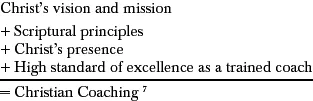
From a Christian perspective, coaching is a relationship that involves Christ’s presence and truths from Scripture along with high standards as a coach. This equation might be viewed like a mathematical formula:
With such a wide-ranging variety of coaching definitions, individuals can become easily sidetracked in examining and comparing the varying nuances of each definition. Therefore, to help target focus and direction, one overarching definition of Christian coaching will be the cornerstone of this book, a definition that positions the coaching relationship as the cornerstone of coaching, just as Jesus Christ is the cornerstone of the church and our relationship with God.
Christian coaching is a focused Christ-centered relationship that cultivates a person’s sustained growth and action.
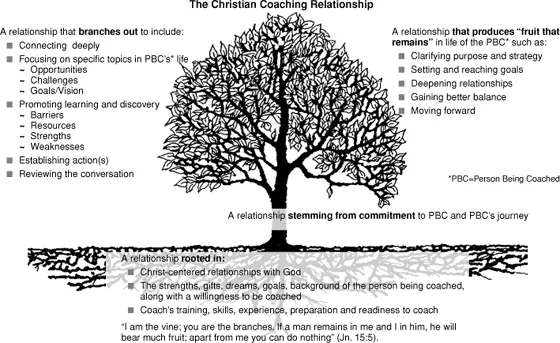
To help envision the coaching relationship, examine Figure 2.1. Let’s unpack some of the meaning conveyed in this illustration.
“A focused Christ-centered relationship…”
Focused: Christian coaching is purposeful in intent. It is not a relationship for the sake of relationship. It is a relationship with a precise and stated reason for being. The focus in a coaching relationship is always on the person being coached and supporting that person’s growth and action.
Christ-centered: The primary distinction that sets Christian coaching apart from all other coaching is its Christ-centeredness. Apart from Christ, there is no Christian coaching. The assumption in Christian coaching is that the coach is a Christian. The person being coached may or may not be a believer. The coach’s faith impacts the entire coaching relationship, including attitudes toward the person being coached and the situation being discussed, use of skills in the coaching conversation, perspectives, as well as holy nudges from the Holy Spirit.
Relationship: Coaching, in its essence, is relational. For the Christian coach, the relationship includes the coach, person being coached, and Christ. Because of the unique strengths, gifts, dreams, goals, and backgrounds of the person being coached along with the unique training, skills, experience, and preparation of the coach, each coaching relationship is unique. It is a relationship with a commitment. The commitment is to Christ and to the person being coached.
“…that cultivates a person’s sustained growth and action.”
Cultivates: Cultivation occurs in conversation. Coaching conversations are the necessary sunshine and water to cultivate the coaching relationship. Through coaching conversations, with the coach using the eight skills outlined and discussed later in this book, the person being coached is able to focus on specific personal opportunities or challenges, anticipate barriers, identify resources, and develop an action plan.
A person’s sustained growth and action: Coaching is about transformation. Coaching without sustained growth and action on the part of the person being coached is not true coaching. Christian coaching always, without exception, results in action. The coach supports the person being coached in developing action plans as well as systems of accountability for following through on those plans.
Roots, Branches, and Fruit of the Coaching Relationship
Now, consider the roots, branches, and fruit of the coaching relationship.
Roots-Preparedness
“So then, just as you received Christ Jesus as Lord, continue to live in him, rooted and built up in him, strengthened in the faith as you were taught, and overflowing with thankfulness” (Col. 2:6–7).
These words of instruction from Paul to the Colossian believers are vital for the Christian coach, as well as for the person being coached, if that person is a believer. Quite often, deepening roots with God allow for deepening exploration, discovery, and action in the coaching relationship.
Choosing to be coached makes a powerful statement about an individual’s readiness to move forward in life, ministry, or work relationships, or in a myriad of other arenas. For coaching to be successful, the person being coached needs to be ready and willing to engage in a coaching relationship. Starting with the first conversation and throughout the coaching journey, the focus will remain on the strengths, goals, areas for development, and specific situations of the person being coached. As different areas are addressed, the willingness of the person being coached to explore and to take action is critical to the coaching process.
Preparedness by the coach is also important. Each coach brings to the coaching relationship a different level of training, skills, and experiences. The wise coach is well prepared for each coaching conversation so that full attention can be given to the person being coached. Being prepared means being able to focus on and be fully present with the person being coached, being in a place without interruptions, and being ready to concentrate on whatever the person being coached brings to the conversation. Commitment to the Lord, to the coaching relationship, and to the journey of the person being coached is paramount to strong coaching.
The Christian coach’s personal commitment to God provides roots and stability for the coaching relationship. The coach’s relationship with God positively impacts the coach’s relationship with the person being coached. In all aspects of the ongoi...
Table of contents
Cover
Title Page
Copyright
Dedication
Contents
Editor’s Foreword
Acknowledgments
Introduction
Chapter 1 - Overview of Coaching
Chapter 2 - Core Coaching Skills
Chapter 3 - Essential and Supporting Coaching Skills
Chapter 4 - Models for the Coaching Conversation
Chapter 5 - The Coaching Relationship
Chapter 6 - A Coach Approach to Ministry Leadership
Chapter 7 - Coaching in the Church
Afterword - Jesus as Our Master Coach
Appendix One - Distinctions of Coaching
Appendix Two - Sample Coaching Documents
Appendix Three - Developing Your Pathway as a Coach
Appendix Four - Ministries That Thrive with Coaching
Appendix Five - Resources for Coaching
Trusted by 375,005 students
Access to over 1.5 million titles for a fair monthly price.
Study more efficiently using our study tools.
Frequently asked questions
Yes, you can cancel anytime from the Subscription tab in your account settings on the Perlego website. Your subscription will stay active until the end of your current billing period. Learn how to cancel your subscription
No, books cannot be downloaded as external files, such as PDFs, for use outside of Perlego. However, you can download books within the Perlego app for offline reading on mobile or tablet. Learn how to download books offline
Perlego offers two plans: Essential and Complete
Essential is ideal for learners and professionals who enjoy exploring a wide range of subjects. Access the Essential Library with 800,000+ trusted titles and best-sellers across business, personal growth, and the humanities. Includes unlimited reading time and Standard Read Aloud voice.
Complete: Perfect for advanced learners and researchers needing full, unrestricted access. Unlock 1.5M+ books across hundreds of subjects, including academic and specialized titles. The Complete Plan also includes advanced features like Premium Read Aloud and Research Assistant.
Both plans are available with monthly, semester, or annual billing cycles.
We are an online textbook subscription service, where you can get access to an entire online library for less than the price of a single book per month. With over 1.5 million books across 990+ topics, we’ve got you covered! Learn about our mission
Look out for the read-aloud symbol on your next book to see if you can listen to it. The read-aloud tool reads text aloud for you, highlighting the text as it is being read. You can pause it, speed it up and slow it down. Learn more about Read Aloud
Yes! You can use the Perlego app on both iOS and Android devices to read anytime, anywhere — even offline. Perfect for commutes or when you’re on the go. Please note we cannot support devices running on iOS 13 and Android 7 or earlier. Learn more about using the app
Yes, you can access Coaching for Christian Leaders by Chad Hall,Linda Miller in PDF and/or ePUB format, as well as other popular books in Theology & Religion & Christian Church. We have over 1.5 million books available in our catalogue for you to explore.