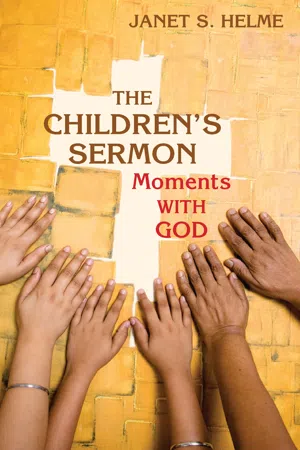
Written by an educator, minister, and writer of children's curriculum materials, this book provides easy-to-do and easy-to-understand methods for developing good children's sermons. Using appropriate scriptures for insight into our relationship with the children in our midst, author Janet Helme takes you step-by-step through the process of developing a successful children's sermon. Topics include: why you should do a children's sermon, how to craft it, what to do about the adults in the pews, tools, insights, and sample sermons.
- 144 pages
- English
- ePUB (mobile friendly)
- Available on iOS & Android
eBook - ePub
About this book
Information
Topic
Theology & ReligionSubtopic
Christian MinistryCHAPTER 1
Why a Children’s Sermon?
At that time the disciples came to Jesus and asked, “Who is the greatest in the kingdom of heaven?” He called a child, whom he put among them, and said, “Truly I tell you, unless you change and become like children, you will never enter the kingdom of heaven. Whoever becomes humble like this child is the greatest in the kingdom of heaven. Whoever welcomes one such child in my name welcomes me.” (Mt. 18:1–5)
One reason that we take the time, spend the energy, and provide the very best in a Children’s Sermon is that we want to welcome children into our worship service. Children are important in the kingdom of God, as evidenced in the scripture passage above. Jesus told his disciples that those who welcome children in his name also welcome Jesus. We need to take care of the children in our midst and let them know they are a vital part of the worshiping community of faith.
Too often we have excluded our children from being a vital part of the worship service. We talk down to them, talk over their heads, try to “shush” and remove them if they get too noisy, or we pretend they do not exist. As an example, think about people exiting the sanctuary. How many times have you seen the minister actually bend down to a child’s level, shake the child’s hand, and talk with that child? Or is it more customary to see the minister shake the hands of the child’s parents and, often, ignore the child?
Making children a vital part of the worship service does not mean that all children need to stay in the worship service during the entire sixty to seventy-five minutes. However, when they are in the worship service, we need to be very intentional about including them in some special ways. The Children’s Sermon is just one way in which that inclusion can be effected. You will find examples of other ways to include children in the worshiping community in appendix A at the end of this book. However, the Children’s Sermon—the topic of this book—is the beginning point for inclusion of children in worship.

You shall love the LORD your God with all your heart, and with all your soul, and with all your might. Keep these words that I am commanding you today in your heart. Recite them to your children and talk about them when you are at home and when you are away, when you lie down and when you rise. Bind them as a sign on your hand, fix them as an emblem on your forehead, and write them on the doorposts of your house and on your gates. (Deut. 6:5–9)
Another important reason for including a Children’s Sermon is so that children begin to learn and recognize some of the important stories and concepts in the Bible. The Bible is an adult book. In fact, adults cannot begin to understand many stories in the Bible! Those are not the stories we want to use when we develop the Children’s Sermon. This can, of course, be tricky if you are the person responsible for the Children’s Sermon and another church leader chooses the scripture. You will find some helps with this in chapter 3, “How Do We Craft the Good Children’s Sermon?” Suffice it to say that even in a long and convoluted text, we can usually find at least one phrase that can be used as a basis for the Children’s Sermon. If not, then we build our children’s presentation on a concept that comes out of that text, if at all possible. You will see examples of this also in chapters 3, and 7–9.
This is the covenant that I will make with the house of Israel
after those days, says the Lord.
after those days, says the Lord.
I will put my laws in their minds,
and write them on their hearts,
and write them on their hearts,
and I will be their God,
and they shall be my people.
and they shall be my people.
And they shall not teach one another
or say to each other, “Know the Lord,”
or say to each other, “Know the Lord,”
for they shall all know me,
from the least of them to the greatest. (Heb. 8:10–11)
from the least of them to the greatest. (Heb. 8:10–11)
A third important reason for including a Children’s Sermon in the weekly worship service is to encourage children that scripture can “speak” to them today. If children learn at an early age to trust their parents, God, their Christian heritage through Jesus Christ and the Church, and what they learn from scripture, we have gone a long way in helping them to “write the scriptures” on their hearts. Of course, to have the scriptures written on their hearts, they must hear the scriptures.
Hear a note of caution. Many passages (over which biblical “authorities” have argued vehemently for years) must always remain a mystery in this lifetime. We do not introduce these scriptures to children at a young age. However, we can definitely introduce themes that children can understand, such as God is love; God loves me; God wants me to love others; and so on. Some of these themes are named and discussed in chapter 2, “How Well Do You Know Your Audience?”
A fourth important reason for including a weekly Children’s Sermon is that it provides a wonderful opportunity to develop the prayer life of children. At the conclusion of the time with children, I always have them fold their hands, bow their heads, and repeat after me a very simple prayer, such as:
“Thank you, God, for your love.
Help us to learn to love others
as you love us.
In Jesus’ name we pray, Amen.”
This may be the only time that children engage in corporate prayer (or even in prayer of any kind), depending on your congregation and families. Children (and adults!) can learn from this brief prayer time that they do not have to use fancy words and that their prayers can be tied in directly to what they have just been hearing, learning, seeing, smelling, or touching.
The fifth and perhaps most important reason for including a weekly Children’s Sermon is that we are, very intentionally, providing “moments with God” for the children in our churches.
A number of years ago while attending a ministers’ spiritual retreat in Ohio, I heard the Reverend Peter Morgan say that the most important task of preachers is to “usher the people into the presence of God.”
I believe that the most important task of those who provide the Children’s Sermon each Sunday is to very intentionally guide our children into “moments with God”—moments when they glimpse the presence of God in their midst.
Last, however, I must include a caution. Over many years I have observed with anguish (but I hope have never intentionally employed during my children’s sermons) how children are mistreated during this time.
Children should never, ever be used as entertainment for the congregation! They are not to be the butt of any joke or be used to make the congregation laugh. I have seen ordained ministers squirt water on unsuspecting children, ask them to do a task that they could not possibly do, or try to answer a question for which their answers could only appear silly—all in the name and context of the Children’s Sermon.
The Children’s Sermon can, definitely, have humor—but not at the expense of the children. Never at the expense of the children or of their feelings. What better way to turn children against the Church, God, and organized religion than to humiliate and/or embarrass them in front of the entire congregation?
I am always reminded of Jesus’ admonition about our care of the “little ones” in our midst: “If any of you put a stumbling block before one of these little ones who believe in me, it would be better for you if a great millstone were fastened around your neck and you were drowned in the depth of the sea” (Mt. 18:6).
While this passage might indeed be referring to the new or young disciples in faith, I have always placed it on my heart as the care I must give as I work with and relate to the children who surround me wherever I am.
Seminary professors tell their students in preaching classes that every minute of a preached sermon should require one hour of preparation time. I would suggest that every minute of the Children’s Sermon should include at least thirty minutes of solid preparation time. In other words, a four–minute Children’s Sermon would require at least two hours of preparation. Not too much, in my estimation, for those whom Jesus named as “the greatest in the kingdom of heaven” (Mt. 18:1–2).
CHAPTER 2
How Well Do You Know Your Audience?
For though I am free with respect to all, I have made myself a slave to all, so that I might win more of them. To the Jews I became as a Jew, in order to win Jews. To those under the law I became as one under the law (though I myself am not under the law) so that I might win those under the law. To those outside the law I became as one outside the law (though I am not free from God’s law but am under Christ’s law) so that I might win those outside the law. To the weak I became weak, so that I might win the weak. I have become all things to all people, that I might by all means save some. I do it all for the sake of the gospel, so that I may share in its blessings. (1 Cor. 9:19–23)
The apostle Paul, the greatest missionary of Christianity, could attribute part of his enormous success to the fact that he knew his audience. Not only did he know them, but he also tried to present the Gospel in ways that they could and would understand. William Barclay, twentieth-century Scottish New Testament interpreter and author, described Paul’s method like this: “Finally, Paul speaks about the method of his ministry, which was to become all things to all men. This is not a case of being hypocritically one thing to one man and another to another. It is a matter in the modern phrase, of being able to get alongside anyone. The man who can never see anything but his own point of view and who never makes any attempt to understand the mind and heart of others, will never make a pastor or an evangelist or even a friend.”1
I would add that neither can we hope to bring our children to God during the Children’s Sermon unless we get to know them, trying to put ourselves in their shoes as they listen to us tell them something important about their church, God, Jesus, or themselves. If we hope to provide them a time and place to spend moments with God, we must know who they are, how they learn, and what their concerns and joys are.
The following list of questions is a beginning to learning more about the children who come to us each Sunday, eagerly and expectantly giving us their attention for several moments during the worship service:
- What are some differences among the children in the group?
- How do children learn in the worship service setting?
- What can we do to include children’s various learning styles during the Children’s Sermon?
- How can we, as leader or minister, get to know our children better?
- What are the major themes of scripture, and how do children understand them?
What Are Some Differences among the Children
in the Group?
in the Group?
Some notable differences among young children include differences of age, mental and physical growth/ability, emotional and spiritual levels, and differences in family relationships and support.
...Table of contents
- Cover
- Title
- Copyright
- Contents
- Introduction
- 1 Why a Children’s Sermon?
- 2 How Well Do You Know Your Audience?
- 3 How Do You Craft the Children’s Sermon?
- 4 What about the People in the Pews?
- 5 What Are the Vital Tools for the Journey?
- 6 What Are Some Helpful Insights for the Journey?
- 7 Sample Children’s Sermons, Lectionary Year B
- 8 Sample Children’s Sermons, Lectionary Year C
- 9 Sample Children’s Sermons, Lectionary Year A
- Appendix A: Additional Ways to Include Children in the Worshiping Community
- Appendix B: Recommended Books
- Appendix C: Scriptures Used
Trusted by 375,005 students
Access to over 1.5 million titles for a fair monthly price.
Study more efficiently using our study tools.
Frequently asked questions
Yes, you can cancel anytime from the Subscription tab in your account settings on the Perlego website. Your subscription will stay active until the end of your current billing period. Learn how to cancel your subscription
No, books cannot be downloaded as external files, such as PDFs, for use outside of Perlego. However, you can download books within the Perlego app for offline reading on mobile or tablet. Learn how to download books offline
Perlego offers two plans: Essential and Complete
- Essential is ideal for learners and professionals who enjoy exploring a wide range of subjects. Access the Essential Library with 800,000+ trusted titles and best-sellers across business, personal growth, and the humanities. Includes unlimited reading time and Standard Read Aloud voice.
- Complete: Perfect for advanced learners and researchers needing full, unrestricted access. Unlock 1.5M+ books across hundreds of subjects, including academic and specialized titles. The Complete Plan also includes advanced features like Premium Read Aloud and Research Assistant.
We are an online textbook subscription service, where you can get access to an entire online library for less than the price of a single book per month. With over 1.5 million books across 990+ topics, we’ve got you covered! Learn about our mission
Look out for the read-aloud symbol on your next book to see if you can listen to it. The read-aloud tool reads text aloud for you, highlighting the text as it is being read. You can pause it, speed it up and slow it down. Learn more about Read Aloud
Yes! You can use the Perlego app on both iOS and Android devices to read anytime, anywhere — even offline. Perfect for commutes or when you’re on the go.
Please note we cannot support devices running on iOS 13 and Android 7 or earlier. Learn more about using the app
Please note we cannot support devices running on iOS 13 and Android 7 or earlier. Learn more about using the app
Yes, you can access The Children's Sermon by Rev. Janet S. Helme in PDF and/or ePUB format, as well as other popular books in Theology & Religion & Christian Ministry. We have over 1.5 million books available in our catalogue for you to explore.