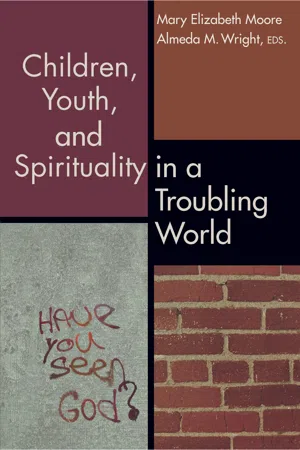
Editors Mary Elizabeth Moore and Almeda M. Wright address the harsh, challenging, and delicate realities of children and youth—who live as spiritual beings within a beautiful yet destructive world. Providing a practical theological analysis of the spiritual yearnings, expressions, and challenges of children and youth in a world of rapid change, dislocation, violence, and competing loyalties, Children, Youth, and Spirituality in a Troubling World provides readers with a purposeful conversation on this important topic. This book will serve as more than a collection; it will be a genuine conversation, which will in turn stir lively conversation among scholars, theological students, and Christian communities that seek to understand and respond more adequately in ministries to and with children and youth. Contributors include: Claire Bischoff, Susanne Johnson, Jennie S. Knight, Bonnie Miller-McLemore, Mary Elizabeth Moore, Joyce Ann Mercer, Veronice Miles, Rodger Nishioka, Evelyn Parker, Luther E. Smith Jr., Joshua Thomas, Katherine Turpin, David White, Almeda Wright, and Karen Marie Yust.
- 288 pages
- English
- ePUB (mobile friendly)
- Available on iOS & Android
eBook - ePub
Children, Youth, and Spirituality in a Troubling World
About this book
Information
Topic
Theology & ReligionSubtopic
Christian TheologyPART ONE
The Young in a
Troubling World
1
When Celebrating Children
Is Not Enough
Every church I know celebrates children and encourages its members to care for them. Their programs include religious education, designated children’s Sunday worship services, children’s choirs, graduation celebrations, and service projects with the poor, elderly, or disabled. A few of these churches extend their witness to the children of their community through day care, tutoring, vacation Bible school, and recreational programs.1
What churches do to nurture children is commendable. Still, the absence of church involvement in the lives and issues of many children is conspicuous. Millions of children linger in crises without religious care. Some children are overwhelmed by an environment of poverty; children with chronic illnesses are without healthcare. Children suffer stress, anxiety, and even death from living in communities plagued by violence. These are the young people whom The Annie E. Casey Foundation describes as “America’s most disconnected youth”: teens languishing in foster care, youth enmeshed in the juvenile justice system, high school dropouts, and teen parents.2 Others express a similar concern for younger children who are forced to the social margins.3
Why are so few churches involved with these challenges? Is this the result of deficient theologies and ecclesiologies? Are churches intimidated by the complexities of influencing public policy? Do churches fear these children and their circumstances? The questions themselves embarrass the church. They imply that churches may be ill-prepared to fulfill their identity and mission. However, the issues that embarrass us may point us toward transformation.4 We can begin to see transformative possibilities when we name our spiritual crises and live into our faith with ever greater clarity and resolve. The embarrassment we feel can be a prelude to more faithful discipleship.
This chapter tarries with these questions and discusses their implications for a spirituality that embraces all children. A practical theology that avoids such questions and their promise for transformation is neither worthy of being considered faithful practice nor sound theology. Even more important than the viability of a particular practical theology is the viability and vitality of children. What we speak and what we practice should foster “response-ability” for the children whom God has entrusted to us.
My reflections in this essay are informed by over thirty-five years of personal activism with children’s issues; thus, my method might be described as a combination of memoir and case analysis in dialogue with data and literature about children. One caveat is worthy of note. In my engagement with children and advocacy, I have worked extensively with interfaith organizations. The challenges of caring for children are for all faith traditions; yet I feel especially answerable for the witness of my own tradition—Christianity. I am (and on a corporate level, the churches are) held accountable to its teachings and examples. This essay’s focus on churches is not a dismissal of the need for all faiths to engage with children’s realities; rather, the focus reflects my sense of urgency for discussion within my own family of faith.
Children in Crisis
Churches care about children. While the Christian faith teaches care for all children, congregations commonly focus only on their own children. This leads some church leaders to adopt the primary strategy of caring for children by increasing the number of children in their churches. If the children are seen, known, and loved by members, then they will receive the support that comes from a church family.
The accent on caring also characterizes congregations that embrace children from the community. In many churches, however, members are wary of children whose backgrounds and motivations are unknown. Thus, they offer few expressions of hospitality to community children. Carl S. Dudley’s research on small churches verifies this pervasive practice. He finds that nonmembers often experience difficulty in being accepted into a small church’s caring network. In these churches, interpersonal relationships formed over extended periods of time define the boundaries of care. Thus, nonmembers are considered outsiders for whom the church has no obligation.5 Though the dynamics of large churches are more complex, they can also be places where nonmembers do not feel welcome—especially children who do not fit the majority profile.
Even when churches welcome children with open arms, their witness is still needed on behalf of the millions of children who remain in desperate circumstances. Care and nurture for these children depend more on churches finding their way to the public square than on children making a trek to the churches. As Bonnie Miller-McLemore discusses in the next chapter, the public square is the place where policies and practices determine whether or not children survive and thrive. Educational forums, letter writing, participation in legal hearings, advocacy marches, and engagement with institutions that play a major role in children’s lives are public square activities. Sometimes overlooked or forgotten by the church, the public square is a crucial place for Christian witness on behalf of children.
To be clear, I am not primarily addressing Christian individuals in the public square—people whose jobs in agencies and government place them in that arena. Christian individuals who serve children through their jobs often express discipleship in that way and extend the church’s witness; however, the witness of individuals does not replace the church’s collective presence as local church, denomination, ecumenical force, and interfaith organization. Church presence in these collective forms offers a different influence on issues affecting children. When the church acts as a body, it affirms a communal identity, with collective discernment and determination. Its collective voice and resources have a distinctive influence on policymakers and the general public.
Even with this capacity to influence how children are acknowledged and embraced in the public square, the church’s record is characterized by absence and silence. On major issues facing children—issues regularly considered by school boards, local governments, state legislatures, and Congress—churches are mostly missing in action. Obvious examples come to mind that challenge this conclusion. Many churches are visible and outspoken in the public square on issues of abortion and same-sex relationships. Christians are on all sides of these issues, contending with one another over whose position is more consistent with the tenets of Christian faith. Convictions are so strong and emotional expression so fierce that Christian activism is at times not only intense, but also ugly.
Abortion and same-sex relationships are important issues. They deserve vigorous civil debate and respectful strategies of persuasion. By no stretch of the imagination, however, can we argue that these are the only issues worthy of attention, especially when millions of children are in a life-and-death struggle. Ironically, unlike the disagreements over abortion and homosexuality, Christians would likely find more common ground about positions and remedies as they focused on other issues besieging children.
Do any Christians find infant mortality acceptable? And yet the United States, the world’s richest nation, ranks forty-second among countries with the lowest infant mortality rates.6 A myriad of severe and sometimes lifelong health problems accompany low birth weight—a problem affecting one in thirteen babies born in the United States.7 What group of Christians would advocate withholding prenatal care that would improve infants’ chances of healthy lives? In one year, over three million cases of child abuse and neglect were reported in the United States.8 Even with disagreements about the efficacy of corporal punishment, one would be hard pressed to find churches endorsing child abuse and neglect. Every day in the United States eight children are killed by firearms.9 Despite this culture’s romance with guns, what Christians dare shrug when asked about ways to limit children’s exposure to gun violence? Worldwide, we see trafficking in child prostitution, child soldiers, and over 100 million children who are killed, maimed, or displaced by war. Do these realities merit Christian indifference?
Human culpability is the source of most of these crises. All of these crises persist and grow from the lack of loving attention and activist care in the public square. Marian Wright Edelman, one of the most notable child advocates in the United States, places blame for what is happening to children on the failure of “people of conscience” to put forth a decent struggle on behalf of children. We react to the crises of our children with resignation rather than outrage. She writes:
It’s time to close the adult hypocrisy gap between word and deed for children. It’s time to compete with those who would destroy, neglect, and lead our children astray. The soul snatchers have been busy at work turning family and child dreams into drugs and violence and greed and consumption. The budget cutters have been relentless and swift in pursuing their special interests and turning child hopes into cold despair and grinding child futures into dust. Child advocates must get better and tougher at reclaiming our children’s birthright to freedom from fear and want by working together and with more disciplined messages and priorities.10
This is the challenge for people of faith. The “hypocrisy gap between word and deed for children”11 is wide. How else could we hear so much in our sanctuaries about the significance of children and see so little activism in the public square on their behalf?
Understanding the reasons for this gap is crucial for reducing or eliminating it. One explanation is that churches and other institutions of high ideals are hypocritical by their very nature. The “fallen” state of humanity and the self-centeredness of institutions (prepared to jettison their ideals to survive another day) are explanations often given for this hypocrisy. These theological and sociological explanations may have elements of truth, but they are not sufficient to foreclose analysis. First, they fail to explain successful initiatives in bridging the gap between word and deed. Fallen humanity and self-centered institutions have often responded to crises with heroic effort. The church’s absence from the public square and from discourse on critical issues named here is a result of choice more than nature. Second, “fallen nature” explanations of human failure do not fully explain the extent of the gap between word and deed. Doing very little on public policy issues is one thing. Doing nothing is a whole other matter.
Children confront health, economic, and social crises that threaten their futures. Additionally, the adults on whom they depend are in faith crises that restrain their responsiveness to the realities of children. Understanding faith crises is essential to liberating adults to advocate in the public square with the passion and compassion that God desires and God’s children need.
Children on the Margin
A Georgia State legislator described to me how she and her colleagues looked with amusement upon animal rights activists who came to the state capitol to advocate for policies to protect animals. The legislators were amused because the activists’ cause was not a priority on the agenda of any legislator. Then she said:
But these people persisted. Day after day they were at the capitol pushing their cause. Outside they distributed literature to passersby. Inside they spoke with legislators about the urgency for new protections for animals. To my surprise, by the end of the legislative session, they had received most of what they wanted.
The legislator continued with a comment that stunned me: “I’ve been a legislator for over twenty years. And in all my years here, serving on the committees with oversight on programs affecting children, I have never experienced the tenacity for children that we experienced from the animal rights activists.” I do not present this example to diminish the importance of protecting animals. The stunning aspect of the legislator’s comment was the absence of a comparable effort on behalf of children. More than a description, her comment was an indictment.
Could it be that we celebrate children instead of advocating for them? Is it possible that our lack of activism reflects ambivalence about the worth of children? Indeed, many cultures through history have considered children of marginal significance. History is replete with societies that have treated children as cheap labor, property for arranging marriages that improve families’ social standing, or soldiers in war. The inherent worth of a child as a human being who deserves protection and nurture is lost when children are primarily valued for their profitability to adults.12
Consider a story from the gospels (Mk. 10:13–16) in which Jesus confronts the marginality of children in his culture. Jesus was involved in the esteemed act of teaching, and people were gathered to hear holy instruction from a holy man. Traditionally, nothing superfluous should interrupt such a sacred time. Yet, into this place of holy teaching and time, people brought little children so that Jesus might bless the children. Jesus’ disciples reacted to prevent the interruption of this adult event. They “spoke sternly” (10:13) to those who brought the children. This was not the time for children to occupy the attention of those involved in holy discourse. Upset that the children were blocked from his company, Jesus said, “Let the little children come to me; do not stop them; for it is to such as these that the kingdom of God belongs” (10:14). Jesus uplifted children as people who were meant for the holy. He embraced the children and blessed them.
This biblical story establishes the importance of children to all that is holy.13 The kingdom of God entails children. They embody the very characteristics that are crucial to anyone who is pursuing God’s ways. Jesus invited, esteemed, embraced, and blessed the children. They may have been interruptions to the agenda of adults, but they were not interruptions to lessons on holy striving that Jesus taught. In word and deed, Jesus transformed children’s marginal status to one that is integral and instructive to the whole community of faith.
Unfortunately, after hearing the sentiments of the text, we cannot say, “case closed.” Children remain on the margins of attention in churches and the public square. In light of improvements in child labor laws, mandatory public education, and social services for orphans and children in abusive homes, this statement of marginality could be challenged as an exaggeration. These three examples of public action are presented as evidence that society has progressed in caring for children. The case remains open, however, because we have failed to make sufficient progress on these very issues when they resurface in places and forms that seem distant from our original concerns.
We enforce child labor laws in the United States, but we have failed to enforce provisions against child labor in trade agreements with developing countries. Public education systems have high dropout rates among poor and ethnic minority students. State budgets are under-funded to meet the basic and special needs of children in foster care. The economics of protecting and nurturing children would appear too costly for international businesses and state and national budgets.14
Economics also drives the sexual exploitation of children. The network of providers, financiers, and publicizing agents is so extensive that it is called an “industry.” Further, producers of video games, music, films, and toys expose children to gratuitous violence. Children are central to the economics of sexual exploitation and selling violence, and they remain marginal to Christian activism.
In state after state, legislators have decreased the age by which juveniles can be tried as adults for certain crimes. Some have even pushed to execute juveniles who previously would have avoided capital punishment by virtue of their age. The prevailing notion seems to be that adult behavior indicates readiness for adult penalties. As a culture we are quick ...
Table of contents
- Cover Page
- Halftitle Page
- Title Page
- Copyright Page
- Contents
- Acknowledgments
- Contributors
- Introduction: Children and Youth Choosing Life
- Part One: The Young in a Troubling World
- Part Two: Choosing Life in a Troubling World
- Conclusion: Choosing Life Requires Action
- Notes
Trusted by 375,005 students
Access to over 1.5 million titles for a fair monthly price.
Study more efficiently using our study tools.
Frequently asked questions
Yes, you can cancel anytime from the Subscription tab in your account settings on the Perlego website. Your subscription will stay active until the end of your current billing period. Learn how to cancel your subscription
No, books cannot be downloaded as external files, such as PDFs, for use outside of Perlego. However, you can download books within the Perlego app for offline reading on mobile or tablet. Learn how to download books offline
Perlego offers two plans: Essential and Complete
- Essential is ideal for learners and professionals who enjoy exploring a wide range of subjects. Access the Essential Library with 800,000+ trusted titles and best-sellers across business, personal growth, and the humanities. Includes unlimited reading time and Standard Read Aloud voice.
- Complete: Perfect for advanced learners and researchers needing full, unrestricted access. Unlock 1.5M+ books across hundreds of subjects, including academic and specialized titles. The Complete Plan also includes advanced features like Premium Read Aloud and Research Assistant.
We are an online textbook subscription service, where you can get access to an entire online library for less than the price of a single book per month. With over 1.5 million books across 990+ topics, we’ve got you covered! Learn about our mission
Look out for the read-aloud symbol on your next book to see if you can listen to it. The read-aloud tool reads text aloud for you, highlighting the text as it is being read. You can pause it, speed it up and slow it down. Learn more about Read Aloud
Yes! You can use the Perlego app on both iOS and Android devices to read anytime, anywhere — even offline. Perfect for commutes or when you’re on the go.
Please note we cannot support devices running on iOS 13 and Android 7 or earlier. Learn more about using the app
Please note we cannot support devices running on iOS 13 and Android 7 or earlier. Learn more about using the app
Yes, you can access Children, Youth, and Spirituality in a Troubling World by MaryElizabeth Moore in PDF and/or ePUB format, as well as other popular books in Theology & Religion & Christian Theology. We have over 1.5 million books available in our catalogue for you to explore.