From Our Doorsteps helps congregations see that their context of ministry is no longer within their church's four walls, but the world around. This book enables a congregation to look at ministry opportunities in their community through new lenses of understanding. By looking at the changes in culture towards congregations and with the tools to interpret their community, congregations will see new ways in which they can begin engaging others in a vital faith community. From Our Doorsteps ends with a specific format by which church leaders can develop a ministry plan, and gain its adoption by the congregation so it can succeed in a transformational process of redevelopment that makes sense for the context.
- 192 pages
- English
- ePUB (mobile friendly)
- Available on iOS & Android
eBook - ePub
About this book
Information
Topic
Theology & ReligionSubtopic
Christian Church1
A Macro Lens of Doing
Church Today
Conversations with Travelers
The kind of church I grew up in really no longer exists because times have changed. People who can remember the church of the 50s and 60s know exactly what I am talking about. The world around us is significantly different.
In this chapter we will look through the first lens in our binoculars. The first lens is a large one called the “objective” lens. It is concave in shape, and takes in a large view before narrowing the focus of the object being looked at.1

To understand our context for ministry, we have to look at the big picture first. Understanding the cultural shifts enables us to see how the broader culture is impacting our community. To do this, we will meet three persons who will introduce us to the mind-set of the postmodern world today.
I travel a lot, and I love to visit with people. While I am most at ease talking with church people, I find it fascinating to visit with those who are not at all a part of the church culture. When you travel, you have time to visit with people, and when they are belted into a seat next to you…let’s just say you have a “captive audience.”
Priorities, Commitments, and Kids
My first seatmate on a plane was an architect who was working on a large stadium in my home city, Indianapolis. She was probably in her mid to late 30s. After a lengthy conversation about our new stadium she asked what I did for a living. When she discovered I was a minister, she made a statement that I hear over and over these days: “I am a spiritual person. I just don’t think I have to be a part of organized religion.”
I have learned over the years that this statement to a minister means, “Don’t you dare try to talk me into coming to your church.” But the statement goes a lot deeper than that. Fifty years ago, there was no question that spiritual people participated in congregations. Today that assumption does not exist. In fact, it is just the opposite. People of younger generations have grown up in a period where every kind of leader, including religious leaders, has earned their distrust.
My seatmate gave me a lot of insight into this mind-set when she talked about her family and their schedule. She juggles two small children who are engaged in every sport imaginable. Her husband also has a demanding profession in the building industry. He doesn’t travel, but works twelve-hour days. When she travels, you can only imagine the logistical nightmare she has to organize, usually on short notice, before she leaves.
This woman is not atypical of many people today. Let’s unpack her life for a moment to see what she is really saying.
Most Americans today see themselves as spiritual: 91 percent of households own a Bible; 80 percent of adults name the Bible as the most influential book in human history; and 96 percent of adults believe in God.2 Yet despite those rousing numbers, only 49 percent of adults claim adherence to any faith community.3
David Olson did some excellent work on trying to measure the Sunday engagement of our population and found some startling results. In his research he took the average worship attendance of every denomination, added in estimates when they only had membership figures, and using consistent methods, measured church attendance over a fourteen-year period. The results were shocking: almost all Christian groups are losing ground. On any given Sunday in 1990, 20.4 percent of the population would be in church. Just fourteen yearls later that percentage had dropped to 17.7 percent.4
Worse yet, Olson demonstrates a gain in the U.S. population of 53 million people since the 1980s. Yet Sunday morning worship attendance has remained constant. Simply put, there are many more people, and they are not attending church.5
This woman I met on the plane is not an exception; she is an example of what is happening in our culture today. People are not making a connection between spirituality and participation in a faith group. She is a part of a growing group, given that in a January 2002 Gallup poll 33 percent of Americans say they are “spiritual but not religious.”6
My seatmate also discussed her family life. Few churches have taken into consideration the changes in the family over the past fifty years. In their surge for more productivity, businesses are getting more and more hours out of the typical worker. According to the U.S. Department of Labor, Americans are working more hours in a typical week than they did in 1976. In 1976, 23 percent of the workforce worked more than forty hours per week. Today that number is closer to 30 percent and the rate is growing despite higher unemployment. What is startling is this figure does not reflect those who are working more than one job.
When compared with the rest of the world, the average U.S. worker puts in 1,792 hours per year, while in Germany the average worker puts in only 1,432 hours annually.7 This is a condition that we must recognize as congregations plan their programs. Churches can no longer expect to run a traditional schedule and meet the needs of people today. We can no longer expect multiple trips back and forth to a congregation for numerous events.
Since the 1950s the number of women in the workforce has nearly doubled. I happen to be the proud son of a mother who excelled in the workforce long before it was popular. I’m not saying it is good or bad; I am simply naming this change in conditions.
In the 1960s, the church had a wealth of volunteer labor, which came from a sense of duty but also from large numbers of women whose tremendous skills in management were not being used in the workforce.
Today, with nearly 80 percent of women working outside the home, that vital resource is missing. The churches that have not adapted to this new reality are hurting.
It has been widely recognized over the past couple of decades that when it comes to making a decision about which church a family will attend, the mother of a traditional family most often has the greatest influence on that decision. The choice may also include “not” attending any congregation. If demanding family and work patterns stress the person making this decision, the choice to cut back on or drop church attendance seems likely.
Another factor, one we cannot quantify, is the changing patterns of play with children. Most of us who are older remember our childhoods of many hours of unsupervised activities. That is to say, I had about a five-mile radius as a child, and I could ride my bike, explore, hike, and hang out with my friends as long as I was home by dinner. Today, with what we know about pedophiles and others who prey on children, our children are far less likely to have that kind of unsupervised freedom.
The cost of that has been that parents today have their young children in more supervised activities, which usually require a trip in the mini-van by a parent. The children may be in daycare (if they live in suburbia), or childcare (if they are metropolitan kids), or even latch-keyed (if they are underprivileged).
This dynamic also has led to children watching far more television than previous generations. Today the average youth spends 900 hours per year in school and an average of 1,500 hours watching television.8
Parents also spend more time in traffic. Today one in eight commuters leave home before 6:00 a.m., and that number is growing.9
In some metropolitan areas a person will spend about six days’ worth of time commuting to and from work each year.10
My traveling partner and her husband had worked 132 hours that week in stressful, demanding jobs. They spent lots of time in traffic. She ran at least five or six trips in the mini-van with her children to supervised activities, not to mention the chores of running a household and caring for their property. Time is valuable to this family, and their time must be spent in quality activities that they value.
Moving in the Global Economy
On another trip, I sat by a man in his 40s who was on his way for a job interview in another city. He had been in his current position for seven years and had hoped to stay longer, but the market was drying up and his company was starting to downsize. He could see the writing on the wall and wanted to get a new position in place before the “hammer fell.”
He was clear with me that such a move was pretty disruptive, given his desire to stay in one place with his family. His wife would have to change teaching positions to a new school district, which would mean a loss for her retirement. However, the employment opportunities in his community would require him to take a substantial cut in pay, which the family could not afford. “We’ve moved a few times before; we’ll do it again,” he said.
This fellow traveler also said he was spiritual but not a part of organized religion.
This man demonstrated another example of what is happening to churches today. Mobility rates are climbing. My childhood church was filled with people who had worked for their company twenty or thirty years. Most of these adults were working for the same company they had worked for since they got out of the military after World War II.
That is not the case today. The average tenure for jobs in 1998 was 13.4 years.11 Today that tenure rate is even lower, forcing increased mobility among families. In one community in which I served as a pastor, the mobility rate was 20 percent, which meant that each year one in five families would leave my community (and new ones would replace them).
This dynamic has had a big impact on congregations. Before 1950 we used to depend on “biology” to enable our churches to grow and sustain themselves. Our communities were largely “closed” systems. People would grow up in that community, marry, work in the community’s industry, and retire there. This would give them continuity in friendships, and that would include their relationship with their church.
Stephen Compton, a Methodist Conference Minister who works in congregational development, noted this dynamic of the past.12 A group of people would come together and start a church. As they had children, the church would grow. When those children grew up and married, they had grandchildren and spouses, adding to their numbers. Occasionally a newcomer would come to town to put down roots. This “closed” system worked for our congregations for many years, but depended on a much longer worker tenure rate.
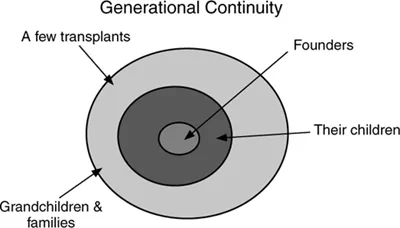
Today people charter a congregation, and then seven years later they move. If they are lucky to remain in the community, when their children grow up those young adults leave home for employment opportunities somewhere else. And when they relocate, they usually become a part of that rapidly growing segment known as the unchurched.13
In addition our families are much smaller than they were in the 1960s. In that time (before birth control pills were widely used) the birth rate among American Anglos was 24 per 1,000 people. Today that number is just 11...
Table of contents
- Cover
- Dedication
- Title
- Copyright
- Contents
- Foreword
- Introduction
- 1. A Macro Lens of Doing Church Today
- 2. Exegete Your Community
- 3. Assessing Congregational Readiness
- 4. Good to Great Congregations
- 5. Called for a Particular Purpose
- 6. Writing a Ministry Plan
- Appendix A: Life-cycle of a Community
- Appendix B: Sample Ministry Plan
- Notes
Trusted by 375,005 students
Access to over 1.5 million titles for a fair monthly price.
Study more efficiently using our study tools.
Frequently asked questions
Yes, you can cancel anytime from the Subscription tab in your account settings on the Perlego website. Your subscription will stay active until the end of your current billing period. Learn how to cancel your subscription
No, books cannot be downloaded as external files, such as PDFs, for use outside of Perlego. However, you can download books within the Perlego app for offline reading on mobile or tablet. Learn how to download books offline
Perlego offers two plans: Essential and Complete
- Essential is ideal for learners and professionals who enjoy exploring a wide range of subjects. Access the Essential Library with 800,000+ trusted titles and best-sellers across business, personal growth, and the humanities. Includes unlimited reading time and Standard Read Aloud voice.
- Complete: Perfect for advanced learners and researchers needing full, unrestricted access. Unlock 1.5M+ books across hundreds of subjects, including academic and specialized titles. The Complete Plan also includes advanced features like Premium Read Aloud and Research Assistant.
We are an online textbook subscription service, where you can get access to an entire online library for less than the price of a single book per month. With over 1.5 million books across 990+ topics, we’ve got you covered! Learn about our mission
Look out for the read-aloud symbol on your next book to see if you can listen to it. The read-aloud tool reads text aloud for you, highlighting the text as it is being read. You can pause it, speed it up and slow it down. Learn more about Read Aloud
Yes! You can use the Perlego app on both iOS and Android devices to read anytime, anywhere — even offline. Perfect for commutes or when you’re on the go.
Please note we cannot support devices running on iOS 13 and Android 7 or earlier. Learn more about using the app
Please note we cannot support devices running on iOS 13 and Android 7 or earlier. Learn more about using the app
Yes, you can access From Our Doorsteps by Rick Morse in PDF and/or ePUB format, as well as other popular books in Theology & Religion & Christian Church. We have over 1.5 million books available in our catalogue for you to explore.