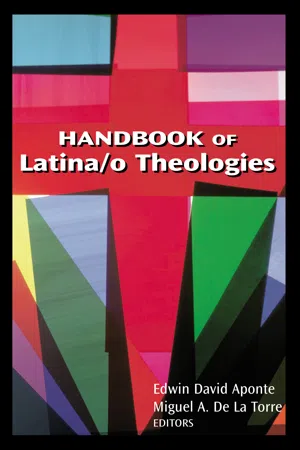
Handbook of Latino/a Theologies explores the varied theological, ecclesiastical, spiritual, and cultural expressions associated with the term 'Latino/a or Hispanic theology.' There is no single definition of Hispanic/Latino theology, but rather a multiplicity of perspectives within the diverse Latino/a communities that articulate a distinctive and relevant Hispanic viewpoint. This collection of thirty-four essays surveys how Latinos/as understand and do theology within those varied contexts. It gives attention to the history, nature, sources, and development of Latinos/as theological expressions within the U.S. and their contribution to the overall theological discourse and to the individual groups that gave rise to them. Part I of the handbook presents essays on many traditional topics in Christian theology representative both of the individual authors and various beliefs found in Latino/a communities. Part II focuses on trends and contextual issues within the overall Hispanic/Latino theological conversation.
eBook - ePub
Handbook of Latina/o Theologies
- 320 pages
- English
- ePUB (mobile friendly)
- Available on iOS & Android
eBook - ePub
Handbook of Latina/o Theologies
About this book
Information
Topic
Theology & ReligionSubtopic
Christian Theology PART I
Thematic Essays
CHAPTER 1
God

Created in the Image of Diosito
The notion of God is a very broad metaphysical concept. To write a short chapter on this subject would not do justice to the variety of religious expressions and understandings behind this theological concept. Therefore, this chapter nuances this topic from the perspective of theological anthropology, in order to better understand notions of God from a Latino/a perspective. This chapter revisits a theological construct referred to in the dogmatic tradition as the imago Dei, a notion taken from the biblical reference to human beings as created in the image and likeness of God (Gen. 1:26–27). By examining the concept from the perspective of the dogmatic tradition in conversation with Hispanic popular religious expression, this chapter will elucidate how the community expresses and images its self-understanding in light of the experience of the sacred. An attempt will be made to show that God as experienced by the Hispanic/Latino/a community is not an exclusive metaphysical reality, but a personal and communal God who journeys with the people in daily life. To this end, this chapter will consult the diverse voices of both the Protestant and the Roman Catholic communities for a broader glimpse of the intimate and endearing God who is often referred to as Diosito.
To speak of God is to reflect on the nature or essence of God as experienced in community. When Protestant ethicist Ismael García writes that “Hispanics confess that our humanity is grounded in our being created in God’s image,” he is speaking about the experience of a people who understand themselves as beloved of God who is amor, that is, love in relationship with others and specifically with a particular community that refers to itself as the Hispanic/Latino/a people of faith (1997:130). As a Protestant theologian who has reflected deeply on the meaning of God as amor, I have discovered from within my own community of faith and familial relationships that the character and nature of God is to be amoroso and cariñoso. This means God is a loving and affectionate friend who is often called Diosito, a term of endearment for One who is known intimately. This endearing friend creates, reveals, and manifests the essence of a caring love most acutely through others. As someone who loves us, Diosito is both a good friend, un Buen Amigo, and a Lover, un Amante, who initiates a loving relationship with the beloved community through the life and death of the beloved Son, Jesus of Nazareth. As Diosito, El Buen Amigo, and Amante, God loves the beloved community and creates us with this essence and capacity for reciprocal love even as our sinful nature often mars this image of perfect love. This amor del Amante and Buen Amigo is most clearly revealed in the incarnational love and ministry of Jesus of Nazareth. This is a view poignantly expressed by Roman Catholic theologian Virgilio Elizondo in his reflections and writings on the Galilean.1
To better understand the construct of the imago Dei and the notion that we as a people have been created “in the image and likeness of Diosito,” who is amor, let us briefly turn to the scriptural references. These texts are Genesis 1:26a: Then God said, “Let us make humankind in our image, according to our likeness…” and Genesis 1:27: “So God created humankind in his [sic] image, in the image of God he [sic] created them; male and female he [sic] created them.” Biblical scholars and theologians throughout the ages have reflected on the meaning of these texts as a way of understanding the nature and essence of the human, who is a reflection of the Creator.
Biblical scholar Claus Westermann points out that human dignity and responsibility for the creation are core values conferred by God in the creation of the human and that “implicit in being created in the image of God is the capacity for language” (1987:11).2 Westermann also observes that the succession of human generations that the early biblical writer places after the creation story in Genesis (chapters 5 and 10) is a succession of names, and in the succession of names lies the beginning of history. History, he notes, grows out of the blessing conferred on the human family through fertility and procreation.
Westermann’s observations resonate with the Hispanic/Latino/a perspective on the imago Dei for several reasons. First, language or the ability to speak and name the world is derivative of the imago Dei as a gift of Diosito. The language of the family of origin is a gift of a historical and theological worldview. The gift of language also confers an identity that is nurtured and affirmed through the culture and history of the family and the community. It allows us to name the world and to cocreate with Diosito in the language of our culture. Historically, Hispanics/Latinos/as have been chastised for speaking the Spanish language because it represents the language of a conquered people. At the same time, Hispanics/Latinos/as who speak English as their primary language have at times experienced the lament of the loss of the native language of their parents and grandparents. While the English language has provided new opportunities, they are still treated as minorities within a much larger English-speaking dominant culture that often does not appreciate or value their contributions. Since the Spanish language is considered a foreign language throughout the United States, both the governmental and educational systems have attempted to eradicate it. The community resists these efforts because it recognizes that the Spanish language is the language of the heart. It is the language of prayer and of communion with Diosito.
Secondly, language is history. The gift of language allows the connection to the past. It gives the Hispanic/Latino/a community its sense of history and specificity within a culture that is not its own. It nurtures the cultural memory of faith and reminds the community that it has a place of belonging in the heart of God.3 It also provides the connection to the larger Hispanic/Latino/a community throughout the United States, so that a sense of solidarity and community arises wherever the Spanish language is heard and spoken. It helps to end the isolation that many immigrants feel when they enter this country and do not speak the English language. It reminds them that they have a common history and familiar roots. It confers dignity.
The apologists during the early church period emphasized the high value of the human being as a recurring theme in their works. This resonates with the Hispanic/Latino/a community. The early church writers appear to be in agreement with the psalmist in elevating the nature of humanity to a degree only slightly lower than the angels (Ps. 8). The noble characteristics they perceive in the human–such as dignity, purity, and virtue; moral freedom and responsibility; reason in the service of morality; the ability to commune with God; as well as the bodily nature as a reflection of the divine and royal image–are all evidence of an exalted view of humanity that was to characterize the early church movement and make it an appealing force for the community of the marginalized. These reflections were the basis for an early Christian theological anthropology that would leave its mark on the Roman Empire as the Christian church continued to grow as a subversive force within the empire. This elevated view of humanity would be a dynamic force in opposing the Roman notions of conquest and subjugation of foreign peoples.
Like the early church movement, the Hispanic/Latino/a community lives with a sense of estranged otherness due to a conquest of territories dating back to the nineteenth century. For Miguel De La Torre and Edwin Aponte, most Hispanics continue to be seen by the dominant culture as exiles, aliens, and outsiders, regardless of their historical connection to U.S. lands (2001:46–53). In light of this perception, the community strives to preserve its dignity based on its understanding of the human family. For Justo González, to be fully human is to be-for-others (1990:131). In this scenario no one exercises power over others, for that would lead to the dehumanization of everyone and the loss of our for-otherness. González and other Hispanic/Latino/a scholars such as Ada María Isasi-Díaz (1993:34–54) and Ismael García (1997:130–72) affirm the human being in other ways. They express and affirm the value of the human distinctively in community and in being-for-others. Sin is the violation of that for-otherness and the violation of God’s image in us, which for González is precisely the image of God’s for-otherness. The Hispanic/Latino/a affirmation of the oppressed minority differs from the way the early church theologians affirmed the human being. While early theologians affirmed the capacities of humans in their abilities to be like God, their interpretation tended to focus on the physical and psychical merits of the individual as a created being. They focused less on the human as a social and relational being who, as a communal person, reflects the image of Diosito who cares for others in community as exemplified in the life and praxis of Jesus of Nazareth.
From the perspective of the Hispanic/Latino/a community, the Genesis texts can only be understood and interpreted from within the context of a history of conquest, exile, and diaspora. This is also the experience of the more recent immigrant community and the U.S. native-born Hispanic/Latino/a community. Both share a history of marginalization, exclusion, and indignity due to cultural, linguistic, and religious roots and affiliations. Reflecting on this experience, Justo González and Ismael García have interpreted the imago Dei construct with an understanding that to be created in the image and likeness of God affirms the human worth and dignity of all people and, in particular, those on the margins of society. For González, creation in the image and likeness of God means the exercise of the creative power and love of God after whom we have been created. As love, God’s nature is being-for-others, and to be fully human is to be for others in a praxis of love and care.
The notion of the exiled community affirming its dignity in the face of oppressive conditions is not unlike the Hebrew writers who affirmed the dignity of their community when they constructed the Genesis texts of the imago Dei. They wrote those texts during or soon after the Babylonian exile and captivity as a way of affirming their God-given dignity and as a way of refuting the notion that only those in power were of divine origin. This experience closely parallels the Hispanic/Latino/a reality of exile and marginalization and the self-understanding that emerges from the encounter with the sacred. Whereas the exiled Hebrews sang the songs of Zion by the waters of Babylon, the Hispanic/Latino/a community sings songs or coritos (little choruses) that affirm the experience of a living and liberating God.4
The community interprets the biblical texts and their songs of praise in light of their experience of Diosito who, as being for-others, loves and cares for them. This understanding of Diosito is expressed most vividly through a popular corito known as “Tu has venido a la orilla” (“You have come down to the lakeshore”). The lyrics express the understanding of Diosito as an intimate friend who calls us by name and invites us into the service of the reign of God:
You have come down to the lakeshore
Seeking neither the wise nor the wealthy,
but only asking for me to follow.
Refrain
Sweet Lord, you have looked into my eyes;
kindly smiling, you’ve called out my name.
On the sand I have abandoned my small boat;
Now with you, I will seek other seas.
Seeking neither the wise nor the wealthy,
but only asking for me to follow.
Refrain
Sweet Lord, you have looked into my eyes;
kindly smiling, you’ve called out my name.
On the sand I have abandoned my small boat;
Now with you, I will seek other seas.
You know full well what I have, Lord:
neither treasure nor weapons for conquest;
just these my fish nets and will for working.
neither treasure nor weapons for conquest;
just these my fish nets and will for working.
You need my hands, my exhaustion,
working love for the rest of the weary
a love that’s willing to go on loving.
working love for the rest of the weary
a love that’s willing to go on loving.
You who have fished other waters;
you, the longings of souls that are yearning:
O loving Friend, you have come to call me.5
you, the longings of souls that are yearning:
O loving Friend, you have come to call me.5
According to Aponte, coritos are concrete vehicles that express a hope, faith, and empowerment rooted in both the Bible and lived experiences of the community. They give a voice to the hope of the people and their faith in God. They allow the community the freedom to give voice to their understanding of Diosito in their own language. They allow us to cross denominational barriers and racial and language boundaries as we recognize that we serve the same Lord and Diosito of all.
In summary, Hispanics/Latinos/as understand themselves to be created in the image and likeness of Diosito. This self-understanding is most clearly revealed through the gift of language by which they know and name themselves in light of their experience of a loving Diosito. The popular coritos capture this sense of the sacred Other who knows them intimately and calls them by name. The Hispanic/Latino/a people proclaim in many and diverse ways that in the community of the beloved all people are welcome and no one is a stranger before Diosito who is both Amigo and Amante. Their faith in Diosito expressed through their own cultural and religious symbols affirms and celebrates their understanding of God who calls all people into a loving relationship with others.
1 See, for example, Elizondo, The Galilean Journey, 2000a.
2 See also Alanís, Dignity for the Foreigner, 2002:8.
3 See, for example, Rodríguez, “Sangre llama a sangre,” 1996:351–66.
4 For an excellent exposition of this cultural symbol, see Aponte, “Coritos as Active Symbols,” 1995:57–66.
5 “Tu has venido a la orilla” by Cesáreo Gabarain; translated from the original Spanish by Medeleine Forell Marshall.
CHAPTER 2
Jesus
At 10:00 a.m., a loud trumpet signals the entrance of Pilate onto the stage to confront Jesus of Nazareth. From this point on, the words and actions follow the gospel passion narratives, with San Fernando parishioners playing the parts of the different characters in the passion story. Pilate sends Jesus to Herod, who in turn returns him to Pilate for judgment. After the crowd calls for the release of Barrabas, Jesus is flogged and crowned with thorns. Pilate presents the beaten and broken Nazarene to the people–that is to the assembled crowd in San Fernando/ Jerusalem–who cry out for his crucifixion. The scene can only be described as eerie: this is not an event that happened two thousand years ago, but an event taking place today and in which we are actively participating (Goizueta,1995:34).
With this haunting description of the Good Friday reenactment at San Fernando Cathedral in San Antonio, Texas, Cuban American theologian Roberto S. Goizueta enters into the popular rituals surrounding one of the most powerful images in Latino/a religiosity: the crucified Jesus. The Jesus of Good Friday is a central christological symbol within Latino/a theology. This stems from a theological worldview that strongly emphasizes Jesus’ humble origins, his prophetic message, and his active presence in the present-day lives of Christians, in particular his solidarity with the oppressed and marginalized. This strong emphasis on Jesus’ suffering and passion distinguishes Latinos/as fro...
Table of contents
- Cover
- Title Page
- Copyright
- Contents
- Contributors
- Intoduction
- Part 1 - Thematic Essays
- Part 2 - Contextual Essays
- Bibliography
Trusted by 375,005 students
Access to over 1.5 million titles for a fair monthly price.
Study more efficiently using our study tools.
Frequently asked questions
Yes, you can cancel anytime from the Subscription tab in your account settings on the Perlego website. Your subscription will stay active until the end of your current billing period. Learn how to cancel your subscription
No, books cannot be downloaded as external files, such as PDFs, for use outside of Perlego. However, you can download books within the Perlego app for offline reading on mobile or tablet. Learn how to download books offline
Perlego offers two plans: Essential and Complete
- Essential is ideal for learners and professionals who enjoy exploring a wide range of subjects. Access the Essential Library with 800,000+ trusted titles and best-sellers across business, personal growth, and the humanities. Includes unlimited reading time and Standard Read Aloud voice.
- Complete: Perfect for advanced learners and researchers needing full, unrestricted access. Unlock 1.5M+ books across hundreds of subjects, including academic and specialized titles. The Complete Plan also includes advanced features like Premium Read Aloud and Research Assistant.
We are an online textbook subscription service, where you can get access to an entire online library for less than the price of a single book per month. With over 1.5 million books across 990+ topics, we’ve got you covered! Learn about our mission
Look out for the read-aloud symbol on your next book to see if you can listen to it. The read-aloud tool reads text aloud for you, highlighting the text as it is being read. You can pause it, speed it up and slow it down. Learn more about Read Aloud
Yes! You can use the Perlego app on both iOS and Android devices to read anytime, anywhere — even offline. Perfect for commutes or when you’re on the go.
Please note we cannot support devices running on iOS 13 and Android 7 or earlier. Learn more about using the app
Please note we cannot support devices running on iOS 13 and Android 7 or earlier. Learn more about using the app
Yes, you can access Handbook of Latina/o Theologies by Dr. Edwin David Aponte,Dr. Miguel A. De La Torre, Dr. Edwin David Aponte, Dr. Miguel A. De La Torre in PDF and/or ePUB format, as well as other popular books in Theology & Religion & Christian Theology. We have over 1.5 million books available in our catalogue for you to explore.