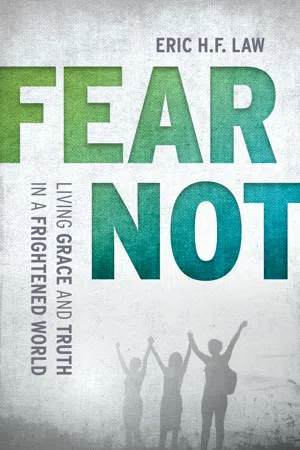
Learn how to face your fears and and live into courageous and faithful action with Fear Not. Americans live in a culture of fear, whether we know it or care to admit it. Who will attack us next? Who will steal our jobs? Whose relationship undermines the sanctity of mine? In an era when manipulative messaging is unavoidable, politicians, media, marketers, and even faith leaders play on our fears and use them to win elections, gain attention, sell products, and influence the way you view those around you — all in the name of claiming power. Fear Not subverts insidious fear-based messaging with the creation of courageous communities committed to truth-telling, grace, hope, and love. Drawing on decades as a community-building and church growth leader for churches and nonprofit organizations, Eric H.F. Law shares practical resources and processes for bringing diverse people together to build authentic relationships and share their truth. Each chapter includes suggested activities and questions for discussion and tips for creating small discussion groups.
- 160 pages
- English
- ePUB (mobile friendly)
- Available on iOS & Android
eBook - ePub
About this book
Information
Topic
Theology & ReligionSubtopic
Religion, Politics & State1: Fear, Phobia, Sex, and Ministry
I went to an open house of a condominium for sale on the thirtieth floor of a beautiful building in Vancouver, British Columbia. It had a fairly good-sized balcony that, according to the realtor, was a major selling point of this property. Gingerly, I stepped onto the balcony, making sure that it was solidly built and that the floor was not wet or slippery. As I moved toward the railing, I noticed my heart was pounding a little faster. I pushed against the rail with my hand making sure that it was also secured before I would lean on it. I held onto the rail with one hand while my other hand automatically moved up toward my face. With my index finger pressing against my glasses to make sure they would not fall off my face, I looked over the railing and down. Cars, like toys, moved through the streets below. I thought to myself: no one would survive a fall from this high up. I looked out and saw the magnificent view of the city, with the snow-capped mountains serving as a backdrop. That view was why I stepped out on this balcony on the thirtieth floor.
The Nature of Fear
I have a fear of heights. I used to be embarrassed to admit it until I started doing research for this book. As I read many books on the subject of fear, I discovered that my fear of heights is normal and justified. Miriam Greenspan, in her book Healing Through the Dark Emotions, writes:
Fear arises in any situation where there is a threat of loss or harm to body, mind, and spirit. It is a basic emotion, built into the biological organism. Part of our deepest instinct for survival, fear is our emotion alarm system…Without it, we would be unable to protect ourselves…What fear tells us is that something requires immediate and close attention. Its purpose is to move us to action to protect life. An alarm signal goes off that says: Stop where you are—there’s danger ahead.1
Gavin de Becker, author of The Gift of Fear, describes fear as an intuitive response to potential danger:
When it comes to danger, intuition is always right in at least two ways:
1. It is always in response to something.
2. It always has your best interest at heart…
Clearly, not everything we predict will come to pass, but since intuition is always in response to something, rather than making a fast effort to explain it away or deny the possible hazard, we are wiser (and more true to nature) if we make an effort to identify the hazard, if it exists. If there is no hazard, we have lost nothing and have added a new distinction to our intuition, so that it might not sound the alarm again in the same situation.2
The intuitive signal of fear invites us to think and then act in ways that will help us avoid the danger, if there is danger ahead. It should not cause us to panic. De Becker continues:
“The very fact that you fear something is solid evidence that it is not happening. Fear summons powerful predictive resources that tell us what might come next. It is that which might come next that we fear—what might happen, not what is happening now…
What you fear is rarely what you think you fear—it is what you link to fear. Take anything about which you have ever felt profound fear and link it to each of the possible outcomes. When it is real fear, it will either be in the presence of danger, or it will link to pain or death. When we get a fear signal, our intuition has already made many connections. To best respond, bring the links into consciousness and follow them to their high-stakes destination— if they lead there.3
This discipline of linking the fear to the high-stakes or worst-case destination does three things:
1. It helps us determine whether the danger is imminent and therefore requires immediate action. For example, my fear of heights is linked to the physical danger of slipping and falling thirty stories, which is then linked to the fear of ending up smashed on the pavement below. It takes two links to death. No wonder my heart rate went up, my system went into higher alert, and I therefore proceeded with greater caution—checking the balcony floor to make sure it was not slippery and making sure that the railing was solidly built—before I leaned on it. Was I overly cautious? Perhaps. But the bottom line was: I did not trust the railing, the balcony, or the building because I was unfamiliar with it. My fear, which led to my cautious behavior, was justified.
2. Linking a fear to its most terrible destination helps us discern an unwarranted fear and therefore alleviate the anxiety that may be triggered by the fear. For example, if I have a fear of speaking in public, this fear could be linked to the fear of being perceived by my audience as incompetent. This would get back to my boss, and she would fire me. Without a job, I would not be able to pay the mortgage of my home or provide for my family and loved ones. My family would reject me. I would be homeless and alone. I would be perceived by others as useless and a burden to society. I might die of hunger or catch some nasty disease. I would not have insurance to pay for my needed care, and I would die. Although I may link the fear of public speaking to death, I can also see that it would be a long and unlikely trip. Linking fear to its most terrible destination helps us distinguish between fear signals that predict real danger and the fears that are not warranted. 4
3. When we are able to link a fear to its ultimate horrible destination, we can begin to see the fear in its wider context. This is like “going on a train ride’ of inquiry: probing the depths of your fear to the final stop or destination, and then widening fear’s story from this end point.”5 Let me continue with my example of my fear of speaking in public. I took the long train ride and arrived at the final destination, which is death. Now, I knew that it was unlikely that I would die from speaking in public; however, I needed to ask myself: what was the wider story emerging out of this fear? Perhaps it has something to do with me not trusting my own ability—a lack of self-esteem. This one is easy to deal with. I may take a public-speaking class and learn the skills and techniques to give good speeches and be prepared when I am invited to speak in the future. But there is something deeper in this story of fear. It may have something to do with the fear of being rejected by a community. This is linked to my need for a community that accepts me. But doesn’t everybody need to have a loving accepting community independent of one’s ability to perform? This wider context of this fear caused me to spend my time and energy to learn how to develop affirming, accepting communities not just for myself but for others as well. By pondering the wider story of this fear of public speaking, I discovered an area in my personal life about which I can do something to improve. I also discovered a greater need of others, which then becomes a call to the ministry to develop inclusive communities.
Taking the time to ponder my fear often points to opportunities for ministry. My fear of heights is linked to my fear of falling, which is linked to my fear of dying from hitting the ground. Having done all the cautionary steps to make sure that I am safe from falling, I need to ask myself: What is this fear of falling about? It probably has something to do with losing control, getting hurt, and dying. Now, I have some choices: I can avoid tall buildings, or I can meditate on my fear of uncertainty, loss of control, and death. Avoiding high places only limits the way I live—for example, missing the magnificent view on the mountains on the thirtieth floor balcony. Also, avoiding tall buildings will not help me live longer.
The other choice would be more productive: meditating on my fear of uncertainty, loss of control, and death. My fear of heights informed me that I’m afraid of death, which is a given in life. It tells me that no matter how hard I try to control things around me, they are not going to be totally in my control. This fear is asking me to live my life in the midst of things that I have no control over, and to live it knowing death is going to come. These topics are worth taking time to explore. As I ponder further on this direction, I may realize that the fear of chaos and death is a common experience among many people in the world in which we live. This exploration may lead me to enter a ministry to help people facing the end-stages of their lives. It may direct my attention and energy in creating a safer environment—working to provide more secure and safe jobs, finding ways to insure everyone has adequate healthcare, providing law enforcement organizations that respect the people they protect, etc.6
Fear and Phobias
If fear is such a good thing that could point us toward doing needed ministries, why do we have so much trouble dealing with it? Why did I have trouble admitting that I have a fear of heights? Why do people have phobias about so many things? Why do people do irresponsible things, putting themselves and others in danger, just to prove that they have no fear? To reap the fruit of fear requires us to face it head on. It requires the willingness to take that train ride to get to the last stop. However, the emotions and physical respon...
Table of contents
- Praise for Fear Not
- Other Books by Eric H.F. Law
- Dedication
- Copyright
- Contents
- Acknowledgments
- Preface
- Introduction
- 1: Fear, Phobia, Sex, and Ministry
- 2: Fear, Marketers, Politicians, and Symbolic Substitutes
- 3: Rituals, Rules, Technologies, and the Color-Coded Threat-Level System
- 4: Fear-Conqueror, Fear-Bearer, and Fear-Miner
- 5: Fear-Exploiter, Fear of God, and Intimacy with God
- 6: Finding Intimacy in a World of Fear
- 7: What Are You Doing Here?
- 8: I Need Your Light
- Appendix
- Prep for the Holidays
- About the Author
Trusted by 375,005 students
Access to over 1.5 million titles for a fair monthly price.
Study more efficiently using our study tools.
Frequently asked questions
Yes, you can cancel anytime from the Subscription tab in your account settings on the Perlego website. Your subscription will stay active until the end of your current billing period. Learn how to cancel your subscription
No, books cannot be downloaded as external files, such as PDFs, for use outside of Perlego. However, you can download books within the Perlego app for offline reading on mobile or tablet. Learn how to download books offline
Perlego offers two plans: Essential and Complete
- Essential is ideal for learners and professionals who enjoy exploring a wide range of subjects. Access the Essential Library with 800,000+ trusted titles and best-sellers across business, personal growth, and the humanities. Includes unlimited reading time and Standard Read Aloud voice.
- Complete: Perfect for advanced learners and researchers needing full, unrestricted access. Unlock 1.5M+ books across hundreds of subjects, including academic and specialized titles. The Complete Plan also includes advanced features like Premium Read Aloud and Research Assistant.
We are an online textbook subscription service, where you can get access to an entire online library for less than the price of a single book per month. With over 1.5 million books across 990+ topics, we’ve got you covered! Learn about our mission
Look out for the read-aloud symbol on your next book to see if you can listen to it. The read-aloud tool reads text aloud for you, highlighting the text as it is being read. You can pause it, speed it up and slow it down. Learn more about Read Aloud
Yes! You can use the Perlego app on both iOS and Android devices to read anytime, anywhere — even offline. Perfect for commutes or when you’re on the go.
Please note we cannot support devices running on iOS 13 and Android 7 or earlier. Learn more about using the app
Please note we cannot support devices running on iOS 13 and Android 7 or earlier. Learn more about using the app
Yes, you can access Fear Not by Eric H. F. Law in PDF and/or ePUB format, as well as other popular books in Theology & Religion & Religion, Politics & State. We have over 1.5 million books available in our catalogue for you to explore.