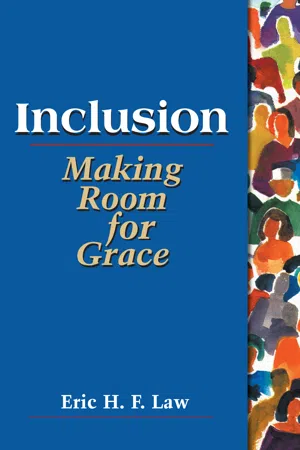
"Inclusion, " says the author, "is a discipline of consciously extending the boundaries of our communities to embrace and affirm people of diverse backgrounds and experiences." In this resource for ministers and church leaders, Law provides models, theories, and strategies that are both practical and theologically sound for moving faith communities toward greater inclusion.
- 140 pages
- English
- ePUB (mobile friendly)
- Available on iOS & Android
eBook - ePub
About this book
Information
Topic
Theology & ReligionSubtopic
Christian Church1
Now That Faith Has Come:
Resisting the Impulse to Exclude
When I started working on this book, I had difficulty focusing on the central topic: inclusion. Whenever I got close to writing down an idea, my train of thought would be intercepted by these questions: But what about how we exclude? How would I deal with all the justifications for exclusion coming from my readers? Immediately, I would think of the many ways that we exclude through our prejudices, discrimination, racism, sexism, ageism, homophobia, and so on. My mind would race around in circles in this arena of exclusion. Then I caught myself. Why am I doing this? There are plenty of books published on the different “isms” and how they exclude. What can I say that has not been said? What is needed is a body of literature on the other side of the equation—how do we include? With that I would attempt to focus on the subject of inclusion again. After going through this pattern a few times, I finally gave in to the need to dwell in the arena of exclusion. I figured that if I wrote about exclusion for at least a short while, I could exorcize and cleanse my mind of it so that I could spend the rest of my energy on describing inclusion. This short play and the pages that follow are the result of that endeavor.
A Dialogue between Two Children of God
| Child 1: | God loves me. |
| Child 2: | God loves me too. |
| Child 1: | How can that be? |
| Child 2: | Why not? |
| Child 1: | Because God loves me. |
| Child 2: | That doesn’t mean God can’t love me. |
| Child 1: | Yes, it does. |
| Child 2: | Why? |
| Child 1: | Because I’m older and God loved me first. |
| Child 2: | That’s not fair. |
| Child 1: | You don’t expect God to love me all these years and then suddenly change his mind and love you just because you show up, do you? |
| Child 2: | Why can’t God love more than one person? |
| Child 1: | Of course God can do that. It’s just that God can’t love you. |
| Child 2: | Why? |
| Child 1: | Because I don’t like you. |
| Child 2: | What does that have to do with anything? |
| Child 1: | If God loves me and I don’t like you, how can God possibly love you? |
| Child 2: | You’re mean. |
| Child 1: | Say all you want, but you won’t get God to love you. |
| Child 2: | Why? |
| Child 1: | Because I told him not to. |
| Child 2: | You can’t tell God what to do! |
| Child 1: | Of course I can. God and I are real buddies. |
| Child 2: | I don’t think God likes being told what to do. |
| Child 1: | You can if he loves you. |
| Child 2: | I think you’re going to hell. |
| Child 1: | What?! |
| Child 2: | God says, “Don’t judge, lest you be judged.” |
| Child 1: | Where did you hear that? |
| Child 2: | It’s in the Bible. Since you judged me, I will tell God to judge you, so you are definitely going to hell. |
| Child 1: | You can’t do that. |
| Child 2: | If you can tell God what to do, so can I. |
| Child 1: | But you don’t even know God. |
| Child 2: | I don’t know your god, but I know mine. |
| Child 1: | Are you saying there are two different gods? |
| Child 2: | Yeah, one loves you, and one loves me. And I don’t think they get along in heaven. |
| Child 1: | That’s because my god is better. |
| Child 2: | No, my god is nicer. |
| Child 1: | My god is stronger |
| Child 2: | My god is smarter. |
| Child 1: | My god is bigger. |
| Child 2: | My god is prettier. |
| Child 1: | Wait a minute. This doesn’t sound right. |
| Child 2: | What doesn’t sound right? |
| Child 1: | I thought there is only one God. |
| Child 2: | Where did you hear that? |
| Child 1: | It says so in the Bible. |
| Child 2: | Then your god must be a fake. |
| Child 1: | No, my god is the real one, and your god must be Satan. |
| Child 2: | How dare you insult my god! |
| Child 1: | You are going to burn in the eternal fire of hell, Satan-worshiper! |
| Child 2: | You are going to be chopped up into a million pieces for insulting my god! |
| Child 1: | I hate you. |
| Child 2: | I hate you too. |
| Child 1: | I’ll kill you. |
| Child 2: | I’ll kill you first because the real god is on my side. |
| Child 1: | No, you have Satan on your side; you will definitely die first. |
(They fight. Then one kills the other and goes on to argue with another child of God.)
Like the two children in this fictional play, we also have the tendency to exclude others just because they are different. Furthermore, for religious groups, we often bring God into the situation to justify our acts of exclusion. I wish I could say that all of us are born with an accepting attitude that appreciates differences, but in reality we tend to react to differences in negative and exclusive ways, especially early in our lives. For example, when young boys or girls discover the existence of the opposite sex, their reaction is not “Isn’t that interesting? Let me learn more about you.” Rather, their initial reaction is most likely a negative one, so they form boy groups and girl groups that are exclusive of each other. Over time, as we mature, we work through these initially negative reactions and learn to accept and appreciate the differences between genders. We even go out of our way to learn to live with the opposite sex, as demonstrated by the large quantity of literature addressing the differences between men and women published in the 1980s and 1990s.
However, the impulse to use exclusion as a means to deal with other kinds of differences remains with most of us even into adulthood. We have a yearning for stability and the familiar. By excluding those who are different, we don’t have to work so hard to interact with new faces with “foreign” backgrounds and histories. In our comfortable group, we know all the rules; we know what to expect from each other; and we can be ourselves. But the world as God has created it is full of diversity. No matter how hard we try to isolate ourselves from these diversities, they are all around us. The moment we step outside our homes into our neighborhoods, our schools, or our workplaces, we cannot help but encounter people who are different. The differences that we have to deal with are, first of all, those basic diversity dimensions that exist within the human family—ethnicity, racial identity, gender, age, physical ability, and sexual orientation.
Beyond the above basic dimensions of diversity, which are mostly unchangeable, are other diversity dimensions we must consider, such as education, marital status, parental status, geographic location, work experience, military experience, religion, and economic status.1 I would add theological difference as a dimension that most churches need to be aware of in considering the spectrum of diversity.
We may presume people who are different to be a threat to the safety and stability of our community. In order to protect ourselves from this perceived threat, we sometimes exclude others by insulating ourselves from them, or by shutting others out. We exclude others by ostracizing them, engaging in outright rejection of the differing others. We discriminate against them. We segregate them. We put up rules and criteria for acceptance, and then pronounce that there is no exception. We make up lies about how they are inferior and suggest that they might even be inhuman.
As I was writing the above paragraph, I realized the enormous number of words in the English language that we have available to describe exclusion: omission, ostracism, segregation, apartheid, banishment, deletion, deportation, discrimination, elimination, exemption, exile, expulsion, exception, expurgation, rejection, removal, and so on. When I think about verbs that we use to exclude, there are even more choices: ban, bar, blackball, blacklist, boycott, cut off, delete, disregard, drop, eject, eliminate, excommunicate, expel, forbid, insulate, isolate, omit, ostracize, overlook, prevent, prohibit, reject, segregate, separate, shun, shut out, and so on.
“What about words for inclusion in the English language?” I started to wonder. “What words are available to me in writing a book on the subject of inclusion?” So I looked in the thesaurus that was available in my computer’s word processing software. I was shocked to find only three synonyms for inclusion: insertion, addition, and enclosure. On further examination, I noticed these three words were all meant to be used to describe the inclusion of objects, not people. I then checked for synonyms of the verb form of inclusion. I was happy to discover that there were more choices in the verb department, but again the choices were mostly verbs describing inclusion of objects—for example, comprise, consist of, constitute, contain, entail, cover, insert, interject, and so forth. When I eliminated those verbs that imply inclusion of objects only, I was left with embody, embrace, encompass, incorporate, and involve.
No wonder we are so ready to dive into the language and action of exclusion when we are faced with a group or person who is different. Our language, which is indicative of our cultural values, supplies a long list of expressions for exclusion but gives very little support for expressions of inclusion. And most expressions of inclusion are of objects, not of people. As a result, many of our efforts in the past to include people have treated those human beings that we were trying to include as objects to be moved around. Inclusion then became inserting the right number of people of each kind into the organization so that the organization would consist of the right percentage of the necessary different kinds of people. We paid little attention to what happened to them once they were “inserted.”
Perhaps one of the reasons for the scarcity of words to articulate the inclusion of people is that the inclusion of people is a fairly new concept in the English language. Another reason may be that inclusion seems much more complicated than exclusion. Exclusion is simple. Once we reject the others, we don’t have to deal with them anymore. We can go back to business as usual—no change, no hassle, no worries. It’s clean. It requires little time, money, and energy. Inclusion involves a great deal of thinking and listening when we take into consideration others’ experience, history, feelings, and so forth. Inclusion requires time and energy to follow up after a group or person has been physically included. It requires that everyone readjust. It requires change. Once a group is embraced in our circle, we have to live with its members for an unspecified period of time. That prospect can be very unsettling.
In all accounts, exclusion seems to be the more appealing choice when it comes to dealing with people who are different. This may be the reason I kept getting stuck in writing and thinking about exclusion when I was trying to articulate inclusion. This may be why we unconsciously choose exclusion time and again as a means to address differences.
Not only do we go straight to acts of exclusion ourselves, we also project our need to exclude onto God through our selective use of the Bible. We are quick to quote chapters and verses to support exclusion. After all, didn’t Jesus drive the money changers out of the temple at Jerusalem? Didn’t Jesus rail against the scribes and the Pharisees?(Mt. 23:1–36; Lk. 11:37–54) Didn’t Jesus say that it was harder for a rich person to enter the kingdom of heaven than to put a camel through the eye of a needle? (Mt. 19:16–30; Mk. 10:17–31; Lk. 18:18–30) Didn’t Jesus say that at the end the Son of man will separate the sheep and the goats and that the sheep will be welcome and the goats will be excluded? (Mt. 25:31–46) Didn’t Paul excommunicate many people from the church? Didn’t Paul say that women were to be submissive to men? We can exclude almost anybody who doesn’t fit our ideas of what a good Christian is and blame it all on God, Jesus, Paul, and whomever else...
Table of contents
- Cover
- Also by Eric H. F. Law
- Title Page
- Copyright
- Dedication
- Contents
- Acknowledgments
- Introduction
- Chapter 1 - Now That Faith Has Come: Resisting the Impulse to Exclude
- Chapter 2 - This Fellow Welcomes Sinners and Eats with Them
- Chapter 3 - Crumbs, Leftovers, and Grace
- Chapter 4 - Making Room for Grace
- Chapter 5 - He Bent Down and Wrote with His Finger on the Ground
- Chapter 6 - Thou Shalt and Thou Shalt Not…
- Chapter 7 - You Shall Have No Other Gods before Me
- Chapter 8 - The Gatekeeper Opens the Gate for Christ
- Chapter 9 - Dancing in the Grace Margin
- Chapter 10 - Adoption, Exile, and a New Creation
- Epilogue
- Appendix A: Checklist for Activating the Inclusion Process
- Appendix B: Rights, Respect, and Responsibilities
- Appendix C: Exploring the History of a Congregation
- Appendix D: Is Your Church Ministry Balanced?: (The Three-legged Stool Process)
Trusted by 375,005 students
Access to over 1.5 million titles for a fair monthly price.
Study more efficiently using our study tools.
Frequently asked questions
Yes, you can cancel anytime from the Subscription tab in your account settings on the Perlego website. Your subscription will stay active until the end of your current billing period. Learn how to cancel your subscription
No, books cannot be downloaded as external files, such as PDFs, for use outside of Perlego. However, you can download books within the Perlego app for offline reading on mobile or tablet. Learn how to download books offline
Perlego offers two plans: Essential and Complete
- Essential is ideal for learners and professionals who enjoy exploring a wide range of subjects. Access the Essential Library with 800,000+ trusted titles and best-sellers across business, personal growth, and the humanities. Includes unlimited reading time and Standard Read Aloud voice.
- Complete: Perfect for advanced learners and researchers needing full, unrestricted access. Unlock 1.5M+ books across hundreds of subjects, including academic and specialized titles. The Complete Plan also includes advanced features like Premium Read Aloud and Research Assistant.
We are an online textbook subscription service, where you can get access to an entire online library for less than the price of a single book per month. With over 1.5 million books across 990+ topics, we’ve got you covered! Learn about our mission
Look out for the read-aloud symbol on your next book to see if you can listen to it. The read-aloud tool reads text aloud for you, highlighting the text as it is being read. You can pause it, speed it up and slow it down. Learn more about Read Aloud
Yes! You can use the Perlego app on both iOS and Android devices to read anytime, anywhere — even offline. Perfect for commutes or when you’re on the go.
Please note we cannot support devices running on iOS 13 and Android 7 or earlier. Learn more about using the app
Please note we cannot support devices running on iOS 13 and Android 7 or earlier. Learn more about using the app
Yes, you can access Inclusion by Eric H F Law in PDF and/or ePUB format, as well as other popular books in Theology & Religion & Christian Church. We have over 1.5 million books available in our catalogue for you to explore.