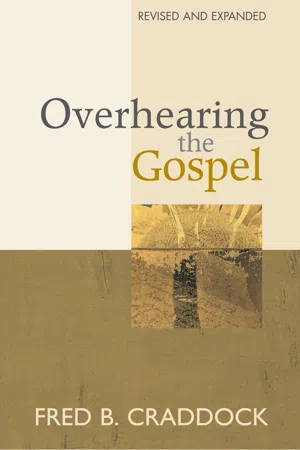
Revised and Expanded Edition! When originally published in 1978, Overhearing the Gospel introduced "narrative preaching" and forever changed the shape of contemporary preaching. Now a new generation of preachers can learn from the master himself in this revised and expanded edition of Craddock's groundbreaking method.
- 160 pages
- English
- ePUB (mobile friendly)
- Available on iOS & Android
eBook - ePub
About this book
Information
Topic
Theology & ReligionSubtopic
Christian MinistryPart I
The Illusion
1
Concerning Method
There is no lack of information in a Christian land; something else is lacking, and this is a something which the one cannot directly communicate to the other.
—SØREN KIERKEGAARD
I suppose you could say this statement from Kierkegaard is my text for the discussion that follows. As such, it is a radical departure from old custom and deep conviction, which have invariably dictated that if a text be used for a Christian discourse, it must be drawn from Holy Scripture. After all, what else is a sermon, or the whole of theology for that matter, but the continuation of the biblical discourse, engaging and being engaged by the ancient text? But I have granted myself an indulgence in this instance, because what follows is neither sermon nor theology.
Elevating a passage to the level of “text” does not mean passively accepting it as unqualified truth, to be served only by elaborations, applications, and exhortations. If with the sacred text one wrestles and grasps with the tenacity of Jacob—“I will not let you go until you bless me”—one can be no less vigorous when engaging Kierkegaard. He delights in picking a fight with his reader, loading his sentences with exaggeration, humor, irony, sarcasm, and homely analogy, offering with one hand what he takes away with the other. So in the ways that a text properly functions—provoking thought and reassessment of old convictions, confirming prior wisdom while serving as governing consideration for new reflection and action—this statement is my text. Phrases within it will prompt our discussions to move in many directions, but its greatest single impact will come in its continually raising the question that refuses to leave the room all the time we are talking: How does one person communicate the Christian faith to another?
But that question itself already hinders us, arousing a widespread notion that threatens to abort fruitful discussion. The threat lurks in a general feeling about the word how. How is for many an ugly word, a cause of embarrassment. There is large opinion that how is to be found not among the prophets or the philosophers, but among mechanics and carpenters. After all, does not how introduce methods and skills more appropriate to a course in driver training than to probing into the mysteries of ultimate reality? What has skill to do with the kingdom of God? Kierkegaard sensed some of this condescension among the clergy and regarded it as a major cause for the decline in the quality of preaching. Perhaps no word among us has suffered more abuse than how, not the honorable abuse of attack, but the humiliating abuse of inattention, disregard, slight. How has been made to stand out in the hall while what was being entertained by the brightest minds among us. What is the issue? What is the truth? What do we believe? What is being taught? Those are the worthy questions, and who would suffer the embarrassment of interrupting the discussion with “But how can we…?” This arrogant dismissal of all considerations of method could properly draw the fire that Somerset Maugham intended for certain haughty devotees of culture among his acquaintances:
Who has not seen the scholar’s thin-lipped smile when he corrects a misquotation and the connoisseur’s pained look when someone praises a picture he does not care for? There is no more merit in having read a thousand books than in having ploughed a thousand fields. There is no more merit in being able to attach a correct description to a picture than in being able to find out what is wrong with a stalled motorcar. In each case it is special knowledge. The stockbroker has his knowledge too and so has the artisan. It is a silly prejudice of the intellectual that his is the only one that counts. The True, the Good, and the Beautiful are not perquisites of those who have been to expensive schools, burrowed in libraries and frequented museums. The artist has no excuse when he uses others with condescension. He is a fool if he thinks his knowledge is more important than theirs and an oaf if he cannot comfortably meet them on an equal footing.1
If this language is too strong for our present consideration, then at least it can register the intensity of my feelings when I survey the devastation wrought by an arrogant dismissal of method in our churches, colleges, and seminaries. Countless young men and women, graduates of excellent schools and of unquestioned intelligence and commitment, are paralyzed early in their ministries because in those tasks that are ministry, in the only sense that really matters, they do not know the how. Of course, there have always been those who insisted on preparation in the how of teaching, preaching, worship, and administration, but the long struggle upstream against the heavily theoretical curriculum tended to make some of them so reactionary and defensive that those of us who had been of a mind to champion their cause grew suspicious of what seemed to be anti-intellectual, nonsubstantive, shallow, and faddish. And these symptoms, in turn, reconfirmed and reinforced the original low opinion of programs centering on method. But the quarrel over the stature of the question how? and whether it deserved a place among the tall questions of our faith was radically shifted by my listening to Kierkegaard. He wrote thirty-five books, all of them in pursuit of a how: how to be a Christian, here in this place, now at this time. As the profundity and significance of those books testify, the pursuit of that question leads one not away from but deeper into the great issues of church history, theology, ethics, and scripture. I grow more and more convinced that the total curriculum of the church, from Sunday school to seminary, should wrestle with the Christian faith as how. Every what deserves consideration only as it serves the overarching question of how to be Christian.
Nevertheless, concern with how to be a Christian can sink into private rituals of self-probing, self-accusation, and self-approbation unless a prior question is faced and met with attempts at solution. That question has already been raised: How can one person communicate the Christian faith to another? As we reflect on the surpassing importance of this question, it is amazing that our condescension toward “how to do it” has not long since been overcome. I say “our” because I am by no means innocent. In graduate school, the program of study operated on the assumption that mastery of the subject matter of my field qualified me to teach in that field. Not only did I voice no complaint about this arrangement, I would have been incensed if my advisors had urged that, in view of my intention to teach, I learn something about teaching. How dare anyone dilute my what with a how!
I am speaking not simply as one who wishes to be a more effective communicator; I have another field of endeavor in which I work daily: listening. This is by far the more difficult, and I hope it is not pure unadulterated selfishness on my part to wish that those communicating to me would give more attention to how, to method, to style. Some listeners in churches have accepted boredom as one of the crosses that come with the commitment, but I cannot.
The issue is not one of simply being gracious in an unpleasant situation. Boredom is not just a condition that prompts humorous stories about this stale professor or that dull preacher. Boredom is a form of evil; perhaps one of Kierkegaard’s characters was more correct when he said, “Boredom is the root of all evil.”2 Boredom is a preview of death, if not itself a form of death, and when trapped in prolonged boredom, even the most saintly of us will hope for, pray for, or even engineer relief, however demonic. Sincere Sunday worshipers will confess to welcoming in muffled celebration any interruption of the funereal droning. Be honest: Have you ever quietly cheered when a child fell off a pew or a bird flew in a window or the lights went out or the organ wheezed or the sound system picked up police calls or a dog came down the aisle and curled up to sleep below the pulpit? Passengers on cruise ships, after nine beautiful sunsets and eighty-six invigorating games of shuffleboard, begin to ask the crew hopefully, “Do you think we will have a storm?”
Recently I heard a quiet and passive clergyman tell of his attending the Indianapolis 500. He confessed that after two hours of watching the same cars speed by again and again, the boredom turned him into a degenerate sinner. At first, he said, he simply entertained thoughts of “What if…?” and his own imagination thrilled him. But soon his boredom demanded more. A car caught fire. Hoorah! Not until later did he remind himself that he, a Christian minister, had experienced no concern for the driver. But a burning car was not enough; something more dramatic was needed to effect a resurrection from the death of boredom. Voices within him, he admitted, began to call for a smashup. The demon of boredom had totally transformed him. Shift the scene to a classroom or sanctuary, subject him or you or me to repeated and prolonged boredom, and a similar process begins. For the communicating of the Christian faith, formally or informally, to be boring is not simply “too bad,” to be glossed over with the usual “but he is really a genuine fellow” or “but she is very sincere.” Boredom works against the faith by provoking contrary thoughts or lulling to sleep or draping the whole occasion with a pall of indifference and unimportance.
Now, I am as quick as you are to come up with reasons why the burden of boredom does not lie solely on the one speaking. The variables are many and certainly are factors in the case: room temperature, time of day or night, physical and mental state of the listeners, and so forth. But after we have completed our lists, scattered the blame lightly over three dozen possible causes, and assured one another that we will take them all into account, especially when holding postmortems over our own failures, should we not then accept a large share of responsibility for the condition and move on?
What is it that sustains the illusion that the Christian faith can proceed effectively without giving prime time or our best intelligence to such lesser considerations as method and style of communicating? The illusion seems to be fed by several fictions that have been naïvely embraced as the truth about how things are and are to remain. One such fiction is the formula widely accepted though seldom voiced that prescribes that attention to method, form, and style will be in inverse ratio to the importance of the subject matter. For example, if the subject is a new brand of barbecue sauce, not exactly a matter of transcendent importance, the speaker will not open his mouth until full and thrice-checked attention to details of method and style have been made. But suppose the subject is the Christian gospel; are we not to assume that the sheer weight of its significance is its own style, cutting a clear path straight to the hearer’s mind and heart, and hence poorly served by any consideration that the speaker might give to appropriate form and method? As a matter of fact, many listeners entertain some suspicion of a speaker’s sincerity if it is sensed that there has crept into the presentation a modicum of attention to the most effective method for communicating. Let the salesperson be lively and brilliant with a bar of soap, but let the person who speaks to and for the church be neither lively nor brilliant. There is no place for the charlatan in the kingdom!
In those academic circles where those who teach and preach receive their education, this same fiction about important matters needing no support from communicative arts is sustained in a way only slightly different from the above. In these circles, the preoccupation is with the truth. Of course, no one regards this as other than laudable, for where else is truth to be pursued with such objectivity, with such disregard for party interests or personal gain? Here the sober facts about life are handled with an imperturbability that could strike a casual observer as total indifference. It has to be; success in the educational endeavor demands adequate isolation from bombarding interests and distracting concerns about consequence and relevance. The basic assumption here is simply this: If the issue of all serious study is the truth, if we can find the truth, then no one need be further concerned with how to relate this truth to human life or human life to the truth. Once the truth is known, personal and communal appropriation of it will follow as naturally as night follows day.
That such is simply not the case is a realization painfully gained. The burden of it is expressed in the text from Kierkegaard: “There is no lack of information in a Christian land; something else is lacking.” Kierkegaard’s whole literary activity takes the measure of that immense gulf between concept and capacity. It is one thing to talk about a concept such as love, and quite another to have the capacity to love. And the one does not lead directly to the other. Knowledge about ethical concepts does not make one ethical. Burghardt DuBois, a great African American educator, sociologist, and historian, upon completion of studies at Fisk University, Harvard University, and the University of Berlin, was convinced that change in the condition of the African American could be effected by careful scientific investigations into the truth about the African American in America. So he proceeded. His research was flawless, and his graphs and charts impeccable. After waiting several years and hearing not the slightest stir of reform, DuBois had to accept the truth about the truth: Its being available does not mean it will be appropriated.
This does not mean that we should pause here and hurl charges against the general public for its blind indifference to higher values in its low pursuit of the thrills of pop culture. Maybe the theologians among us wish to speak here about original sin. Whatever the cause, the plain fact is, it is a tragic error to assume that the truth is its own evangelist. Whoever thinks that “telling them the truth” is all that is necessary to dispel human ills is going to spend a great deal of time shaking dust off the feet and traveling. You and I should face it: speeches on the transcendent values of ultimate reality can be awfully dull. As Kierkegaard put it, “Truth is not nimble on its feet”; it can be heavy-footed and pedestrian. And those of us concerned with communicating the Christian gospel, while confessing to the intrinsic adequacy of the message for salvation, must all the while follow the operational principle, if it has been heard. To effect that hearing is no small task.
The line of thinking productive of the errors discussed above presupposes an even more widespread fiction in our culture, that content and form of expression are separate considerations. Wherever this assumption exists, almost invariably content is on the inside and style on the outside; content is essential, and form is accessory, optional. It is supposed that matter and manner are separate entities, as though one has a message that, incidentally, is then expressed in a poem, or a historical event that just happens to then be cast into a story. Not so. How a speaker or singer or artist does is no subordinate dimension of what he or she does. How they do is what they do, and what they do is how they do it. A song is a song, a story is a story, a syllogism is a syllogism, and a parable is a parable.
For instance, analyze a parable to ascertain its meaning, dispense with the parabolic form, state its message as a proposition, and you have altered not just the how but also the what. Another case in point is the gospel. A gospel is a form as well as a message; it is a narrative conveying a sense of historical chronology and continuity, naming places and times and characters. That particular form of communicating is saying something important about the life of faith, and it is something quite different from a proverb or paradox or poem. Or permit a homely analogy. Have you ever noticed how much of what we experience is shaped by the anticipation of how we will share it with someone? You did not listen across the Austrian Alps for the fivefold echo of your own “hello,” you did not coax your daughter into her very first step, you did not lean against the rail and stare into the fog for the first glimpse of the Statue of Liberty, and then sometime later think of communicating the experience. Were you not at the very time of the experiences already searching for words, phrases, analogies to go into the journal, the letter, the phone call? How experiences are communicated is a major factor in defining what those experiences are. There is no surgery—literary, logical, or experiential—by which what and how can be severed.
Even more regrettable, however, than the thought that style of expression would be regarded as separate from, subsequent and accessory to content, is that style would be viewed negatively, at best unnecessary embroidery on the truth and at worst subversion of it. You and I know that there is always style in communication. The bare and chaste description of a scientific undertaking is a style. But unfortunately, the word style enters our conversations only when there is a flourish, a flair, a noticeable artistry in the communication, and then sober brows denounce it as an intruder, a detractor. Of course, that can be and often is the case, and our highest and best thoughts suffer rather than profit from such glare and gloss. As Somerset Maugham said of certain writers,
Their flashy effects distract the mind. They destroy their persuasiveness; you would not believe a man was very intent on ploughing a furrow if he carried a hoop with him and jumped through it at every other step.3
But all extremes and distortions aside, we still have a problem: “How is one to exorcise the feeling that ‘style,’ which functions like the notion of form, subverts content?”4 We are still haunted by the ancient fear that style, especially attention to artistic ...
Table of contents
- Cover
- Also by Fred B. Craddock from Chalice Press
- Title Page
- Copyright
- Contents
- Preface to the First Edition
- Part I
- Part II
- Part III
- Notes
Trusted by 375,005 students
Access to over 1.5 million titles for a fair monthly price.
Study more efficiently using our study tools.
Frequently asked questions
Yes, you can cancel anytime from the Subscription tab in your account settings on the Perlego website. Your subscription will stay active until the end of your current billing period. Learn how to cancel your subscription
No, books cannot be downloaded as external files, such as PDFs, for use outside of Perlego. However, you can download books within the Perlego app for offline reading on mobile or tablet. Learn how to download books offline
Perlego offers two plans: Essential and Complete
- Essential is ideal for learners and professionals who enjoy exploring a wide range of subjects. Access the Essential Library with 800,000+ trusted titles and best-sellers across business, personal growth, and the humanities. Includes unlimited reading time and Standard Read Aloud voice.
- Complete: Perfect for advanced learners and researchers needing full, unrestricted access. Unlock 1.5M+ books across hundreds of subjects, including academic and specialized titles. The Complete Plan also includes advanced features like Premium Read Aloud and Research Assistant.
We are an online textbook subscription service, where you can get access to an entire online library for less than the price of a single book per month. With over 1.5 million books across 990+ topics, we’ve got you covered! Learn about our mission
Look out for the read-aloud symbol on your next book to see if you can listen to it. The read-aloud tool reads text aloud for you, highlighting the text as it is being read. You can pause it, speed it up and slow it down. Learn more about Read Aloud
Yes! You can use the Perlego app on both iOS and Android devices to read anytime, anywhere — even offline. Perfect for commutes or when you’re on the go.
Please note we cannot support devices running on iOS 13 and Android 7 or earlier. Learn more about using the app
Please note we cannot support devices running on iOS 13 and Android 7 or earlier. Learn more about using the app
Yes, you can access Overhearing the Gospel by Fred B Craddock in PDF and/or ePUB format, as well as other popular books in Theology & Religion & Christian Ministry. We have over 1.5 million books available in our catalogue for you to explore.