This collection of sermons by noted homileticians illustrates thirty-four distinct styles of contemporary and traditional preaching.
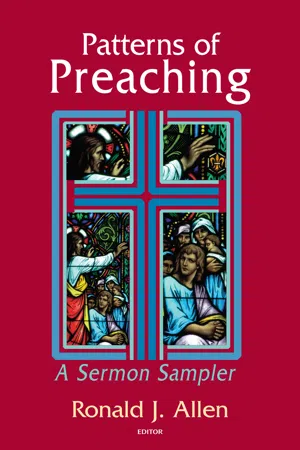
- 264 pages
- English
- ePUB (mobile friendly)
- Available on iOS & Android
eBook - ePub
About this book
Information
Topic
Theology & ReligionSubtopic
Christian Ministry
1
Puritan Plain Style
As the term “plain” implies, this approach to preaching is simple and to the point. The purpose of the style is to help the congregation encounter the gospel as directly as possible. The Plain Style has been (and is) used by preachers in several theological movements.
The elements of the sermon in the Plain Style are Beginning, Exposition of the Biblical Text, Theological Analysis of the Text, Application of the Interpretation of the Text to the situation of the congregation, Ending. This style can be adapted to sermons on Christian doctrines and practices and other topics. In the latter instances, the Exposition of the Text would be replaced by Exposition of the Doctrine, Practice, or Topic. The Theological Analysis would focus on the doctrine, practice, or topic.
The Beginning helps the congregation focus on the subject of the sermon. The preacher may include a short Statement of the Direction of the Sermon. This statement alerts the congregation to the claim of the sermon. In the Exposition of the Biblical Text, Doctrine, Practice, or Topic, the preacher gives a brief exegesis of the biblical passage, doctrine, practice, or other topic. When turning to Theological Analysis, the sermon reflects theologically on the theological claims of the text, doctrine, practice, or other topic from the perspective of the gospel. Is the witness of text appropriate to the gospel? intelligible? moral? What can the congregation believe about the subject of the sermon? When Applying the text, the preacher helps the community articulate the implications of the congregation’s understanding of the text, doctrine, or practice for its everyday life. When Ending, the preacher tries to help the congregation continue the conversation that started in the sermon.
Some sermons in this style do not contain a separate component for theological analysis. When a text, doctrine, or practice is appropriate to the gospel, intelligible, and morally plausible, the preacher sometimes moves directly from exegesis to application.
As Thomas G. Long’s sermon below illustrates, this style need not be wooden or mechanical. It can have a dynamic quality. The preacher makes excellent use of imagery and story in the service of clarity of communication. The application, while direct and clear, leaves room for the imagination of the listeners to extend its implications into their own everyday worlds.
Listening to a sermon in the Puritan Plain Style, the congregation has every opportunity to get the preacher’s point. This type of sermon is easy to prepare. While the preacher must consider what to say, the preacher doesn’t have to wrestle with how to say it. The task of each part of the sermon is clearly defined. Further, this style helps the community consider forthrightly the implications of the gospel for their everyday world. Some preachers, however, find this approach unimaginative, tedious, and predictable (especially if the preachers uses it weekly). The Plain Style can violate some materials. Our perception of a poem, for instance, does not always conform to the linear flow of exposition-theological analysis-application.
THOMAS G. LONG, one of the most prolific and influential figures in contemporary preaching, is director of Geneva Press. His The Witness of Preaching (Louisville: Westminster/John Knox Press, 1989) and Preaching and the Literary Forms of the Bible (Philadelphia: Fortress Press, 1988) are fulcrum works in contemporary preaching. He assembles useful collections of materials, e.g., with Edward Farley, Preaching as a Theological Task: World, Gospel, Scripture. In Honor of David Buttrick (Louisville: Westminster John Knox Press, 1996); with Cornelius Plantinga, Jr., A Chorus of Witnesses: Model Sermons for Today’s Preacher (Grand Rapids: Eerdmans, 1994); with Gail O’Day, Listening to the Word: Essays in Honor of Fred B. Craddock (Nashville: Abingdon Press, 1993); with Neely Dixon McCarter, Preaching In and Out of Season (Louisville: Westminster/John Knox Press, 1990). He has also written biblical commentaries on Matthew and Hebrews. He preaches and lectures in congregations and conferences throughout the United States and Canada.
THOMAS G. LONG
The Difference Between Brown and Green
Jeremiah 17:5–8
(Beginning) This passage of prophetic wisdom from the book of Jeremiah sharply contrasts the life of faith—a life that trusts the ways of God—with the life that most of us are tempted to lead, a life that relies on its own wits and places its bets on the ways of the world. To be a person of faith, says Jeremiah, is to be like a deep-rooted tree standing on the banks of a flowing river. To be otherwise is to be like a scrub plant, wilting in the fierce desert heat, fighting for its life in a parched and thirsty wasteland.
It is easy to admire the poetic images here—shrub versus tree, desert versus oasis, parched wilderness versus moist and fertile land. However, Jeremiah is not mainly interested in making poetry, but in making souls. This word from the prophet exercises its true power only if its poetry winnows its way into the deep places of our experience. To be grasped by this passage, we must do more than touch its surfaces with our fingers. We must feel the dry heat of the waterless places in our throats. To put it bluntly, we must know about drought, and quite honestly, about drought most of us know very little.
One summer a few years back, we went thirty-seven days without rain, and we called it a drought. My neighbors and I paced our front yards, pawing at the yellow spots, and raised our fists to the merciless heavens because we had lost a few boxwoods and patches of Zoysia. “We sure could use some rain,” we would call to each other in the heat. “Yes, we could,” the neighbor would call back. “My tomatoes are burned up.” But then we would retreat to the air-conditioned cool of our houses and pour glasses of iced tea. About drought we know little.
A kid in line at the theater concession stand orders a tub of popcorn and a soda pop. “What size soda?” the clerk wants to know. “Gimme a giant size,” the kid replies. “I’m dying of thirst.” About drought we know little.
(Statement of the Direction of the Sermon) But about drought, Jeremiah knows much. And Jeremiah has much to teach us—about drought in the human heart.
(Exposition of the Biblical Text) In Palestine, drought is not merely a threat to backyard tomatoes and Zoysia lawns. It is a threat to all of life—human, animal, plant. When the harsh Judean sun turns its blazing wrath upon the land, fields are scored and cracked, cisterns become dry as sandpaper, towns grieve, farmers cover their heads in morning, the crops shrivel, the doe abandons her fawn, and donkeys pant like dogs in the torrid and killing heat (Jeremiah 14:2–6). About drought Jeremiah knows much.
Jeremiah knew not only about the drought that affects the land, but also about the drought that afflicts the human spirit. “The sin of Judah,” he warned, “is written with an iron pen,” and that sin was idolatry. “Idolatry” sounds, of course, like an entry in a Bible encyclopedia, a remote description of strange and ancient practices, of Baal and Ashera, of fertility cults, and gods of stone and wood. But the idolatry of Judah sprung from a source very familiar to us—the human thirst for life, full and joyful. The fertility religions of the ancient world, so seductive to the Jewish people, were about the richness of life, the abundance of the land, the human desire not to miss a single pleasure, to celebrate life, to eat the sweet fruit of existence, and to allow the succulent juices to flow freely down one’s face.
The advertising copy over the photo of a sexy-looking luxury sports car reads:
“You’ve made a statement. Here’s the exclamation point. This is exhilaration, period”
That’s what we all want for our lives, of course—something to break the tedium, an exclamation point, exhilaration, excitement, the wind in our face. And wanting to lift high the cup of life and drink it down to the bottom is not wrong in and of itself. The arts, the dance, the game, laughter, the feast, the tender touch—all of these are expressions of the human thirst for life, abundant. Indeed, such a life is a gift from God.
But how do we become fully alive? To this question Jeremiah speaks a hard word: The human heart, left to its own devices, chooses the wrong path. What seems to us to be the place to be, what seems to us to be a lush field of joy, what seems to us to be the obvious way to wring every satisfaction from life is, in fact, a mirage. And what seems to us to be a perilous, costly, even foolish way of life—the life of sacrificial faith—is, in truth, the fertile and joyful oasis we weary travelers are seeking.
(Theological Analysis) Many years ago, a biblical scholar, Johannes Pedersen, wrote a book on the geography of Palestine. He was struck by the fact that three of the major world religions—Judaism, Christianity, and Islam—all spring from this same small patch of unpromising land. Pedersen wondered if this were true partly because the inhabitants of that land know the difference between brown and green, between the killing desert and the life-giving oasis, between the scorching wind that burns the skin and the cool oil that heals. Brown and green…death and life…trusting in ourselves and trusting in God. Jeremiah wants us to know the difference.
An old joke tells of a rabbi on his deathbed who called to his side his oldest son. “Itzak,” the dying man whispered, “I want to tell you the secret of life.” Itzak placed his ear next to his father’s trembling lips, the better to hear his parting wisdom. “Itzak,” said the old man urgently, “an angel appeared to me in a dream last night and showed me two bridges to the place of glory. One bridge is built of human cunning. It is wide and strong and made of iron and stone. The second bridge is built of Torah, the instruction of God. It is narrow, seemingly frail, dangerous to cross, and made of the woven strands of Moses’ beard. Itzak, my son, take my advice. Travel over the first bridge.”
And we do, of course. “Blessed are those who hunger and thirst for righteousness.” But we hunger and thirst for a comfortable lifestyle. “Blessed are the peacemakers,” says Jesus, but we are ready to punish anyone who challenges our national pride. “Blessed are the merciful,” Jesus teaches, but if we don’t look out for ourselves we will get taken advantage of at the office. We know the way of God, but we choose the bridge of human cunning.
Ironically, the gospel violates common sense. What looks to the human eye like life, Jeremiah tells us, is really a killing desert. What looks like a wilderness, the way of faith, trusting in the promises of God, is really a verdant field of joy.
In 1931, the Midwest experienced a bumper crop of wheat. Cash flowed freely, and times were good. Farmers bought land and machinery. Only a fool would not place trust in the unending richness of the land. “A sort of madness pervaded the atmosphere,” one of those farmers wrote years later, “and I fell for it like ever.” The next year there was little rain; indeed, the rains failed to come year after year, and the seemingly fertile fields became parched and withered, the famous Dust Bowl of the 1930s. “The summer of ’36 was one of the hottest ever,” said Oklahoma farmer Lawrence Svobida. “Hundreds of square miles of bare fields absorbed the sun’s rays like fire brick in a kiln. The wind was like a blast from a huge, red-hot furnace, causing my face to blister and peel off…. I found myself hardening to disaster. Words are useless to describe the experience when the thin thread of faith snaps. My youth and ambition were ground into the very dust itself.”1
(Application) Jeremiah would have known well how the youth and ambition of a people could be ground into dust. “Those who trust in mere mortals and make mere flesh their strength, whose hearts turn away from the Lord…shall be like a shrub in the desert.” But Jeremiah also knew of another way. “Blessed are those who trust in the Lord…. They shall be like a tree planted by water…. It shall not fear when heat comes, and its leaves shall stay green in the year of drought.” The difference between brown and green.
There is a person named Wayne who lives in an urban homeless shelter. Wayne has a psychological disorder severe enough to prevent him from keeping a job, but not severe enough to allow him to receive disability payments. So, Wayne is condemned to wander the wasteland of the city streets. But Wayne has also found a green place, an oasis. Wayne has joined a church, and he is present for every service, every meal, every event. “When I go outside this church, I’m a homeless guy, a bum, a transient,” Wayne says. “When I’m with [the church] people, I’m just another person.” Ask Wayne what the church and its life of faith has meant to him, and he will quickly reply, “These people saved my life.”2 Wayne knows what Jeremiah was talking about. Wayne knows the irony of the gospel, the truth that makes for full and joyful life does not look at life-giving from the vantage point of the wisdom of the world. But Wayne and the church people who honor him know—the difference between brown and green.
Maybe, then, we must know of the drought. Jesus once said that only those who humble themselves could know the rule of God. And Jesus taught that only those who lose their lives for the sake of the gospel could find them. Jesus told the story of a prodigal whose wandering in a wasteland made him hunger for the joys of home. So maybe when we have tasted the dust of the desert, felt the heat of foolish choices, and wandered once-promising paths that led to places of loss and pain, then we can look to the sky and pray for rain and look to the horizon of our hope.
Recently there was an exhibition at New York’s Museum of American Folk Art of the drawings of an obscure San Francisco artist named A.G. Rizzoli, who died in 1981. He was the son of poverty-stricken Italian immigrants, and his work would be completely unknown had it not been rescued from a dumpster by a great-nephew. Rizzoli was shy and withdrawn. He lived by himself, working by day as a draftsman and toiling at night drawing pictures of those he loved: his mother, God, and the few people who were ever kind to him.
One day a year, Rizzoli would arrange his drawings in a room in his house and invite his neighbors in for a showing. He would spread homemade signs announcing the exhibition throughout the neighborhood. But his neighbors were occupied with their own lives, and few of them took the time to come. Mostly, it was children, curious about this strange person who lived in their neighborhood, who would wander into Rizzoli’s home and gaze at his drawings. “Those who did,” writes Frank Rich in The New York Times, “would later themselves be adoringly enshrined in his pictures—though they never knew it. Love was for him its own private reward. ‘No longer any reason for feeling lonely,’ was the inscription he put on a portfolio.”3 Love is stronger than loneliness. Faith is more enduring than flame. The difference between brown and green.
(Ending) Jeremiah wants us to hear again the good news of the God who is. To those who wander in desert wastes, God is the oasis of compassion. To those whose lives are scorched by the noonday heat, God is the shade of rest and restoration. To those who are perishing from the thirst of meaninglessness, God is the fountain of living water, the rain that turns the dry places into fields of life. “When the rain finally came,” said a Dust Bowl farmer, “it meant life itself. It mean...
Table of contents
- Cover
- Title Page
- Copyright
- Dedication
- Acknowledgments
- Table of Contents
- Introduction
- Part 1 - Traditional Patterns
- Part 2 - Contemporary Patterns
- Part 3 - Patterns for Subjects
- Part 4 - Patterns for Theology
- Index of Sermon Texts
Trusted by 375,005 students
Access to over 1.5 million titles for a fair monthly price.
Study more efficiently using our study tools.
Frequently asked questions
Yes, you can cancel anytime from the Subscription tab in your account settings on the Perlego website. Your subscription will stay active until the end of your current billing period. Learn how to cancel your subscription
No, books cannot be downloaded as external files, such as PDFs, for use outside of Perlego. However, you can download books within the Perlego app for offline reading on mobile or tablet. Learn how to download books offline
Perlego offers two plans: Essential and Complete
- Essential is ideal for learners and professionals who enjoy exploring a wide range of subjects. Access the Essential Library with 800,000+ trusted titles and best-sellers across business, personal growth, and the humanities. Includes unlimited reading time and Standard Read Aloud voice.
- Complete: Perfect for advanced learners and researchers needing full, unrestricted access. Unlock 1.5M+ books across hundreds of subjects, including academic and specialized titles. The Complete Plan also includes advanced features like Premium Read Aloud and Research Assistant.
We are an online textbook subscription service, where you can get access to an entire online library for less than the price of a single book per month. With over 1.5 million books across 990+ topics, we’ve got you covered! Learn about our mission
Look out for the read-aloud symbol on your next book to see if you can listen to it. The read-aloud tool reads text aloud for you, highlighting the text as it is being read. You can pause it, speed it up and slow it down. Learn more about Read Aloud
Yes! You can use the Perlego app on both iOS and Android devices to read anytime, anywhere — even offline. Perfect for commutes or when you’re on the go.
Please note we cannot support devices running on iOS 13 and Android 7 or earlier. Learn more about using the app
Please note we cannot support devices running on iOS 13 and Android 7 or earlier. Learn more about using the app
Yes, you can access Patterns of Preaching by Ronald J. Allen in PDF and/or ePUB format, as well as other popular books in Theology & Religion & Christian Ministry. We have over 1.5 million books available in our catalogue for you to explore.