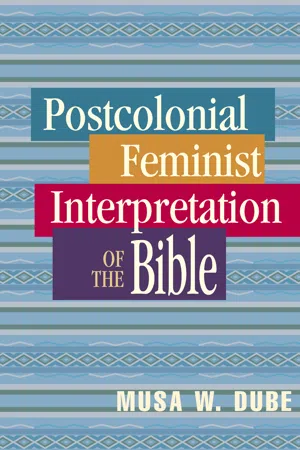
Noting that the ways of interpreting the Bible now practiced in the West are patriarchal and oppressive of those in other parts of the world, Dube offers an alternative interpretation that attends to and respects needs of women in the two-thirds world. In a provocative and insightful reading of the book of Matthew, she shows us how to read the Bible as decolonizing rather than imperialist literature.
- 232 pages
- English
- ePUB (mobile friendly)
- Available on iOS & Android
eBook - ePub
Postcolonial Feminist Interpretation of the Bible
About this book
Information
Topic
Theologie & ReligionSubtopic
Bibelkritik & -auslegungPART I
Defining the Problem
Modern imperialism was so global and all-encompassing that virtually nothing escaped it; besides, as I have said, the nineteenth-century contest over empire is still continuing today. Whether or not to look at the connections between cultural texts and imperialism is therefore to take a position in fact taken— either to study the connection in order to criticize it and think of alternatives for it, or not to study it in order to let it stand…1
Edward Said
_____________________
1Edward Said, Culture and Imperialism (New York: Alfred A. Knopf, 1993), 68.
1
The Postcolonial Condition
and the Bible
Oral Stories, Debates, and Colonial Heroes
During the decades of the armed struggle for liberation in sub-Saharan Africa, an anonymous short story, orally narrated and passed on by word of mouth, became popular. The story held that “when the white man came to our country he had the Bible and we had the land. The white man said to us, ‘let us pray.’ After the prayer, the white man had the land and we had the Bible.”1 The story summarizes the sub-Saharan African experience of colonization. It explains how colonization was connected to the coming of the white man, how it was connected to his use of the Bible, and how the black African possession of the Bible is connected to the white man’s taking of African people’s lands. Admittedly, the story holds that the Bible is now a sub-Saharan African book, but it is an inheritance that will always be linked to and remembered for its role in facilitating European imperialism.
Those of us who grew up professing the Christian faith in the age of the armed struggle for liberation, from World War II to South African independence in 1994, were never left to occupy our places comfortably. Debating societies in high schools and colleges passed one motion after another and constantly summoned us to the debating floors. We were called upon to explain the ethics of our religion: to justify its practice, its practitioners, and its institutions. Debating societies demanded to know why the biblical text and its Western readers were instruments of imperialism and how we, as black Africans, justify our faith in a religion that has betrayed us—a religion of the enemy, so to speak. In these questions and motions lies the foundation of my quest; that is, given the role of the Bible in facilitating imperialism, how should we read the Bible as postcolonial subjects?2
Difficult as these motions were, historical records gave us no support. To start with, at the Berlin conference of 1884, where the European imperial powers met to divide the map of Africa amongst themselves and to draw a constitution on how to do it, the role of missionaries, among other agents of imperialism, was recognized and given its rightful place. The constitution read, “Christian missionaries, scientists, and explorers, with their followers, property and collections, shall likewise be objects of especial protections.”3 This protection implies several things. First, missionaries as Bible readers, whose perspectives of justice were presumably informed by this text, were not ethically opposed to the imperial project of their countries. Second, this protection could imply that missionaries were useful in promoting the imperialism of their countries. In other words, missionaries and other imperialist agents were all informed and influenced by the same culture, which includes the biblical faith. The latter point leads to the third implication: that any attempt to distance missionaries from the rest is at best superficial. In fact, Andrew Walls’s analysis suggests that there was little or no dividing line between missionaries and their colonizing counterparts. He notes that
the missionary pioneer was spoken of in the vocabulary of the imperial pioneer. With some notable exceptions, British missions became overwhelmingly concentrated in areas that were, or were to become, part of the British Empire. Sometimes missionary occupation preceded annexation or political penetration and sometimes it followed; sometimes, as in Uganda, Nyasaland, and Bechuanaland, it was intimately associated with the establishment of British rule; sometimes, as in eastern Nigeria, it was obviously associated with the reconciliation of annexed peoples to a new way of life under the British crown. Occasionally, as in the Upper Niger, it took place against the representatives of secular power.4
On the whole, Walls notes that “missionary opinion, like most British opinion in the high imperial age, for the most part took the empire for granted, and the question of abdication was never seriously raised.”5 According to Walls, “many of the writers on missions saw a sort of manifest destiny for Britain as the principal Christian influence in the world.”6 This harmonious relationship of missionaries and the imperial agendas of their compatriots is indeed evident in the mission reflections of Josiah Strong, a Congregationalist minister. Strong proudly noted that the Anglo-Saxon has a “genius for colonizing,” for “he excels all others in pushing his way into new countries.”7 For Strong, the Anglo-Saxon was not only “divinely commissioned to be, in a peculiar sense, his brother’s keeper,” but as such was indeed his indisputable destiny.8 Strong states:
Is there room for reasonable doubt that this race…is destined to dispossess many weaker races, assimilate others, mold the remainder, until, in a very true and important sense it has Anglo-Saxoned mankind? Already the English language, saturated with Christian ideas, gathering up into itself the best thought of all ages is the great agent of Christian civilization throughout the world; at this moment affecting the destinies and molding the character of half the human race.9
Seemingly, Strong’s ethics are not in conflict with dispossession of weaker races, their assimilation, and their being “Anglo-Saxoned.” He tries to show that the English language and the culture of the Anglo-Saxons are “saturated with Christian ideas,” hence its eligibility as a “great agent of Christian civilization.” In the latter claim one finds that the attempt to make a distinction between the missionary and other imperial powers is superficial given that they were both from the same culture. As Strong asserts that the English language is saturated with Christian ideas, it follows that English thinking, its ethics, and its perception of reality are heavily informed by biblical ideas. Similarly, if biblical ideas “divinely commissioned them” to be their “brother’s keeper” or to have a “genius for colonizing,” we cannot divorce the biblical text from informing and inspiring their imperialist violence.
To speak of a divinely commissioned genius in colonizing is to speak of David Livingstone.10 Livingstone, a doctor, botanist, explorer, ethnographer, and mapmaker, is a shining example of a missionary who openly championed colonial domination of sub-Saharan Africa. Declaring that “civilization—Christianity and commerce—should ever be inseparable,” Livingstone appealed to his compatriots to colonize Africa: “I beg to direct your attention to Africa…I go back to try to make an open path for commerce and Christianity; do carry out the work which I have begun.”11 To persuade his people, Livingstone capitalized on rampant human trade in the interior of Africa.12
Not only was such an appeal and promise made, it was done. Livingstone braved the continent of Africa, moving from one ethnic group to another, from one river to another, from coast to coast, and from one forest to another. He kept a detailed description of the vegetation, terrain, customs, people, diseases, trade; he drew maps; he explored the navigable rivers; and he reported the findings to his targeted parties back home.13 His efforts were meant to invite and stimulate the interests of traders, geographic societies, and missionary societies, that is, various colonial agents who might occupy and civilize Africa. And in this he was indeed successful, opening Africa for Western commerce, civilization, and Christianity.
If at the debating societies, the Berlin conference, the mission writings, and the legacy of David Livingstone were an overwhelming historical attestation of the connection of biblical texts, their readers, and their institutions to imperial domination of Africa, we also grew up with the South African apartheid regime. Apartheid, a violent and exploitative ideology of racial discrimination, was propounded by Bible readers and supported by their institutions, based on the biblical texts. But apartheid only followed the dispossession of South African people of their lands and property by white settlers, who claimed to be a “chosen race” with the right to take the land, to settle on it, and to displace the natives in the best way possible, which, in this case, became apartheid. Therefore, on those debating floors we never won an argument, for historical attestation was simply against us. The question of why the biblical text, its readers, and its institutions are instruments of imperialism has remained unanswered, yet is still urgently posed. The anonymous short story quoted at the beginning of this chapter is a story that captured this history succinctly, and unavoidably invoked reflections and questions. The short story also articulates the deep sense of betrayal for those of us who have endured the exploitation and the humiliation of Western imperialism but still dared to call ourselves Christians. The story is an experience that compels us to search for answers for ourselves as well as to hold a critical conversation with Westerners.
Therefore, the motions of debating societies remain a genuine quest for understanding: They pose the question of the ethics and politics of the Bible, the question of Western imperialism and the Bible, and the question of how we should read the Bible given this history of its role, its readers, and its institutions. This is the problem of the Bible and postcolonial demands and challenges.
The centrality of the Bible in facilitating Western imperialism remains evident to African people and provides the cause for much reflection. It has not only occupied African oral stories and debates; it still occupies most African critical writers of literature, philosophy, theology, and biblical studies, as the following discussion highlights.
African Writers, the Bible, and Imperialism
Literary Writers
Inevitably, the issue of imperial domination has informed and occupied much of African literature, and with it, the concept of the European novel as an imperialistic instrument. As Barbara Harlow points out, “the writers and critics writing within the context of organized resistance movements comprehend the role of culture and cultural resistance as part of the larger struggle for liberation.”14 Among the many African writers who have concerned themselves with imperial domination and resistance, I will briefly discuss the views of Ngugi wa Thiongo.15
In his books Decolonizing the Mind and Moving the Center: The Struggle for Cultural Freedoms, Ngugi is primarily concerned with the use of English literature and language in the colonization of sub-Saharan Africa. He argues that the modern marketing of the so-called humanist tradition of literature to universal standards undermined the fact that, like every piece of literature, it was bound to its context and culture. So through this allegedly universal humanistic tradition, “African children who encountered literature in colonial schools and universities were thus experiencing the world as defined and reflected in the European experience of history…Europe was the center of the world.”16 This employment of imperialist literature was an integral part of colonization, alienating the subjugated from their own languages, religions, environments, and cultures.
In addition, Ngugi shows the role of the Bible to be equally central ...
Table of contents
- Cover Page
- Halftitle Page
- Title Page
- Copyright Page
- Dedication
- Contents
- Preface
- Part I: Defining the Problem
- Part II: Empire and Method
- Part III: A Postcolonial Feminist Reading of Matthew 15:21–28
- Select Bibliography
- Scripture Index
- Author Index
- Subject Index
Trusted by 375,005 students
Access to over 1.5 million titles for a fair monthly price.
Study more efficiently using our study tools.
Frequently asked questions
Yes, you can cancel anytime from the Subscription tab in your account settings on the Perlego website. Your subscription will stay active until the end of your current billing period. Learn how to cancel your subscription
No, books cannot be downloaded as external files, such as PDFs, for use outside of Perlego. However, you can download books within the Perlego app for offline reading on mobile or tablet. Learn how to download books offline
Perlego offers two plans: Essential and Complete
- Essential is ideal for learners and professionals who enjoy exploring a wide range of subjects. Access the Essential Library with 800,000+ trusted titles and best-sellers across business, personal growth, and the humanities. Includes unlimited reading time and Standard Read Aloud voice.
- Complete: Perfect for advanced learners and researchers needing full, unrestricted access. Unlock 1.5M+ books across hundreds of subjects, including academic and specialized titles. The Complete Plan also includes advanced features like Premium Read Aloud and Research Assistant.
We are an online textbook subscription service, where you can get access to an entire online library for less than the price of a single book per month. With over 1.5 million books across 990+ topics, we’ve got you covered! Learn about our mission
Look out for the read-aloud symbol on your next book to see if you can listen to it. The read-aloud tool reads text aloud for you, highlighting the text as it is being read. You can pause it, speed it up and slow it down. Learn more about Read Aloud
Yes! You can use the Perlego app on both iOS and Android devices to read anytime, anywhere — even offline. Perfect for commutes or when you’re on the go.
Please note we cannot support devices running on iOS 13 and Android 7 or earlier. Learn more about using the app
Please note we cannot support devices running on iOS 13 and Android 7 or earlier. Learn more about using the app
Yes, you can access Postcolonial Feminist Interpretation of the Bible by Musa Dube in PDF and/or ePUB format, as well as other popular books in Theologie & Religion & Bibelkritik & -auslegung. We have over 1.5 million books available in our catalogue for you to explore.