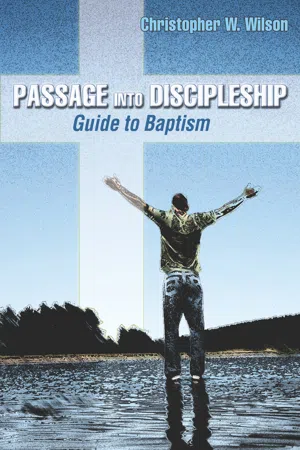
Passage Into Discipleship is designed to help older children and youth more faithfully prepare for the act of baptism by teaching what it means to walk a Christian journey. This book incorporates four different learning models that stimulate young people in being excited about becoming followers of Jesus. Learning models include classroom instruction, community and communal hands-on experiences, mentors that guide youth throughout the process, and a day-long retreat that concludes the curriculum. Topics discussed in the book include confession, contrition, covenant, community, and connection, which are each coupled with key scripture texts. Each topic covered connects church theological concepts with daily life application.
- 112 pages
- English
- ePUB (mobile friendly)
- Available on iOS & Android
eBook - ePub
About this book
Information
Subtopic
Religion
Class Component
Session 1 Orientation
Session 2 Confession (classroom)
Session 3 Confession (experience)
Session 4 Contrition (classroom)
Session 5 Contrition (experience)
Session 6 Covenant (classroom)
Session 7 Covenant (experience)
Session 8 Community (classroom)
Session 9 Community (experience)
Session 10 Connection (classroom)
Session 11 Connection (experience)
Session 12 Church
SESSION 1: Orientation
Getting Oriented
The orientation session with youth and parents helps each family learn about the discipleship and baptism process. Promote the baptism process through newsletters, phone calls, or face-to-face interactions. Invite the youth and their parents so both hear about the details of the process and what is expected of each person who wants to participate. The orientation session is to be led with excitement to highlight the joy of these young people who are interested in becoming more faithful in their lives as followers of Jesus Christ.
The orientation is an overview of all that the youth will encounter in the weekly sessions, in the interaction with mentors, and in a closing retreat. The purpose is creating an environment with various learning approaches to best help a young person grow in his or her Christian faith. The process includes four learning approaches: (1) class instruction, (2) experience instruction, (3) mentor instruction, and (4) closing retreat. The design is to reinforce and build on the content and learning covered throughout the process. Distribute the overview sheet that shows how the different components are scheduled. This allows the youth and parents to see that classroom sessions are a combination of instruction and experience. The purpose is to practice what they learn the week before. Mention that many of the classroom sessions include a worksheet or activity that is to be completed before the youth return for the next session. Encourage parents to work with their children in completing assignments. The completed assignment provides the best preparation for the next week.
The process is intended to inform youth about the covenantal nature of our faith. We rely on God to guide us and love us, and God relies on us to become faithful followers. The draw to the process is to discern about baptism, but it should not be an expected outcome. If any youth reach the end of the process and do not feel ready, then they can wait to be baptized at another time. I have had the experience of youth deciding to wait rather than feel the peer pressure to be baptized because everyone else is being baptized. The process is about becoming and continuing to be faithful followers of Jesus and disciples of Christ.
The mentor selection is very important for the youth. The youth will be asked to submit three names of church leaders of the same gender they would like as mentors. You will make the contacts. When their mentor is confirmed, you notify the youth. The mentor process begins once this pairing is accomplished. Mentors will be given clear instructions of activities and material to complete with you.
The closing retreat will be a day you will all share together, which allows you to experience three distinct areas of learning that you are covering in small ways throughout the class. It is a day of fun and growth for everyone.
Remind the parents that full participation of their children ensures the best overall experience. Also remind them to stay involved with what the youth are learning and share the journey with their children. Parents may be called on to help with transportation and help with the experience sessions of the process. This includes help with the retreat day.
Allow time at the end for youth and parents to ask questions. Questions help give clarity to anything you might have failed to mention or cover.
The final part of the orientation is deciding on the best time for the group to meet weekly. I have found that different groups often have different optimal times to meet during the week. Work with your group, for you want to ensure as full attendance as possible.
Remember to begin and end the orientation with prayer for these young people who are interested in baptism and becoming more familiar with being faithful followers of Jesus.
The materials you will need for the orientation are the outline and the overview sheets found in appendix A.
“Confession is investing our lives in what
we feel is important to us and how we
should live our lives.”
we feel is important to us and how we
should live our lives.”
SESSION 2: Confession
(classroom)
Theme: Confession
Class Concepts
- Confession as a belief statement
- Confession as the moment we write or say what we believe to others
- We should not be afraid to share with others what we believe
- We learn from scripture that followers of Jesus had to decide for themselves what they believed about Jesus
Scripture Emphasis: Matthew 16:13–20
Theological Foundation
- This session helps youth develop a credo (personal faith construction) that will help them in their Christian journey
- What we believe and communicate about God, Christ, and church is an important step in developing our foundation of faith
- An important part of our Christian identity comes in sharing the gospel message with others (as commanded in the great commission in Matthew 28:18–20)
Class Outline for Leaders
Opening Prayer
Sentence Completion Exercise
The first exercise consists of completing sentences. Share with the group that God created us all. Each person is special and unique. Share more about yourself with the youth by completing the following statements seen below. Then have each of the youth complete the same statements. An easy way to begin the confessional process is by sharing basic information. Once everyone feels comfortable and safe, the conversations will open up to sharing deeper faith beliefs. There are no right or wrong responses to the uncompleted sentences.
- My name is…
- I was born…
- Three words that describe me are…
- Something important to me is…
- I am involved in the church because…
- I am in this class because…
Bragging Exercise
The next exercise is a “bragging” session. You will want a stopwatch or other watch to keep track of time. Each person will have two minutes to share as much about him- or herself as possible with the group. Each person can share freely and name the following kinds of things: family details; hobbies or personal interests; favorite movie, music, food, color, etc.; specials talents; and what is unique about him- or herself. You might discover that the youth have a hard time filling the two minutes talking about themselves. Speaking out loud about ourselves can be harder than we realize when we are the center of attention. More extroverted youth will do better with this activity and it will challenge others to expand their comfort zones.
What Is Confession?
Discuss what the word confession means. First, ask the class members what they think the word means. After the group has shared their responses, teach two ways that confession may be understood. One definition is that it is the act of telling another person or God that you are sorry for something that has happened. A second definition is that it is an oral or written statement of belief, which is what this session is all about.
Scripture Discussion
When focusing on confession as a statement of belief, the participants are going to put this into action. Read Matthew 16:13–20. Jesus was learning what the disciples were hearing about him and also what his followers were thinking of him. Discuss the difference between saying what others believe and what one personally believes. The community of believers around us shapes our faith, but we must come to terms with what we ourselves believe. Our confessions can tell us about our priorities in life and how we see and experience the world around us. Confession is when we own what we say to others and ourselves.
When we say or write what we believe, then it becomes a confession. Ideas and thoughts need to be articulated and brought out into the open through sharing. Confession occurs when God and others know what it is that we believe. Young people are often instructed to recite back what is taught to them. Confession is more than reciting what we are told to believe. Confession is investing our lives in what we feel is important to us and how we should live our lives. This kind of confession helps shape our identity and enables us to relate to others in our world—to people who believe in similar or different ways.
It is important for Christians to know what they believe and be willing to share that belief with others. It is important to be proud of our belief system and be confident in why we believe it.
Other Christians’ Confessions
Have the youth look in the Chalice Hymnal at examples of what other Christians have said about their faith and church throughout Christian history.
- A Disciples Affirmation (no. 355)
- Nicene Affirmation of Faith (no. 358)
- Apostolic Affirmation of Faith (no. 359)
- United Church of Christ Statement of Faith (no. 361)
Ask the group to share what they see as common threads among all the statements of faith. What is unique about some of the statements? Remind the class that each statement is a way for a community of faith to express what they believe as Christians. (If you do not have access to the Chalice Hymnal, then you can find these and similar statements in denominational resources or on the Internet.)
First Person Exercise
The next activity is called “First Person Exercise.” Split into three groups, dividing up as evenly as possible. Each group will take on a faith entity and share with the rest of the class who they are and why they are important. The groups will take on the following entities: God, Jesus Christ, and Church. They must use “I” statements to share who they are.
Here is an example. If there are six youth in the class, divide the class into three groups of two. One set of two people will be assigned “God.” They will write up to five sentences starting with “I” without using the word God. The statements should describe God or God’s actions and give clues for the other class participants to guess who they are describing. The other sets of two youth will do the same for Jesus Christ and the Church.
The hope is for the youth to better understand the nature and function of God, Jesus Christ, and the Church by using language to characterize them. It is one thing to believe i...
Table of contents
- Cover
- Title
- Copyright
- Dedication
- Contents
- Acknowledgments
- Introduction
- Rationale
- Class Component
- Mentor Component
- Retreat Component
- The Role of Worship
- Appendix Materials
Trusted by 375,005 students
Access to over 1.5 million titles for a fair monthly price.
Study more efficiently using our study tools.
Frequently asked questions
Yes, you can cancel anytime from the Subscription tab in your account settings on the Perlego website. Your subscription will stay active until the end of your current billing period. Learn how to cancel your subscription
No, books cannot be downloaded as external files, such as PDFs, for use outside of Perlego. However, you can download books within the Perlego app for offline reading on mobile or tablet. Learn how to download books offline
Perlego offers two plans: Essential and Complete
- Essential is ideal for learners and professionals who enjoy exploring a wide range of subjects. Access the Essential Library with 800,000+ trusted titles and best-sellers across business, personal growth, and the humanities. Includes unlimited reading time and Standard Read Aloud voice.
- Complete: Perfect for advanced learners and researchers needing full, unrestricted access. Unlock 1.5M+ books across hundreds of subjects, including academic and specialized titles. The Complete Plan also includes advanced features like Premium Read Aloud and Research Assistant.
We are an online textbook subscription service, where you can get access to an entire online library for less than the price of a single book per month. With over 1.5 million books across 990+ topics, we’ve got you covered! Learn about our mission
Look out for the read-aloud symbol on your next book to see if you can listen to it. The read-aloud tool reads text aloud for you, highlighting the text as it is being read. You can pause it, speed it up and slow it down. Learn more about Read Aloud
Yes! You can use the Perlego app on both iOS and Android devices to read anytime, anywhere — even offline. Perfect for commutes or when you’re on the go.
Please note we cannot support devices running on iOS 13 and Android 7 or earlier. Learn more about using the app
Please note we cannot support devices running on iOS 13 and Android 7 or earlier. Learn more about using the app
Yes, you can access Passage Into Discipleship by Rev. Dr. Christopher Walker Wilson in PDF and/or ePUB format, as well as other popular books in Théologie et religion & Religion. We have over 1.5 million books available in our catalogue for you to explore.