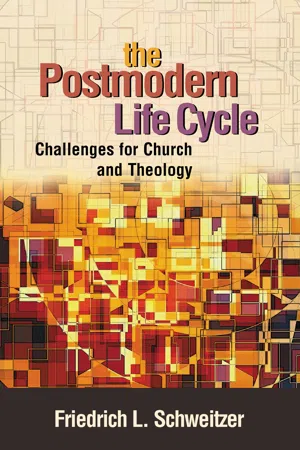
Schweitzer's goal in this book is to explore what postmodernity actually means for theology and how theology and the church may respond to its challenges. He focuses on the life cycle as it is changing with the advent of postmodernity, looking sequentially at segments of the life cycle using different lenses: modernity, postmodernity, and responses from church and theology. Schweitzer concludes with a theology of the life cycle.
- 160 pages
- English
- ePUB (mobile friendly)
- Available on iOS & Android
eBook - ePub
About this book
Information
Subtopic
Developmental PsychologyIndex
PsychologyCHAPTER 1
The Religious Demands of
Postmodern Life
Challenges for Practical Theology
When “postmodernity” came into the picture a little less than twenty years ago, it was often connected with Jean-François Lyotard’s now famous prediction that all “master stories” had come to their end.1 Interpreters of postmodernity tell us that all attempts at comprehensive description or explanation of society, history, human behavior, or the meaning of life have broken down. Postmodernity was and is seen as a time in which everything is becoming fluid and flexible, pluriform and contingent, fast and ephemeral.
Moreover, no schemes, let alone systems, seem to be available that could hold the increasing varieties of human experiences together. Everything appears to be a matter of which perspective one takes and in whose interest one prefers to speak. Postmodernity is a time of many stories and also of many different voices—the voices of different age groups, of women and men, of different ethnicities, to only mention a few of the many possible perspectives.
What kind of time is this for theology and the church? Is it a time for hopeful new beginnings, or is it a time of ever-increasing difficulties? Listening to ministers, teachers, counselors, Christian educators, and youth workers in the field, we learn of many worries and concerns. Is there still a place for Christian faith if there is no more room for master stories to guide our lives? How are children and youth to find any sense of direction if everything is pluriform and contingent? What are the guidelines for responsible adulthood? Is it even possible for theology to communicate successfully with people whose lives have less and less in common?
Yet, there are others who happily embrace the advent of postmodernity, even among theologians, ministers, and educators. For them, postmodernity is not a threat to the Christian faith. Rather, in their understanding, postmodernity is opening up new possibilities for those who had been silenced and oppressed by the forces of modernity and who now, finally, dare to make themselves seen and heard—women, minorities, people without power. According to these observers, the end of all master stories does not exclude the possibility of Christian faith. Quite the opposite, the many stories that give expression to the Christian faith can only come to the fore where the master stories of modern science and economy have lost their uncontested dominance. In this view, postmodernity means liberation—liberation for the gospel and no less for the people who want to follow it by leading a Christian life and by shaping the communities in which they live.
So this is a time of hope and a time of doubt and despair— postmodernity has many faces. This book will not address all of them. There are too many aspects involved from the beginning. No single book can claim to cover them anymore. But it will be my attempt throughout this book to become clearer about what postmodernity actually means for theology and how theology and the church may respond to its challenges critically, as well as constructively, by making use of its potentials.
My focus will be on the life cycle—on the life cycle as it is changing with the advent of postmodernity. Yet fortunately or unfortunately, it is not at all clear how to define or to describe the postmodern life cycle. Some people even doubt that it makes sense to speak of a postmodern life cycle. So our first task is to get at least an initial understanding of what we mean by the “postmodern life cycle.”
The Flexibility of the Human Life Cycle: Images of Family Life
In my teaching and lecturing, photographs of different family situations taken at different times during the twentieth century have often been helpful for gaining some understanding of how family life has changed. Such pictures typically capture different scenes from everyday life, from work as well as from leisure activities. In part, they remind us of our own childhood; in part, they refer us to the stories and descriptions that our parents and grandparents have told us. In any case, such pictorial material, which can be found in the photo albums of many families, makes intuitively clear that the human life cycle by no means is a constant or an anthropological given that would be exempt from change.
Pictures of this kind look different in different countries. Houses are different, cars are different, clothing is different, manners are different, and so forth. Yet what they all have in common is that they are clear indications of how much things have changed for the family during the last one hundred years.
Readers who have any doubts about this may want to consult their own family photo albums on their living room shelves. I myself very vividly recall three different scenes rendered in a German study on the modernization of childhood and the family.2 The three scenes cover a span of sixty years. They come from the 1930s, the 1950s, and the 1990s:
The first scene shows a family in the 1930s. There are ten people in the picture, men and women, children and adults. They clearly belong to three different generations. Two things keep them busy together. They are taking a break from harvesting a field, and they are sharing a meal consisting of simple sandwiches and something to drink, which is poured from a simple pitcher.
The impression that this scene leaves on the observer is far from neutral. The whole situation is highly evocative, breathing peacefulness and also a certain gratitude. The people are enjoying each other. They may not be very rich, but they seem to have what they need. They are content.
The background of this picture is an agricultural society. Family life—here sharing a meal in the fields—is integrated with work. People are working together and they are eating together, and everything is happening more or less in the same place. There are no long-distance commutes. Three different generations are present on an everyday basis. Moreover, all of them are actively participating in the same task of working the fields.
The second scene in this study comes from the 1950s. In the center of the picture is a car, a small and simple car. While today such a vehicle might not even be able to trigger our nostalgia, the car in the picture clearly is more than a car. For many people and in many different countries, such a car was a powerful symbol indeed. It was the symbol of personal achievement and of individual mobility for everyone. But the car in the picture has even more implications for the family. The number of seats available in this vehicle tended to define the ideal size of the family: two adults and a maximum of two or three children—a limited family size that would also make it affordable to take a car vacation in the mountains or to the shore. And unless they had their own car, grandparents could not come along. It is no coincidence that the oldest generation is not present in this scene.
This kind of scene stands for the experience of improved living conditions in the decades after World War II. At that time the so-called nuclear family, which is limited to two generations (parents and children), was in the process of becoming the dominant form of family life. For many people, the home had ceased to be the workplace. Mobility included longer commutes, which again was made possible by the availability of cars.
With the third scene, we have arrived in the early 1990s, our immediate past or almost present. It shows how the promises of the 1950s have come to fruition in suburban life. The simple car of the 1950s has been replaced by a much more sophisticated vehicle, which is not only a means of transportation and not only a symbol of personal achievement. This car appears to be some kind of toy that testifies to the new affluence of many middle-class families at that time. The family does not have to go to the mountains anymore in order to enjoy life—it may do so in their own backyard, which might really be a close to perfect piece of lawn. And again, the family has become smaller. Paid work and family life are also clearly separate, but now this separation often applies to both parents. At best, there is one parent left to play with the children. The older generation of the grandparents is not visible anymore, not even in the home of the family. Probably they are living somewhere else, possibly far away. At least, they are not sharing their work and daily life with their children and grandchildren.
It is interesting to think about the question of what kind of scene from contemporary family life we ourselves would pick in order to capture our own situation. What kind of picture could convey the image of postmodernity? It is obviously easier to look back at former times and to realize how far away those times appear to us—the tranquility of agricultural society in the 1930s as well as the time of the 1950s or even the 1990s. So we may either wait for the future to give us a picture of who we were at the beginning of the new century, or readers may just insert their own observations and images of the postmodern life cycle. For the time being, it may be most appropriate to leave a question mark, which will remind us of the open question of how to picture the postmodern life cycle. At the end of this book, we will be in a better position to answer this question.
For now, it may be helpful to imagine what the different kinds of family experience mean for an individual person on his or her passage through the life cycle. The first scene points to a life cycle that is very much predefined from birth. In most cases, the person moves along through life by taking over the positions that other members of the family had filled—the position of mother or father, of field hand, of working in the house, and so forth. The family with its sequence of generations defined much of one’s life. There were few choices to be made about this. One’s future looked like the family’s past. In industrial societies this continuity between past and future comes under attack. To move through the life cycle now means to strive for achievements that, if possible, will allow the person to surpass his (and sometimes her) parents. There are achievements of education and training, and they are measured by the success of a working life defined by status and income. Choices are becoming more important for the individual, but, for the most part, they are choices between clearly defined alternatives like different kinds of education or work. Probably it is at this point that the experience of an individual person moving through the life cycle today has become most different. Choices have multiplied, and they are no longer predefined. Nor is it clear what the consequences of such choices will be in the long run. The past of one’s family does not offer much direction for the future anymore, and society holds no more promises of clear-cut professional futures.
Let me return to my earlier question concerning a preliminary understanding of the difference between the modern and the postmodern life cycle. What do the pictures or scenes from family life tell us about the life cycle? Three aspects seem especially important.
(1) First, it is obvious how much the shape of daily life has changed over the generations of the last fifty or sixty years. The routines in which everyday life is embedded have changed in almost every respect, even within the family. Fewer persons are involved. The character of family life has been strongly affected by moving paid work away from the home and by relocating it in separate institutions of industry or trade. Consequently, the temporal order of daily life also had to change. In all these respects, the life cycle has been subject to radical changes. To put it into more general terms, the life cycle is not an anthropological given that can never change. Our contemporary situation makes us aware of how flexible the life cycle really is or, at least, how flexible it has become.
It is helpful to think about the life cycle in terms of a threefold distinction between the premodern, the modern, and the postmodern experience. In a traditional agricultural situation, individual life is built into an integrated pattern of living and working together of three or more generations. Consequently, the individual person proceeds more or less naturally and automatically through a life cycle that is, for the most part, predetermined by one’s birth into a certain family. By looking at their parents and grandparents, children are able to tell what their own life will be like once they reach the respective age. As pointed out above, there is much continuity between past and future. Given the preindustrial background of this kind of life and society, I call this the premodern life cycle.
The designation “premodern” is, of course, not very exact. Taken literally, it means everything “before modernity,” which applies to everything from the Stone Age to the medieval period. It would certainly be misleading to assume that the human life cycle has stayed the same through all these different times. When I speak of the “premodern life cycle,” my claim is a different one. I do not want to make romantic assumptions about life in earlier periods of history or the former stability of the life cycle. I am interested in a backdrop against which the contemporary changes of the life cycle can be discerned. So let us look further. What happens to the life cycle once agricultural society is on the wane?
Even without considering any details, one thing is obvious. With the expanding influence of industrialization and of paid labor outside the family, the life cycle turns into a much more demanding task for the individual. Not only does family life become separated from work while families become smaller and less stable, the life cycle itself is redefined as a career—a career that for the most part is measured by the economic and social success achieved by the respective individual. In this sense, increasing success and personal achievement are the characteristic ideals of the modern life cycle.3
Again, it must be admitted that the designation as “career” is a very preliminary way of describing the modern life cycle, and, as I want to show in the subsequent chapters, it is also a very one-sided, contradictory, or even ideological way of viewing the life cycle. Yet there can be no doubt about the central influence that the idea of making a career, or of having missed one’s opportunity for a successful career, has had on modern life. In this view, the family into which a child is born should not determine the course of his or her life cycle. The model of one’s parents and grandparents no longer is the mold for one’s own future life. Modern society holds the promise of many opportunities for everyone who is able to make use of them.
Toward the end of the twentieth century, new developments have come into view that are still hard to characterize. Some observers speak of a new type of biography in the sense that life has turned into an individual project and into a matter of personal choice.4 Others are more skeptical about whether a postmodern life cycle really exists or if we are just witnessing a further extension of modernity.5 At this early point of my analysis, I prefer to keep this question open. Suffice it to say, at this initial stage, that the postmodern life cycle must be what comes after the model of the life cycle as career has lost at least some of its power and persuasiveness. This preliminary understanding will be enough to get us started with further investigations into the changes that we are currently observing.
(2) Let me make a second point about the different scenes of family life rendered above. The pictures on which I have based my descriptions are not simply pictures of reality. This is true even though they are photographs. Photographs of the family as they are found in family albums tend to be highly artificial and symbolic. Often, they are not just snapshots taken by chance, and, in any case, they are not the result of realistic documentation. In earlier times, such pictures were often taken only after a lengthy procedure of arranging and rearranging the people in the picture, always attending to the questions of who should be in the picture and in front of what background, with what additional objects like houses, cars, trees, mountains, and so forth. And certainly, not every picture was allowed a place in the album or behind a frame.
This is why such pictures are not to be confused with the reality of family life. Rather, these pictures are trying to capture certain ideals— ideals of what the family should be, in the eyes of the photographer or according to the views of those who hold on to these pictures.
Consequently, the scenes of family life rendered above are not really documentary. They are not indicative of what the family really was twenty, thirty, or fifty years ago. But they can tell us something about what the family was supposed to be at that time, at least within the traditional middle class. The ideal character of such pictures and scenes also explains why certain realities of family life are absent from the official photographs. This is most obvious for the situation in the late twentieth century. The suburban family enjoying life is only one side. The other side is, for example, the situation of a single mother who is trying to finish her education while holding her baby on her lap. Most likely this woman is lacking the resources to fully participate in the world of material enjoyments, and her tight schedule does not give her much leeway...
Table of contents
- Cover Page
- Halftitle Page
- Title Page
- Copyright Page
- Contents
- Introduction
- 1. The Religious Demands of Postmodern Life: Challenges for Practical Theology
- 2. Born into a Plural World: Growing Up between Multicultural Richness and Religious Homelessness
- 3. In Search of a Faith of One’s Own: The Identity of Plural Selves in Adolescence
- 4. Religious Affiliation and Distancing in Postadolescence: The Impact of a Neglected Period of Life
- 5. Church, Individual Religion, Public Responsibility: Images of Faith between Modern and Postmodern Adulthood
- 6. Between Adulthood and Old Age: The Question of a “Third Age”
- 7. Theological Demands on Postmodern Life: Toward a Theology of the Life Cycle
- Epilogue: Still a Life Cycle?
- Notes
Trusted by 375,005 students
Access to over 1.5 million titles for a fair monthly price.
Study more efficiently using our study tools.
Frequently asked questions
Yes, you can cancel anytime from the Subscription tab in your account settings on the Perlego website. Your subscription will stay active until the end of your current billing period. Learn how to cancel your subscription
No, books cannot be downloaded as external files, such as PDFs, for use outside of Perlego. However, you can download books within the Perlego app for offline reading on mobile or tablet. Learn how to download books offline
Perlego offers two plans: Essential and Complete
- Essential is ideal for learners and professionals who enjoy exploring a wide range of subjects. Access the Essential Library with 800,000+ trusted titles and best-sellers across business, personal growth, and the humanities. Includes unlimited reading time and Standard Read Aloud voice.
- Complete: Perfect for advanced learners and researchers needing full, unrestricted access. Unlock 1.5M+ books across hundreds of subjects, including academic and specialized titles. The Complete Plan also includes advanced features like Premium Read Aloud and Research Assistant.
We are an online textbook subscription service, where you can get access to an entire online library for less than the price of a single book per month. With over 1.5 million books across 990+ topics, we’ve got you covered! Learn about our mission
Look out for the read-aloud symbol on your next book to see if you can listen to it. The read-aloud tool reads text aloud for you, highlighting the text as it is being read. You can pause it, speed it up and slow it down. Learn more about Read Aloud
Yes! You can use the Perlego app on both iOS and Android devices to read anytime, anywhere — even offline. Perfect for commutes or when you’re on the go.
Please note we cannot support devices running on iOS 13 and Android 7 or earlier. Learn more about using the app
Please note we cannot support devices running on iOS 13 and Android 7 or earlier. Learn more about using the app
Yes, you can access The Postmodern Life Cycle by Friedrich Schweitzer in PDF and/or ePUB format, as well as other popular books in Psychology & Developmental Psychology. We have over 1.5 million books available in our catalogue for you to explore.