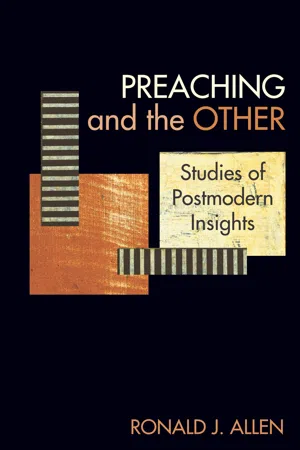
Preaching and the Other introduces the reader to six major themes characteristic of the postmodern era that are important for preaching and explains their implications. Themes discussed include: perception as interpretation, deconstruction, otherness, transgression, pluralism, and the importance of apologetics.
- 168 pages
- English
- ePUB (mobile friendly)
- Available on iOS & Android
eBook - ePub
About this book
Information
Topic
Theology & ReligionSubtopic
Religion1
From the Premodern to the
Postmodern Worlds
I have a rule for preaching that applies to the opening phase of this book: Take nothing for granted with respect to what you think the congregation knows. Given the varied backgrounds of listeners, the preacher cannot assume that the congregation is familiar with details about the Bible or Christian theology, but rather should always explain basic information such as events, places, and geography. Some listeners, for example, will not know the location of Ur of the Chaldees, the starting point of the journey of Abram and Sarai. Given the basic level of much theological education today, even some ministers may not know the difference between (or even the meaning of) infralapsarianism and supralapsarianism.
Taking little for granted, this chapter explores the background of postmodernism. Postmodern writers often compare and contrast postmodern and modern worlds of thought (with modernity as a villain). Such discussions sometimes portray the modern worldview in caricature (thus violating one of the fundamental precepts of postmodernism, which is to honor the integrity of the Other). Moreover, postmodernists sometimes recover motifs from the premodern world. Consequently, as a backdrop for exploring the postmodern trajectories of chapters 2 through 6, the current chapter now sketches the main lines of the modern, premodern, and postmodern worldviews.
This chapter is organized according to the following categories: how people in each world understand the cosmos; human identity and purpose in relationship to the individual and community; sources of authority; knowledge; truth; attitudes toward the past and future; the nature of language; as well as views of God, the Bible, and the sermon. Table 1 summarizes and compares these three worldviews. This chapter also raises some general questions about postmodern perspectives.
The designations premodern, modern, and postmodern are not to label people and put them in boxes but are to help get a sense of patterns of thought, feeling, and behavior. As noted previously, the categories premodern, modern, and postmodern originated among peoples of European origin, especially in Western Europe and North America, though people who reflect these worldviews can be found in many different times, places, and cultures.1 Some communities today remain largely premodern. Some groups are moving from premodern to postmodern without passing through a modern phase. Some people interpret the fact that these notions derive from the Western philosophical tradition as evidence of the continuing attempt of people of European origin to dominate people of non-European origin and culture. Nevertheless, the generalizations that follow have a certain heuristic value even as we recognize that, from culture to culture and within specific communities, we can often identify diverse perspectives, including exceptions to aspects of these characterizations.
Premodern Perspectives
The premodern worldview began with the dawn of human life and extended in western European and North American thought until the Enlightenment (which scholars usually date as an eighteenth-century phenomenon). In some communities, premodern perspectives can be found to this very day. To the premodern community the universe is not divided into animate and inanimate (or natural and supernatural) arenas but is considered one created body that is alive. Indeed, the so-called natural elements of the universe can respond to God as well as to human behavior. For example, according to the great prophet Isaiah, the land itself shall rejoice when the exiles make their way home. Indeed, the responsive quality of the universe enlivens the metaphorical expression that the “the trees of the field shall clap their hands” (Isa. 55:12–13, esp. 12c).
Identity is typically communal in the premodern world. A person’s fundamental life orientation derives from the household, tribe, nation, or similar primary group in which the person is born and among whom the person grows up. The purpose of the individual is to embody the values of the community in her or his everyday life. The person is represented in the community. At the same time, the community is represented in the individual. In a sense, the individual’s life is supposed to be a miniature of the life of the most important qualities of the community’s life. A person born into Israel, for instance, was first and foremost a member of the community in covenant with the God of Israel. The individual was to embody the most important values of covenantal community—worshiping the God of Israel (and not idols), living according to the commandments, and especially practicing justice and mercy.
The primary source of authority in the premodern setting is the tradition of the community. Tradition can be transmitted in oral-aural media as well as through texts. The tradition determines how people understand the world, deity, their own purposes and goals, and how to deal with occasions when the community departs from tradition. However, tradition is not simply a fixed deposit that remains ever the same. Premodern communities adapt traditions in order to account for changing circumstances or perspectives.2
In the premodern setting, knowledge is familiarity with the tradition (and with broader aspects of life) and with how to live out of the tradition in the everyday world. Of course, knowledge includes mastery of the main tenants of the tradition, but even more it involves recognizing and implementing the wisdom of the tradition.
Discussions regarding the nature of truth are not typical of premodern societies. Nevertheless, a functional understanding of truth typically prevails: Truth is the agreement of appearance (or statement) and reality. Moreover, insofar as the tradition summarizes the community’s understanding of truth, a true statement is one that is consistent with tradition. The gospel of John exhibits such an understanding when it identifies Jesus as the truth (e.g., Jn. 14:6). As students from Introduction to Philosophy know, some Greek philosophers did explore the nature of truth (and what we can know) in the course of philosophical discourse.
Premoderns typically hold the past (the source of the tradition) in great respect. They turn to the past for both positive and negative lessons. On the positive side, the past contains the wisdom necessary for the present and the future. On the negative side, some stories from the past recount ideas, behavior, and events that strayed from the tradition. The contemporary community thus learns to avoid such attitudes and actions.
Progress as such is not a prominent category of the premodern mind. Nevertheless, we can surmise that for premoderns, progress is creating conditions that help the community better live out its identity in a setting of security and abundance. In post-exilic Israel, for example, the prophet Haggai believed that the rebuilding of the temple would be part of a network of developments that would help the people live more fully (Hag. 2:1–9).
With respect to language, many people have believed that the spoken word has the power to create that of which it speaks (e.g. Isa., 55:10–11). Premoderns can speak in both informational and mythic ways. In evocative language, a myth expresses how a community feels about the universe and its place in it. A myth explains why things are the way they are, often speaking of the gods and supra-human beings as if these characters speak and act like people on a cosmic scale. Yet, while it seems evident that premodern people largely accept mythic language as fact, it is not always clear where premoderns distinguish between what people today call literal and figurative uses of language.
For the premodern Jewish and Christian worlds, God is a personal being. For example, the biblical writers portray God anthropomorphically walking in the garden and talking with the first couple, and cursing aspects of existence (Gen. 3:1–17). God can act directly in history or can act indirectly through supra-personal or human intermediaries. Moreover, many premoderns believed that the universe was also inhabited by beings who oppose God, such as Satan and the demons.
For premodern Christian communities, the Bible contains the stories that are the core of the tradition. It explains the character of the God of Israel and unfolds what God offers and asks. It indicates how the community is to live. However, as both modern and postmodern biblical interpreters point out, the Bible is not a single fully unified narrative but a collection of stories, ethical guidelines, and theologies with diverse, even different, emphases.
In the premodern church, the major purposes of the sermon are to help the community learn the content of the tradition as it is expressed in Bible and Christian doctrine. The preacher reflects on the implications of that tradition. The preacher reinforces where the community is embodying the tradition faithfully, draws out how to apply the tradition to changing situations, names where the people are drifting away from the tradition, and suggests correctives.
Modern Perspectives
I have already lamented that postmodern thinkers sometimes caricature the modern period. It is important to remember that perspectives in the modern period were diverse, as they are in any period. In the following remarks I sometimes distinguish between hard-core modernism and movements, such as Romanticism, that were modern in outlook but that sought to soften the edges of modern perspectives.
Many moderns envisioned the natural world less as a partner and more as a source of raw materials to supply the needs of the industrial revolution that began about the same time as the Enlightenment. Many modern thinkers interpreted the admonition in Genesis 1:26–27 that humankind should have dominion over the earth as license to exploit the earth (and animals) for the raw materials needed to supply human pleasure and needs through industrial expansion. By contrast, the Romantics viewed nature more lyrically, even regarding it as a more pure and simple form of life than the human one and from which human beings could learn. For example, the latter emphasis was important in compelling Henry David Thoreau to take up residence at Walden Pond.
Whereas the premodern world regarded human identity as communal, emphasis in the modern world shifted toward the individual as the basic unit of human identity. Each human being is to discover or create his or her own identity. One of my high school English teachers used a line from a poet to make this point. “You are the master of your fate. You are the captain of your soul.”3 Many modern people thought of a community less as a body of people who were inherently connected and more as a collection of individuals.
For the modern world, reason replaced tradition as the primary authority in community and functioned from two starting points. The more familiar one to contemporary readers is empirical or scientific observation: Something will be considered authoritative if it can be verified through the senses. When a statement cannot be proven by empirical observation, it cannot be fully accepted as authoritative. This way of thinking was quite popular. The starting point that was less familiar at the popular level is sometimes called rationalism and derives from the idea that a logical thinker can identify unchallenged first principles on which all ideas are founded. If a thinker starts at a certain point, the thinker can logically make all necessary deductions from that point.
Knowledge in the modern era became the possession of empirically verified (or logically proven) facts. Thinkers intensified the compartmentalization of knowledge into different arenas. Specialists developed who were considered authorities in their particular blocks of knowledge. Many people with this worldview believed the most accurate and reliable knowledge came in the form of clear ideas. As the modern era developed, areas of specialization often became more and more focused, especially in the professions. Both formally and informally people recognized boundaries around specific foci and looked to specialists to interpret the knowledge under their purview. Some modern thinkers did aver that human beings could have awareness in the realm of feeling. Friedrich Schleiermacher, for instance, interpreted religion as a feeling of absolute dependence. Even amongst such thinkers, though, an emphasis on empiricism remained: the feeling itself could be verified.
While the notion of truth as correspondence was already alive in the premodern world, it became a fixture of the Enlightenment mentality. The difference is that for moderns, truth is that which corresponds with empirical observation or unquestioned first principles. The modern mind is suspicious of ideas or descriptions of ideas and events that are not consistent with things that have been established on the basis of empirical observation or unquestioned first principles and logical deduction. According to many modern thinkers, by definition truth is universal, that is, it is valid in every time and place.
With respect to the past, modern historians developed the idea that the purpose of the discipline of history was to reconstruct a reliable picture of the past. Such historians sought to account for what really happened and what did not. For example, historians questioned whether crossing of the Red Sea could have occurred as reported in Exodus 14 with the waters parting dramatically and the people of Israel passing through the waters.
Beyond this technical understanding of history, some modern people developed skepticism about the importance of the past because the past was so filled with superstition—such as stories, beliefs, and practices that could not be verified. In an especially memorable (if regrettable) expression, Henry Ford declared, “History is more or less bunk. It’s tradition. We don’t want tradition. We want to live in the present and the only history that is worth a tinker’s dam is the history we made today.”4 Modern people with this view thought that they not only could live without much reference to history but that ideas from the past could mislead them. At the same time, some moderns averred that to ignore the past was to overlook valuable lessons. Indeed, in a discussion of the relationship of the past to progress, the philosopher George Santayana said, “Those who cannot remember the past are condemned to repeat it.”5
Many moderns view progress in terms of creating and using ever more sophisticated technological devices that would benefit human beings in terms of improving health care, saving human labor, and expanding ways of enhancing the quality of human life. For example, in the 1950s, the General Electric corporation used as an advertising slogan, “Progress is our most important product,” meaning that General Electric intended to constantly develop new and improved cooking stoves, refrigerators, washing machines, jet engines, electrical generators, and similar products.
Modern linguists often differentiated between two uses of language. They often preferred direct statements that communicated with scientific and logical precision. Such moderns wanted to speak and write in statements that corresponded with reality, that told the truth. Many people with a modern mind-set regarded mythic language as inferior, even as superstitious. For example, my modern mother was quite pointed in saying, in reference to the story of Jonah, “How can people believe a person was swallowed by a fish and then burped up three days later?” Some moderns did recognize the figurative use of language as expressing aspects of life that could not be captured by propositional discourse. The Romantic poets, for example, reacted against what they perceived as sterility in Enlightenment concentration on reason and technology (often associated with urban life). The Romantic poets such as William Wordsworth, Samuel Taylor Coleridge, and William Blake used language in ways that emphasized intuition and feeling, and that often favored the countryside and nature.
Some moderns chose (and continue to choose) not to believe in God because the existence of such a being cannot be verified empirically and cannot be established as an unchallenged foundational premise. Many moderns do accept the existence of God but, under the sway of the empirical method and philosophy’s notion of unchallenged first principles, recognize that they cannot speak casually about God’s nature and activity. ...
Table of contents
- Cover
- Title
- Copyright
- Contents
- Introduction
- Chapter 1: From the Premodern to the Postmodern Worlds
- Chapter 2: Preaching and the Other
- Chapter 3: Preaching and Deconstruction
- Chapter 4: Preaching and Social Location
- Chapter 5: Preaching and Transgression
- Chapter 6: Preaching and Diversity
- Notes
Trusted by 375,005 students
Access to over 1.5 million titles for a fair monthly price.
Study more efficiently using our study tools.
Frequently asked questions
Yes, you can cancel anytime from the Subscription tab in your account settings on the Perlego website. Your subscription will stay active until the end of your current billing period. Learn how to cancel your subscription
No, books cannot be downloaded as external files, such as PDFs, for use outside of Perlego. However, you can download books within the Perlego app for offline reading on mobile or tablet. Learn how to download books offline
Perlego offers two plans: Essential and Complete
- Essential is ideal for learners and professionals who enjoy exploring a wide range of subjects. Access the Essential Library with 800,000+ trusted titles and best-sellers across business, personal growth, and the humanities. Includes unlimited reading time and Standard Read Aloud voice.
- Complete: Perfect for advanced learners and researchers needing full, unrestricted access. Unlock 1.5M+ books across hundreds of subjects, including academic and specialized titles. The Complete Plan also includes advanced features like Premium Read Aloud and Research Assistant.
We are an online textbook subscription service, where you can get access to an entire online library for less than the price of a single book per month. With over 1.5 million books across 990+ topics, we’ve got you covered! Learn about our mission
Look out for the read-aloud symbol on your next book to see if you can listen to it. The read-aloud tool reads text aloud for you, highlighting the text as it is being read. You can pause it, speed it up and slow it down. Learn more about Read Aloud
Yes! You can use the Perlego app on both iOS and Android devices to read anytime, anywhere — even offline. Perfect for commutes or when you’re on the go.
Please note we cannot support devices running on iOS 13 and Android 7 or earlier. Learn more about using the app
Please note we cannot support devices running on iOS 13 and Android 7 or earlier. Learn more about using the app
Yes, you can access Preaching and the Other by Ronald J. Allen in PDF and/or ePUB format, as well as other popular books in Theology & Religion & Religion. We have over 1.5 million books available in our catalogue for you to explore.