A generation of biblical scholars have sparked a revolution in thinking about the apostle Paul. Now, bible scholar and progressive Christian pastor Eric C. Smith is helping Christians see how that revolution makes a difference for people engaged in the work of justice and inclusion.In Paul the Progressive, Smith revisits Paul in light of modern biblical scholarship, telling the story of a Paul who challenged the norms of his day, broke down barriers of gender and ethnicity, and re-imagined God's plan for the world in terms of radical inclusion and salvation available to everyone.
eBook - ePub
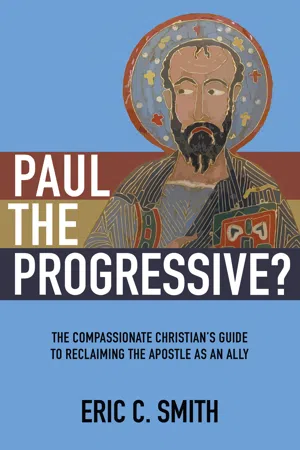
Paul the Progressive?
The Compassionate Christian's Guide to Reclaiming the Apostle as an Ally
- 160 pages
- English
- ePUB (mobile friendly)
- Available on iOS & Android
eBook - ePub
Paul the Progressive?
The Compassionate Christian's Guide to Reclaiming the Apostle as an Ally
About this book
Information
Topic
Theology & ReligionSubtopic
ReligionChapter 1: Hating Paul (An Introduction)
“I Kind of Hate Paul.”
“I kind of hate Paul.” In almost every Bible class I’ve ever taught in a church or in a seminary classroom, someone has said these words of the person whose name is on about half of the books of the New Testament. They usually say it in a way that tells me that they know they’re not supposed to hate Paul. With a nervous grin on their faces and a “please don’t be angry about this” tone in their voices, dozens of people have told me that they cannot stand one of the most important figures in the history of Christianity.
People are usually relieved when I smile back. Not that I hate Paul—I don’t—but I certainly understand why people do. Most of my circles are filled with progressive Christians, and progressive Christians seem to hate Paul much more often than their conservative sisters and brothers do. Progressive Christians can usually recite a laundry list of reasons why they hate him, but most people seem to have one particular reason for why they hate Paul. For some, it’s because of all the passages in Paul’s writings that condemn homosexuality—and, usually, these Christians turn out to be people who have been wounded deeply by other Christians using Paul’s words against them. For others, it’s because of Paul’s contempt for women and women’s leadership. Often, these are women who have had their calls to ministry squashed, challenged, or undermined by their communities—and their gifts devalued—because of words that Paul wrote. Still others have a particular disgust for Paul’s sexual ethics—the way he always seemed to be shaming people for having bodies and wanting to derive pleasure from them. Some see Paul as a defender of slavery. Others point to Paul’s anti-Semitism as their most important reason for hating him, often citing personal connections to the Jewish faith and the ways Paul’s anti-Jewish words have been used to hurt people they love. Recently, some people have a new reason to hate Paul—after his writings were used to defend the separation of families detained at the United States’ southern border. And, perhaps most frequently of all, people will talk about the way Paul took the message of Jesus—a message of peace, love, forgiveness, and community—and turned it into a system of personal salvation full of guilt, debt, and unpayable obligations to God. These people have often escaped fundamentalist or conservative Christian childhoods, in which the writings of Paul were used to instill feelings of inadequacy, shame, and (to use a word from the writings of John Calvin) depravity. For many Christians like this, Paul was the hijacker of Christianity, the person whose writings mark the point at which the tradition went from beautiful to abusive.
I’ve encountered so many Paul haters in my New Testament courses that I now begin class with a stark confession of my own: I love Paul. I don’t always like Paul, but I love Paul. I think Paul has gotten a bad rap. More than that, I think Paul has been completely misinterpreted by the Christian tradition. The Paul we know (and hate) has almost nothing in common with the Paul we encounter by taking a fresh look at his letters. I love Paul, I tell my classes, because once you get past centuries of Christian interpretation of him and approach Paul on his own terms, he turns out to be endearing and sneakily liberal. He turns out to be passionate about what he believes in, and he gets angry when he thinks people are being deceitful or dishonest. He can be stunningly egalitarian, a supporter of women’s ministries, and nothing at all like the misogynistic Paul we usually imagine. Instead of being anti-Semitic, he is one of the proudest defenders of Judaism in antiquity. Almost every reason to hate Paul listed in the previous paragraph turns out to be mostly unfounded if you look at the writings of Paul himself. Once you get to know Paul on his own terms, and get rid of the things the church has piled onto his shoulders over the years, most of the reasons to hate Paul go away, and what’s left is a Paul who is inspiring, moving, and actually very progressive.
I know: you don’t believe me—yet. Most of my students don’t either, in the beginning. Often they’ll say that they’re open to being convinced, but they’re obviously skeptical. That’s understandable given how the church has used and misused Paul over the years, and how much damage that misuse has done. But by the end of the course, many of my students have gained a grudging respect for Paul, and some even love him as I do. A few continue to hate Paul, but in my experience the more you’re able to strip away layers of Christian theology and doctrine and encounter Paul in his own voice in the writings he left us, the more you like him.
It turns out that the Paul most of us know isn’t the real Paul. Most of us know a Paul who’s an invention of generations of interpreters and theologians, so encrusted with the residue of creeds and bad interpretations that he’s hard to recognize. We know Paul through isolated verses pulled out of context, or we know him through books that bear his name that he didn’t actually write. We know Paul through sermons about hellfire and those dramatic, “If you died tonight, where would you go?” ultimatums, although Paul never asked anything that sounded like that. We know a Paul that has passed through the filter of two thousand years of Christian thinking, but those twenty centuries of thought have made Paul into something he never meant to be. And, if we can get past that Paul, to the real Paul that we meet in his letters, we will find a very different person there waiting for us.
Ground Rules for Reading Paul
This book is an attempt to convince you to think about Paul differently. I hope that I can convince you that Paul was not a misogynist, a homophobe, an anti-Semite, a prude, an apologist for slavery, a defender of arbitrary government power, a purveyor of spiritual debt and guilt, or a hijacker of the Christian tradition. I hope I can introduce you to a Paul who was early Christianity’s great champion of inclusion, constantly pushing the boundaries of how people thought about God’s family. I want to convince you that Paul was a champion of women, working alongside women and holding them up as examples of faithfulness. And, I want to persuade you that Paul was a Jew, and a proud one at that, and by no means an enemy of Jews and Judaism. By looking at the way Paul thought about ethics, I want to show that Paul was not a supporter of slavery, that he never meant his words to be used to instill shame about sex, and that he would object strongly to having his writings used to defend the separation of families at the border. I want to demonstrate that Paul was a great pilot of the Christian tradition, not its hijacker, and that the ways Paul’s words have been used to create theologies of guilt and debt have nothing to do with Paul himself.
But before we do all that, we need to set some ground rules about how to study Paul’s writings and other New Testament writings about Paul. These ground rules come from modern biblical scholarship and the many tools it uses to analyze texts. Not all scholars would agree with all of these, but through years of research and teaching about the Bible, these are the ones that I have chosen. There are four ground rules:
- Know that Paul didn’t write everything attributed to him.
- Trust Paul’s own words over the words of others about him.
- Trust Paul’s actions as evidence of his commitments.
- Recognize that we are always already viewing Paul through a particular theological and historical lens.
Together, these four ground rules will help us to sift through the evidence found in the New Testament and come closer to the truth about Paul. They aren’t foolproof, but they will give us a road map through Paul’s life, teachings, and writings. I’ll say a bit more about each of these ground rules, giving some context for them and why they are helpful.
Paul Didn’t Write It All
First, it’s important to realize that Paul did not write everything that has his name on it in the New Testament. This can be difficult for some people to hear, because it challenges their notion of what the Bible ought to be. It’s hard to accept that there might be dishonesty canonized in the pages of the Bible. But in the ancient world, it was not uncommon for works to be written under someone else’s name, and it wasn’t always dishonesty, exactly. Often the followers of an important figure would write works using that person’s name after their death as a way of furthering that legacy or of “completing” that work. The book of Isaiah is a good example of this; scholars believe that the “original” Isaiah wrote only chapters 1–39 of the book, and that one or more additional authors, inheritors of his tradition, wrote the remaining 27 chapters using Isaiah’s name.1 It also happened with other ancient writers, who sometimes complained even in their own lifetimes about people writing in their name, a stranger making a buck off their reputation.2 But with Paul, it probably didn’t happen until after he had died, and it was probably done by people with good intentions, who only wanted to claim some of Paul’s authority to make a point with which they thought Paul would have (or should have) agreed. This seems really shady to us today, and it violates our ideas about intellectual honesty, but in antiquity it was fairly common, and sometimes it was even honorable.
There are 14 books sometimes associated with Paul. Of these, we can dismiss one right away. The book of Hebrews, which is sometimes called “Paul’s Epistle to the Hebrews,” isn’t by Paul (and it isn’t an epistle, for that matter; it’s probably a homily), and it doesn’t even claim to be written by Paul. His name’s attachment to it is just laziness; the book is part of the same section of the New Testament as Paul’s writings, so it gets lumped in with the rest. Of the remaining 13 books, scholars are unanimous about Paul’s authorship of only seven of them: Romans, 1 Corinthians, 2 Corinthians, Galatians, Philippians, 1 Thessalonians, and Philemon. It’s hard to find a Bible scholar who disputes that Paul wrote those; it’s as close to a sure thing as there is in the study of the New Testament.
The remaining six are subject to varying levels of debate. Colossians, Ephesians, and 2 Thessalonians are sometimes called the “disputed” epistles or the “Pseudo-Pauline” epistles, because there is significant disagreement among scholars about whether Paul wrote them or not. Generally speaking, more theologically conservative scholars tend to think Paul did write them, while non-Christian or liberal Christian scholars tend to think he didn’t. Beyond theology, the differences of opinion come down to how much importance you give to things such as vocabulary and style. These three letters differ from the seven undisputed ones in important ways. Reading them in the Greek, you can tell that there are big changes in the word selection and even in the sentence structure when compared to Paul’s undisputed writings. There are also differences in theology; 2 Thessalonians, for example, has a very different view of the timing of Jesus’ return than 1 Thessalonians and Paul’s other writings. Of course, a person’s writing and theology might change over time, and that is a major argument made by people who think Paul did write these books. I am one of those who thinks that these three books were probably not written by Paul, although there are sections of them that sound a lot like Paul, and that might preserve authentic traditions of Paul’s sayings or even snippets of Paul’s writings. But generally speaking, we can’t count on these books to tell us much for certain about Paul, and when determining Paul’s positions on things I set these aside. In this book, though we will look at passages from some of these books, we will always view them as non-Pauline works.
Titus, 1 Timothy, and 2 Timothy are often called the “Pastoral Epistles,” and it is more broadly (but not unanimously) agreed that Paul didn’t write these. They are called “Pastoral” because they all have an emphasis on pastoral ministry; they are all written from the standpoint of an elder “pastor” or missionary giving advice to a younger one, using Paul’s name as the elder. There are many reasons to think that these don’t come from Paul himself, including the same reasons of style, word selection, and theology that we saw with Colossians, Ephesians, and 2 Thessalonians. But, there are other reasons too. The Pastoral Epistles seem to assume a church structure that didn’t yet exist in Paul’s day; 1 Timothy, for example, spends a lot of time talking about church offices, such as bishop and deacon, that didn’t fully develop until a later time.3 Although Paul’s undisupted letters sometimes mention deacons (like Phoebe), these mentions always presume an informal kind of leadership, as opposed to the Pastoral Epistles’ presumption of a more organized and standardized hierarchy of church offices. In all likelihood, these letters come from a time well after Paul’s death, and were written in his name as a way of offering advice to future generations of church leaders. That certainly makes them useful, but they can’t tell us much about Paul himself, and these too we have to set aside. Again, I’ll reference some of these works in this book, but always with the assumption that Paul didn’t write them. I sometimes tell my students that it’s helpful to think of these works as “fan fiction.” They are tributes to the “original,” and in some ways they participate in the same universe as the “original,” but they exist outside the boundaries of what the “original” author imagined or set forth. As with fan fiction, these books can still be useful and even entertaining, but they aren’t Paul.
Of the fourteen works commonly attributed to Paul, then, we have to limit ourselves to only half: the undisputed (or “authentic”) letters. These range from majestic and sophisticated letters, such as Romans and 1 Corinthians, to a messy and chaotic letter such as 2 Corinthians. Philemon, the shortest of them all, is hardly a spiritual letter at all, although it will play an important role in chapter 6...
Table of contents
- Praise for Paul The Progressive?
- Dedication
- Copyright
- Contents
- Preface
- Acknowledgments
- Chapter 1: Hating Paul (An Introduction)
- Chapter 2: Paul the Misogynist
- Chapter 3: Paul the Homophobe
- Chapter 4: Paul the Anti-Semite
- Chapter 5: Paul the Prude
- Chapter 6: Paul the Slavery Apologist
- Chapter 7: Paul the Xenophobe
- Chapter 8: Paul the Debt and Guilt Monger
- Chapter 9: Paul the Hijacker (A Conclusion)
- Bibliography
- About the Author
Trusted by 375,005 students
Access to over 1.5 million titles for a fair monthly price.
Study more efficiently using our study tools.
Frequently asked questions
Yes, you can cancel anytime from the Subscription tab in your account settings on the Perlego website. Your subscription will stay active until the end of your current billing period. Learn how to cancel your subscription
No, books cannot be downloaded as external files, such as PDFs, for use outside of Perlego. However, you can download books within the Perlego app for offline reading on mobile or tablet. Learn how to download books offline
Perlego offers two plans: Essential and Complete
- Essential is ideal for learners and professionals who enjoy exploring a wide range of subjects. Access the Essential Library with 800,000+ trusted titles and best-sellers across business, personal growth, and the humanities. Includes unlimited reading time and Standard Read Aloud voice.
- Complete: Perfect for advanced learners and researchers needing full, unrestricted access. Unlock 1.5M+ books across hundreds of subjects, including academic and specialized titles. The Complete Plan also includes advanced features like Premium Read Aloud and Research Assistant.
We are an online textbook subscription service, where you can get access to an entire online library for less than the price of a single book per month. With over 1.5 million books across 990+ topics, we’ve got you covered! Learn about our mission
Look out for the read-aloud symbol on your next book to see if you can listen to it. The read-aloud tool reads text aloud for you, highlighting the text as it is being read. You can pause it, speed it up and slow it down. Learn more about Read Aloud
Yes! You can use the Perlego app on both iOS and Android devices to read anytime, anywhere — even offline. Perfect for commutes or when you’re on the go.
Please note we cannot support devices running on iOS 13 and Android 7 or earlier. Learn more about using the app
Please note we cannot support devices running on iOS 13 and Android 7 or earlier. Learn more about using the app
Yes, you can access Paul the Progressive? by Eric C. Smith in PDF and/or ePUB format, as well as other popular books in Theology & Religion & Religion. We have over 1.5 million books available in our catalogue for you to explore.