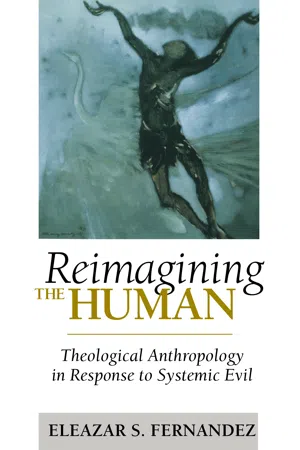
This book explores theological anthropology—the doctrine of what it means to be human and to be created in God's image. Fernandez argues that our life in the image of God is damaged and frustrated by the systemic evil of society, particularly the four radical evils of classism, racism, sexism, and naturism (destructive practices against the ecosystem). At the heart of these four evils are matters of faith and idolatry—worshiping human constructs and living under the lie of false securities. Idols demand the sacrifice of our souls, bodies, time, and anything that we cherish most.
eBook - ePub
Reimagining the Human
Theological Anthropology in Response to Systemic Evil
- 288 pages
- English
- ePUB (mobile friendly)
- Available on iOS & Android
eBook - ePub
About this book
Information
Topic
Theology & ReligionSubtopic
Christian TheologyCHAPTER 1
Exploring Hermeneutic Lenses
for Reconstructing the Human
Out of the pain of those who have experienced life at the margins new voices have emerged challenging our usual ways of thinking and doing. These voices are not simply content to give “new” answers to “old” questions (answers that, as it is argued, continue to operate within the old parameters); rather, they attempt to raise “new” questions that often jar the parameters of the old questions.1 This questioning of the old parameters is an expression of a crisis simmering at the heart of our society, a crisis that I would characterize as a crisis of sensibility. I am taking these new voices seriously and this chapter reflects my own struggle to find a different hermeneutic lens for constructing theological anthropology. What follows is a simultaneous double move of deconstruction of some conceptual traps and an articulation of a hermeneutic lens.
From Hermeneutic Manicheanism to Embodied Knowing
The term “hermeneutic Manicheanism” is my reappropriation of William Lloyd Newell’s notion of “methodological Manicheanism.”2 Newell characterizes this as a methodology that has forgotten its own historicity. What Newell calls methodological Manicheanism resonates with what others call “disembodied knowing,” a knowing that has forgotten its own embodiedness.3 It is a knowing that has severed the head from the body, as if it were possible to think without our bodies or as if we do not think through our bodies. If I am who I am only through my body, it is inconceivable to imagine a form of thinking that has forgotten the body. But this form of thinking is a pervasive one.
I am aware that with the advent of modernity there has been a greater realization of our conditionedness or a greater awareness that we understand as we do because we “exist” as we do and, conversely, we exist as we do because we interpret as we do. This hermeneutic move toward humans’ historical conditionedness points in the proper direction, but the move has been aborted and left hanging before it has touched the ground. By remaining at the ontological level, this move has abbreviated “history” into “historicity.”4
Karl Marx and Friedrich Engels launched a similar criticism against Ludwig Feuerbach at the turn of modernity.5 Feuerbach vigorously challenged speculative thoughts and identified his stand: “I differ toto coelo from those philosophers who pluck out their eyes that they may see better; for my thought I require the senses, especially sight; I found my ideas on materials which can be appropriated only through the activity of the senses.”6
But Marx and Engels found the Feuerbachian-turn-to-the-self or to the realm of the senses unable to touch the ground completely. Engels could only say of Feuerbach that “the lower half of him is materialist; the upper half is idealist.”7 Feuerbach remained bourgeois materialist and stopped short in general psychology and anthropology without grounding his subjects in embodied history. In a similar way, many hermeneutic theories stop short in ontology and historicity or in the linguisticality of understanding and interpretation.
Cornel West continues the criticism launched against disembodied knowing. For him, any talk about historicity that does not deal with our embodied sociality (geographical location, class, race, gender, etc.) is “thin” history. In West’s lines:
To tell a tale about the historical character of philosophy while eschewing the political content, role, and function of philosophies in various historical periods is to promote an ahistorical approach in the name of history. To undermine the privileged philosophic notions of necessity, universality, rationality, objectivity, and transcendentality without acknowledging and accenting the oppressive deeds done under the ideological aegis of these notions is to write an intellectual and homogeneous history, a history which fervently attacks epistemological privilege but remains relatively silent about forms of political, economic, racial, and sexual privilege.8
Feminists and womanist writers have launched a sustained critique against various expressions of disembodied knowing and its oppressive consequences.9 Disembodied knowing usually portrays itself as pure and value-free (pristine logic), and is associated with male rationality: detachment and objectivity. Such a view, feminist thinkers argue, is opposed to embodiedness and subjectivity, which are ways of knowing traditionally identified with women. Disembodied knowing, which is masquerading itself as objective and universal, must be exposed for what it is: “concrete, situated, particular, and limited.”10
There is, I believe, a need to move away from the view that denigrates our embodiedness toward an embodied knowing: a way of knowing that celebrates our embodiedness.11 Embodied knowing sees reality through the configuration of our bodiliness and seriously considers the effects of ideas as they bear on bodies and vice versa, especially the disfigured bodies of the marginalized. As a form of knowing, it demands that one does not remain content with mere assertions of historicity that mute differences; instead, it pays attention to radical plurality, particularity, and the differences between human beings and other living beings.
Pursuing historical embodiment seriously requires that we take the “who” of our discourse in such a way that introduces into hermeneutics the rich detail of social location, which is crucial to any interpretive enterprise.12 When we take the “who” of our discourse beyond the ontological level into the rich details of geography and social location, we come to the realization that our interpretations are not separate from, but are tied to, who we are. Not only do we interpret texts, the interpreted texts interpret us. Moreover, our identities also interpret the texts.13
Embodied knowing calls us to a different way of seeing, opening up new and rich dimensions for constructing theological anthropology. Contrary to the understanding that an embodied hermeneutic is myopic and exclusivist, it is broad and responsive to the particularities of a given context. Embodied knowing opens up novel ways of interpreting various theological concepts, such as transcendence and immanence. In embodied knowing, transcendence and immanence are two sides of the same reality. Transcendence is not moving away from embodiment, but being thoroughly embodied in multifarious specificity. Instead of running away from embodiment, the transcendent is, in fact, experienced in concrete embodiments.
Beyond Totalizing Discourse
Disembodied knowing works along with universalizing and totalizing discourse. Oftentimes without knowing it, we elevate a particular perspective to the level of universality; thereby, we impose it on others under the mask of objectivity and neutrality. “I am increasingly aware,” writes Sharon Welch, “that to speak of the universal is all too often, and perhaps even necessarily, to elevate as universal and normative a particular aspect of human being.”14 Similarly, James Cone points out that many white theologians “do not recognize the narrowness of their experience and the particularity of their theological expressions. They like to think of themselves as universal people.”15 Our tortuous history testifies that universalizing and totalizing discourse has undergirded many projects of conquest, colonization, and exploitation. Thus, the subversion of totalizing discourse is not only an epistemological, but also a political, necessity.
Subversion of universalizing and totalizing discourse has been central in the struggle of counter-hegemonic movements. This is certainly true in the case of theological movements identified with the Third World and, more specifically, in a theological current known as contextualization. By contextualization I mean something beyond translation or adaptation of the unchangeable deposits of faith to specific contexts. It is not simply a mode of communication or finding cultural media as vehicles to communicate some eternal truths, but a mode of apprehension that recognizes that context shapes the perception of reality, the way theology is done, and the content that may emerge.
Contextualization has become a common theological term both in the Third World and the wealthy countries of Europe and North America. Nevertheless, there is still that pervasive understanding of the normativity of Western theologies. Many of the dominant theologies of the West readily acknowledge the contextuality of Third World theologies, but they are often forgetful of their own location. Robert McAfee Brown helps to clarify this point in noting a remark made by a Latin American theologian during a conference of North and South American theologians: “Why is it that when you talk about our position you always describe it as ‘Latin American theology,’ but when you talk about your position you always describe it as ‘theology’?”16 This is not a simple matter of forgetting; it is deeply grounded in the understanding that Western theology is “normative” and universal, whereas other theologies are “derivative” and particular.
The contextual character of theology has been emphasized for several years now, but it has been the Third World theologians, feminists, womanists, and other marginalized groups who have pursued the contextual thrust with passion. That these groups have pursued the contextual character of theology is not surprising, because to insist on the contextual character of theology is to subvert the normativity of the dominant theological views and create a space for other theological voices. In other words, contextualization is not only made on epistemological and theological grounds, but also because of its extreme political implications. When theology listens to the once submerged voices, it is going to experience dramatic change.
My critique of universalizing and totalizing discourse does not mean that we are forbidden from making claims that have universal validity, otherwise we become imprisoned in our individual boxes of particular assertions that do not take seriously the challenge that others make about who we are, how we constitute ...
Table of contents
- Cover Page
- Halftitle Page
- Title Page
- Copyright Page
- Dedication
- Contents
- Acknowledgments
- Introduction
- 1. Exploring Hermeneutic Lenses for Reconstructing the Human
- 2. The Interlocking Structures of Forms of Oppression
- 3. A Theological Reading of the Interlocking Forms of Oppression: Sin and Evil
- 4. Humanity in the Crucible of Classism: Reimagining the Human in Response to Classism
- 5. Reimagining the Human in Response to Sexism: Toward an Integrated Man and Woman
- 6. Reimagining Anthropology in Response to Racism: Encountering God in One’s Racial Identity
- 7. Reimagining the Human in Light of the Travail of the Ecosystem
- 8. Becoming a New Human Being in Right (Just) Relation
- 9. The Eschatological People: Living the Promise of the Future in the Realities of the Present
- Proper Name Index
- Subject Index
Trusted by 375,005 students
Access to over 1.5 million titles for a fair monthly price.
Study more efficiently using our study tools.
Frequently asked questions
Yes, you can cancel anytime from the Subscription tab in your account settings on the Perlego website. Your subscription will stay active until the end of your current billing period. Learn how to cancel your subscription
No, books cannot be downloaded as external files, such as PDFs, for use outside of Perlego. However, you can download books within the Perlego app for offline reading on mobile or tablet. Learn how to download books offline
Perlego offers two plans: Essential and Complete
- Essential is ideal for learners and professionals who enjoy exploring a wide range of subjects. Access the Essential Library with 800,000+ trusted titles and best-sellers across business, personal growth, and the humanities. Includes unlimited reading time and Standard Read Aloud voice.
- Complete: Perfect for advanced learners and researchers needing full, unrestricted access. Unlock 1.5M+ books across hundreds of subjects, including academic and specialized titles. The Complete Plan also includes advanced features like Premium Read Aloud and Research Assistant.
We are an online textbook subscription service, where you can get access to an entire online library for less than the price of a single book per month. With over 1.5 million books across 990+ topics, we’ve got you covered! Learn about our mission
Look out for the read-aloud symbol on your next book to see if you can listen to it. The read-aloud tool reads text aloud for you, highlighting the text as it is being read. You can pause it, speed it up and slow it down. Learn more about Read Aloud
Yes! You can use the Perlego app on both iOS and Android devices to read anytime, anywhere — even offline. Perfect for commutes or when you’re on the go.
Please note we cannot support devices running on iOS 13 and Android 7 or earlier. Learn more about using the app
Please note we cannot support devices running on iOS 13 and Android 7 or earlier. Learn more about using the app
Yes, you can access Reimagining the Human by Eleazar Fernandez in PDF and/or ePUB format, as well as other popular books in Theology & Religion & Christian Theology. We have over 1.5 million books available in our catalogue for you to explore.