New elders and veteran leaders alike will find wisdom, biblical guidance, and useful suggestions in Gary Straub's examination of the crucial role of elders in Christian Church (Disciples of Christ) congregations. This simple and easy to read overview of Disciples eldership examines the nature of the office and describes its responsibilities and challenges. It emphasizes the importance of spirituality in the lives of elders. Straub beckons elders to embark on their leadership adventure together, fortifying their leadership through prayer, learning, discussion, mutual accountability, and other paths to spiritual growth and encouragement. Their faithful eldership is a beacon for faithful congregations as elders' prayers become spiritual channels through which graces unfold in congregational life. That exciting prospect lies at the heart of eldership and of Straub's inspiring insights.
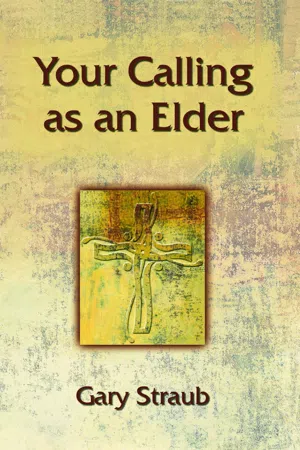
- 96 pages
- English
- ePUB (mobile friendly)
- Available on iOS & Android
eBook - ePub
Your Calling as an Elder
About this book
Information
Topic
Teología y religiónSubtopic
Denominaciones cristianas1
Who, Me? An Elder?
When the nominating committee calls, there’s a moment of transcendental hesitation on your end of the line. This call is a clear-cut case of mistaken identity: They have asked you to serve as an elder!
But seriously, a flood of emotions hits. You are honored, flattered, and scared. Many elders tell me they feel joy to be invited to serve Christ’s church in this capacity, but don’t feel worthy. You finally manage to mumble something about how you’d “like to pray about it.” Now what? Where do you begin the process of sorting out this decision?
One place I encourage potential elders to start is the listening side of prayer. How about entering into a season of discernment, during which you sift through questions designed to illuminate some of the spiritual considerations as you search out God’s call on your life? The actual practice need not be cumbersome. Simply set aside a small daily time block (fifteen to twenty minutes) for perhaps a week. You may find it helpful to develop a simple ritual, such as sitting in your favorite chair and lighting a candle as a sign of your intention to welcome the light of Christ as you present yourself to the Presence to receive whatever illumination God might be so gracious as to offer. If you are “on the run” schedule-wise, you may elect to devote a particular stretch of road you are driving to quiet discernment, setting aside these miles as consecrated to the listening side of prayer (and paying attention to driving!). Whatever the physical arrangements, the spiritual intention is clear: to purposefully offer yourself in a particular time and space to God. Here are twenty sets of questions that may help you discern your answer to the call.
Discerning the Call to Eldership
(An inventory for spiritual self-examination)
- Joy. Can I name the joy in this possibility?
- Advice. What does my family think? Got any words of wisdom from longtime friends who know me all too well?
- Negative Impact. Is there anything in my past that if publicly known might negatively impact the congregation (arrests, felonies, lawsuits, violations, accusations, what else)? How have I resolved these matters within my own soul? Would it help to disclose them in confidential conversation with a trusted spiritual adviser?
- Unfinished Business. Are there any emotional, spiritual, or personal issues that are substantially unfinished in my soul that might hinder my ability to serve wholeheartedly? Do I know what my “hot button” issues are that consistently skew my perspective? Am I willing to name, dig out, address, and resolve these matters?
- Spiritual Gifts. Do I know my own spiritual gifts well enough to know how my strengths might complement the congregation and its needs at this time in its life? Am I willing to collaborate and serve out of my spiritual gifts for the common good of the congregation?
- Scandal. Is there anything in my life as I examine it that could create a scandal to the gospel and give unbelievers just the excuse they need to disrespect the church? How do I deal with aspects of my own “not-so-pretty” personality that may arise from time to time?
- Recovery. If I am in recovery for an addiction, have I been walking that path long enough to develop a mature perspective? Is my life “in order”?
- Personal Disclosures. Are there any matters that I have not confessed before God and humankind that could negatively affect my capacity to serve effectively?
- Pastoral Relationship. Do I have a positive regard for the pastor beside whom I’ll serve? Do I have a collegial spirit with current pastoral leadership? Am I willing to lead and be led by my pastor?
- Unyieldedness. Since eldering is a major commitment to ongoing spiritual growth, are there any hindrances or barriers to my spiritual growth I am unwilling to yield to God? Do I have any major or minor issues that might become a stumbling block to my leadership? What about my “pet peeves” and “hobby horses”?
- Holy Spirit. Have I developed a mature understanding of and intimate communion with the Holy Spirit that allows me to respond with consistent sensitivity to the guidance of God in my life? Have I gotten past being “spooked” by the Spirit to appreciate the energy and strength of Paul’s statement in Philippians 4:13?
- Devotional Life. Have I devoted myself on a daily basis to those habits and practices of faith (especially prayer and reading scripture) that will sustain my spiritual service over the long haul, especially through times of controversies, dry spells, grief, upheaval, frustration, and aggravation that mark some seasons in the life of my congregation?
- Fears. Are any of my hesitancies about accepting this call fear-based? Will I allow God’s perfect love to cast out fear so I can discern the deeper call beneath the anxiety?
- Problems or Satisfactions. What do I imagine my biggest problems with being an elder might be? What might be the most spiritually satisfying aspect?
- Facing Myself. Since it is inevitable that eldering will bring me face-to-face with my own faults, flaws, foibles, frailties, and finitude (to say nothing of my weaknesses), what do I imagine will be the outcome of my facing the shadow side of my own human nature?
- Expectation. Is there anything I expect will happen to me spiritually in that moment when I am installed or ordained to the office of elder?
- Example. How will I deal with the discomfort of being “looked up to” as a spiritual example? How comfortable am I with the spiritual reality of my own Christlikeness?
- Core Faith. Have the essential core matters of the ancient faith been settled within my soul in such a way that I can embody them in teaching—both formally and informally? Do I know the faith, both inside and out? (intellectually and experientially)? Can my soul bear the weight of being a bearer of Christ’s light?
- Legacy. What might my spiritual legacy as an elder to this congregation look like? Am I willing to begin now doing those things that will lead to such a blessing or legacy?
- Vision. Can I gather into my own spirit any sense of the spiritual vision of our congregation’s mission; and what of that vision is mine to own and carry out? How does my personal mission statement fit with the mission of the congregation at this time?
I invite you to work through this list, examining your own soul and adding your own questionings to these. I encourage you to learn to love the questions as well as the answers. Carry your questions around awhile and open them out before God often. You may wish to invite a trusted friend or two to pray over the same twenty questions in their prayers and meet together later to compare notes. You may want to make a daylong retreat dedicated to the specific purpose of discerning a call. There is no substitute for setting aside a block of time in your favorite place of prayer and simply waiting before God. Any time and space you consecrate by your intention can become a temple for meditation—a cathedraled moment! When you are done rehearsing before God all your reasons and reservations, hollow out some space at the deepest levels of your being for only listening. Just being present for God, honoring and appreciating the divine Presence will place you in a place where you may hear a call.
Why on Earth Did They Ask Me to Be an Elder?
Beyond the surprise and sense of unworthiness, many who are asked to serve in this office sincerely wonder why they were chosen. Here is a possibility: The congregation sees in your soul those qualities of spiritual leadership necessary for churches to survive and thrive in ministry. Eldering is not a popularity contest or a political office with constituencies to poll and voters to impress. Nor is eldering an opportunity to inflict our own personal pet peeve issues on the congregation. The church already has a mission around the Great Commission: to win, disciple, baptize, and serve; to teach obedience to Christ; to remember and represent the Presence of the One who is ever with us (Mt. 28:19).
We have our work cut out for us. The question is: Are we cut out for this work? In the congregation’s considered wisdom, you are. Don’t spend a lot of time second-guessing or underestimating that.
Laying aside any self-deprecating humor about “those nominators really scraping the bottom of the barrel,” your first assignment is to discover the joy of this call. After all, people who have known you for some time and watched you operate in some difficult situations and circumstances find in you the spiritual gifts and graces needed to lead Christ’s church. The question becomes: How can I lend my strength to this quest?
You have been selected as an elder because you cannot seem to help yourself: You already are one! I encourage nominating committees or call teams to look out across the congregation and ask this question: “Who is already elding?” Elders just “eld.” That’s just what they do, because that’s who they are. In the eyes of your local nominating team, you consistently and gladly give yourself to spiritual matters and community concerns in the life of your home congregation as well as the broader church. Your willingness to wade in the deep waters while others are content to play in the shallow end of the pool helped the nominating committee exclaim: “Look, there’s one!” In other words, eldering is both “being” and “doing.”
Disciples eldership is both an office you are elected to and a way of life you have chosen to live before God. Elders are much more than people who are selected to fill slots on the communion team schedule! Elders are part of a living tradition of faithful persons who keep saying yes to the heart of God. As you live out your “yes to God,” the actual duties of the office are not at all burdensome to you. You bear them with a lightness of spirit and begin to discover that your soul would gladly bear much more than any church constitution might require! As a disciple and follower of Jesus Christ, you are already committed to a lifelong learning process that increasingly conforms you to the image of Christ and increasingly confirms Christ’s image in you. So this new call to serve as elder may come at a good time in your life, confirming your chosen spiritual vocation and providing clarity about the next decisive step on this journey.
A Word to Newly Ordained, First-time Elders
Congratulations, you have just joined the ranks of those who for more than five thousand years have faithfully answered a divine call on their lives. The first biblical reference to elders appears to date back to the time of the exodus. In the wilderness story of Exodus 18, Moses was exhausted, depleted, and weary of advising and overseeing the tribes and adjudicating their daily disputes. He was well advised by Jethro, his father-in-law, to select key elders to assume this role. Ever since Moses took Jethro’s advice and appointed elders to guide, guard, and lead, a portion of God’s Spirit has rested on those who honor this calling. You have no doubt been invited into this leadership circle because your congregation sees something of God’s worth and glory in the way you conduct your life and serve the kingdom.
Some reflection of glory came to rest on the elders Moses appointed as they ate and drank before the Lord, on the mountain of God (Ex. 24:11). A similar reflection of the glory of God is portrayed in the New Testament, as a special benediction of the Spirit resting on the local elders who were left “in charge” of the missionary churches that Paul and Barnabas founded across Asia Minor (Acts 20). When hands are laid on you to ordain you to this elder calling, you may well sense this same weight of glory inspiring and empowering you.
A Word to Returning Elders
Congratulations! You have just rotated back on the church board, and the mantle of leadership falls on your shoulders once again to feed and lead God’s flock (1 Pet. 5). The grace of the Great Shepherd will surely guide you as you seek simply and humbly to provide for your flock what God provides you. As you anticipate the weight and burden of problems facing the congregation in your next term of service, don’t let the despair of that “lonesome leadership feeling” overwhelm you. Of course you will bear the weight of decisions affecting the spiritual welfare of the congregation, but you are not alone. God has given you companions for this part of the journey. The bread and the cup will also sustain you in the presence of Christ. You will find friendship and spiritual kinship in the elders’ circle. This is a good time to reaffirm the spiritual bond—the yoke of partnership—you share with your pastor. It is also a season to seek a renewed vision around the question of how the call of God rests on you for this season or passage of the church’s life. In other words: Why you? Why now? The dedication of your spiritual gifts and energies could play a major role in the next “defining moment” in the congregation’s history. Do not modestly rule this possibility out.
2
The Elder in the New Testament
What kind of person accepts the office of elder? We might kiddingly answer, “Only a glutton for punishment!” or “someone who actually enjoys being stoned to death by popcorn!” Seriously, though, an elder is one who already bears the work of Christ deeply in his or her heart. Here’s why. Just as members of the congregation often still put their pastors on pedestals (even though they have good reason to know better), so they often put their elders on pedestals too. Generally speaking, congregations expect their elders to be the kind of spiritual people they wish they had the time (or discipline) to be. As an elder, you are expected to be a “real, down-to-earth, yet spiritual” person. The bottom line: You are called to manifest integrity of character. You are invited to reflect and embody the Christ Spirit. Elders serve best by being what Henri Nouwen has called “the living reminder” in your local congregation. In his book by that title, Nouwen teaches us: “There has been, and only ever will be one ministry in the whole history of the world—that of Jesus Christ. All any of us ever do is serve as the living reminders of his one, true ministry.”1 As Disciples elders, being a living reminder is our best and only work.
In a “Chat with Chet” column in the Disciple magazine years ago, Chester Sillars put it quite su...
Table of contents
- Cover
- Title Page
- Copyright
- Contents
- Preface
- Chapter 1 - Who, Me? An Elder?
- Chapter 2 - The Elder in the New Testament
- Chapter 3 - The Elder and the Chalice
- Chapter 4 - The Elder’s Calling
- Chapter 5 - The Elders’ Circle
- Chapter 6 - Sustaining the Work of an Elder
- Chapter 7 - The Outpouring of an Elder’s Life
Trusted by 375,005 students
Access to over 1.5 million titles for a fair monthly price.
Study more efficiently using our study tools.
Frequently asked questions
Yes, you can cancel anytime from the Subscription tab in your account settings on the Perlego website. Your subscription will stay active until the end of your current billing period. Learn how to cancel your subscription
No, books cannot be downloaded as external files, such as PDFs, for use outside of Perlego. However, you can download books within the Perlego app for offline reading on mobile or tablet. Learn how to download books offline
Perlego offers two plans: Essential and Complete
- Essential is ideal for learners and professionals who enjoy exploring a wide range of subjects. Access the Essential Library with 800,000+ trusted titles and best-sellers across business, personal growth, and the humanities. Includes unlimited reading time and Standard Read Aloud voice.
- Complete: Perfect for advanced learners and researchers needing full, unrestricted access. Unlock 1.5M+ books across hundreds of subjects, including academic and specialized titles. The Complete Plan also includes advanced features like Premium Read Aloud and Research Assistant.
We are an online textbook subscription service, where you can get access to an entire online library for less than the price of a single book per month. With over 1.5 million books across 990+ topics, we’ve got you covered! Learn about our mission
Look out for the read-aloud symbol on your next book to see if you can listen to it. The read-aloud tool reads text aloud for you, highlighting the text as it is being read. You can pause it, speed it up and slow it down. Learn more about Read Aloud
Yes! You can use the Perlego app on both iOS and Android devices to read anytime, anywhere — even offline. Perfect for commutes or when you’re on the go.
Please note we cannot support devices running on iOS 13 and Android 7 or earlier. Learn more about using the app
Please note we cannot support devices running on iOS 13 and Android 7 or earlier. Learn more about using the app
Yes, you can access Your Calling as an Elder by Gary Straub in PDF and/or ePUB format, as well as other popular books in Teología y religión & Denominaciones cristianas. We have over 1.5 million books available in our catalogue for you to explore.