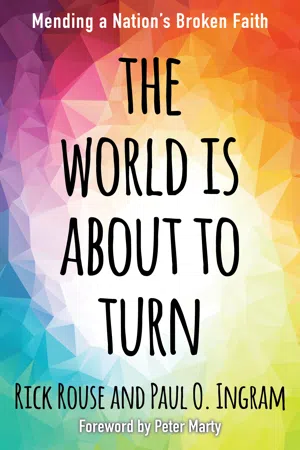
In these increasingly divisive times, how does God intend for us to live well together in the common life? Drawing from scripture as well as writings from a variety of other faith traditions and contemporary theologians, The World is About to Turn offers a practical guide for dialogue and mutual understanding for leaders of faith organizations, schools, and member of faith communities; everyone who hopes to make a positive difference in our corporate life together. Chapters include: The Failure of the American Religious Experiment; When Justice Rolls Down: Finding the Moral Courage to Do What is Right; Love One Another: Practicing Mercy and Compassion; Walking Humbly with God: Repentance and Reconciliation as a Path to a More Civil Society; Values Matter: Discovering Common Values in Many Faith Traditions; Embracing Differences: The Gift of Religious Pluralism; and Building Bridges of Hope: Ten Ways Forward with Multicultural and Inter Religious Dialogue. Discussion questions at the end of each chapter, as well as an appendix with liturgical worship resources, make this hopeful book perfect for small group study, class usage, and congregational leadership.
- 176 pages
- English
- ePUB (mobile friendly)
- Available on iOS & Android
eBook - ePub
About this book
Information
Topic
Theology & ReligionSubtopic
History of Christianity1–The Failure of the American Religious Experiment
In these dangerous times where the world is ripping apart at the seams,
We can learn from those who stare death in the face everyday
By reaching out to each other and bonding as a community
Rather than hiding from the terror of life.
—Jonathan Larson, New York City, 1996
He was the creator of Rent, the rock musical that took Broadway by storm winning the 1996 Tony award for best musical. It is the story of young artists struggling to survive in New York City under the shadow of HIV/AIDS. Jonathan Larson died hours before the premier of his show, but his legacy lives on in a powerful way, especially in his music. In the production, the main character asks, “How do you measure a year?” Then he suggests, “How about love. Measure in love. Seasons of love.”
About four years after Rent premiered on Broadway, a young seminarian was attending his first national church convention in Indianapolis. One of the hot topics being debated that year was whether or not LGBTQ persons who were in committed relationships should be allowed to be ordained as ministers. Outside the convention hall, a conservative pastor known for his radical views had mobilized members of his congregation and others in staging a protest. The seminary student was shocked to see children as young as four years old carrying signs that proclaimed “God hates fags.”
One cannot help but be jarred by the contrast of these two scenarios. One preaches about love and the other advocates hate. Especially disconcerting is that the message of love was coming from the secular world while hate mongering was the response of the religious. What had happened in the American religious experience over the past two hundred and fifty years to bring us to this place?
How did we come to understand religion as a weapon that could be used against those who are different? When a business suggests that it is against the owner’s religion to provide birth control, the courts agree it is right to with-hold this medical benefit. When a baker or a florist wishes to deny services to LGBTQ persons because their lifestyle is offensive to the vendor’s religious belief system, many nod in assent. When a county clerk in Kentucky chooses to deny a marriage license to a gay couple, she becomes a hero to some. When self-proclaimed White Nationalists wave Confederate or Nazi flags and spew hate-filled messages while quoting Bible passages at a national rally, they are defended by politicians. When advocates of “the right to life” participate in the bombing of clinics and the murder of physicians, they are hailed by church leaders. Is this how God intended us to treat one another? How did religion in America get so distorted?
The Dark Side of Religion
Religion has always had a dark side. One example is the “Great Inquisition” of the Catholic Church that occurred between the twelfth and mid-sixteenth centuries in Europe. Originally designed to combat heresy, it became a means to punish and eradicate any dissent. Thousands were burned at the stake, including religious leaders such as the reform-minded preacher John Hus in Prague and the Bible translator John Wycliff in England (whose bones were burned postmortem along with his writings). The name of Tomas de Torquemada, Spain’s first grand inquisitor, became synonymous with horror, religious bigotry, and cruel fanaticism. And in Spain, Jewish people were given a choice to convert to Christianity or lose their life and property.
Religious wars have been fought for centuries as well. During the time of the Crusades starting in 1095, popes mobilized the armies of Europe in order to liberate Jerusalem and the Holy Land from Muslim rule. In spite of the supposedly noble rationale for this campaign, murder, rape, and pillaging were commonplace. One could also site the Peasant Revolt of 1524 which led to the Thirty Years War in Europe, pitting Protestants against Catholics. The warfare between these two expressions of the Christian faith bled over into the British Isles; and the two factions continue to clash in Northern Ireland where innocent young people and children are still being killed because of their religious affiliation. Then there is the more contemporary example in America and elsewhere of the fire bombings and murders in churches, temples, and mosques, usually carried out by religious zealots. Houses of worship have been attacked in Bloomington, Minnesota; Oak Creek, Wisconsin; Charleston, South Carolina; Sutherland Springs, Texas; Los Angeles, California; and Ypilanti, Michigan, and the list grows and grows.
The Doctrine of Discovery
So how did we get here? Let’s begin by examining the Doctrine of Discovery, a concept of international law that gave Europeans the “right” to discover and occupy new territories around the globe, imposing their culture and religion on the people already living in those lands. Thought to have originated with Pope Alexander VI, the Doctrine of Discovery provided a rationale for European explorers of the Christian faith to lay claim to territories inhabited by non-Christians. Supposedly the goal was to bring civilization and Christianity to those viewed as uncivilized and pagan. In actuality, it was to provide a rationale for Europeans to exert dominance over other cultures. During the Colonial Era, as Europeans discovered and conquered new territory, their governments believed they had a divine right to seize land and often to enslave the inhabitants whom were considered savages. In fact, in the late nineteenth century, Great Britain issued a manifesto to its colonies that when it came to counting members of the commonwealth, Indigenous people were not to be included. Whether it was the English in Australia, the Spanish in South and Central America, or a fledgling American nation in North America, the results were the same. Indigenous people had few if any rights.
Many Native people had no concept of owning land and they were often forced into treaties that allowed the occupiers to purchase it for goods and trinkets. Thomas Jefferson suggested to his Secretary of State that the government loan money to the Native tribes so that they would accumulate so much debt they would be forced to repay by giving up their land. In some cases, there was a deliberate campaign to eradicate Native people by various means such as raids on villages, distributing blankets laden with the Smallpox virus, and armed warfare. By the end of the Indian Wars in the United States, most native people lived on reservations; and by 1890 only 248,000 Native Americans remained—down from an estimated 9 to 12 million in North America before the Europeans arrived. For those who survived, the United States government embarked on a campaign to “westernize” native children, taking them from their parents on the reservation at an early age and placing them in Indian Residential Schools across the country. These schools took away the students’ cultural identity by giving them new names, cutting their hair, dressing them in uniforms, and forcing them to learn English and abandon their native ways. Many Christian missionaries were likewise zealous in their insistence that Native people convert to Christianity and forgo their cultural heritage.
The plight of slaves brought to America from Africa and elsewhere was likewise dire. If one was not of European descent, one was often treated as a second-class citizen or worse. In the summer of 2019, African Americans gathered in Hampton, Virginia, to commemorate the landing of the first “slave” ships in 1619. However, what is little known or remembered is that the first Africans to arrive in America were sold into bondage as indentured servants, not as slaves. It should be noted that most of these black bondsmen worked off their indentures and were free by 1630. And yet ten years later slavery—and the racism that undergirded it—had become institutionalized in the American colonies. Famed historian Lerone Bennett observed that “before the invention of the Negro or the white man or the words and...
Table of contents
- Praise for The World Is About to Turn
- Copyright
- Dedication
- Foreword by Peter W. Marty
- Preface
- Introduction
- 1–The Failure of the American Religious Experiment
- 2–When Justice Rolls Down: Finding the Moral Courage to Do What Is Right
- 3–Love One Another: Practicing Mercy and Compassion
- 4–Walking Humbly with God: Repentance and Reconciliation as a Path to a More Civil Society
- 5–Values Matter: Discovering Common Values in Many Faith Traditions
- 6–Embracing Differences: The Gift of Religious Pluralism
- 7–Building Bridges of Hope: Ten Ways Forward
- Epilogue
- Appendix 4–A Declaration of Inter-Religious Commitment: A Policy Statement of the Evangelical Lutheran Church in America
- Appendix 5–Reclaiming Jesus: A Confession of Faith in a Time of Crisis1
- Bibliography
- About the Authors
Trusted by 375,005 students
Access to over 1.5 million titles for a fair monthly price.
Study more efficiently using our study tools.
Frequently asked questions
Yes, you can cancel anytime from the Subscription tab in your account settings on the Perlego website. Your subscription will stay active until the end of your current billing period. Learn how to cancel your subscription
No, books cannot be downloaded as external files, such as PDFs, for use outside of Perlego. However, you can download books within the Perlego app for offline reading on mobile or tablet. Learn how to download books offline
We are an online textbook subscription service, where you can get access to an entire online library for less than the price of a single book per month. With over 1.5 million books across 990+ topics, we’ve got you covered! Learn about our mission
Look out for the read-aloud symbol on your next book to see if you can listen to it. The read-aloud tool reads text aloud for you, highlighting the text as it is being read. You can pause it, speed it up and slow it down. Learn more about Read Aloud
Yes! You can use the Perlego app on both iOS and Android devices to read anytime, anywhere — even offline. Perfect for commutes or when you’re on the go.
Please note we cannot support devices running on iOS 13 and Android 7 or earlier. Learn more about using the app
Please note we cannot support devices running on iOS 13 and Android 7 or earlier. Learn more about using the app
Yes, you can access The World is About to Turn by Rick Rouse,Paul O. Ingram in PDF and/or ePUB format, as well as other popular books in Theology & Religion & History of Christianity. We have over 1.5 million books available in our catalogue for you to explore.