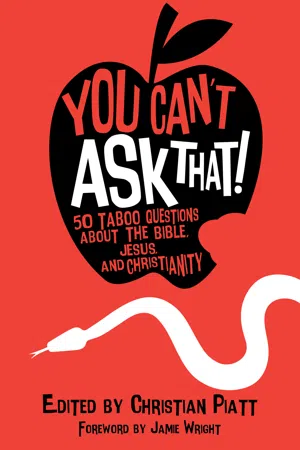
Have you ever had a burning question that seemed off limits or inappropriate to ask about Christianity, the Bible, or Jesus? You Can't Ask That! gathers 50 of the most provocative, challenging, or otherwise taboo questions that many of us have wondered about but few have actually asked. Edited by Christian Piatt, who once had a bible thrown at his head for asking too many questions during a Sunday school class, this collection considers nothing off limits and takes the hard questions seriously. Responses from theology professors, pastors, lay leaders, and other progressive Christians range from the personal to the profound and from sarcastic to deeply touching. By offering multiple perspectives to those banned questions, readers can craft their own answers. Better yet, they'll understand that questioning faith is not taboo; it's the foundation of a strong and growing faith.
eBook - ePub
You Can't Ask That!
50 Taboo Questions about the Bible, Jesus, and Christianity
- 216 pages
- English
- ePUB (mobile friendly)
- Available on iOS & Android
eBook - ePub
About this book
Information
Why would God send Jesus as the sacrificial lamb of God, dying for the sins of the world, instead of just destroying sin or perhaps offering grace and forgiveness to the very ones created by God? Why does an all-powerful being need a mediator anyway?
Chris Haw
A. I have found it important for my mind to get the “sacrificial lamb” idea back into working shape by, for example, considering how Jesus also died from the sins of the world. A terrible steamroller of mob violence, groupthink, and sacred violence struck down Jesus—as it struck down many others. A multitude of our sins, not God, killed Jesus. What is hopeful, however, is how he did not squirm under the temptations to violate love (even toward his enemy) and reduce himself to the level of his torturers and accusers. This fortuitous and righteous display of love is not tangential to his mission—for God is love. This witness is salvific not only because it is a good example to live by—which it is—but also because it is now part of the human story. Humanity has a chance—for at least one of its members lived in truth.
As to a “mediator” this seems (at least) like a confusion of words: Forgiveness needs mediation like a sentence needs words. When I forgive you for stealing my couch, I need the mediation of an action or a word to make my forgiveness real—or else it is mere sentiment in my mind. But to go even further beyond a mediated forgiveness, and enter into truth and reconciliation, you are going to need to also return my couch! Is that not how the metaphor of the “Word of God made flesh” works? We need at least one human not only to receive God’s mercy—which has been latent in the universe since before it began—but also to return God’s couch, so to speak; Jesus, the tradition seems to say, is the human to have done so.
And for what it is worth, the “sending his son” verse should not be understood as God killing someone. (Did God’s denunciation of human sacrifice not begin with the binding of Isaac?) No, We killed God’s Son, and it was sinful and unjust; Jesus’ freely accepting his (pseudolegal) mob scapegoating does not legitimize it but instead attempts to overcome it with love. Thus John 3:16–21 should be understood constructively as God sending us righteousness incarnate—the way of true love in visible expression—not a great person to torture and satiate a bloodlust.
Lee C. Camp
A. There is a long and complex tradition of varying interpretations of the meaning of the death of Jesus. The early church primarily thought of the death of Jesus as a victory over the powers of sin and death. Sin was not understood merely as the willful act of breaking God’s rules, but as a power that enslaved and corrupted God’s good creation. Personified in Satan, that power was always pulling humans down to the grave, punishment, and wrath. In Jesus, God overcame the rebellious powers through suffering love.
In the medieval era, another trajectory became predominant in the West. Anselm of Canterbury argued that a God-man was necessitated because of the great gravity of sin: Sin dishonored God, and humankind had to make some reparation, some satisfaction for sin. Humankind was unable to make such a repayment, and thus Jesus became the substitute, restoring the honor due to God through his obedience unto death. By the sixteenth century, John Calvin focused on punishment: Because of the immensity of humankind’s sin, God’s wrath demanded punishment. Jesus became the substitute punishment.
Peter Abelard, a contemporary with Anselm, argued that it was neither reparation nor punishment that God demanded, but repentance. Thus the loving example of Jesus effects a change in the heart of humankind, bringing about such repentance.
There has been renewed attention to this doctrine in the last number of decades: Numerous interpreters are assessing the variety in the Christian tradition not as mutually exclusive and competing interpretations but as metaphors—each having its own particular strengths and weaknesses—that give us different glimpses of the profound historical fact of a crucified Messiah.
Jarrod McKenna
A. Ever read Leviticus 16? Odd text. Yet French anthropologist René Girard reminds us that, despite how primitive Leviticus 16 might seem to us, every culture creates “scapegoats.”
Scapegoats are those we blame to keep us in the dark to what has shaped us, namely, the systems that demand victims. Nero put early Christians to the stake. Europe burnt powerful women as witches. Magisterial reformers drowned the Anabaptists. Colonizers deliberately infected indigenous peoples with smallpox. Nazis took millions of Jews to the gas chambers. Jim Crow America lynched black America. The Australian government imprisons “boat people” seeking refuge. A Christian school fires a teacher because of her sexual orientation despite her passion for Jesus. To maintain their place in the “cool group,” kids universally seek out and identify “geeks.” Guantanamo tortures innocents, fearing they are terrorists. All this is done to keep us “safe,” to maintain “order,” to protect “us,” and restore “peace.” In the face of this reality, our reality, “total depravity” seems optimistic.
The gospel is not that some deity takes out its rage on an innocent victim so he doesn’t have to take it out on all of us eternally. This is a diabolical lie dressed up in Christian drag that reverses the gospel, making it the same old bad news, while concealing that Jesus is victorious over it. God doesn’t need blood. God doesn’t need a mediator. We do!
In Jesus, God knowingly becomes the scapegoat, as “the Lamb of God who takes away the sins of the worl...
Table of contents
- Copyright
- Foreword
- Introduction
- Can I be a Christian if I don’t believe the Bible is perfect, handed down directly from God to humanity without error?
- Aren’t women treated poorly throughout the Bible? Why would any intelligent modern woman today even want to read the Bible?
- How can a God be all-loving yet allow people to be thrown into hell?
- What does the Bible really say about homosexuality?
- Why haven’t any new books been added to the Bible in almost two thousand years? Is there a chance any new books will ever be added? Why or why not?
- Did God write the Bible? If so, why didn’t God simply create it miraculously, rather than using so many people over thousands of years to write it down?
- How do we reconcile the Old Testament command for vengeance (eye for an eye) with Jesus’ command to turn the other cheek and love our enemies?
- Is there a right or wrong way to read the Bible?
- Does God justify violence in scripture? What about genocide?
- Hell, Sheol, Hades, Gehenna, and Tartarus are all labeled as “hell” by most Christians. Are they really the same? Are they all places of fiery torment? Are such things to be taken literally, metaphorically, or as myth?
- How can we begin to take the Bible literally when it seems to contradict itself so often?
- Are Lucifer, the Adversary, Satan, the Beast, and the Antichrist all the same? If so, why use so many names? If not, what are their different roles, and who is in charge?
- Was Mary Magdalene a prostitute?
- Are there any mistakes in the Bible? Like what?
- In some cases, Paul (the purported author of many New Testament books) seems to support women in leadership roles in church, and in others, he says they have no place. Which is it? And why the seeming contradiction?
- Are some sins worse or better than others?
- If people have to be Christians to go to heaven, what happens to all of the people born before Jesus or who never hear about his ministry?
- Why would stories about a father murdering his daughter (Judg. 11) or handing his daughters over to a crowd to be raped and killed (Gen. 19) be included in the Bible?
- Why would God send Jesus as the sacrificial lamb of God, dying for the sins of the world, instead of just destroying sin or perhaps offering grace and forgiveness to the very ones created by God? Why does an all--powerful being need a mediator anyway?
- Many Christians embrace the phrase, “I believe Jesus is the Christ, the son of the living God, and I accept him as my personal Lord and Savior,” but I can’t find this anywhere in the Bible. Where did it come from?
- In John 14:6, Jesus says, “I am the way, and the truth, and the life. No one comes to the Father except through me.” Do people have to choose to follow Jesus to go to heaven? And what does it mean to choose his way?
- What happened during the “missing years” of Jesus’ life, unaccounted for in the Bible?
- Why should I believe that Jesus was resurrected? What does it mean to the Christian faith if he wasn’t resurrected?
- Does it really matter if Jesus was born to a virgin or not? What if Mary wasn’t a virgin or if Joseph (or someone else) was the father?
- Did Jesus really live a life without any sin? What do we base this on? And does it matter? Why?
- Why did Jesus cry out “My God, my God, why have you forsaken me?” from the cross? Did God really abandon him? If so, doesn’t this mean that Jesus wasn’t actually God?
- Aren’t Jesus’ miracles similar to other healings and miracles recorded outside the Jewish and Christian tradition?
- When Jesus participates in the Last Supper, doesn’t that mean he’s eating his own body and drinking his own blood?
- Did Jesus understand himself to be God, like God, in line with God, or something else? Did he understand this from birth? If not, then when did he begin to understand it and how?
- If Jesus could resurrect people, why didn’t he do it more often?
- Was Jesus a pacifist?
- Did Jesus believe God wanted him to be crucified? If so, why did he ask God, “My Father, if it is possible, let this cup pass from me” in the garden of Gethsemane?
- Was Jesus ever wrong? About what?
- Jesus forgave people of their sins before he died. How could he do this if he actually had to die in order to save us from sin?
- Jesus broke certain biblical laws by healing on the Sabbath, associating with non--Jews, and not keeping all of the kosher laws. So how do we know which rules to follow and which are irrelevant to us today?
- Can you be LGBTQ and be a Christian? A minister? More denominations and Christian communities are welcoming LGBTQ people, as well as ordaining LGBTQ as ministers. Is this really possible?
- Preachers such as Joel Osteen preach about Jesus wanting us to be rich. Where does this belief come from? Wasn’t Jesus poor? Didn’t he tell rich people to give everything away?
- Are Mormons, Jehovah’s Witnesses, Seventh Day Adventists, Spiritists, Christian Scientists, etc., really Christians? Who gets to decide?
- Do Christians have to be baptized? Why do some sprinkle while others immerse? Which one is “right”?
- If all Christians basically believe the same thing, why do they have so many different denominations? And if there are so many denominations struggling to survive, why don’t they just combine with other ones?
- Can someone be both an atheist and a Christian? If “Christian” actually means “follower of Christ,” could someone be a student of the life of Jesus without accepting the claims of his divinity, or claims of the existence of any divinity at all?
- What do Christians believe about disaster and suffering in the world? If God has a plan, why is suffering part of it? How do Christians reconcile suffering in their own lives?
- It seems as if most Christians focus a lot more on issues of sex and sexuality than any other issue. Why?
- I hear Christians say all the time that, good or bad, everything happens for a reason. What about genocide? Famine? Rape? What could the reason possibly be? Does there have to always be a reason?
- Where does the idea that so many Christians and political leaders maintain about the United States being a Christian nation come from? Do all Christians believe this?
- How is it that so many Christians support, or even call for, wars when one of the names for the Christ they supposedly follow is “Prince of Peace,” and Jesus urged love for enemies and nonviolent responses?
- How do some Christians use their faith to oppose abortion, while also supporting the death penalty or personal gun rights?
- Many Christians describe themselves as “evangelical.” What does that mean? Is that the same as being conservative?
- Do Christians still believe that wives should submit to their husbands? What do they mean by “submit”?
- Is the Christian God the same God as the God of Islam and Judaism? If not, what’s the difference? If so, why have three separate religions?
- What do Christians believe happens after they die, and why? Do they believe they are judged immediately and are ferried off to heaven or hell? What about purgatory?
- To be a Christian, is it necessary to believe that Jesus really (as in factually) healed the blind, made the lame to walk, rose from the dead, and ascended into somewhere called heaven, where he sits with someone he calls his Father? And if not, why do Christians recite a creed that says that?
- Why is the church growing in Africa and Asia, but declining in Europe and the U.S.?
- Why is personal/individual salvation emphasized so much more in modern Christianity than global transformation of the world into the just peace realm of God’s commonwealth? How can one person be saved while others continue to suffer?
- Why do so many evangelicals seem to feel the term “social justice” is a bad thing? Why is it generally associated with leftist political activism?
- Many Christians read and study the King James Version of the Bible. Some believe it is the best and most accurate translation there is. Why? Can I read a different translation? What about paraphrases such as The Message?
- What does it actually mean when Christians say they believe that Jesus is the Son of God? And how, if at all, is this different from when other people are called “children of God”?
- Do all Christians believe Jesus died for their sins? What exactly does this mean, and where did the belief come from? If some Christians don’t believe this, what do they believe about the crucifixion?
- Contributors to You Can’t Ask That
- About the Editor
Trusted by 375,005 students
Access to over 1.5 million titles for a fair monthly price.
Study more efficiently using our study tools.
Frequently asked questions
Yes, you can cancel anytime from the Subscription tab in your account settings on the Perlego website. Your subscription will stay active until the end of your current billing period. Learn how to cancel your subscription
No, books cannot be downloaded as external files, such as PDFs, for use outside of Perlego. However, you can download books within the Perlego app for offline reading on mobile or tablet. Learn how to download books offline
Perlego offers two plans: Essential and Complete
- Essential is ideal for learners and professionals who enjoy exploring a wide range of subjects. Access the Essential Library with 800,000+ trusted titles and best-sellers across business, personal growth, and the humanities. Includes unlimited reading time and Standard Read Aloud voice.
- Complete: Perfect for advanced learners and researchers needing full, unrestricted access. Unlock 1.5M+ books across hundreds of subjects, including academic and specialized titles. The Complete Plan also includes advanced features like Premium Read Aloud and Research Assistant.
We are an online textbook subscription service, where you can get access to an entire online library for less than the price of a single book per month. With over 1.5 million books across 990+ topics, we’ve got you covered! Learn about our mission
Look out for the read-aloud symbol on your next book to see if you can listen to it. The read-aloud tool reads text aloud for you, highlighting the text as it is being read. You can pause it, speed it up and slow it down. Learn more about Read Aloud
Yes! You can use the Perlego app on both iOS and Android devices to read anytime, anywhere — even offline. Perfect for commutes or when you’re on the go.
Please note we cannot support devices running on iOS 13 and Android 7 or earlier. Learn more about using the app
Please note we cannot support devices running on iOS 13 and Android 7 or earlier. Learn more about using the app
Yes, you can access You Can't Ask That! by Christian Piatt in PDF and/or ePUB format, as well as other popular books in Theology & Religion & Biblical Criticism & Interpretation. We have over 1.5 million books available in our catalogue for you to explore.