This is the story of the dramatic clandestine escape, in June of 1961, of sixty African students from Portugal across Spain and into France. Most were Angolan intellectuals. Some were from Mozambique and others from Guinea-Bissau, the Cape Verde Islands, and São Tomé-and-Principe. Soon after the first anti-colonial armed rebellions broke out in Angola (March 1961), the student community in Portugal suffered increasing harassment by the Portuguese political police. Passports were confiscated and some arrests of suspected student leaders occurred. Many students—men and women—decided to flee Portugal illegally. It was risky business. False passports from friendly African countries had to be found, contacts set up for night border crossings into Franco's Spain, and then overland transportation to France. Some of the students, graduates of North American and British missionary schools in Africa, appealed to the World Council of Churches in Geneva to help them escape. The challenge was accepted by the French Protestant service agency CIMADE. The successful operation makes for exciting reading.
eBook - ePub
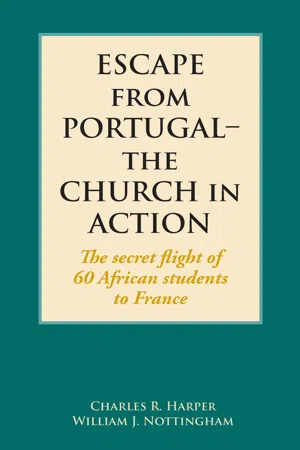
Escape from Portugal–the Church in Action
The secret flight of 60 African students to France
- 116 pages
- English
- ePUB (mobile friendly)
- Available on iOS & Android
eBook - ePub
Escape from Portugal–the Church in Action
The secret flight of 60 African students to France
About this book
Information
Subtopic
20th Century HistoryIndex
History1
A call for help from Lisbon, African students, the World Council of Churches and CIMADE
By May of 1961, the growing number of graduate students from the “provinces,” as the Portuguese government called its colonies, was thoroughly galvanized by the Portuguese vengeful repression of armed rebellion occurring in Angola since January. Their meeting places, in such social centres like the Clube dos Marítimos or the Casa dos Estudantes do Império (“House of the Students of the Empire”) in Lisbon, came into sharp surveillance by the Portuguese political police. They were also increasingly apprehensive over harassment by the police to which they were subjected. Many had their passports revoked. Secretly, decisions were taken by the most politicized to leave the country–illegally if necessary–and to head for France and elsewhere. The incipient independence movements had neither sufficient financial means nor an organizational infrastructure in Europe to enable these students to escape Portugal.
Thus, one of the organizers of the group, Pedro Antonio Filipe, made an urgent appeal to the World Council of Churches, based in Geneva. Pedro was related to the World Student Christian Federation–the WSCF–and was part of the 15% of the students who had received primary and secondary education in Angola at schools run by Baptist, Methodist, and Congregational missionaries from the U.K., Canada and the USA.
A mission executive for Africa of the Methodist Church in the USA, the Rev. Melvin Blake, stopping in Lisbon to visit some of these Methodist students in early May, 1961, was entrusted with the Angolans’ urgent request, made on behalf of students from all five of the Portuguese colonies. The students said, “If you don’t get us out of Portugal, you’re not Christian!” Some other students–Silvio de Almeida, a medical student among them–who had left Portugal a year earlier to continue their studies in the rest of Europe, confirmed the request to the General Secretary of the WCC, the Dutch theologian Willem Visser ’t Hooft, informing him of the daily pressures being brought by the Portuguese authorities on the students and asking for the solidarity of the churches to help them to get out rapidly.
The World Council of Churches in Geneva
The WCC, founded in 1948 at a General Assembly in Amsterdam, had been an ecumenical movement prior to and during WW II. Its pioneer founders were facing and resisting the fascist ideology of Hitler’s Germany. The active engagement of Christian men and women across Europe, including ecumenical leaders in Geneva, were tireless in protecting citizens and refugees and in acting to defeat the Third Reich. Cooperative Germans were mainly participants of the so- called Confessing Church, after the Barmen Synod of 1934. This commitment prepared ecumenical leaders– such as Willem Visser ’t Hooft, the Dutch first General Secretary of the WCC, to be particularly sensitive, years later, to the request of the Portuguese-speaking students in Portugal to help them escape to freedom. For example, his moral authority and leadership, exercised along with that of Madeleine Barot and other French lay and pastors, all influenced by Swiss theologian Karl Barth, produced the publication, in 1944, of the powerful Thèses de Pomeyrol. The Thèses amply reflect the ecumenical clarity at that time concerning the responsibility of Christians to protect the most vulnerable under the German occupation in several European countries and to resist the policies of the Nazis.
Responding to the students’ appeal, the WCC turned to Paris-based CIMADE, an ecumenical service agency of the French Protestant Federation, asking that it take on the responsibility of organizing an escape by these men and women from Portugal to France. At the time, Madeleine Barot, one of the founders of CIMADE and still a member of its Équipe de Direction, held a high office in the WCC, in charge of the Desk on Cooperation between Men and Women in Church, Family, and Society. Alongside Visser ’t Hooft, the two ecumenical leaders were particularly sensitive to the urgency expressed by the students in Portugal. They had to act quickly because the passports of several among them were being confiscated by the Portuguese authorities and others undergoing frequent interrogations.
According to Jacques Beaumont, “One Saturday morning in May 1961, the Équipe de Direction (Executive Committee) of CIMADE–Madeleine Barot, Paul Evdokimov, Suzanne de Diétrich, François de Seynes-Larlenque and I–met as usual for our twice-weekly meeting. It was at Suzanne’s apartment at 53 Avenue du Maine, in Paris. Madeleine, who worked during the week at the headquarters of the World Council of Churches in Geneva, informed us that she had a request from the WCC. She reported that the WCC had just recently received the visit by a US Methodist Church representative, Melvin Blake, whose responsibilities included the Church’s missionary work in Angola. He had just arrived from a visit to Lisbon. He told the WCC that the Portuguese government was actively keeping an eye on a maximum number of students in Lisbon from the Portuguese-speaking colonies (and especially Angolans). According to him, the Methodists maintained a student hostel in Lisbon, whose residents were under increasing pressure from the PIDE, the political police of Portugal. In addition, the government was beginning to withdraw their valid passports. The students in Lisbon were “fed up” with this treatment and wished to leave the country. Would the WCC help?
CIMADE in Paris
The decision of the WCC to turn to CIMADE was based on the vast experience which its team members (équipières and équipiers) had accumulated in clandestine action carried out during the Second World War. The remarkable history of this organization, born out of the courageous efforts of French Protestant youth movements to protect Alsatian refugees from the onslaught of invading troops of the German army in 1939, was rapidly followed by vital assistance inside forced internment camps in Southern France. In the early years of the war CIMADE applied a unique kind of présence in such camps, whose inmates came from groups of society considered “undesirable elements” by the French pro-German Vichy government: Spanish Republicans who had fled the Franco regime, German citizens who resisted the Third Reich, gypsies (Roma gens de voyage), homosexuals, the handicapped and–above all–Jews. CIMADE team members helped many to escape these camps, fabricating identity papers when needed, some with ingenious sculptured stamps carved out of potatoes with uncanny accuracy.
CIMADE originated in 1939 as a coordinating body of French Protestant youth movements–the French Federation of Student Christian Associations (FFACE), the French chapters of the YMCA and YWCA, Boy and Girl Scouts–as they acted to accompany families fleeing the German occupation of Alsace to the western French departments of Gers and Dordogne. The strong women lay leaders like Suzanne de Diétrich, Violette Mouchon, Jeanne Merle d’Aubigné and Madeleine Barot worked alongside French Reformed Pastors Marc Boegner, Charles Westphal, and George Casalis. The theological underpinning of resistance to Nazi and French Vichy ideology can be detected in its earlier roots in the historic Huguenot struggle for survival in the 17th and 18th centuries– and more recently (1934) inspired by the Barmen Confession. Actions were taken by CIMADE to protect French and other Jewish children and adults, thus acquiring valuable experience in accompanying Jewish children clandestinely across the border from France to Switzerland during WWII.
It was one of the first non-governmental organizations to set up a permanent presence in several camps maintained by the French Vichy government. These camps, located for the most part in Southern France, forcibly interned political opponents of the Nazi Regime, Republican refugees from Franco’s Spain, French communists, Jews and other political “suspects”.
After WW II, CIMADE assisted displaced persons from Eastern Europe, including Russian exiles, Hungarian “freedom fighters,” Albanians, as well as Vietnamese refugees and Algerian political leaders. In the early 1960s, CIMADE was heavily involved in assisting the Algerian population to endure the ravages of the 1954-62 war of independence from France, as well as living amongst Algerian immigrant families in la France metropolitaine.
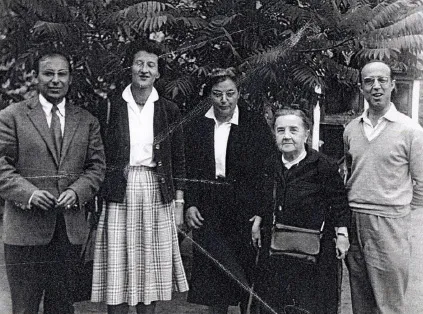
Part of the Equipe de Direction in Paris: Left to right: Jacques Beaumont, Véronique Laufer, Madeleine Barot, Suzanne de Diétrich and André Rouverand
Madeleine Barot, former General Secretary of CIMADE, was subsequently recognized by Yad Vashem, the Holocaust Martyrs’ and Heroes’ Remembrance Authority in Jerusalem, as being among the “Just”–those non-Jewish individuals and organizations which performed unusual and heroic acts of courage to protect members of the Jewish community during WWII. After WWII, displaced persons and refugees were the responsibility of CIMADE in cooperation with the WCC. Many of these young men and women in CIMADE emerged as part of a new generation: ecumenically-minded, honed by an acute spirit of solidarity and justice. This generation listened carefully to the urgent voices coming out of European colonies–and not only those under French control like Algeria or in central Africa.
True to form, in later years and to the present, CIMADE spoke out in defense and took strong action in favor of sub-Saharan Sahel populations, of Chilean and Brazilian victims of military repression, of Haitians, and of Palestinians under Israeli occupation.
The CIMADE leadership in Paris was thus open, experienced, and ready to take on the job. By 1961, political and social tensions arising from the upheavals caused by this civil war (1954-1962) in Algeria were almost at their bitter peak in France. Only the policy and prestige of a Charles de Gaulle, then president of France, would lead to the recognition of the legitimacy of an independent Algeria. It was for this reason that a so-called “Angolan operation” was conceived in strict secrecy. It was an attempt, in June of 1961, to smuggle as many African students as possible out of Portugal, then ruled by the dictator Antonio Salazar, and transporting them across Franco’s Spain, a dangerous haven for right-wing opponents to Algerian independence, and into France.
The first preparations
By May of 1961 the General Secretary of CIMADE, Jacques Beaumont, on behalf of the WCC, flew to Lisbon to discretely meet the leaders of the students. One hundred students wished–and needed–to leave immediately as they were sympathetic or already committed to the embryonic liberation movements taking shape in their African countries.
These 100 were highly motivated and, in a real sense, constituted an intellectual elite. Among them at least three men were carrying out their military service as officers in the Portuguese army based in the “Metropolis”–and feared that they might be shipped overseas to fight against their own people. The Portuguese PIDE (Polícia Internacional e de Defesa do Estado), the notorious political police, kept a close eye on the students themselves, deeming them a threat to Portuguese unity and suspecting them to be complicit with the rebels in the colonies. Of the total group who finally made the trip from Portugal to France, 95% were Angolans.
Total silence covered the operation. The French Foreign Minister, Maurice Couve de Murville, himself a trusted member of the Eglise Réformée de France, was alerted to the upcoming operation through Pastor Marc Boegner, president of CIMADE and of the Protestant Federation of France. He was also a member of the prestigious Académie Française. President Charles de Gaulle, informed of the upcoming operation, tacitly approved of it –but it was a delicate situation: As a member of NATO, France could hardly grant official refugee status to citizens of an ally, Portugal! Thus, safe passage of the students for an undetermined amount of time through France was authorized.
At the same time CIMADE was heavily committed in Algeria with teams in the Eastern and Central urban centers of the country, carrying out social and humanitarian assistance among the local populations in the midst of the war for independence. This highly sensitive and controversial role meant that CIMADE-Paris had to maintain discretion with regard to its operation in Portugal. No-one in CIMADE’s teams involved with the Algerian events or population was informed of the upcoming fuga (flight) until it was all over.
Phase One: the CIMADE team gets to work
On Jacques’ return from Lisbon to Paris in mid-May the plan was drawn up: One team of four persons would be on call and work out of CIMADE’s offices in Paris. After recruiting some drivers for the Spanish part of the escape, the team would obtain new but blank passports to hand to the potential escapees as they crossed from Portugal to Spain. This Parisian-based team would remain on alert (en permanence) in the CIMADE offices on a 24-hour round the clock basis to monitor and ensure communications with the two other teams in Portugal and in Spain. Véronique Laufer, André Rouverand, Yvonne Trocmé and Marie Meylan were so designated. Tania Metzel, the head Protestant chaplain of the National Prison System was primed to be ready to meet the students at the French/Spanish border in Hendaye.
The second team of two persons worked out of Lisbon and Porto: the French citizen Jacques Beaumont and Charles Harper, a Brazilian-born American who was a CIMADE équipier in Marseille at the time and who had been appointed for a three-year term as a fraternal worker of the Presbyterian Church USA. These two coordinated the escape plans with the student organizers in Lisbon, renting and driving high-powered automobiles and setting up contact points for the stealthy night-time dash through back roads to the northern towns of Coimbra and Porto–and then to the river border with Spain.
A key back-up person in Lisbon was Lewin Vidal. He was a former classmate of Jacques in the French Student Christian Federation–La Fédé. Enjoying power of attorney status in the Portuguese-French Bank, Vidal, in effect, played the role of a Dr. Jekyll and Mr. Hyde: above reproach as a leading banker during the day but sneaking out at night to guide certain actions, keep a sharp eye out for the police, and provide valuable advice on local conditions. (Two years later Vidal would be arrested and imprisoned in Lisbon for his participation in the operation.).
The third CIMADE team was assigned to Spain. Bill Nottingham, also an American fraternal worker sent by the Disciples of Christ Church to work with CIMADE as one of its Associates to the General Secretary, headed this team. Earlier, in Paris Bill had recruited Kim Jones, Dave Pomeroy and Dick Wiborg, three American students who were in Paris at the time, as his chauffeur teammates. This team would work out of Pontevedra, in Galicia just north of the border between the Portugal and Spain. After hiring large automobiles in France–near the Spanish border there, they were to drive across Spain to meet at a secret location along the border with Portugal where each small group of students, having crossed the Minho River border into Spain, would be hiding. Their job was to drive the escapees over the 800 miles of tough roads back across northern Spain to San Sebastian–and from there across the border with their charges into France.
Three American drivers
Bill Nottingham was in his office at CIMADE in Paris on Friday, June 9, 1961, when two students from Union Theological Seminary came in and introduced themselves. Dick Wiborg and Dave Pomeroy were in Europe for an ecumenical work camp of the World Council of Churches and had been told in New York that CIMADE could help them if they needed anything. They had a couple of weeks before the work camps started and had the idea of touring France on motor bikes, if we could help them rent some. They talked about Union and about CIMADE and France.
Jacques Beaumont called Bill into his office to say that he had something to ask to which he could say “no” if he wanted or needed to, and then went on to say that CIMADE was being asked by the World Council of Churches–at the urging of the American Methodist Church–to spirit some Angolan students out of Portugal. It would be a clandestine operation and perhaps dangerous, which is why he could decline to take part. Bill pointed out that he and his wife Pat had been sent to work as équipiers of CIMADE by their church the Disciples of Christ and there were no conditions on that. Since 1958 they had already taken plenty of risks, including the work camp in Algeria for Bill. Pat was fully supportive. He did not know it, but as noted above, Jacques had already flown to Lisbon two weeks earlier to meet the leaders of the African Portuguese-speaking students.
Nottingham went back to his office and found Dick and Dave waiting for news about their motorbikes. He said, “Do you guys have drivers’ licenses?” This surprised them, but they replied, “Oh, yeah!” They got out a map of Africa and Bill let them in on the proposition. It turned out both of them were Methodists, anyhow! He said, “Come back Tuesday, and we’ll see if this thing is going to go.” They thought of it as something of a lark but as the adventure grew and the theological discussions multiplied in the weeks ahead, it was to take on a meaning that would last a lifetime.
Jacques went on to say that Pastor Marc Boegner, president of CIMADE, and of its Executive Committee, had received a message from Willem Visser ‘t Hooft and Madeleine Barot in Geneva. Melvin Blake, the Africa secretary for the Methodists in the U.S., had been to see them after stopping in Portugal during the month of May 1961 to visit students on Methodist scholarships, there from the Portuguese colonies. They met at the Protestant seminary located in Carcavelos, near Lisbon. (Years later, in the US, Bill met Kenneth Goodpastor who was a Presbyterian fraternal worker in Carcavelos at the time of the Fuga Operation and told Bill that he had found one morning that everyone had disappeared! He told Bill about the arrest of the Sco...
Table of contents
- Cover
- Title
- Copyright
- Contents
- Introduction
- 1. A call for help from Lisbon
- 2. The reconnaissance trip to Portugal
- 3. On the road with Operation Angola
- 4. The perilous crossing into Spain
- 5. The race to San Sebastian
- 6. Five close calls
- 7. The prison
- 8. Freedom at last–crossing into France
- 9. The aftermath–Press reports, new destinations, encounters
- 10. Fiftieth anniversary reunion in Cape Verde in 2011
- Appendix 1: The list of the sixty students in The Escape
- Appendix 2: What have some of the students become since 1961?
- Appendix 3: The list of participants at the 50th reunion in Praia, Cape Verde
Trusted by 375,005 students
Access to over 1.5 million titles for a fair monthly price.
Study more efficiently using our study tools.
Frequently asked questions
Yes, you can cancel anytime from the Subscription tab in your account settings on the Perlego website. Your subscription will stay active until the end of your current billing period. Learn how to cancel your subscription
No, books cannot be downloaded as external files, such as PDFs, for use outside of Perlego. However, you can download books within the Perlego app for offline reading on mobile or tablet. Learn how to download books offline
Perlego offers two plans: Essential and Complete
- Essential is ideal for learners and professionals who enjoy exploring a wide range of subjects. Access the Essential Library with 800,000+ trusted titles and best-sellers across business, personal growth, and the humanities. Includes unlimited reading time and Standard Read Aloud voice.
- Complete: Perfect for advanced learners and researchers needing full, unrestricted access. Unlock 1.5M+ books across hundreds of subjects, including academic and specialized titles. The Complete Plan also includes advanced features like Premium Read Aloud and Research Assistant.
We are an online textbook subscription service, where you can get access to an entire online library for less than the price of a single book per month. With over 1.5 million books across 990+ topics, we’ve got you covered! Learn about our mission
Look out for the read-aloud symbol on your next book to see if you can listen to it. The read-aloud tool reads text aloud for you, highlighting the text as it is being read. You can pause it, speed it up and slow it down. Learn more about Read Aloud
Yes! You can use the Perlego app on both iOS and Android devices to read anytime, anywhere — even offline. Perfect for commutes or when you’re on the go.
Please note we cannot support devices running on iOS 13 and Android 7 or earlier. Learn more about using the app
Please note we cannot support devices running on iOS 13 and Android 7 or earlier. Learn more about using the app
Yes, you can access Escape from Portugal–the Church in Action by Charles R. Harper,William J. Nottingham in PDF and/or ePUB format, as well as other popular books in History & 20th Century History. We have over 1.5 million books available in our catalogue for you to explore.