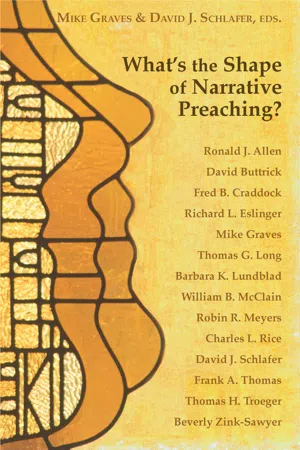
Bringing together some of the finest voices in contemporary homiletics to examine the different forms as well as the status of narrative preaching, What's the Shape of Narrative Preaching? will give readers much to ponder on this impact topic. Teachers of preaching have long recognized that the Bible is told in story form. Yet the responses to the topic of narrative preaching have varied over the years, from singing its praises to outright rejection. The homiletical landscape is always changing, but what many thought might be a fad is still being discussed in the seminaries and practiced in many a pulpit. What's the Shape of Narrative Preaching? asks: What exactly is narrative preaching? What does it mean to be a narrative preacher? Is narrative preaching at odds with exposition? What are the biblical precedents for such an approach? What kinds of theology undergird narrative theory? What is the role of narrative preaching in a time of rampant biblical illiteracy? How does narrative preaching help to shape congregational life? Contributors include: Charles Rice, Ron Allen, Fred Craddock, Frank Thomas, Thomas Long, David Buttrick, Richard Eslinger, Barbara Lundblad, William McClain, Beverly Zink Sawyer, Thomas Troeger, Robin Meyers, David Schlafer, and Mike Graves.
- 256 pages
- English
- ePUB (mobile friendly)
- Available on iOS & Android
eBook - ePub
What's the Shape of Narrative Preaching?
About this book
Information
Topic
Theology & ReligionSubtopic
Christian MinistryPART I
Wellsprings
What Gives Shape to
Narrative Preaching?
1
A More-or-Less Historical Account
of the Fairly Recent History of
Narrative Preaching
CHARLES L. RICE
Narrative preaching is neither new nor novel, especially in the American experience; it has taken many forms in the pulpit. The earliest preachers were eager to tell of the signs of Providence both in nature and in human affairs. A Massachusetts divine declared that “the cow doth calf and the milk doth clabber, and great are the ways of God.” When the first settlers came ashore they told their story in a phrase, a narrative that continues to sway the American psyche: “Having been brought safely to this good land…” Believing they were a people whose every trial and achievement revealed divine Providence, they melded their history with the biblical stories. That coalescence of story with Story continues to this day.1
In the pulpit, this confident narrative has often taken the form of testimonial. The compelling, sometimes tear-jerking story of conversion has been characteristic of the revival movement. Across the spectrum of denominations and forms of worship, it is the exceptional American preacher who has not turned to the personal illustration to move the congregation. In his history of the United States, Henry Steele Commager concluded that there is nothing Americans like so much as a huckster.2 The stock-in-trade of the huckster, politician or revivalist, has been the enthralling narrative. Ronald Reagan used vignettes of the war hero and the working mother, touching stories—often illustrated by the presence of the very person—to sway Congress and the public, a technique still in use. Garrison Keillor, on A Prairie Home Companion, tells down-home stories about family, small-town life, and religion that have both heart and a political edge. Even on television, among the most popular documentaries are those that tell stories of individuals—from Thomas Edison to Jesse James—or the story of the nation, its tragedies and triumphs.
A powerful influence on the American pulpit in the first half of the twentieth century was Harry Emerson Fosdick, founding pastor of the Riverside Church in New York City and preacher to the nation on the National Radio Pulpit. Fosdick called for a reconsideration of rigidly theological and textual preaching, advocating “life situation” preaching instead.3 He claimed that those who preach are greatly mistaken if they assume that people come to church with a burning desire “to learn what happened to the Jebusites.” Rather, he said, people come with human questions and problems. The preacher, accordingly, should speak to specific human situations. Not only did Fosdick tell biblical stories; he told stories that came his way as he went about the work of a city pastor. He carefully recorded the events and the dialogue of his daily rounds, and this material found its way into the Sunday sermon.4 The result was preaching Fosdick described as “pastoral counseling writ large,” a model that has had lasting influence on the American pulpit.
But in seeking the sources of narrative preaching, we need to go much farther than American culture. Storytelling is a universal and indispensable human means of symbolic communication. Humanity lives by narrative; hearing and telling stories we organize and give meaning to our experience. Our ancestors gathered by the fire to remember and create stories as a way of giving meaning to the present and moving purposefully toward the future.
Frederick Buechner has said that Christians are people who know some stories and tell them to others.5 This is no less true of those who follow Judaism. The Hebrew Scriptures start with, “In the beginning,” and the Christian Bible ends with a vast and colorful drama of the end. Everything in between is steadied and propelled by telling the old stories and connecting them to the daily drama of our unfolding history.
So, what has occurred in the field of homiletics since Amos Wilder published Early Christian Rhetoric in 1964 is not so much invention or innovation as rediscovery. Christians and Jews have lived by story from the beginning. What we have seen is a growing body of literature, accompanied by preaching in the churches, exploring the theological underpinnings and homiletic possibilities of preaching as storytelling.6 The chapters that follow in this book reveal the rich terrain of that exploration and the contribution of one of its leading scouts, Gene Lowry. This chapter will describe the seminal work of representative figures.
Amos Wilder [1895–1993]
Biblical scholar—and brother of playwright Thornton Wilder— Amos Wilder, first in Early Christian Rhetoric and later in Theopoetic, laid the groundwork for homiletic advance in the last third of the twentieth century. Wilder’s interest in rhetoric and literature came to focus on the literary heritage of Judeo-Christian faith. In his effort to allow the Bible and contemporary literature to cast light on one another, he published The New Voice: Religion, Literature, and Hermeneutics.7 Here he shows that among the many literary forms of the Old Testament, the narrative mode is primary: “In Israel an earthy kind of realism came to birth such that its recitals encompass and interweave the whole story of heaven and earth and of man in unique fashion.”8 Narration, Wilder says, creates order: “Indeed, the biblical epic remains as a kind of cable or lifeline across the abyss of time and cultures, because man is here sustained over against anarchy, non-being, nescience. In this sense language is, indeed, a ‘house of being.’”9 Israel lived by narrative, dwelt in a house of narration: the history of a people, the lives of its kings and prophets, the stories of men and women, and the imagined story of the coming messiah and the reign of peace.
Wilder went on to investigate the language of the gospels, asking what rhetorical forms provided the earliest expressions of Christian faith. He was among the first to point toward story as a natural speech-form for the gospel. The anecdote, he says, belongs to the earliest speech of the church and is essential to the community’s celebration of the gospel. Wilder gives an example in Jesus’ cure of the blind Bartimaeus at the gate of Jericho, calling this story “a small companion piece to the Resurrection-drama.”10 He suggests that the models for preaching as storytelling are in the gospels themselves.
Wilder concludes that the nature of the gospel per se shaped the language of the early church as these faith communities relied primarily on various forms of story.
How they expressed themselves, Wilder claims, was formed by what they believed, by the gospel itself, just as Jesus’ quintessential preaching took its shape—in the parables—from his vision of the reign of God. Wilder writes:
How Jesus and his followers spoke and wrote cannot be separated from what they communicated. It was the novelty of grace and the fundamental renewal of existence which brought forth a new fruit of the lips, new tongues and rhetorical patterns… The language phenomenon which broke into the world with the discourse of Jesus and which continued in the church arose out of a depth of impulse which imposed plastic expression throughout. The early Christian vision and grasp of existence…had a dynamic character…a level of apprehension which the New Testament speaks of as that of the Spirit.11
This was new wine, demanding new and supple containers. From the beginning, the gospel demanded imaginative expression. In his later work, Wilder stretches this further:
In liturgy and festival, but also in prophecy, the divine reality mediates itself through plastic images and metaphors and stories which take hold of our experience. It is only through such a total register that the Gospel can reenact itself anew in our time.12
This understanding of biblical language has had a lasting influence on the direction of homiletics into the third millennium.
In his description of the earliest Christian communities, Wilder set forth a dozen ideas that proved seminal for the teaching and practice of preaching:
1.Language is potent, and the word, particularly the spoken word, is central in Christian faith and practice.13
2.Expression of the Christian gospel is extempore.14
3.There is no commitment to a holy language, a “language of Zion.”15
4.Christian rhetoric is not verbose, and this economy of expression derives from the nature of revelation.16
5.This speech is communal.17
6.Our words, following the incarnation of the Word, are prone to the incognito and the understated.18
7.This rhetoric is directed toward the heart.19
8.This language is artful without being studied, as in the parables of Jesus.20
9.The parables of Jesus reveal the organic connection of metaphorical speech and the kingdom of God.21
10.Christian communication, more often than not, is story.22
11.Poetry is a large part of both the Old and New Testaments, and the poetic should be understood as organic to human life.23
12.The New Testament writings are largely works of imagination, as faith reveals itself in the varied and plastic expressions of its various genres.24
The gospel has been passed on and interpreted as a continuing narrative. From the early fathers of the church to the present, we see pastors and teachers doing their interpretive and guiding work as storytellers: the narratives of Augustine and the allegories of Origen; the preaching friars, such as Jacque deVitry and his exempla; even the windows and sculpture of Europe’s cathedrals, telling the Story when preaching had lost touch. Though we might not call the Reformation imaginative, it was a great and vital new story, unfolding in the stories of its leaders and in the vivid telling of examples of faith.
Edmund A. Steimle [1907–1988]
For more than a quarter of a century as a teacher of preaching— at the Lutheran Theological Seminary in Philadelphia and at Union Theological Seminary in New York City—Edmund Steimle, both by his own preaching and through his students, shaped American preaching. He was heard widely on “The Protestant Hour” from 1955 to 1974. Those who listened to his distinctive voice absorbed a distinctive approach and style. His easy, dialogical manner—cultivated especially for radio—trained the ears of preachers and churchgoers alike for sermons in the inviting style of the storyteller.
His preaching was friendly, low-key, down to earth, disarming in its simplicity. In a letter to the Lutheran Department of Press, Radio and Television, an executive of the National Broadcasting Company wrote:
I thought you would like to know what a favorable impression Dr. Steimle’s broadcasts have produced among the professionals in the radio field. I have been out of the country, and not able to hear every broadcast, but my own reaction (and a general one, I think) is that he is exceptionally pleasing and compelling. There is about his voice and manner an informality that is at once expressive and intimate. In my view, this is far and away the best manner such a speaker could have, for radio is a very personal medium, speaking to multitudes, to be sure, but to each one individually.25
A person hearing Steimle for the first time would have been puzzled: he did not sound like a preacher. His sermons were given in the context of conventional Lutheran liturgy, but he called these addresses “conversations.”
Steimle was the son and grandson of clergy, for whom the question of language was a major issue. So strongly did his grandfather believe that the Lutheran liturgy should be said in German that he withdrew seven congregations from the Northeast Synod of the Lutheran Church to form the German-speaking “Steimle Synod.” Young Edmund was steeped in this ethnic tradition, but he also loved being an American. Rather than going to a Lutheran college, he enrolled at Princeton, where he studied English. Every sermon he wrote reflected this love of the language. Thus Steimle prepared the way for the growth of the “New Homiletic,” and for a new emphasis on preaching as narrative. Employing the most exacting discipline in exegesis and in sermon composition, Steimle relaxed the form and style of preaching. Anyone hearing him would have sensed new possibilities for preaching. It was possible simply to speak with people, as if talking to someone over a cup of coffee about an issue of mutual importance, trusting the story to carry the message without coming down hard or laboring a point.
In large measure, this was just the sort of person Steimle was. He had a clear theological perspective, however. Steimle’s homiletic was shaped by a theology of the Incarnation. As he put it: God does not blast away; God comes down. His own contemplation of the meaning of the Incarnation led Steimle to speak in such a way as to give preachers permission to tell the Story in the form of ordinary story.
In 1980, Steimle—along with Morris Niedenthal and Charles Rice—published Preaching the Story. In the introduction, Steimle wrote: “We have chosen to concentrate our focus…on that one insight, or perspective, which the three of us regard as of high importance: preaching as storytelling and the preacher as raconteur.”26 This book sets preaching in its threefold context: the Story, as found primarily in the Bible; a community’s particular story; and the story of the preacher. The sermon is organically connected to the ongoing life of the Church, to the present experience of a congregation in its unique cultural and social context, and to the life of the preacher herself or himself. The authors write:
Anyone who has experienced preaching, whether in pulpit or pew, knows that it is an event—a moment, a meeting, a sudden seeing—in which the preacher, listener, the message, and the impinging social environment all come together. Can we find a word for that event, a paradigm which will recognize all the elements and in doing so tell us what preaching is, and how it is done when it is done well?… Let us consider the storyteller.27
The paradigm pervading the book is shared story. Christian faith is hearing, telling, and living a story. Accordingly, given the nature of the Bible and of the daily life of the listeners and their ordained speaker, it is inevitable that preaching will be at its heart narrative.
Steimle was influenced...
Table of contents
- Cover Page
- Halftitle Page
- Title Page
- Copyright Page
- Contents
- Selected Works of Eugene L. Lowry
- Introduction
- Part I. Wellsprings: What Gives Shape to Narrative Preaching?
- Part II. Assessments: What Shape Is Narrative Preaching in Today?
- Part III. Prospects: What Fresh Shapes Might Narrative Preaching Take?
- Notes
- Contributors
Trusted by 375,005 students
Access to over 1.5 million titles for a fair monthly price.
Study more efficiently using our study tools.
Frequently asked questions
Yes, you can cancel anytime from the Subscription tab in your account settings on the Perlego website. Your subscription will stay active until the end of your current billing period. Learn how to cancel your subscription
No, books cannot be downloaded as external files, such as PDFs, for use outside of Perlego. However, you can download books within the Perlego app for offline reading on mobile or tablet. Learn how to download books offline
Perlego offers two plans: Essential and Complete
- Essential is ideal for learners and professionals who enjoy exploring a wide range of subjects. Access the Essential Library with 800,000+ trusted titles and best-sellers across business, personal growth, and the humanities. Includes unlimited reading time and Standard Read Aloud voice.
- Complete: Perfect for advanced learners and researchers needing full, unrestricted access. Unlock 1.5M+ books across hundreds of subjects, including academic and specialized titles. The Complete Plan also includes advanced features like Premium Read Aloud and Research Assistant.
We are an online textbook subscription service, where you can get access to an entire online library for less than the price of a single book per month. With over 1.5 million books across 990+ topics, we’ve got you covered! Learn about our mission
Look out for the read-aloud symbol on your next book to see if you can listen to it. The read-aloud tool reads text aloud for you, highlighting the text as it is being read. You can pause it, speed it up and slow it down. Learn more about Read Aloud
Yes! You can use the Perlego app on both iOS and Android devices to read anytime, anywhere — even offline. Perfect for commutes or when you’re on the go.
Please note we cannot support devices running on iOS 13 and Android 7 or earlier. Learn more about using the app
Please note we cannot support devices running on iOS 13 and Android 7 or earlier. Learn more about using the app
Yes, you can access What's the Shape of Narrative Preaching? by Mike Graves in PDF and/or ePUB format, as well as other popular books in Theology & Religion & Christian Ministry. We have over 1.5 million books available in our catalogue for you to explore.