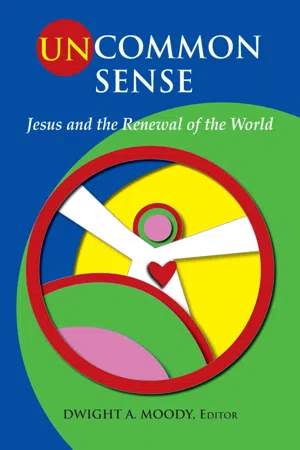
These sermons from the 2012 National Festival of Young Preachers were videorecorded and may be viewed on the YouTube channel of the Academy of Preachers. The study guide included in this book provides thoughtful assistance for groups who wish to read, watch, and study the sermons. Uncommon Sense and two previous volumes of sermons, A Beautiful Thing and Waking to the Holy, are the only literature that celebrates the preaching ministry of the millennial generation.
Trusted by 375,005 students
Access to over 1.5 million titles for a fair monthly price.
His name was J.T. Gould. He was a reverend and the Civil War era president of Millersburg Female Academy located in Millersburg, Kentucky. He held perhaps the highest position in society—that of a white male.
His name was Elisha Green. He was a reverend and a former slave. He had started churches in counties not too far from where we are today. He knew struggle and suffering all too well. His is a story found often throughout slavery: He was forced to give up his son, never to see him again, for his only son would be sold into slavery.
These two meet on June 8, 1883. The 65-year-old Rev. Green had boarded a train in Maysville, Kentucky, and it was at the stop for Millersburg that Rev. Gould, two professors from the Academy and some students boarded. Green was the only person in the train car, but Gould and his cohorts decided that they wanted his seat. Shouting racial epithets at Green, they demanded that he move. Seventy-two years before Rosa Parks refused to give up her seat, the Rev. Elisha Green stood his ground—he did not move. This was not acceptable to Gould. He and his fellow professors proceeded to pin down Green and beat him with a brassbound traveling bag. Green would suffer serious injuries, but Gould would only suffer a weak assault conviction by an all-white jury that carried with it a measly $24 fine. On that train, two stories meet. On that train, two men were living the dream; one was living the Dream of Jesus.
The American Dream has been used as a marker for the thought that everyone can succeed, but for Gould, “everyone” meant “white men.” The dream has looked different throughout history and will undoubtedly change in the future. Even now we, too, have an idea of what the American Dream really is. In eleven months, we will make our way to the polls to cast our vote for the next president. In the intervening time, we will hear candidates provide their visions of the American Dream. Yet we, in this room, are citizens of two realms: American citizens and followers of Christ. So, the question we must face today is, what is the dream we are called to live? What is the dream Christ calls us to?
On a small cliff Jesus sees those following him: men, women, children, and people desiring to change their situations. The hangover from the Israelite exile still looms, and though it is Jesus’ works of healing that seemingly attracted people, it is his words of challenge that still attract people today. These sentences tingle, sizzle, and prod the reader, the hearer, to imagine a world where peacemakers are blessed and the hungry fed. Yet as I read this, I can’t help but think that this dream is nothing short of preposterous, nothing short of unbelievable.
It’s hard to hear “blessed are the hungry” when 17.2 million households are food-insecure, the highest number ever recorded in the United States.
It’s hard to hear “blessed are the merciful” when we repeatedly condone state-sanctioned murder upon the Troy Davises of the world.
It’s hard to hear “blessed are those that weep now” when right now 49.9 million Americans do not have medical insurance.
It’s hard to hear the Beatitudes because our world, even 2,000 years later, does not reflect the world Jesus dreamed to see.
Are you living the dream?
The dream, for so many, seems distant, far, and unattainable. We will go great lengths to fulfill a dream, but the question is, which dream are we fulfilling?
So, there I was, last week, waiting with my entire family to take our annual Christmas picture. As we waited, my phone rang. Answering it, I heard, “This is the Winston-Salem Police Department.” It was a rare occasion in which I was given the opportunity to say, “How may I help you?” to the police. I was informed that my house in North Carolina had been broken into, $500 worth of items stolen, and my bedroom was the desired path of entry. After some questions were asked, I hung up the phone. You never expect your home to be broken into, and the fury that built within me desired to come spewing out. But, I had family pictures to take. All smiles.
The next day, as I ventured to New Jersey, the police called again. This time they informed me that they had suspects, and described them as four young African-American men. After hanging up the phone, I puttered on in my car and wondered about my situation. You see, I can look at this situation and say that they were malice-fueled young men with no good in them. After all, that’s what society does. With African-American men disproportionately feeding our jail cells, that was the easy assumption to make.
My fury, however, was misplaced. I remembered about a dream I read about in Luke and Matthew. I remembered about a dream that inspired people to look at the system, not just the individual. I began thinking about what breeds the culture of theft. What breeds a culture of young men who see their only opportunity as stealing and robbing? What dream did those young men try to obtain by breaking into a house? It’s not the dream that Jesus preached 2,000 years ago. It’s the American Dream—a dream that has become a nightmare for far too many. Jesus reminds us, today, that what we call dreaming demands that others live a nightmarish life. While those young men made the decision to break in and steal, there is a system that started long ago that defines success. If we want justice served, it’s not enough too simply convict; we must evict the systematic injustices that plague our society.
Upon a hill Jesus preached a dream, one that seems so distant and far-fetched. Dreams have the realization that the way the world is now is wrong, out of touch, in need of transformation. You will hear politicians from the Right and the Left provide options for “fixing the problems” of today.
In order to protect the American Dream, one politician says “Lower taxes” while the Dream of Jesus says “Blessed are the poor.”
In order to preserve the American Dream, one politician says “Shut down the border” while the Dream of Jesus says “Blessed are the resident aliens.”
In order to preserve the American Dream, one politician says “Cut educational funding” while the Dream of Jesus says “Blessed are the children, the inheritors of the earth.”
Politicians will call for the problems to be fixed, but the Dream of Jesus says “Change the System.”
Are we living the dream? Is the church living the dream? Are our models in the pulpit preaching Jesus’ dream or the dream that will build a bigger sanctuary? Long before a black Baptist preacher stood upon the Lincoln Monument and declared, “I have a dream!” Jesus stood on a small cliff and declared, “Blessed are those that society cares nothing about.”
There’s a caucus today in Iowa. The nation waits with bated breath to see just who, out of the many contenders, will lead the way for the GOP. The months of fundraising and debates have led those Presidential hopefuls up to this point. We wait to see which version of the American Dream will win. But here we are, face to face with harsh realities of life. Where do you find yourself? Maybe today you have a father who recently lost a job. Maybe today you have a mother who suffers from an incurable disease. Maybe today you find yourself filled with sadness because you know that the four young men who robbed your house think that’s the only way. We cannot escape from our sadness and the realities of brokenness in this world. Yet part of the dream that Jesus dreamed requires that we dream together, holding each other up. Changing the systems, changing the way our society dreams will not occur in isolation.
The American Dream says that it is the individual who succeeds and makes his or her way, but the Dream of Jesus imagines a world that leaves no person without. Whether it’s the oppression you receive because of the color of your skin, or the knapsack of privilege you bear because of your skin; whether it’s the deep pockets you possess or the lack of possessions you own; whether highly educated or just hoping for education, we are called by the Dream of Jesus to come together.
The Dream of Jesus allows us all to dream, to find how we want to change the world. Maybe you want to feed the poor. Maybe you want to become a lawyer and fight for equal rights for lesbians and gays. Maybe you want to create an interfaith council in your community. What is your dream? What does the Dream of Jesus inspire you to do?
When we start dreaming and carrying the banner of justice, others start dreaming too. Our communities become imbued with our hope and transformed by our dreaming. Two thousand years ago a man stood on a small hill, dreamed aloud, and people kept following him. Apostles and disciples kept carrying the banner, even to the point of persecution and death. People will see, will hear, and ask, “Why?”
When someone asks, “Why do you feed the hungry?” you can say, “I’m living the dream.”
When someone asks, “Why do you fight for the DREAM Act?” you can say, “I’m living the dream.”
When someone asks, “Why do you fight for diplomatic resolutions rather than militaristic action?” you can say, “I’m living the dream.”
We are called to live the dream with hope that calls for action in this world. The task may seem difficult, but it is with this dream Jesus proclaims that we can find hope for ourselves. When we live out the dream and call for justice, we speak with a great cloud of dreamers. From the lesser-known dreamers like small-town ministers who refused segregation and bigotry, to the well-known dreamers like MLK and Mother Teresa, we find ourselves connected to each one. The Dream of Jesus is such that when we speak out for justice and against wrongdoing, we are standing with a long line of dreamers.
When we speak against the disproportionate number of minorities in our prison system, we don’t speak alone. When we call out the malevolent forces of predatory lending and corporate greed, we don’t speak alone. When we challenge the mentality of war that leads to mourning across the globe, we don’t speak alone. Jesus proclaims a dream that when we speak and demand justice, we speak with the full force, inspiration, and support of those who have struggled, fought, and even died for justice.
But here we are in this room, knowing that in a few days we will find ourselves back in the sanctuary. What are we expecting? Are we expecting transformation? As dreamers we stand between the world God desires and the world we know. We all know that we haven’t reached what Jesus would call “the Kingdom of God.” We long for this day for the kingdom of God to be made manifest, for equality to be the political pundit’s punch line. We strive for all to be made right—for justice to be the norm. But we aren’t there yet.
The dream had yet to materialize when Jesus preached on a cliff. The dream had yet to materialize when Elisha Green refused to give up his seat. The dream had yet to materialize when protestors proclaimed, “We are the 99%!” But with each dreamer, with each person in this room, the Dream of Jesus comes closer. Bombs explode in Afghanistan. Bellies churn in Somalia, gurgling from malnourishment. LGBTQ hate speech explodes over the airways. Bullets riddle our schools. Despair seems the likely candidate. Yet we are called to be dreamers, to look at this world and take bold, daring action. This cannot happen if we refuse to be honest about the injustices in our society today. We do not rejoice because all will be just fine; we rejoice because we have called out the injustice and decided that we will challenge the system.
At the end of the Civil War, Elisha Green became the vice president of the Negro Republican Party in Kentucky and pushed for the founding of a college. That college you may find 1.2 miles from this hotel, Simmons College. Elisha Green’s dream did not die that day he was beaten on a train. Living the Dream demands courageous fortitude and bold love. You will face great challenges, but you must keep pushing forward.
So, today, here we are—huddled masses yearning for greater equality. On your right sits the prophet Isaiah, on your left, the social justice champion Jesus. Behind you sits Fannie Lou Hamer and in front of you stands Howard Thurman. Standing in the corner is the old Reverend Elisha Green, battered but pressing onward. Filling this room and your life are those silent resisters and bold dreamers who have carried us this far. And if you listen close enough, you can hear the voice of Jesus whisper ever so faintly, “Blessed are the dreamers, for they shall transform the world.”
2
THE PURSUIT OF A BLESSING
Matthew 5:6
Terrence Chandler-Harrison
In 1943, Abraham Harold Maslow penned a paper entitled “A Theory of Human Motivation.” In this particular piece, Dr. Maslow gives his readers a front-seat look into what would become groundbreaking material. Dr. Maslow’s work paralleled many other theories of human developmental psychology, all of which focus on describing the stages of human growth. In this paper, Dr. Maslow presents a theory that would dominate psychological thought up to the present. Maslow presented what he referred to as the hierarchy of needs. According to Maslow, all humans own a series of crucial, inevitable needs that must be satisfied as they progress through life. These needs are stored in five categories within the hierarchy itself. The categories are: physiological needs, security needs, social needs, esteem needs, and self-aware needs. Dr. Maslow argues that when these needs are met, then humans are able to live a very healthy, stable, and vibrant life. The same is true in our spiritual walks of life. There is a hierarchy of needs that must be met in order for you and me to become positive, contributing members of society. The statement that echoes throughout the corridors of this periscope is that we all have needs, and we are blessed as we seek God to fulfill them.
We have an opportunity to look in on Jesus’ first recorded sermon according to the Matthean account. Here, Jesus offers to his listeners some insight on...
Table of contents
Cover
Dedication
Title
Copyright
Contents
Preface
Introduction
You Are Blessed
Salt And Light
Love And Forgive
When You Pray
Trust God
Wise And Foolish
One With Authority
Be A Blessing!
Study Guide
Contributors
Frequently asked questions
Yes, you can cancel anytime from the Subscription tab in your account settings on the Perlego website. Your subscription will stay active until the end of your current billing period. Learn how to cancel your subscription
No, books cannot be downloaded as external files, such as PDFs, for use outside of Perlego. However, you can download books within the Perlego app for offline reading on mobile or tablet. Learn how to download books offline
Perlego offers two plans: Essential and Complete
Essential is ideal for learners and professionals who enjoy exploring a wide range of subjects. Access the Essential Library with 800,000+ trusted titles and best-sellers across business, personal growth, and the humanities. Includes unlimited reading time and Standard Read Aloud voice.
Complete: Perfect for advanced learners and researchers needing full, unrestricted access. Unlock 1.5M+ books across hundreds of subjects, including academic and specialized titles. The Complete Plan also includes advanced features like Premium Read Aloud and Research Assistant.
Both plans are available with monthly, semester, or annual billing cycles.
We are an online textbook subscription service, where you can get access to an entire online library for less than the price of a single book per month. With over 1.5 million books across 990+ topics, we’ve got you covered! Learn about our mission
Look out for the read-aloud symbol on your next book to see if you can listen to it. The read-aloud tool reads text aloud for you, highlighting the text as it is being read. You can pause it, speed it up and slow it down. Learn more about Read Aloud
Yes! You can use the Perlego app on both iOS and Android devices to read anytime, anywhere — even offline. Perfect for commutes or when you’re on the go. Please note we cannot support devices running on iOS 13 and Android 7 or earlier. Learn more about using the app
Yes, you can access Uncommon Sense by Dwight A. Moody in PDF and/or ePUB format, as well as other popular books in Theology & Religion & Religion. We have over 1.5 million books available in our catalogue for you to explore.