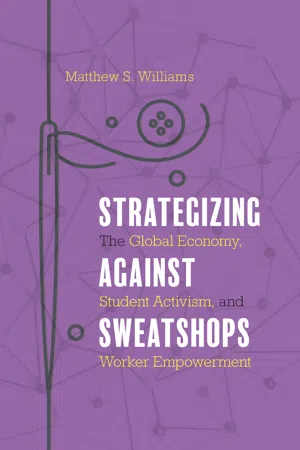
Strategizing against Sweatshops
eBook - PDF

Strategizing against Sweatshops

The Global Economy, Student Activism, and Worker Empowerment

  1. English
  2. PDF
  3. Available on iOS & Android
eBook - PDF

Strategizing against Sweatshops

The Global Economy, Student Activism, and Worker Empowerment

About this book

For the past few decades, the U.S. anti-sweatshop movement was bolstered by actions from American college students. United Students Against Sweatshops (USAS) effectively advanced the cause of workers' rights in sweatshops around the world. Strategizing against Sweatshops chronicles the evolution of student activism and presents an innovative model of how college campuses are a critical site for the advancement of global social justice. 

Matthew Williams shows how USAS targeted apparel companies outsourcing production to sweatshop factories with weak or non-existent unions. USAS did so by developing a campaign that would support workers organizing by leveraging their college's partnerships with global apparel firms like Nike and Adidas to abide by pro-labor codes of conduct. 

Strategizing against Sweatshops exemplifies how organizations and actors cooperate across a movement to formulate a coherent strategy responsive to the conditions in their social environment. Williams also provides a model of political opportunity structure to show how social context shapes the chances of a movement's success—and how movements can change that political opportunity structure in turn. Ultimately, he shows why progressive student activism remains important.

Frequently asked questions

Yes, you can cancel anytime from the Subscription tab in your account settings on the Perlego website. Your subscription will stay active until the end of your current billing period. Learn how to cancel your subscription.
No, books cannot be downloaded as external files, such as PDFs, for use outside of Perlego. However, you can download books within the Perlego app for offline reading on mobile or tablet. Learn more here.
Perlego offers two plans: Essential and Complete
  • Essential is ideal for learners and professionals who enjoy exploring a wide range of subjects. Access the Essential Library with 800,000+ trusted titles and best-sellers across business, personal growth, and the humanities. Includes unlimited reading time and Standard Read Aloud voice.
  • Complete: Perfect for advanced learners and researchers needing full, unrestricted access. Unlock 1.4M+ books across hundreds of subjects, including academic and specialized titles. The Complete Plan also includes advanced features like Premium Read Aloud and Research Assistant.
Both plans are available with monthly, semester, or annual billing cycles.
We are an online textbook subscription service, where you can get access to an entire online library for less than the price of a single book per month. With over 1 million books across 1000+ topics, we’ve got you covered! Learn more here.
Look out for the read-aloud symbol on your next book to see if you can listen to it. The read-aloud tool reads text aloud for you, highlighting the text as it is being read. You can pause it, speed it up and slow it down. Learn more here.
Yes! You can use the Perlego app on both iOS or Android devices to read anytime, anywhere — even offline. Perfect for commutes or when you’re on the go.
Please note we cannot support devices running on iOS 13 and Android 7 or earlier. Learn more about using the app.
Yes, you can access Strategizing against Sweatshops by Matthew S. Williams in PDF and/or ePUB format, as well as other popular books in Politics & International Relations & Labour & Industrial Relations. We have over one million books available in our catalogue for you to explore.

Table of contents

  1. Contents
  2. Preface: The Continuing Relevance of Progressive Student Activism in an Age of Right-Wing Populism
  3. Acknowledgments
  4. 1. Introduction: Theorizing Social Movement Strategy
  5. I. Political Opportunity Structures
  6. II. An Anatomy of United Students Against Sweatshops (USAS)
  7. III. Cycles of Contention and Strategic Innovation
  8. 14. Conclusion
  9. Appendix: Methods and Data
  10. References
  11. Index