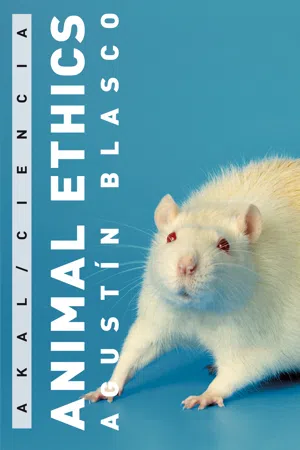
If today's human lived alongside other less endowed human species than ours (some sort of Neanderthal or Homo habilis) we would respect their differences and not consider them beings that we can use for our service. However, the fact that the closest species on the evolutionary scale to us, is the chimpanzee, puts us in a more delicate situation: to what extent do they suffer, are they masters of their fates or do they enjoy some features that we attribute only to man? Moreover, some mentally handicapped have intelligence not unlike some higher primates. Should we respect some as humans and not others? Should the line that separates us be determined by species? Why establish divisions between species and not within them? This book aims to address ethical concerns from an animal biology perspective, addressing specific real-world situations.
- 160 pages
- English
- ePUB (mobile friendly)
- Available on iOS & Android
eBook - ePub
Animal Ethics
About this book
Information
1. THE PROBLEM
The issue arises
Memory provides the soul with a kind of consecutiveness, which imitates reason, yet must be distinguished from it ... For instance: when a stick is shown to dogs, they remember the pain it has caused them, and howl and run away ... But it is the knowledge of necessary and eternal truths that distinguishes us from mere animals and gives us Reason and the Sciences, raising us to the knowledge of ourselves and of God.
GOTTFRIED LEIBNIZ, Monadology, 1714
Recently, we have begun to consider animals as something more than “things” or more than simply a piece of our property. Respect towards animal suffering is very recent, not only in Spain but worldwide. Although remote precedents of defence of animals are usually cited - in Appendix 1 we provide a brief history of these antecedents - in fact it is only as of the 70s that consideration of the suffering of animals has extended beyond the bounds of small anti-vivisectionist groups or well-meaning animal health professionals and reached the public at large. The starting point for popularisation of the defence of animals was the publication of the book “Animal Liberation” by the moral philosopher and current Ethics Professor at Princeton Peter Singer (SINGER, 1975), the true bible of animal liberation movements. This awareness in the general public came about on the basis of activism by radical sectors, organising different kinds of demonstrations and protests, even sometimes going so far as to use purely terrorist methods to attract attention; but the fact is that these actions do indeed bring the issue of animal suffering home to the increasingly urban inhabitants of developed countries.
Due partly to the activity of groups concerned about animal rights, society is currently increasingly worried about how animals that form part of an experiment are treated and how they are handled on farms. This consequently results in changes to the legal framework, and an increasingly developed and detailed legislation to regulate man’s relations with animals. The European Convention for the protection of animals kept for farming purposes was signed in March 1976, followed in 1986 by the European Convention on protection of vertebrate animals used for experimental and other scientific purposes. Both agreements were followed by their corresponding directives [1] and the consequent legislation in the member countries; other directives take in specific aspects such as slaughter in abattoirs or transport. The legislation also covers the creation of ethics committees to determine if experiments with animals are suitably carried out as well as inspection of laboratories and production farms to ensure that the welfare norms established are followed. In the United Kingdom, for example, a person who has animals in their care must assure their welfare, and may be prohibited from keeping animals or even have the animals confiscated if this is not the case. According to the Animal welfare Act [2], currently applicable in England and Wales, a person found guilty can de condemned to imprisonment for a term up to 51 weeks. Even in Spain, the land of bull-fighting, the article 332 of the penal code states that:
“Those cruelly and unjustifiably mistreating domestic animals, causing their death or injuries leading to serious physical impairment, will be punished with a sentence of three months to one year imprisonment and special disqualification of one to three years for the exercise of any profession, office or trade related with animals.”
Not that many years ago, the notion that a “rational” being might be sent to prison for mistreating an “irrational” being would have been quite shocking. Today things have changed. We may agree with the changes or not, but social sensitivity on this issue is on the rise and scientists and farmers are going to be increasingly in the sights of the ethics committees and legislators. Ever since the mid-70s, the volume of literature regarding our obligations with the animals has done nothing but grow, and concern about the issue has also increased. Animal protection measures constitute points of no return; in the future, animals are not going to be any less protected than before. This is one of the good reasons that it is pertinent to examine the bases on which the exigency of our duties towards animals is sustained. Another reason - more important - is to understand what these obligations might be and what the basis for demanding them is. Finally, whether we must ask that certain duties towards animals are fulfilled or have to comply with those imposed upon us, a proper understanding of what these requirements are based on is important.
A thorny problem
Custom does not breed understanding, but takes its place, teaching people to make their way contentedly through the world without knowing what the world is, nor what they think of it, nor what they are. When their attention is attracted to some remarkable thing, say to the rainbow, this thing is not analysed nor examined from various points of view …That scepticism should intervene in philosophy at all is an accident of human history, due to much unhappy experience of perplexity and error.
JORGE AGUSTIN RUIZ DE SANTAYANA [3] Scepticism and Animal Faith, 1923
The problem that appears is an entangled issue. In the first place, there are ethical considerations: it is generally admitted that one should not make animals suffer, but to what extent is doing so punishable? Can a man be sent to prison for mistreating an animal? This becomes more complicated with the definition of suffering: Do animals suffer? Do insects? Do lobsters suffer when being boiled alive? Do bulls suffer in the ring? Do trained elephants suffer in a circus? Do chimpanzees suffer when used in experiments? The difference between distinct types of pain is implicit in these questions; automatically withdrawing you arm when feeling a twinge is not the same thing as the pain felt at the death of your son. Unquestionably the answer to many of these issues must come about through science and not by mere reflection; properly oriented experiments can throw light on the metabolites produced during suffering, neurological reactions, etc. Underlying all these problems is the issue of consciousness. To what extent is an animal aware that it is suffering? How self-aware is an animal? Does an animal know that is was born and has to die? The answers to these questions are important for the consequences that are derived from them; for example, if an animal is indeed unaware of its future, it has no expectations, nor does it have any kind of life plan in the same sense as a human might, on the one hand keeping it locked up is not as serious as locking up a human and on the other hand taking its life is not such a big deal. This latter point is maintained even by a defender of animals such as Peter Singer (Singer, 2011).
The issue is even further entangled by legal considerations, or, if you prefer, of a deontological nature. The fact that humans have a series of acknowledged rights, which is not the case with animals, cannot be due to belonging to different species; until about 17,000 years ago, modern humans coexisted with the species Homo floresiensis discovered recently in Indonesia (Brown et al., 2004), up to 35,000 years ago with Neanderthals, and in general we are fortunate that no intermediate states from the common predecessors to present man were left. It is merely accidental that there are no places in the world with Homo erectus, Homo antecessor, Homo floresiensis, Homo habilis or any other species close to ours, but whose inferior cranial volume and lower intellectual capacities would not allow them to be included in categories such as that of Homo sapiens sapiens.
Nor is it immaterial that man may have appeared gradually or arisen suddenly [4], the product of an emergent property, as occurs with the life generated from inorganic matter. Emergent properties have bad press among scientists because they are usually used to conceal ignorance about the mechanisms that generate the new property, and this aura of mystery is prejudicial to them; but it does not necessarily have to be this way, and today we understand well how the emergent property of life comes about from inanimate matter. Put bluntly, whether the difference between a human and a cow or a chimpanzee is one of degree or is a radically new category is not the same thing. If we consider that the differences are only of degree, there are also degree differences within humans, and some mentally disabled people might in some cases be less intelligent than certain apes, or less endowed in some of the characteristics that make us human. Research into knowledge areas such as neurology or evolution could throw some light on the process.
If animals can have something akin to human rights, to this end we should consider them as humans with fewer intellectual aptitudes, like the mentally disabled. Not taking advantage of a mentally challenged person because I am good is not the same as because they have the right to not be taken advantage of by anybody. Not making animals suffer because I am good is not the same as doing so because they have the right not to suffer. Animals, at least the anthropomorphic simians like orang-utans, chimps and gorillas, could be considered as mentally impaired in terms of the features that make them similar to humans. Here, again, the answer will be more in scientific research that in considerations about the meaning of humanity.
These appeals to science do not mean that we are not faced with a genuinely ethical problem. The problem of rights, both of animals and humans, is not a scientific issue, and neither are the reasons about how we should behave towards them, although these reasons are based on our knowledge of the biology of animals and humans. In this book, we shall not go into the question of whether the bases of ethical decisions - for example, if avoiding suffering is the aim of ethical decisions, or on the contrary this is a fallacy - although we shall deal with the solutions provided by different ethical schools of thought in the question of our relation with animals, since they have consequences that help complicate the problem. For example, if preventing suffering is the fundamental objective of our relation with animals, we would have to feed the lions in natural parks with animals slaughtered humanely and stop them hunting zebras to avoid the zebras suffering, as proposed by the mid-19th century precursor of animal liberation, Lewis Gompertz (Gompertz, 1824) [5]. Whether this decision is practical or not, it would be consequent, as it would be if the defenders of animal - frequently vegetarian - were able to consume the meat of animals that had died a natural death.
To finish complicating the problem, it is not always easy to decide which actions are appropriate to benefit the animals that we wish to give our protection. Some decisions that favour aspects of animal welfare may damage other aspects of well-being, which why it is necessary to weigh up the consequences of the actions taken and the relations between some and others. Breeding rabbits in parks allows them to better express their natural behaviour, but notably increases mortality from contagion of diseases due to the contact among them and with the excrement of other animals. Domestic poultry are animals with an aggressively expressed hierarchy, with fights resulting in beak wounds, cannibalism and other derived problems, which have led a classic defender of animal welfare to consider that keeping animals in cages with facilities that improve them (enriched cages) is a more appropriate solution for hens’ welfare (Webster 2005). In the following chapters we shall try to gradually unravel the pro...
Table of contents
- Cover
- Title
- Legal
- Acknowledgements
- Introduction
- 1. The problem
- 2. The responses of Science
- 3. Ethical theories
- 4. Some practical clases
- 5. Final remarks
- 6. Appendix 1
- 7. Appendix 2
- 8. Appendix 3
- 9. References
Trusted by 375,005 students
Access to over 1.5 million titles for a fair monthly price.
Study more efficiently using our study tools.
Frequently asked questions
Yes, you can cancel anytime from the Subscription tab in your account settings on the Perlego website. Your subscription will stay active until the end of your current billing period. Learn how to cancel your subscription
No, books cannot be downloaded as external files, such as PDFs, for use outside of Perlego. However, you can download books within the Perlego app for offline reading on mobile or tablet. Learn how to download books offline
Perlego offers two plans: Essential and Complete
- Essential is ideal for learners and professionals who enjoy exploring a wide range of subjects. Access the Essential Library with 800,000+ trusted titles and best-sellers across business, personal growth, and the humanities. Includes unlimited reading time and Standard Read Aloud voice.
- Complete: Perfect for advanced learners and researchers needing full, unrestricted access. Unlock 1.5M+ books across hundreds of subjects, including academic and specialized titles. The Complete Plan also includes advanced features like Premium Read Aloud and Research Assistant.
We are an online textbook subscription service, where you can get access to an entire online library for less than the price of a single book per month. With over 1.5 million books across 990+ topics, we’ve got you covered! Learn about our mission
Look out for the read-aloud symbol on your next book to see if you can listen to it. The read-aloud tool reads text aloud for you, highlighting the text as it is being read. You can pause it, speed it up and slow it down. Learn more about Read Aloud
Yes! You can use the Perlego app on both iOS and Android devices to read anytime, anywhere — even offline. Perfect for commutes or when you’re on the go.
Please note we cannot support devices running on iOS 13 and Android 7 or earlier. Learn more about using the app
Please note we cannot support devices running on iOS 13 and Android 7 or earlier. Learn more about using the app
Yes, you can access Animal Ethics by Agustín Blasco Mateu in PDF and/or ePUB format, as well as other popular books in Social Sciences & Sociology. We have over 1.5 million books available in our catalogue for you to explore.