Este completo libro, elaborado por un equipo multidisciplinar de especialistas, propone una reflexión coral sobre las contradiciones y las tensiones a las que está sometida la práctica de una disciplina que aspira a construir nuevas aproximaciones al pasado desde el registro material, modelando la memoria en el presente.
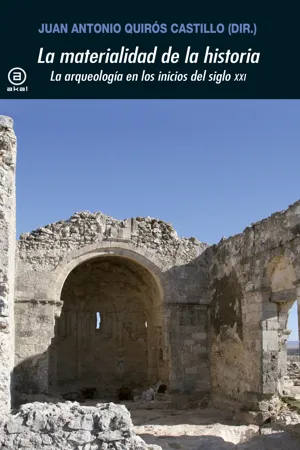
eBook - ePub
La materialidad de la historia
La arqueología en los inicios del siglo XXI
- 368 pages
- English
- ePUB (mobile friendly)
- Available on iOS & Android
eBook - ePub
La materialidad de la historia
La arqueología en los inicios del siglo XXI
About this book
Information
Topic
Scienze socialiSubtopic
ArcheologiaBIBLIOGRAFÍA
ACUTO, F. y GIFFORD, C. (2007), «Lugar, arquitectura y narrativas de poder: experiencia y percepción en los centros Inkas de los Andes del Sur», Arqueología Suramericana 3 (2), pp. 135-161.
AITCHISON, K. (2009), «Archaeology and the global financial crisis», Antiquity 319 [http://www.antiquity.ac.uk/projgall/aitchison319/].
ALCOCK, S. E. (1993), Graecia Capta. Landscapes of Roman Greece, Cambridge.
ALLISON, P. (2008), «Household archaeology» en D. M. Pearsall (ed.), Encyclopedia of Archaeology, San Diego, Academic Press, pp. 1449-1458.
ALMAGRO, A. (2002), «El análisis arqueológico como base de dos propuestas: El Cuarto Real de Santo Domingo (Granada) y el Patio del Crucero (Alcázar de Sevilla)», Arqueología de la Arquitectura 1, pp. 175-192.
ALMANSA SÁNCHEZ, J. (ed.) (2011), El futuro de la Arqueología en España, Madrid.
AMIR, S. y GIDALIZON, E. (1990), «Expert based Method for the Evaluation of Visual Absorption Capacity of the Landscape», Journal of Environmental Management 30, pp. 251-163.
ANDERSON, P. (2000 [1998]), Los orígenes de la posmodernidad, Barcelona, Anagrama.
ANDRÉN, A. (1998), Between Artifacts and Texts. Historical Archaeology in Global Perspective, Nueva York, Plenum Press.
ANICO, M. y PERALTA, E. (eds.) (2009), Heritage and Identity. Engagement and Demission in the Contemporary World, Oxon, Routledge.
APPLEBY, J.; HUNT, L. y JACOB, M. (1994), Telling the Truth about History, Nueva York, Norton.
ARANDA JIMÉNEZ, G. (2011), «Presente y futuro de la Arqueología en Andalucía», en J. Almansa Sánchez (ed.), El futuro de la Arqueología en España, Madrid, JAS Arqueología, pp. 13-20.
ARCE, I. (1996), «El estudio de los acabados y revestimientos de la arquitectura», en Arqueología de la Arquitectura, Burgos, Junta de Castilla y León, pp. 87-102.
ARGEMÍ RELAT, M. (1999), A les vores dels torrents. Una prospecció desl assentaments pagesos andalusins de Pollença, Pollença, Ajuntament de Pollença.
ARIÑO, E.; GURT, J. M. y PALET, J. M. (2004), El pasado presente. Arqueología de los paisajes en la Hispania romana, Barcelona.
ARIZAGA, B. y MARTÍNEZ, S. (2006), Atlas de villas medievales de Vasconia. Bizkaia, Donostia.
ARNOLD, C. (1984), Roman Britain to Saxon England, Londres, Croom Helm.
— (1986), «Archaeology and history: the shades of confrontation and cooperation», en J. Bintliff y C. Gaffney (eds.), Archaeology at the Interface, Oxford, British Archaeological Reports, International Series 300, pp. 32-39.
ARRAZCAETA, A. (2002), «Habana vieja: Arqueología en edificios históricos», Gabinete de Arqueología 2, pp. 14-23.
ARTHUR, L. M.; DANIEL, T. C. y BOSTER, R. S. (1977), «Scenic assessment: an overview», Landscape Planning 4, pp. 109-129.
ASCHERSON, N. (2000), «Editorial», Public Archaeology 1, pp. 1-4.
ASINS, S. (2009), El paisaje agrario aterrazado. Diálogo entre el hombre y el medio en Petrer (Alicante), Valencia.
AUSTIN, D. (1998), «Private and public: an archaeological consideration of things», en H. Hundsbichler, G. Jaritz y T. Kühtreiber (ed.), Die Viefalt der Dinge: Neue Wege zur Analyse mittelalterlicher Sachkultur, Viena, Verlag der Österreichischen Akademie der Wissenschaften, pp. 163-206.
— y THOMAS, J. (1990), «The “proper study” of medieval archaeology: a case study», en D. Austin y L. Alcock (ed.), en From the Baltic to the Black Sea. Studies in Medieval Archaeology, Londres, Unwin Hyman, pp. 43-78.
AYÁN, X. M. (2003), «Arquitectura como tecnología de construcción de la realidad social», Arqueología de la Arquitectura, pp. 17-24.
— (2008), «El paisaje ausente: por una Arqueología de la guerrilla antifranquista en Galicia», en A. González Ruibal (ed.), Arqueología de la guerra civil española. Complutum 19 (2), Madrid, pp. 213-237.
— y AMADO, X. (2001), «La evaluación de impacto arqueológico de la red de gasificación de Galicia: consideraciones metodológicas y síntesis de resultados», Trabajos de Prehistoria 58, 1, pp.127-141.
AZKARATE, A (2001), «Análisis de la evolución histórico-constructiva de la catedral de Santa María de Vitoria-Gasteiz (Aplicación de la Arqueología de la Arquitectura a un modelo complejo)», en V Congreso de Arqueología Medieval Española (Valladolid, 1999), Valladolid, pp. 177-211.
— (2001), Arqueología de la Arquitectura (Experiencias de investigación desde la Universidad del País Vasco), Lección inaugural de apertura del Curso Académico de la Universidad del País Vasco/Euskal Herriko Unibertsitatea, 2001-2002, Bilbao, Ed. Universidad del País Vasco.
— (2002), «Intereses cognoscitivos y praxis social en Arqueología de la Arquitectura», Arqueología de la Arquitectura 1, pp. 55-72.
— (2009), «Reflexiones, d...
Table of contents
- Portada
- Portadilla
- Legal
- Los autores
- Introducción
- I. ¿El fin de la arqueología? La arqueología a inicios del siglo XXI
- PRIMERA PARTE. LA ARQUEOLOGÍA Y LA PRODUCCIÓN DE CONOCIMIENTO
- II. Arqueología histórica. Más allá de las «evidencias»
- III. Arqueología e historia medievales como historia
- IV. La producción de sentido. La arqueología más allá de la interpretación
- SEGUNDA PARTE. LA ARQUEOLOGÍA COMO PROFESIÓN
- V. Arqueología preventiva. Gestión del patrimonio arqueológico
- VI. Trabajo, mercado y conocimiento. La arqueología como profesión
- TERCERA PARTE. LOS CONTEXTOS DE APLICACIÓN
- VII. Arqueología del paisaje: procesos sociales y territorios
- Apéndice
- VIII. En los adentros de la ciudad. Arqueología y urbanismo
- IX. La construcción y lo construido. Arqueología de la arquitectura
- Apéndice
- Bibliografía
Trusted by 375,005 students
Access to over 1.5 million titles for a fair monthly price.
Study more efficiently using our study tools.
Frequently asked questions
Yes, you can cancel anytime from the Subscription tab in your account settings on the Perlego website. Your subscription will stay active until the end of your current billing period. Learn how to cancel your subscription
No, books cannot be downloaded as external files, such as PDFs, for use outside of Perlego. However, you can download books within the Perlego app for offline reading on mobile or tablet. Learn how to download books offline
Perlego offers two plans: Essential and Complete
- Essential is ideal for learners and professionals who enjoy exploring a wide range of subjects. Access the Essential Library with 800,000+ trusted titles and best-sellers across business, personal growth, and the humanities. Includes unlimited reading time and Standard Read Aloud voice.
- Complete: Perfect for advanced learners and researchers needing full, unrestricted access. Unlock 1.5M+ books across hundreds of subjects, including academic and specialized titles. The Complete Plan also includes advanced features like Premium Read Aloud and Research Assistant.
We are an online textbook subscription service, where you can get access to an entire online library for less than the price of a single book per month. With over 1.5 million books across 990+ topics, we’ve got you covered! Learn about our mission
Look out for the read-aloud symbol on your next book to see if you can listen to it. The read-aloud tool reads text aloud for you, highlighting the text as it is being read. You can pause it, speed it up and slow it down. Learn more about Read Aloud
Yes! You can use the Perlego app on both iOS and Android devices to read anytime, anywhere — even offline. Perfect for commutes or when you’re on the go.
Please note we cannot support devices running on iOS 13 and Android 7 or earlier. Learn more about using the app
Please note we cannot support devices running on iOS 13 and Android 7 or earlier. Learn more about using the app
Yes, you can access La materialidad de la historia by Juan Antonio Quirós Castillo in PDF and/or ePUB format, as well as other popular books in Scienze sociali & Archeologia. We have over 1.5 million books available in our catalogue for you to explore.