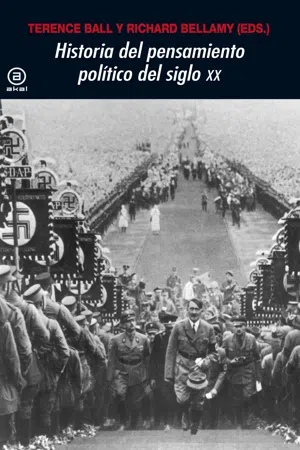
Esta obra de referencia fundamental proporciona una vasta e inteligente panorámica del pensamiento político y las ideas que modelaron el convulso siglo XX.Elaborado por un equipo internacional de prestigiosos autores, el presente volumen aborda la aparición de un incipiente Estado de bienestar, así como las reacciones ante el mismo: las críticas planteadas por el fascismo y el comunismo, y las alternativas ensayadas a la democracia liberal; las formas novedosas de organización política, resultado del ascenso de un electorado de masas, y los nuevos movimientos sociales; las diversas tradiciones intelectuales –del positivismo al posmodernismo– que han conformado el estudio de la política; la interacción entre las tradiciones occidentales y no-occidentales del pensamiento político, y el reto que representa para el Estado la globalización. Riguroso a la par que ameno, este manual de obligada consulta para estudiantes y profesores es, asimismo, una grata lectura para todo aquel que quiera profundizar en las ideas que han configurado nuestra época.Terence Ball es profesor de Ciencias Políticas en Arizona State University. Richard Bellamy es profesor de Ciencias Políticas y director del European Institute en University College of London. "Una obra de referencia impresionante, rematada con una bibliografía de 57 páginas y prácticos bosquejos biográficos de 180 pensadores fundamentales [...] un mapa indispensable [...] una herramienta de referencia esencial."The Economist"El equipo de autores es formidable [...] Una contribución indispensable para toda biblioteca de ciencias sociales o de humanidades." International Affairs
eBook - ePub
Historia del pensamiento político en el siglo XX
- 784 pages
- English
- ePUB (mobile friendly)
- Available on iOS & Android
eBook - ePub
Historia del pensamiento político en el siglo XX
About this book
Information
Bibliografía
Primera parte: la variable fortuna de la democracia liberal
Fuentes primarias
Arendt, H. (1951), Origins of Totalitarianism, Nueva York [ed. cast.: Los orígenes del totalitarismo, Madrid, Alianza, 2010].
Aron, R. (1957), The Opium of the Intellectuals [1954], trad. Terence Kilmartin, Nueva York.
— (1972), The Imperial Republic, the United States and the World 1945-1973, Londres.
Bachrach, P. y Baratz, M. S. (1962), «The Two Faces of Power», American Political Science Review 56, pp. 947-952.
Barrès, M. (1925), Scènes et doctrines du nationalisme, 2 vols., París.
Barry, B. (1988), Theories of Justice, Berkeley, California [ed. cast.: Teorías de la justicia, Barcelona, Gedisa, 1995].
Beitz, C. (1979), Political Theory and International Relations, Princeton, Nueva Jersey.
Bell, D. (1979), Cultural contradictions of Capitalism, Londres [ed. cast.: Las contradicciones culturales del capitalismo, Madrid, Alianza, 2010].
Benoist, A. de (1980), Les idées à l’endroit, París [ed. cast.: Las ideas de la nueva derecha, Barcelona, Nuevo Arte Thor, 1986].
Beran, H. (1987), The Theory of Political Obligation, Londres.
Berelson, B. et al. (1954), Voting, Chicago.
Berlin, I. (1979), «Nationalism: A Neglected Concept», en Against the Current: Essays in the history of Ideas, Londres [ed. cast.: Contra la corriente: ensayos sobre historia de las ideas, Madrid, Fondo de Cultura Económica, 2000].
Beveridge, W. (1942), Social Insurance and Allied Services, Cmd 6404, Londres [ed. cast.: Seguro social y servicios afines, Madrid, Ministerio de Trabajo y Servicios Sociales, 1989].
— (1945), Full Employment in a Free Society, Londres [ed. cast.: Pleno empleo en una sociedad libre, Madrid, Ministerio de Trabajo y Servicios Sociales, 1989].
— (1948), Voluntary Action, Londres.
Biddiss, M. (ed.) (1970), Gobineau: Selected Political Writings, Nueva York y Londres.
Blake, Lord y Patten, J. (eds.), The Conservative Opportunity, Londres.
Le Bon, G. (1926), The Crowd: A Study of the Popular Mind [1895], Londres.
Bonald, Vizconde de (1864), Ouvres politiques, en Ouvres complètes, ed. M. L’Abbé Migne, 3 vols., París.
Bottai, G. (1949), Vent’anni e un giorno, Naviglio.
Boutros-Gahli, B. (1992), Agenda for Peace, Nueva York.
Bryce, J. (1888), The American Commonwealth, 2 vols., Londres.
Buchanan, A. (1991), Seccession: The morality of Political Divorce from Fort Sumter to Lithuania and Quebec, Oxford.
Buchanan, J. M. (1975), The Limits of Liberty, Chicago.
Buchanan, J. M. y Wagner, E. E. (1977), Democracy in Deficit: the Political Legacy of Lord Keynes, Nueva York.
Buchanan, J. M.; Burton, J. y Wagner, R. E. (1978), The Consequences of Mr. Keynes, Londres.
Buckley, W. F., Jr. (1958), Up from Liberalism, Nueva York.
Camus, A. (1956), The Rebel, Nueva York [ed. cast.: El hombre rebelde, Madrid, Alianza, 2010].
Canetti, E. (1978), Crowds and Power, Nueva York [ed. cast.: Masa y poder, Madrid, Alianza, 2010].
Carr, E. H. (1945), Nationalism and After, Londres.
Castillo Velasco, J. (1963), Las fuentes de la democracia cristiana, Santiago de Chile.
Churchill, W. S. (1909), Liberalism and the Social Problem, Londres.
Connor, W. (1978), «A Nation is a Nation, is a State, is an Ethnic Group, is a…», Ethnic and Racial Studies I (4), pp. 379-388.
Croly, H. (1909),...
Table of contents
- Portada
- Portadilla
- Legal
- Prefacio
- Introducción
- Primera parte. La variable fortunda de la democracia liberal
- I. El advenimiento del Estado del bienestar
- II. Política y mercados: Keynes y sus críticos
- III. La sociedad de masas y el surgimiento de la teoría moderna de la democracia
- IV. Nacionalismo e imperialismo
- V. Fascismo y racismo
- VI. Conservadurismo
- VII. Democracia cristiana
- VIII. Los críticos del totalitarismo
- IX. ¿El fin del Estado del bienestar?
- Segunda parte. Tipos de marxismo
- X. La Segunda Internacional: socialismo y socialdemocracia
- XI. La Revolución rusa: la ideología al poder
- XII. El comunismo asiático
- XIII. El marxismo occidental
- XIV. El marxismo francés: del existencialismo al estructuralismo
- Tercera parte. Ciencia, modernismo y política
- XV. El positivismo: reacciones y evolución
- XVI. La Posmodernidad: patologías de la Modernidad, de Nietzsche a los postestructuralistas
- XVII. Weber, Durkheim y la sociología del Estado moderno
- XVIII. Freud y sus seguidores
- XIX. Modernismo en el arte, la literatura y la teoría política
- XX. La nueva ciencia de la política
- XXI. Utilitarismo y más allá: la teoría política analítica contemporánea
- Cuarta parte. Nuevos movimientos sociales y políticas de la diferencia
- XXII. Pacifismo y pacifismo
- XXIII. Feminismos
- XXIV. Políticas de identidad
- XXV. Teoría política ecologista
- Quinta parte. Más allá del pensamiento político occidental
- XXVI. El pensamiento político no occidental
- XXVII. El pensamiento político islámico
- Epílogo. La gran dicotomía del siglo XX
- Biografías
- Bibliografía
- Colaboradores
- Otros títulos
Trusted by 375,005 students
Access to over 1.5 million titles for a fair monthly price.
Study more efficiently using our study tools.
Frequently asked questions
Yes, you can cancel anytime from the Subscription tab in your account settings on the Perlego website. Your subscription will stay active until the end of your current billing period. Learn how to cancel your subscription
No, books cannot be downloaded as external files, such as PDFs, for use outside of Perlego. However, you can download books within the Perlego app for offline reading on mobile or tablet. Learn how to download books offline
Perlego offers two plans: Essential and Complete
- Essential is ideal for learners and professionals who enjoy exploring a wide range of subjects. Access the Essential Library with 800,000+ trusted titles and best-sellers across business, personal growth, and the humanities. Includes unlimited reading time and Standard Read Aloud voice.
- Complete: Perfect for advanced learners and researchers needing full, unrestricted access. Unlock 1.5M+ books across hundreds of subjects, including academic and specialized titles. The Complete Plan also includes advanced features like Premium Read Aloud and Research Assistant.
We are an online textbook subscription service, where you can get access to an entire online library for less than the price of a single book per month. With over 1.5 million books across 990+ topics, we’ve got you covered! Learn about our mission
Look out for the read-aloud symbol on your next book to see if you can listen to it. The read-aloud tool reads text aloud for you, highlighting the text as it is being read. You can pause it, speed it up and slow it down. Learn more about Read Aloud
Yes! You can use the Perlego app on both iOS and Android devices to read anytime, anywhere — even offline. Perfect for commutes or when you’re on the go.
Please note we cannot support devices running on iOS 13 and Android 7 or earlier. Learn more about using the app
Please note we cannot support devices running on iOS 13 and Android 7 or earlier. Learn more about using the app
Yes, you can access Historia del pensamiento político en el siglo XX by Terence Ball, Richard Bellamy, Sandra Chaparro Martínez in PDF and/or ePUB format, as well as other popular books in Politik & Internationale Beziehungen & Politische Ideologien. We have over 1.5 million books available in our catalogue for you to explore.