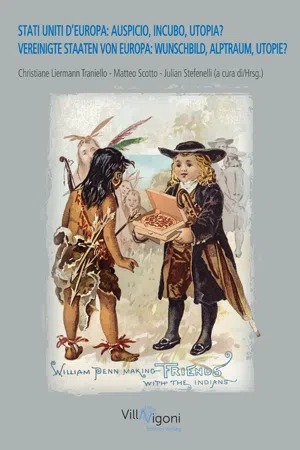
eBook - ePub
STATI UNITI D'EUROPA: AUSPICIO, INCUBO, UTOPIA? VEREINIGTE STAATEN VON EUROPA: WUNSCHBILD, ALPTRAUM, UTOPIE?
- 324 pages
- English
- ePUB (mobile friendly)
- Available on iOS & Android
eBook - ePub
STATI UNITI D'EUROPA: AUSPICIO, INCUBO, UTOPIA? VEREINIGTE STAATEN VON EUROPA: WUNSCHBILD, ALPTRAUM, UTOPIE?
About this book
Das neue Buch Vereinigte Staaten von Europa: Hoffnung, Alptraum, Utopie" ist im Villa Vigoni Editore | Verlag erschienen. Der Sammelband wird herausgegeben von Christiane Liermann Traniello (Generalsekretärin, Villa Vigoni), Matteo Scotto (Wissenschaftlicher Referent, Villa Vigoni) und Julian Stefenelli (Justiziar, Villa Vigoni).Seit Winston Churchills berühmter Züricher Rede im Jahr 1946 hat die Idee der Vereinigten Staaten von Europa den politischen Diskurs nie wirklich verlassen. Jedoch ist man sich hierzu nie ganz einig: mal ist es ein Modell, von dem man sich distanzieren sollte oder will, manchmal scheint es eine Vision, die man anstrebt, und andere sehen diese Vision lediglich in Ermangelung von Alternativen. Der Sammelband beschäftigt sich genau mit diesen Visionen in drei Kapiteln: "Überlegungen zu den gegenwärtigen Staaten", "Europäische Einheit" und "Überlegungen zueiner gemeinsamen politischen Vision des heutigen Europas"
Information
II
L’Unità europea: riflessione su come intendiamo rimanere uniti oggi in Europa
Europäische Einheit: Wie wollen wir heute in Europa geeint bleiben?
What “Union” Do We Want For A United Europe?
Michael Gehler*
Abstract
This article attempts to provide answers to the question of what kind of “union” one would like to see for a united Europe. This question can be answered realistically in the light of the history of European unification. This will be done in three steps. First of all it is a question of the previous different conceptions of Europe in its historical context and its development, then by ten classical approaches and finally by three specific approaches for a better understanding of the history of European integration. It becomes generally clear that the slogan “United States of Europe” is no longer realistic, but rather to speak of “Europe’s united states”.
I. Nine Different Conceptions of Europe in Historical Context and Development
If we look at the long road to the institutionalised Europe from 1918 to 2019, there had been a varied development of European associations, ideas, images, and identifications.
- Paneurope from Portugal to Poland, as personified by Richard Coudenhove-Kalergi with the Paneuropean Union founded in Vienna in 1922. Even though Coudenhove was regarded as a “republican by reason”, Paneurope symbolised also revitalised or reapplied Greater European Danube-area concept which one could profess – one which, however, remained an illusion. It did not happen by chance that after the Second World War, the Paneuropean Union was occupied more and more by monarchists and was presided over by Otto von Habsburg.
- “Central Europe” (Mitteleuropa) and Danube (Con-)Federation as personified by the Austrian Chancellor Ignaz Seipel, the Hungarian Economist Elemér Hantos or the French Prime Minister André Tardieu, was a reduced concept of Europe starting out from the Paneurope idea, a reduced Habsburg-Danube area concept to which one could feel attracted, but which in political terms was likewise unrealistic.
- The Nazi idea of Europe as an “European economic community” as the basis for the Greater German Reich in connection with a Großraum policy by Adolf Hitler (1941–45) may have offered a certain substitute for the unachievable Paneurope and Central Europe, but just like every hegemonic and imperial formation by force from above, in Europe it was doomed to failure.
- After the Second World War, concepts of a “small Europe” or a Carolingian Western “core Europe” by Konrad Adenauer und Robert Schuman were fixated purely on Western Europe with the European Coal and Steel Community (ECSC) and the European Economic Community (EEC). But as a result of the status of separate countries like the neutrals, they could not and would not be participated in.
- Ideas of a “Greater Europe”, which for the Council of Europe in Strasbourg represented by the Secretaries Generals like Peter Smithers (1964-1969), Franz Karasek (1979–1984) or Catherine Lalumière (1989-1994) appeared as good as a done deal, created far more identification with a Europe that was also to range far beyond the Iron Curtain after 1989. Against the background of the Cold War, however, Greater Europe was not realisable as a result of the double division of Europe: first of all, Europe was politically divided into West and East, and secondly, Western Europe was also divided in terms of trade policy between the European Free Trade Association and the European Economic Community (1960–72).
- Thus in the 1970s and 1980s, in the wake of the depressing experience with the suppression of the Prague Spring in 1968, but also against the background of the Conference on Security and Cooperation in Europe (CSCE) with the Helsinki Final Act on 1 August 1975, a new whole Europe and “Central Europe” (Mitteleuropa) discourse began, represented by dissidents civil rights movements, Helsinki groups and intellectuals e. g. Václáv Havel, György Konrád or Milan Kundera.
- In addition to “Central Europe”, there was the Western EC-Europe and later incomplete EU-Europe which, in the 1980s and 1990s, appeared more and more to be without an alternative, particularly since the project offered the small free trade zone of EFTA only little material for identity. Although even the EC of the 1980s or the EU of the 1990s was still received by the Central and Eastern Europeans as incomplete, in need of enlargement and also criticised because of the exclusion of Russia, represented by Mikhail Gorbachev and his idea of a “common European house”.
- The Unification of whole Europe by the EU “Eastern Enlargement” (2004–07) led to the end of the idea of “United States of Europe” as a Federal State represented by the president of the Constitutional Convention Valery Giscard d’Estaing. In the early 1990s, Helmut Kohl stressed to doubtful Eurosceptics in the Union parties that he had a federal solution in mind for the EC, but that this should not be misunderstood as the creation of the “United States of Europe”. Remarkable is the fact that the Bonn political scientist Ludger Kühnhardt and the member of the European Parliament Hans-Gert Pöttering (European People’s Party) have already published a book with the changed title: Europas vereinigte Staaten. Annäherungen an Werte und Ziele (Texte + Thesen 237), Zürich 1991.
- The result of point 8 is a realistic and pragmatic Europe concept: the Europe of concentric circles, the Europe of the variable geometry and different speeds starting from the point of “Core Europe” (Kerneuropa), presented in 1994 by Karl Lamers and Wolfgang Schäuble (both belonging to the CDU), which represents the reality throughout the whole European integration history.
Which Europe do we want? The answer to the question depends on where we want more and less Europe. But the question of more or less Europe is also asked too simply and cannot be answered in general terms. We have to look at individual policy areas. Let us take the example of security and defence. If one thinks of the deficiencies in the exchange of information by the security authorities in the fight against terrorism, more Europe is needed here. The same applies to migration, the securing of external borders and a Europe-wide immigration regime. At present, Europe is still far from achieving this.
Less Europe concerns enlargement. The Western Balkans, which are now pushing into the EU, will certainly have to wait. In retrospect, Turkey’s accession talks must be described as phantom debates. They were a mistake.
More Europe is certainly needed in the social dimension, because one of the most burning problems is youth unemployment in southern Europe or the emigration of young people, especially from south-eastern Europe. The social dimension of the EU needs to be sharpened. I think it makes sense to strengthen the European Social Fund and to establish a system of European youth unemployment insurance.
II. Ten Classical Approaches for a Better Understanding of European Integration History
First, the idea, concept, and space history approach (Paneurope, core Europe or Western Europe, Whole Europe or Greater Europe, Zwischeneuropa or Middle Europe, the Europe of concentric circles, the Europe of the variable geometry, of different speeds, etc.).
Second, the integration theory approach (idealism, constitutionalism, functionalism, neofunctionalism, liberal intergovernmentalism, constructivism).
Third, the protagonist approach, above all against the background of the “German-French engine” (Schuman-Adenauer, Brandt-Pompidou, Giscard d’Estaing-Schmidt, Mitterrand-Kohl, Merkel-Macron).
Fourth, the treaty history approach by signing and ratification (the Treaties of Rome 1957–58, the Single European Act 1986-87, the Union Treaty of Maastricht 1991–93, Amsterdam 1997–99, Nice 2000-03, “Constitutional Treaty” 2003-failed 2005, and Lisbon 2007–09).
Fifth, the enlargement history approach (northern enlargement with Denmark, the United Kingdom, and Ireland in 1973; southern enlargement with Greece 1981, and Portugal and Spain 1986; the Eastern German enlargement with the GDR 1990; the EFTA states of Finland, Austria, and Sweden 1995; the Central Eastern European countries and the Baltic states with Estonia, Latvia, Lithuania, Poland, Hungary, the Czech Republic, Slovakia, Slovenia, Malta, and Cyprus 2004; and the South-eastern European countries with Bulgaria and Romania 2007 and Croatia 2013).
Sixth, the interdependency history approach: the dialectic between europeanisations and re-nationalisations (the Treaties of Rome and Gaulism 1958-68; Maastricht and nationalistic or [right-wing] populist counterreactions 1991-99; the EU treaties, the introduction of the euro, the “Constitutional Treaty”, and the corresponding rejections by national referendums in Denmark in 1992 and 2000, Sweden in 2001, Ireland in 2002, France and the Netherlands in 2005, and Ireland again in 2008).
Seventh, the crisis history approach or the “challenge and response” principle (the failure of the EDC in the French National Assembly 1954 and the departure toward or the new beginning with the Treaties of Rome as a Relance Européenne in 1955-57; the boycott of the EEC Council of Ministers with the policy of the empty chair by Charles de Gaulle and the Luxembourg Compromise of 1965-66; the debate on the UK Rebate with Margaret Thatcher 1979-1984; German unity as a crisis of the EC and the Union Treaty of Maastricht as a response 1990-93; the ratification crisis of the EU treaties 1991-92, 2001-02, 2005-06, 2008-09).
Eighth, the perception, reception, and intervention history approach: external perceptions and attempts at influence with regard to the EEC, EC, and EU, for example by the USSR or Russia gauged at various phases of development (1952-57, 1958-73, 1974-91, 1992-2004, 2005-2019).
Ninth, the transatlantic approach: at the beginning of Western European integration, the United States of America acted as a midwife with the European Recovery Programme (ERP) 1947-48 and the North Atlantic Alliance (NATO) 1949. At the end of the continent’s political unification, the US anticipated and flanked the EU “eastward enlargement” with NATO “eastward enlargement” (1999-2004).
Tenth, the hegemonic and imperial history approach.
While the first seven approaches can be deduced from integration history and its development as well as from the research to date, the latter three approaches still have been studied very little.
III. Three Special Approaches for a Better Understanding of European Integration History
These approaches will take place with regard to the Communities or the Union with more intensive consideration of the main political protagonists and can be realised in five phases in each case.
1. The Perception History, Reception History, and Intervention History Approach of the Soviet Union and the Russian Federation
First, the USSR under Josef W. Stalin was in a negative action mode of total confrontation with rejecting, combating, and undermining the formation of Western European integration (the ERP, OEEC, and ECSC) by the mobilisation of the communist parties in Western Europe within the context of Cominform as well as with the promotion of proposals for a freedom from coalitions or a neutralisation of Germany for the prevention of the formation of a Western Bloc (1947-53).
Second, the USSR under Nikita S. Khrushchev pursued constructive and more positive matters of concern with regard to a total European security conference under the promotion of the superiority of the Soviet...
Table of contents
- I
- II
- III
- IV
- V
Trusted by 375,005 students
Access to over 1.5 million titles for a fair monthly price.
Study more efficiently using our study tools.
Frequently asked questions
Yes, you can cancel anytime from the Subscription tab in your account settings on the Perlego website. Your subscription will stay active until the end of your current billing period. Learn how to cancel your subscription
No, books cannot be downloaded as external files, such as PDFs, for use outside of Perlego. However, you can download books within the Perlego app for offline reading on mobile or tablet. Learn how to download books offline
Perlego offers two plans: Essential and Complete
- Essential is ideal for learners and professionals who enjoy exploring a wide range of subjects. Access the Essential Library with 800,000+ trusted titles and best-sellers across business, personal growth, and the humanities. Includes unlimited reading time and Standard Read Aloud voice.
- Complete: Perfect for advanced learners and researchers needing full, unrestricted access. Unlock 1.5M+ books across hundreds of subjects, including academic and specialized titles. The Complete Plan also includes advanced features like Premium Read Aloud and Research Assistant.
We are an online textbook subscription service, where you can get access to an entire online library for less than the price of a single book per month. With over 1.5 million books across 990+ topics, we’ve got you covered! Learn about our mission
Look out for the read-aloud symbol on your next book to see if you can listen to it. The read-aloud tool reads text aloud for you, highlighting the text as it is being read. You can pause it, speed it up and slow it down. Learn more about Read Aloud
Yes! You can use the Perlego app on both iOS and Android devices to read anytime, anywhere — even offline. Perfect for commutes or when you’re on the go.
Please note we cannot support devices running on iOS 13 and Android 7 or earlier. Learn more about using the app
Please note we cannot support devices running on iOS 13 and Android 7 or earlier. Learn more about using the app
Yes, you can access STATI UNITI D'EUROPA: AUSPICIO, INCUBO, UTOPIA? VEREINIGTE STAATEN VON EUROPA: WUNSCHBILD, ALPTRAUM, UTOPIE? by Christiane Liermann Traniello - Matteo Scotto - Julian Stefenelli,Christiane Liermann,Matteo Scotto, Christiane Liermann,Julian Stefenelli,Matteo Scotto, Christiane Liermann, Julian Stefenelli, Matteo Scotto in PDF and/or ePUB format, as well as other popular books in Politik & Internationale Beziehungen & Europäische Politik. We have over 1.5 million books available in our catalogue for you to explore.