Around the world, LGBTQ+ activists have won an unprecedented series of political victories, from marriage equality to increased representation in government. But this success has sparked a backlash. While there has been much scrutiny of the role of the Christian right in opposing LGBTQ+ equality in the US, the backlash goes far beyond these traditional elements, and also extends beyond the US to countries including the UK, Ireland and Canada.
In this book, Nash and Brown consider the rise of the new 'heteroactivism', showing how social media and new sources of funding have reinvigorated the opponents of LGBTQ+ rights. They also show how the rhetoric and tactics of this new generation of heteroactivists differs from that of their predecessors, exploiting notions of 'parental rights' and freedom of speech to assert heteronormative values in spaces ranging from schools to workplaces. They also reveal the increasingly transnational nature of anti- LGBTQ+ activism, with growing links between heteroactivists in the US, UK and beyond.
eBook - ePub
Heteroactivism
Resisting Lesbian, Gay, Bisexual and Trans Rights and Equalities
- 248 pages
- English
- ePUB (mobile friendly)
- Available on iOS & Android
eBook - ePub
Heteroactivism
Resisting Lesbian, Gay, Bisexual and Trans Rights and Equalities
About this book
Information
1
Same-Sex Marriage: Supporting ‘Heterosexual Families’
Introduction
Same-sex marriage played a key role in LGBT activisms in Canada, the UK and Ireland in the 21st century. Same-sex marriage equalities were the result of innumerable legal and social contestations in all three locations. The battle over same-sex marriage was not only ‘intensely political’ for society at large was but was also vigorously and sometimes acrimoniously debated within LGBT and queer positionings (Kitzinger and Wilkinson, 2004: 132; see also Bell and Binnie, 2000; Browne and Nash, 2015; Warner, 1999; Weeks et al., 2001). Less attention has been paid to contemporary oppositions to same-sex marriage outside the US. This chapter explores how heteroactivist arguments develop in those legal and social contexts where gay men and lesbians no longer cause moral, religious, legal and social outrage in society at large. Thus, contemporary heteroactivist arguments against same-sex marriage (and its implications) need to find alternative grounds to support their opposition other than the vilification of LGBT ‘lifestyles’. Here, we investigate heteroactivist opposition to same-sex marriage as it emerged in Ireland and Great Britain. In both these instances, oppositional arguments both resonated with, and departed from, arguments made by defenders of heteronormative marriage in Canada some 10 to 15 years earlier. Throughout the chapter, we show that heteroactivists largely moved away from arguments about the moral turpitude of gays and lesbians and focused on claims that hetero- and gender normative marriages were best for society, and in the best interests of biological children. The figure of the child introduced here is critical to heteroactivist discussions and is an underlying heteroactivist theme we explore throughout the book.
We begin this chapter with a brief discussion of debates in Canada in the early 2000s about same-sex marriage before we then introduce the British and Irish contexts. The chapter primarily considers the activities of heteroactivists in the 2014 debates in Britain regarding same-sex marriage and the 2015 Irish referendum on gay marriage. At the end of the chapter, we discuss how opponents in the British 2014 debate in particular, detailed the supposedly negative impacts of same-sex marriage on Canada in an attempt to influence the British debate. In examining these British and Irish marriage debates, we detail the key tenets underpinning heteroactivist ideologies that we explore throughout this book. These include: the figure of the child in trans or gender ‘ideologies’ and the undermining of Western social mores (Chapters 3 and 5); parental rights (Chapter 2) and the potential exclusion of ‘traditional Christians’ and other heteroactivists from the public sphere (Chapter 5). Overall, we contend that heteroactivist objections to LGBT equalities, including same-sex marriage, have to grapple with new legal and cultural contexts in the 21st century, where overt vilifications of LGBT people, relationships and lives are both unproductive and potentially illegal.
Canada, Great Britain and Ireland: Same-Sex Marriage and Heteroactivist Resistances
Same-sex marriage was formally instituted in Canada in 2005. For a decade, there was little overt or public mainstream difficulty around LGBT equalities until about 2015 when the events discussed here began to generate greater opposition around certain flashpoints such as sexual education and gay–straight alliances in public schools as well as questions about trans rights (Nash and Browne, 2019).1 Those objecting to same-sex marriage in Great Britain and Ireland made arguments similar to those made in Canada in the early 2000s. That said, how these arguments were taken up and elaborated on demonstrates distinctive contextual differences between countries. In this section, we outline several key points arising in the Canadian debates on same-sex marriage before considering the British and Irish conversations. These national contextualisations highlight the transnational formulation of heteroactivist ideologies as they travel, merge and diverge across places and illustrate the transnational processes we discuss in the Introduction. This transnationalism is central not only to our engagement with heteroactivism but is critical to understanding heteroactivism itself.
Canada legally recognised same-sex marriage in 2005, after several decades of court cases and legislative actions that, in a piecemeal fashion, incorporated same-sex couples and their children into family legislation. Opponents of same-sex marriage in the early 2000s focused almost exclusively on the rights, needs and welfare of the child. Heterosexual (married) parents, it was argued, provided the most nurturing environment: ‘By their sexual difference, they provide their children the full range of human nurturing that comes by being raised by a mother and a father’ (Henry, 2006: para. 7). Ethicist Margaret Somerville claimed that children’s rights include the experience of living in a procreative family unit held together by heterosexual marriage and enabling access to the biological mother and father (Somerville, 2010). This focus on heterosexual marriages claimed that children raised by married, male same-sex couples would be denied their inherent rights to their biological mother, and thus would be rendered ‘motherless’ – an unfair and troubling result (Nash, Gorman-Murray and Browne, 2019). Heteroactivists therefore contended that the best interests of the child could only be met within the heterosexual procreative unit, rendered stable by the institution of heteronormative marriage, and as the best model of proper gendered and sexual roles (Browne and Nash, 2014). Although criticism was not directly or overtly aimed at single or divorced parents (men or women), these arguments constituted an implied criticism of unmarried, separate or divorced heterosexual parents, as well as adoptive and foster families or those turning to reproductive technologies. Those failing to meet this ideal standard of child-rearing were seen to be deficient in their role as both partner and spouse. Enshrine Marriage Canada argued, for example, that ‘Marriage is a child-centred, not an adult-centred, institution. No one has the right to redefine marriage so as intentionally to impose a fatherless or motherless home on a child as a matter of state policy’ (quoted in Nash, Gorman-Murray and Browne, 2019: 4). Linking the public/private, state/home creates the presumption of the good of the ‘nation’ being located within a heteronormalised trajectory that makes home lives and personal relationships a public good and public goods. As we show throughout the chapter, and the remainder of the book, state policy is positioned by heteroactivists as protecting the child. Thus, the risk of same-sex marriage is not only a privatised one for the child, but also a public one that undermines the underpinning foundations of heteronormative nations and societies (and at times Western civilisation).
As we detail throughout this book, arguments about the superiority of normative heterosexual and gendered marriage have become a central plank in heteroactivist arguments. However, these are not uniform as they travel and touchdown in ways that recreate the arguments, activisms as well as legal landscapes. As we show at the end of this chapter, the Canadian experience of same-sex marriage was portrayed as creating serious problems and was deployed by heteroactivists, particularly in Britain in 2014, to warn of the key ‘dangers’ of implementing same-sex marriage.
Same-sex marriage was legalised in Great Britain in 2014 after the initial implementation of same-sex civil partnerships in 2005 (see Barker and Monk, 2015). Debates about instituting same-sex marriage in 2013 were met with considerably more opposition than for civil partnerships in 2004. While groups opposed to LGBT equalities had operated for some time, new groups were founded to specifically combat the proposed same-sex marriage legislation (e.g. Coalition for Marriage). In other cases, existing organisations refocused their activism to more fully encompass objections to same-sex marriage. The Society for the Protection of Unborn Children (SPUC), for example, publicly opposed same-sex marriage despite not having campaigned on same-sex issues since the 1990s. Thus, in Great Britain, when the possibility of same-sex marriage arose, organisations were created, gathered and refocused their collective opposition which had, to that point, opposed LGBT equalities through individual court cases largely based on questions of religious freedoms (see Cooper and Herman, 2013; Cooper, 2019). With the specific focus on opposition to same-sex marriage, heteroactivists shifted how their resistances were framed, including drawing on transnational alliances and interconnections. It is important to note that while civil partnerships extended to Northern Ireland, same-sex marriage did not. We therefore refer to Great Britain throughout this chapter. Same-sex marriage was put into place in Northern Ireland in October 2019 by the UK Westminster parliament. Same-sex marriage and abortion are powers that were devolved to the Northern Irish assembly; therefore this was only possible because the Northern Irish parliament (Stormont) has not been in place since January 2017. The move was opposed by some parties in Northern Ireland, but they could not stop it due to the lack of a sitting parliament (see also Chapter 4).
The newly independent Ireland of the 20th century gave ‘pride of place’ to the heterosexual reproductive married family unit as constitutive of the Irish nation (Greene, 1994: 357). Not only did British colonialism reject homosexuality from the national body, so too did Irish 20th-century nationalisms (Conrad, 2001, 2004). Given that the Irish constitution of 1937 incorporated an explicit reference to man/woman marriage, any amendment to include same-sex marriage required a referendum with Ireland becoming the first country to hold such a referendum in 2015 (see Ryan, 2015 for full constitutional details). In this referendum, 62.07% voted Yes (1,201,607 people) and 37.93% voted No (734,300 people) (Referendum Results, 2015). There were official and unofficial No to same-sex marriage campaigns, with numerous organisations arguing for a No vote. The rules on referenda in Ireland meant that equal airtime on mainstream media was given to both the Yes and the No campaigns with extensive coverage given to both sides of the debate (Mulhall, 2015). Public spaces throughout Ireland were dominated by posters for both sides, appearing on lampposts across the country. We use these posters to explore key elements of the No campaign and how they sought to work against the emergence of a ‘New Ireland’ that would vote to accept same-sex marriage (see also Browne et al., 2018).
We now turn to key debates in the Irish and British discussions regarding same-sex marriage. These both reiterate and move away from key elements noted in the Canadian arguments in the early part of the century. One key difference to which we now turn, was the existence, in Ireland and Great Britain, of civil partnerships, which influenced how equality could be claimed by heteroactivist groups.
Beyond Bigotry: Supporting Civil Partnerships to Contest Same-Sex Marriage
In Canada, Britain and Ireland, heteroactivist groups and commentators sought to distance themselves from accusation that their objections were based on personal and specific opprobrium towards LGBT people (see also Chapter 4). For example, the Campaign Life Coalition, a Canadian organisation, argued that being labelled ‘homophobic’ was an ‘anti-Christian slur’, and one that could not be ‘farther from the truth’ (Campaign Life Coalition, 2012, Canada, as quoted in Nash and Browne, 2015: 567). Similarly, at the Lumen Fidei conference in Ireland in 2018, John-Henry Westen (editor of LifeSite News) asserted that the ‘usual tactic’ of those promoting the LGBT ‘agenda’ was to call an opponent ‘a hater and a bigot because of [their] stance on same-sex attraction’ (Browne, fieldnotes, Lumen Fidei conference, August 2018, quotes are approximate). As we argue more fully in Chapter 4, heteroactivists claim their views are not homophobic (or transphobic or indeed bigoted) and that any attempt to paint them as such is designed to silence them. In this section, we explore how they worked to deflect these accusations in the same-sex marriage debates in Ireland and Great Britain. In particular, heteroactivists worked to develop arguments that did not vilify homosexuals and could not be portrayed as anti-gay. Instead, they developed alternative arguments that valorised the heteronormative family as best for society and children while simultaneously claiming that same-sex marriage and families are inferior, but not (necessarily) wrong.
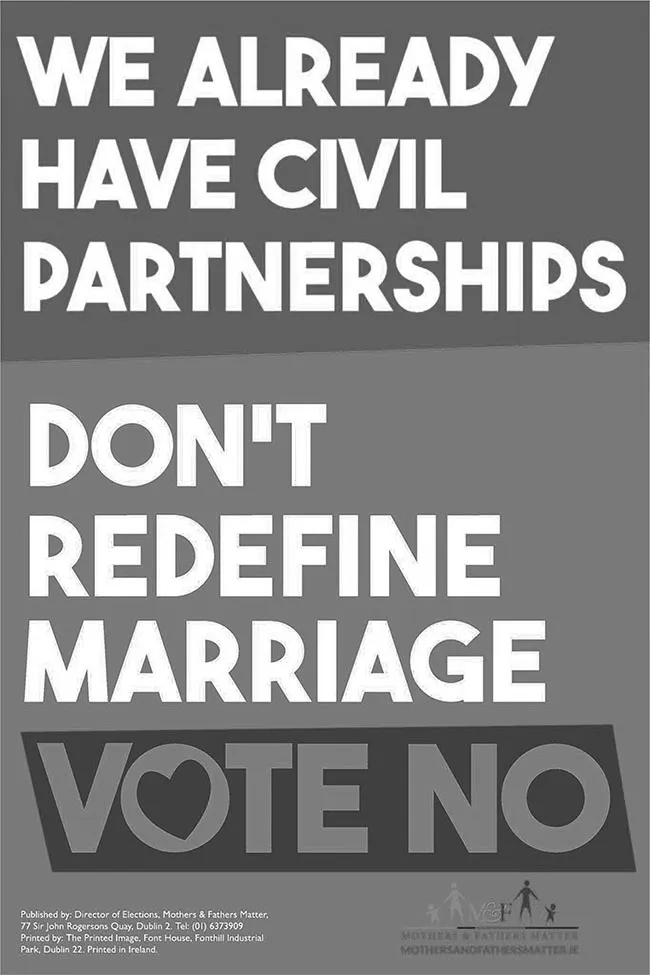
Figure 1.1 ‘We Already Have Civil Partnerships. Don’t Redefine Marriage’. Poster from the Irish Same-Sex Marriage Referendum
In their arguments to retain marriage as only for heterosexual man/woman relationships, heteroactivists appeared to support a form of LGBT equalities while at the same time arguing against same-sex marriage. In the same-sex marriage debates in Ireland in 2014, for example, posters such as Figure 1.1 argued that LGBT people were already protected within civil partnerships. Therefore, in their terms, ‘traditional’ marriage, understood as being between a man and a woman could be maintained. The use of the word ‘already’ is indicative of something that has happened and that is enough, asking for more is unnecessary, and an indulgence that does not need to be granted. Ireland, as a n...
Table of contents
- Cover
- About the Author
- Title Page
- Copyright Page
- Table of Contents
- List of Figures
- Acknowledgements
- Introduction
- 1 Same-Sex Marriage: Supporting ‘Heterosexual Families’
- 2 Schools: Challenging the Inclusion of LGBT Lives and Families
- 3 Trans: Resisting Gender Ideologies and Trans Equalities
- 4 Freedom of Speech: Creating Space to Contest LGBT Equalities
- 5 Public Inclusions: Claiming the Place of Heteroactivism
- Concluding Considerations
- Notes
- References
- Index
Trusted by 375,005 students
Access to over 1.5 million titles for a fair monthly price.
Study more efficiently using our study tools.
Frequently asked questions
Yes, you can cancel anytime from the Subscription tab in your account settings on the Perlego website. Your subscription will stay active until the end of your current billing period. Learn how to cancel your subscription
No, books cannot be downloaded as external files, such as PDFs, for use outside of Perlego. However, you can download books within the Perlego app for offline reading on mobile or tablet. Learn how to download books offline
Perlego offers two plans: Essential and Complete
- Essential is ideal for learners and professionals who enjoy exploring a wide range of subjects. Access the Essential Library with 800,000+ trusted titles and best-sellers across business, personal growth, and the humanities. Includes unlimited reading time and Standard Read Aloud voice.
- Complete: Perfect for advanced learners and researchers needing full, unrestricted access. Unlock 1.5M+ books across hundreds of subjects, including academic and specialized titles. The Complete Plan also includes advanced features like Premium Read Aloud and Research Assistant.
We are an online textbook subscription service, where you can get access to an entire online library for less than the price of a single book per month. With over 1.5 million books across 990+ topics, we’ve got you covered! Learn about our mission
Look out for the read-aloud symbol on your next book to see if you can listen to it. The read-aloud tool reads text aloud for you, highlighting the text as it is being read. You can pause it, speed it up and slow it down. Learn more about Read Aloud
Yes! You can use the Perlego app on both iOS and Android devices to read anytime, anywhere — even offline. Perfect for commutes or when you’re on the go.
Please note we cannot support devices running on iOS 13 and Android 7 or earlier. Learn more about using the app
Please note we cannot support devices running on iOS 13 and Android 7 or earlier. Learn more about using the app
Yes, you can access Heteroactivism by Catherine Jean Nash,Kath Browne in PDF and/or ePUB format, as well as other popular books in Social Sciences & Human Rights. We have over 1.5 million books available in our catalogue for you to explore.