A glimpse into the lives of LGBTQ migrants in Johannesburg, in their own words
Seeking Sanctuary brings together poignant life stories from fourteen lesbian, gay, bisexual and transgender (LGBT) migrants, refugees and asylum seekers living in Johannesburg, South Africa. The stories, diverse in scope, chronicle each narrator's arduous journey to South Africa, and their corresponding movement towards self-love and self-acceptance. The narrators reveal their personal battles to reconcile their faith with their sexuality and gender identity, often in the face of violent persecution, and how they have carved out spaces of hope and belonging in their new home country. In these intimate testimonies, the narrators' resilience in the midst of uncertain futures reveal the myriad ways in which LGBT Africans push back against unjust and unequal systems.
Seeking Sanctuary makes a critical intervention by showing the complex interplay between homophobia and xenophobia in South Africa, and of the state of sexual orientation and gender identity (SOGI) rights in Africa. By shedding light on the fraught connections between sexuality, faith and migration, this ground-breaking project also provides a model for religious communities who are working towards justice, diversity and inclusion.
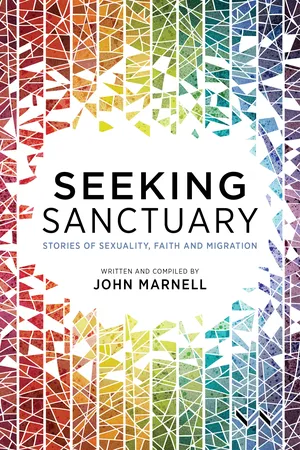
- 288 pages
- English
- ePUB (mobile friendly)
- Available on iOS & Android
eBook - ePub
About this book
Information
Topic
Theology & ReligionSubtopic
ReligionCHAPTER 1
BACKGROUND AND METHODOLOGY
On making and sharing stories
Seeking Sanctuary began life as a standard oral history project, one that sought to record the memories and experiences of those associated with the LGBT Ministry. It was not until the project was well under way that the idea of a book was first floated. By then it was clear that the stories would be of interest to a broader audience; what had begun to emerge were tales of family pressures, social policing, economic struggles, state neglect, institutional discrimination and interpersonal violence. The narrators spoke of multiple forms of prejudice, of long struggles to feel comfortable in their skins, and of difficult journeys – sometimes across multiple borders – in search of safety. Yet, within each story, no matter how bleak, was an unmistakeable will to survive, to connect, to grow and to love.
The project itself came about because of a long-standing relationship between the GALA Queer Archive and the LGBT Ministry. On top of providing financial and institutional support, GALA wanted to document the crucial work being undertaken at Holy Trinity, both to cement the LGBT Ministrys' place within the historical record and to make sure that other religious institutions could learn from its experiences. What form this documentation process would take took longer to establish.
As a scholar of LGBT migration and a long-time GALA collaborator, I was approached to see if I would manage the project. It was an invitation I accepted without hesitation. Although I dont' identify as a person of faith, I have long been interested in the nexus between religion and mobility. When these concepts are mentioned in my line of work, it is usually in reference to migration catalysts (for example, when people flee due to religious persecution), but I have long been intrigued by the possibility of faith communities being sites of belonging, especially for those on the margins of society.1 Over the years, I have heard LGBT migrants of various backgrounds speak of traumatic experiences justified on faith grounds, yet seldom do these individuals frame religion in wholly negative terms. At first this would catch me off guard, shocking my humanist sensibilities, but with time I began to recognise the narrowness of my own position. I found myself wondering why religion features so sporadically in LGBT migration literature and, when it does, why it is depicted negatively, or at least ambivalently. Surely, I thought, there is more to the issue than reactionary zealots, brainwashed victims and hateful rhetoric.
I also had a more personal interest in the project. Nine years ago, when I first arrived in South Africa, I had the pleasure of viewing a body map by Azu Udogu, a Nigerian trans woman who was one of the first known people to claim asylum based on sexual orientation (this was a tactical manoeuvre as there was no legal precedent for transgender claims at the time).2 In the lower right-hand corner of Azus' artwork was a small white cross, emblazoned with the words ‘Holy Trinity’. Intrigued and somewhat confused, I asked the GALA archivist what this iconography meant and was fascinated to learn about the nearby churchs' efforts towards inclusion. A few years later, courtesy of my social activism, I had the pleasure of meeting Dumisani Dube, the LGBT Ministrys' chairperson, and hearing more about the groups' activities. All of this left me with a positive impression of the church. Yet, whenever I thought about Holy Trinity, I was left with niggling doubts about the place of faith communities in ‘secular’ matters such as human rights. While I could appreciate the good work being done, I struggled to grasp why LGBT migrants, especially those who had experienced religious-based persecution, would seek out a church group. My bewilderment increased when I heard about LGBT migrants running their own religious services inside Kenyas' Kakuma Refugee Camp, an action that would no doubt intensify the violence to which these individuals are routinely subjected.3 It was clear that I was missing something. What was it that brought LGBT migrants back to religion, whether in South Africa, Kenya or elsewhere? Had I been too quick to dismiss the positive impacts of faith?
It was a desire to answer these questions that pushed me towards life stories. While I was keen to document the practical side of the LGBT Ministry, I also wanted to engage with group members’ emotions, memories and aspirations. A life-story approach, I reasoned, would allow me to view religion more holistically. I wanted to find out how faith fitted with other aspect of the narrators’ experiences, not just here in Johannesburg but also in their countries of origin and any countries of transit. I also wanted to leave room for the contradictions and messiness that constitute peoples' lived realities. I had a hunch that group members’ beliefs were more dynamic than one might assume and I wanted to ensure such variations were captured. In this way, I was motivated by a growing corpus of work that uses storytelling to explore the nuances of LGBT spiritual lives on the African continent.4 I was also inspired by recent developments in religious studies, especially work looking at faith as negotiated and lived practices, rather than static institutions or dogmatic systems.5
Once the methodology was agreed upon, information about the project was shared at the LGBT Ministrys' fortnightly meetings and then circulated to group members using social media. Those who volunteered to take part underwent an initial interview that mapped out key biographical events, significant interpersonal relationships and lived experiences within religious spaces. The interviews also sought to understand the role that faith plays in identity formation and to surface critical reflections on participants’ hopes and dreams.
The interviews were somewhat formal, in that there were discussion prompts and an audio recorder, but they were designed to be as relaxed and conversational as possible. Participants were encouraged to share whatever memories came to mind and to talk for as long or as little as they liked. Some of the most interesting memories ended up being shared outside of the official interviews, such as when enjoying a cup of coffee or walking back to a taxi rank.
Like any conversation, a life-story interview can head in infinite directions; some never find their rhythm, while others flow quickly from anecdote to anecdote, each described in vivid colour. When this happens, a conversation can last for many hours, as happened repeatedly in this project.
While conducting the interviews, I had to remind myself that not everyone is comfortable sharing personal memories, especially with someone they have only known a short time. I myself am a gay migrant and in some ways I share a similar life trajectory to the narrators, but in reality we inhabit different social worlds, courtesy of my race, class, gender and nationality (I am a white, middle-class cisgender man with Australian citizenship). Such differences inevitably generate complex power dynamics, no matter how generous or well intentioned I may be.
The other major challenge was deciding which stories to feature in the book. Of the 30 interviews conducted, 14 were selected for inclusion, a number determined primarily by the space available. A key aim was to showcase diverse perspectives and experiences, and this guided editorial decisions as much as possible. Preference was given to stories of lesbian, bisexual and transgender narrators, although the groups' demographics made it impossible to achieve equal representation (for example, there is currently only one trans group member). Other practical factors included the level of detail provided in the initial interviews and each individual narrators' willingness to have their story published.
The chosen interviews were transcribed and then shaped into chronological accounts. This was a daunting task: many of the transcripts exceeded 150 pages and decisions had to be made about which memories to leave in and which ones to exclude. Such choices werent' taken lightly; more than once they were preceded by crippling indecision and sleepless nights. I was also aware of my responsibility to maintain the tone and cadences of each narrators' speaking style, something that was easier said than done.
The solution to both challenges was to involve the narrators as much as possible. Follow-up meetings were held to clarify inconsistencies and ensure intended meanings werent' being misrepresented. Once complete drafts were produced, the narrators were invited to review their stories. As part of this process, they were encouraged to anonymise identifying details and amend wording that didnt' feel right. Participants were also reminded of the potential negative impacts of being featured in a book and given an opportunity to withdraw their participation. Lastly, each narrator was asked to select a title and pseudonym. Although most narrators took up this option, some individuals, particularly those whose experiences are already on the public record, requested to use their real names.
Given that most participants had concerns about being identified, a decision was taken to avoid narrator portraits. However, a number of people indicated a desire to have their identities represented pictorially. A solution was found in the form of animal totems. Narrators were invited to select the animal that best symbolises their personality and to explain the significance of their choice. A drawing and quote reflecting these conversations can be found at the start of each story. These are, of course, inadequate proxies for the individuals they represent, yet they do evoke a sense of each narrators' character and the playfulness that was present at different moments in the interviews. The drawings and quotes are intended to connect readers with the narrators by offering another entry point into the storytellers’ affective, sensorial and imaginative worlds.
The stories featured here are not verbatim transcripts, but they do remain faithful to the spirit and meaning of the original interviews. Indeed, many hours were spent crafting each story into an accurate representation of that narrators' life. This was a collective process: if a narrator wanted a memory added or removed, I adhered to the request without question. After all, the stories belong to them, not me.
It is important to remember that life stories are a particular form of meaning-making.6 They are personal accounts presented from the perspective of those excluded from official histories. For me, the telling of a story is as important as, if not more important than, the details it may contain. This is not to suggest that the stories have been fabricated or exaggerated. It is merely an acknowledgement that storytelling is a complex process – memories are as much about the present as they are about the past; they are shaped by and interpreted through our identities, relationships, hopes and failures.7
In telling their histories, the narrators attempt to make sense of events that have largely been out of their control, while also seeking to legitimise their identities, motivations and social locations. To look back on the past is never easy, even more so when ones' experiences are coloured by trauma, grief and violence. I am incredibly grateful to the narrators for their willingness to share such intimate accounts of their lives.
CHAPTER 2
THE POLITICISATION OF FAITH
Religious responses to sexual and gender diversity
It is difficult to appreciate the significance of the stories collected here without knowing something of how homo/transphobia operates on the African continent. In many countries, political and religious leaders fuel anti-LGBT sentiments with moralistic rants about impending social disintegration. Underpinning this rhetoric are religious justifications for a return to ‘traditional’ or ‘family’ values; influential figures point to sacred texts as incontrovertible proof that heterosexuality is the only natural, normal and acceptable expression of human desire.1 While there isnt' space to give a comprehensive account of religions' role in perpetuating homo/transphobia, the summary below should provide sufficient context for the narrators’ experiences.2
Homo/transphobic attitudes tend to be shaped by four interlinked discourses: that LGBT people are abnormal, immoral, anti-family and un-African.3 Circulating around these discourses is a broader claim that LGBT identities or expressions are expressly prohibited under Christianity, Islam or whichever faith dominates a region.4 A popular refrain is that ‘real’ African values are under imminent threat5 and therefore constant vigilance – usually in the form of criminalisation – is required to preserve societys' moral fabric.6 This is equally true for countries that have specific laws targeting LGBT people (such as Ghana, Sudan and Tanzania), countries that didnt' inherit colonial anti-sodomy laws but still see high rates of homo/transphobic persecution (such as Benin, Mali and Rwanda) and countries that have undergone formal decriminalisation (such as Angola, Lesotho and Mozambique). Even in South Africa, the country with the most extensive LGBT rights, homo/transphobia remains pervasive and is often underpinned by conservative religious beliefs.7
In many contexts, the religious dimensions of homo/transphobia are plain to see. In Nigeria, for example, faith leaders of all denominations were quick to endorse former president Goodluck Jonathans' campaign to intensify penalties for same-sex intercourse and to criminalise support for LGBT individuals and organisations. In 2010, when debates about amending the law were well under way, former anglican Archbishop Nicholas Okoh claimed that Nigeria was at risk from an ‘invading army of homosexuality, lesbianism and bisexual lifestyle [sic]’, echoing comments he made at an earlier press conference: ‘Same-sex marriage, paedophilia and all sexual perversions should be roundly condemned by all who accept the authority of scripture over human life.’8
In neighbouring Cameroon, Catholic authorities regularly denounce LGBT people as unnatural, sinful and a threat to Gods' model for human reproduction. A notable example is Archbishop Simon-Victor Tonyé Bakot, who in 2013 described homosexuality as a ‘shameful, disrespectful criticism of God’.9 The following year, the church released the Declaration of the Bishops of Cameroon on Abortion, Homosexuality, Incest and Sexual Abuse of Minors, in which the signatories call on ‘all believers and people of good will to reject homosexuality’, adding that ‘homosexuality is not a human right but a disposition that seriously harms humanity because it is not based on any value intrinsic to human beings’.10
Comparable statements can be drawn from across the continent (noteworthy examples come from Côte dIvoire', DR Congo, Kenya, Morocco, Namibia, Senegal, South Sudan, Tanzania and Zambia) and are not limited to the Christian faith. In December 2014, Malam Shaibu, an Islamic cleric from Ghana, urged residents of Accra to capture and burn suspected gay men ‘because Islam abhors homosexuality’.11 More recently, influential clerics in Mali have mobilised thousands of people in protest against the ‘moral depravity’ of homosexuality. Mohamed Kebe, a member of Malis' High Islamic Council and one of the organisers of a 2019 anti-LGBT rally, has repeatedly demanded violent punishments for those ‘who want homosexuality’.12
In other contexts, homo/transphobia serves as a useful bridge between religions, offering faith leaders a rare chance to express solidarity. In 2011, a Muslim mufti joined the heads of the Orthodox, Catholic and Protestant churches in Ethiopia in denouncing plans for an HIV conference that they claimed would promote homosexuality.13 Further north in Egypt, LGBT rights have been condemned in similar terms by Grand Mufti Shawki Allam and Coptic Pope Tawadros II. Their framing of LGBT identities a...
Table of contents
- Cover
- Title
- Copyright
- Contents
- Foreword
- INTRODUCTION Reframing sexuality, faith and migration
- CHAPTER 1 Background and methodology: On making and sharing stories
- CHAPTER 2 The politicisation of faith: Religious responses to sexual and gender diversity
- CHAPTER 3 A life on hold: LGBT migration and the (false) promise of freedom
- CHAPTER 4 Preaching love: A history of the LGBT Ministry
- CHAPTER 5 The stories
- CHAPTER 6 Looking ahead: The case for affirming religious spaces
- Glossary
- Notes
- Bibliography
- Acknowledgements
- Index
Trusted by 375,005 students
Access to over 1.5 million titles for a fair monthly price.
Study more efficiently using our study tools.
Frequently asked questions
Yes, you can cancel anytime from the Subscription tab in your account settings on the Perlego website. Your subscription will stay active until the end of your current billing period. Learn how to cancel your subscription
No, books cannot be downloaded as external files, such as PDFs, for use outside of Perlego. However, you can download books within the Perlego app for offline reading on mobile or tablet. Learn how to download books offline
Perlego offers two plans: Essential and Complete
- Essential is ideal for learners and professionals who enjoy exploring a wide range of subjects. Access the Essential Library with 800,000+ trusted titles and best-sellers across business, personal growth, and the humanities. Includes unlimited reading time and Standard Read Aloud voice.
- Complete: Perfect for advanced learners and researchers needing full, unrestricted access. Unlock 1.5M+ books across hundreds of subjects, including academic and specialized titles. The Complete Plan also includes advanced features like Premium Read Aloud and Research Assistant.
We are an online textbook subscription service, where you can get access to an entire online library for less than the price of a single book per month. With over 1.5 million books across 990+ topics, we’ve got you covered! Learn about our mission
Look out for the read-aloud symbol on your next book to see if you can listen to it. The read-aloud tool reads text aloud for you, highlighting the text as it is being read. You can pause it, speed it up and slow it down. Learn more about Read Aloud
Yes! You can use the Perlego app on both iOS and Android devices to read anytime, anywhere — even offline. Perfect for commutes or when you’re on the go.
Please note we cannot support devices running on iOS 13 and Android 7 or earlier. Learn more about using the app
Please note we cannot support devices running on iOS 13 and Android 7 or earlier. Learn more about using the app
Yes, you can access Seeking Sanctuary by John Marnell in PDF and/or ePUB format, as well as other popular books in Theology & Religion & Religion. We have over 1.5 million books available in our catalogue for you to explore.