During the course of the past three decades efforts of democratisation and institutional reforms have characterised the African continent, including demands for gender equality and women's political representation. As a result, some countries have introduced affirmative action measures, either in the aftermath of conflicts or as part of broader constitutional reforms, whereas others are falling behind this fast track to women's political representation. Utilising a range of case studies spanning both the success cases and the less successful cases from different regions, this work examines the uneven developments on the continent.
By mapping, analysing and comparing women's political representation in different African contexts, this book sheds light on the formal and informal institutions and the interplay between these that are influencing women's political representation and can explain the development on women's political representation across the continent and present perspectives on an 'African feminist institutionalism'.
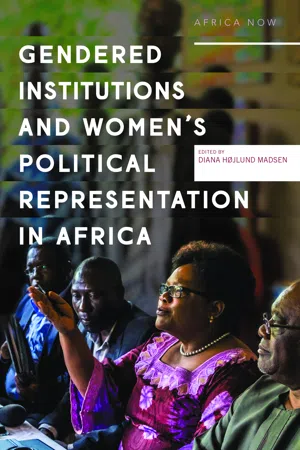
eBook - ePub
Gendered Institutions and Women’s Political Representation in Africa
- English
- ePUB (mobile friendly)
- Available on iOS & Android
eBook - ePub
Gendered Institutions and Women’s Political Representation in Africa
About this book
Trusted by 375,005 students
Access to over 1.5 million titles for a fair monthly price.
Study more efficiently using our study tools.
Information
1
Feminist institutionalism, women’s representation and state capture: The case of South Africa
Introduction
By now, women’s descriptive representation has increased by leaps and bounds because of the acceptance of quotas for women. Globally it is a success story, as well as on the African continent, with Rwanda at 68 per cent, the highest in the world, and by 2009 twenty-eight countries in Africa had some form of quota (Tripp et al. 2009), with varying impact on political Policy making. Whether this can be considered substantive representation is, however, contested. There is a tenuous relationship between women’s substantive representation and feminist institutions. While theories of feminist institutionalism are quite robust, they cannot be applied to Africa without revision, even substantial revision, because of the particularity of African liberation struggles, weak political institutions, the impact of nationalism and patriarchal cultures in post-colonial contexts.
Weak African state institutions pose not only significant challenges, but also specific problems for women’s substantive representation. Where women’s institutions or national gender machineries exist they lack the authority to influence ministries, and where they are embedded in ministries they seem to deal with social welfare issues and community development. Often their mandates are unclear, they lack staff capacity, are under-resourced and where they are able to influence policy it is often devoid of feminist content (Tripp et al. 2009: 178–9). Issues of party loyalty, patronage, clientelism and, in the South African case, state capture, where institutions are repurposed to serve the needs of a corrupt elite, endanger electoral processes, women’s substantive representation, as well as feminist institutionalism.
In this chapter, I explore feminist institutionalism in South Africa by analysing political conditions which contribute to undermine women’s substantive representation and feminist institutionalism such as state and party fusion; slate politics and cadre deployment; state capture and women’s compliance with and complicity in patronage relationships.
Illustrating the problems of feminist institutionalism in Africa I focus on the challenges of patronage, clientelism and women’s compliance to the extreme form of the hollowing out of the state, called state capture, in the South African context. If state feminism is based on an understanding of how the state functions, it is undermined when a shadow state is ensconced for which the rules are not known, women are excluded from male patronage networks or are made compliant in order to enter these networks. In these conditions, they become beholden to the goodwill of men who repurpose the objectives of the state for their own gain and therefore deeply damage feminist institutionalism as well as women’s substantive representation. For this purpose I draw on secondary literature and participant observation.
Feminist institutionalism
The inclusion of feminist perspectives contributes to an understanding of a dynamic relationship between gendered institutional architects, gendered institutionalized subjects and gendered institutional environments, involving strategic and creative action combined with calculated self-interest (Hay and Winnicott in Mackay et al. 2010). Mackay (2014) warns that institutional blueprints need to be put into practice and institutionalized and that gender reforms are vulnerable to regress. Where new institutions become embedded in old ones, they are exposed to the ‘stickiness of old rules’ (Mackay 2014: 551) or the continued reliance on ‘the old and forgetting the new’.
New institutions require active maintenance, especially where they become linked to different kinds of older institutions. As Mackay (2014: 554) indicates the importance of ‘attending to the ways in which gendered institutions are enacted and instantiated in the post-design phase by gendered actors using formal and informal rules and norms and new and old institutional elements’ (her emphasis), especially where there are processes of contestation and shifting coalitions of actors over time. She calls this the ‘liability of newness’ (2014: 565).
Transitional processes open spaces for institutional renewal or the creation of new institutions to perform functions that were not required under previous regimes. How these institutions are shaped and used contribute to the legitimacy of new governments. The winning transitional coalitions take on board gender equity concerns and make space for gender entrepreneurs. The transition to democracy in South Africa presupposed the engineering of new institutions to protect a very progressive Constitution and to give effect to the requirements of equality, including gender equality (see, e.g., Waylen 2007). These institutions in South Africa, the National Gender Machinery (NGM), were not encumbered by being nested in old institutions, nor the stickiness of old rules.
Feminist institutionalism produces certain path dependencies over time, as well as what Chappell (2006: 225) calls ‘the logic of appropriateness’. These routines and practices are enforced through informal means (varying from disapproval, social isolation, threats and even violence) (Lowndes 2014). The logic of appropriateness constrains some types of behaviour, encourages others and is perpetuated by institutional actors (Chappel 2006).
Chappel (2006: 224) draws on Beckwith’s notion of gender as a category and gender as a process, which is ‘the differential effect of apparently neutral structures and policies upon women and men actors’. Norms of institutions may appear gender neutral, while they are deeply gendered, most often to the benefit of men. How these norms shape and influence policies, legislation and rulings is important to understand, as well as how they produce and reproduce gender. Where liberal democracies prevail, we expect responsive governments; yet, actors behave in certain ways that may promote gender outcomes or inhibit them. Institutions also create formal and informal rules, and as Waylen (2014) remarks it is important to understand how these rules are gendered. This is especially necessary when the rules are created in the murky world of patron–client relations.
Feminist institutionalism cannot be separated from women’s representation in government and women’s participation in politics. Globally women’s quotas have ensured the entry of more women into legislatures. In African countries, quotas have also made a great difference, with Rwanda now having the highest number of women in a legislature in the world with 68 per cent. Greater descriptive participation leads to expectations of greater substantive representation that can be facilitated through a working relationship between women in government and the women’s movement to get important issues onto the legislative and policy agendas (Stetson and Mazur 1995).
While these predictors of substantive representation are important, there are other issues in the political context in African/developing countries that need to be considered. In this regard, the research of Bjarnegård (2009), Wängnerud (2009) and Ahikire (2018) is important. All these authors focus on the male dominance of legislatures and the late entry of women into legislatures. Wängnerud (2009) distinguishes between two kinds of divisions between men and women where first kind relates to formal power and second to policy areas. Women seem to be more left on the political spectrum and women prioritize other policy issues as men – such as social policy, family policy and care issues. It also seems that women members of legislatures prioritize issues that are prioritized by women voters. According to Wängnerud (2009), preconditions for substantive representation are the existence of gender differences in the public opinion between men and women that influence the political culture and the presence of women in the executive. The best electoral system to get women in remains closed list proportional representation (PR) systems, but parties remain the biggest gatekeepers in the recruitment process.
Bjarnegård’s (2009) research on men in politics in Thailand makes an important contribution because she brings in issues of clientelism, corruption and homosocial capital. While these issues are prevalent in developed countries, they have a more damaging effect on developing countries where political stability is often fragile and oversight mechanisms are weak. Political context plays a very important role; because where clientelism is rife, it influences and constrains the majority of people, because it targets communities and exercises influence through service delivery or the lack thereof. Elections and electoral support are also influenced through vote buying.
The important point that Bjarnegård (2009) makes is that women have a different relationship to state patronage than men, because they are excluded from many political arenas and networks. These networks are constituted through what she calls ‘homosocial capital’ – how men relate to each other in tight networks based on patronage that exclude women. Male dominance is achieved through different means such as compliant men (and women), as well as traditions, culture and institutions, so that power is dispersed and exercised beyond the legislature. Neopatrimonialism and patronage networks form the political culture with the effect of reproducing patriarchy. It also translates into parliamentary seats, especially in PR list systems where male party bosses draw up the final lists before elections.
Political ideology is made subservient to particularist and personal politics. Bjarnegård (2009) argues that male networks do not necessarily keep women out because they are women, but in order to protect men. In this way, male dominance is reproduced. The accumulation of homosocial capital produces predictability because without it some men may never get into positions of political power. What she argues, importantly, is that women benefit more from heterosocial capital because including men may benefit them, while men benefit more from homosocial capital, because of perceptions that men are successful, having authority and privilege. The traits that are often authoritarian and paternalistic are viewed as competence that women do not have. What is also important about Bjarnegård’s contribution is showing that when formal institutions are weak, informal institutions play a very important role. It shifts the demands on the formal system to the informal system. In countries with high levels of poverty, people cannot wait for the formal system to deliver but rely on clientelism. This is a way of reducing the unreliability of formal institutions. It also bolsters the behaviour of parties that start to rely on informal networks rather than formal rules. In the Ugandan case, for example, Ahikire (2018: 10) shows how women have to ‘innovate’ to win over the goodwill of men in patronage networks.
Stensöta et al. (2015) show in a thirty-country study that women’s impact on corruption is greater in the electoral arena than in the bureaucracies or civil service. Women are more visible in the electoral arena where they can also make a stand on values (such as anti-corruption). In bureaucracies, there are rules and procedures that degender experiences that will prevent women from having an impact on corruption. Where bureaucratic organization is weak there may be opportunities for women to influence corruption. Their study bears out these assumptions. However, the argument is based on the notion that bureaucracies have strong rules and procedures. In countries like South Africa where a middle class is grown through the civil service, the impartial rules of bureaucracy are often devalued to suit the purposes of self-enrichment through, for example, procurement fraud. There is a need to understand how women become co-opted.
Feminist institutionalism in Africa
Feminist institutionalism has been weak in Africa, operating mostly through Women’s Ministries that have ghettoized women’s issues in one place without mainstreaming gender throughout government. While women’s representation in Africa has increased, it seems that the structures that were created to include feminist issues in the state never materialized, but femocracy, understood as the First Lady Syndrome and the Women’s League Syndrome, works against the positive outcomes of women’s representation. Mama (2000) argues that state structures in Africa became involved in mobilizing women for nation building, which means support for the status quo. As she argues, the structures of national machineries function in isolation from each other, reflecting the low status of women in society, and are in general under-resourced. In her view, national machineries have only achieved the most modest liberal goal of giving women a space in the state. In many countries, there are or were only one structure such as a Ministry for Women, or a Department of Women’s Affairs, rather than a set of structures (see also Gouws (2008) and Tripp et al. (2009: 169–72) for a comprehensive table of National Gender Machineries).
More recent literature has shown more positive results about women’s quotas in Africa, for example, a study on Uganda found no evidence that quota women are more likely to be party loyalists than any other representatives or that party loyalty comes at the expense of women’s interests. Quota women who are party loyal will also attempt to put women’s issues on the political agenda (O’Brien 2012). In the case of Rwanda the impact of the quotas was wide and deep, because it went beyond government to change perceptions of gender equality in society, even though it did not contribute to more transparent democracy or changed the legislative process because legislation starts in the executive branch (Burnet 2012). In the case of Morocco, however, a study has shown that even when women are educated and politically active, the source of their political success is allegiance to political leaders and their efforts to create gender equality are often far removed from the reality of women and that these women remain non-receptive to gender reforms (Sater 2012).
Amina Mama (2000) pointed out the influence of African first ladies in matters of the state. This does not refer to feminist influence (the femocrat phenomenon), but to the influence of wives of African leaders as a result of them being close to power. A 2018 First Lady database that was compiled by Van Wyk and her co-authors shows that first ladies create a dynamic in which political space is appropriated and abused by the wives of presidents for personal gain (Van Wyk et al. 2018).
In African countries such as Chad, Uganda, Eritrea and Zimbabwe, first ladies have captured certain institutions because of their proximity to power, but not in a way that promote gender equality, but rather to promote the First Lady’s own interests (see Van Wyk et al. 2018). South Africa, in this regard, has been one of the exceptions. Since 1994, South African first ladies have been visible, but as independent politicians in their o...
Table of contents
- Cover
- Halftitle Page
- Title Page
- Contents
- List of Illustrations
- Author Bibliography
- Introduction
- 1 Feminist institutionalism, women’s representation and state capture: The case of South Africa
- 2 Confronting the double-bind dilemma in the representations of Joice Mujuru in Zimbabwean newspapers between 2000 and 2008
- 3 Candidate training programmes in Africa – A waste of resources or pedagogies of the oppressed? Experiences from Letsema training workshops in Botswana (2013–19)
- 4 Party primary candidate nomination institutions, informality and women’s candidature in Malawi’s parliamentary elections
- 5 ‘Inspiring a revolution’: Women’s central role in Tanzanian institutions, independence and beyond
- 6 Experiences of gender equality legislation in Kenya: The role of institutions and actors
- 7 Women’s political representation and institutionalism in Nigeria – historical perspectives
- 8 Affirmative action in Ghana? Patriarchal arguments and institutional inertia
- Concluding remarks
- Index
- Imprint
Frequently asked questions
Yes, you can cancel anytime from the Subscription tab in your account settings on the Perlego website. Your subscription will stay active until the end of your current billing period. Learn how to cancel your subscription
No, books cannot be downloaded as external files, such as PDFs, for use outside of Perlego. However, you can download books within the Perlego app for offline reading on mobile or tablet. Learn how to download books offline
Perlego offers two plans: Essential and Complete
- Essential is ideal for learners and professionals who enjoy exploring a wide range of subjects. Access the Essential Library with 800,000+ trusted titles and best-sellers across business, personal growth, and the humanities. Includes unlimited reading time and Standard Read Aloud voice.
- Complete: Perfect for advanced learners and researchers needing full, unrestricted access. Unlock 1.5M+ books across hundreds of subjects, including academic and specialized titles. The Complete Plan also includes advanced features like Premium Read Aloud and Research Assistant.
We are an online textbook subscription service, where you can get access to an entire online library for less than the price of a single book per month. With over 1.5 million books across 990+ topics, we’ve got you covered! Learn about our mission
Look out for the read-aloud symbol on your next book to see if you can listen to it. The read-aloud tool reads text aloud for you, highlighting the text as it is being read. You can pause it, speed it up and slow it down. Learn more about Read Aloud
Yes! You can use the Perlego app on both iOS and Android devices to read anytime, anywhere — even offline. Perfect for commutes or when you’re on the go.
Please note we cannot support devices running on iOS 13 and Android 7 or earlier. Learn more about using the app
Please note we cannot support devices running on iOS 13 and Android 7 or earlier. Learn more about using the app
Yes, you can access Gendered Institutions and Women’s Political Representation in Africa by Diana Højlund Madsen in PDF and/or ePUB format, as well as other popular books in Politics & International Relations & African Politics. We have over 1.5 million books available in our catalogue for you to explore.