How World War II changed New Castle, Indiana. "This is a unique look at the war, far from the front lines, but equally impacting life on the home front." —
Bookviews.com
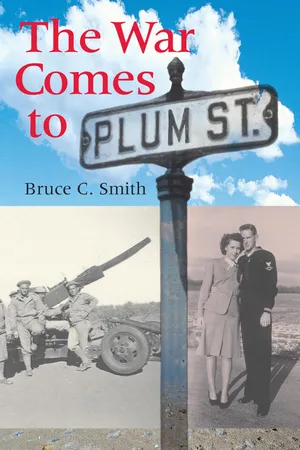
The War Comes to Plum Street brings to life the Second World War through the eyes of a small group of neighbors from a Midwestern town. Bruce C. Smith presents their stories just as they happened, without explanation or interpretation. To experience the war as they did, insofar as it is possible, we must understand how they perceived everyday events and recognize the incompleteness of their knowledge of what was taking place in Europe and the Pacific. The inhabitants of Plum Street in New Castle, Indiana, resemble many other average Americans of their day. As we discover how they experienced those fateful years, these Americans may have something to teach us about how we live in our own turbulent time.
"This remains a superb story. Bruce C. Smith has a wonderful eye for detail and a compelling perspective and voice. We care about this place and the people who live here." —James H. Madison, author of
Hoosiers: A New History of Indiana
"The book is worth reading for what it offers about the emotional life of the times. Smith recognizes that in a small community and, more particularly, on a single street, lives are enmeshed . . . Ultimately, this book is deeply personal, but it reminds us that life is lived at a deeply personal level." —
HistoryNet.com
- English
- ePUB (mobile friendly)
- Available on iOS & Android
eBook - ePub
The War Comes to Plum Street
About this book
Information
1. Migration and a New Start in the 1920s
THIS IS A STORY of how ordinary people create the mosaic of American life in a part of the country far removed from teeming cities and the seats of power. On the farms and in the small villages and middling towns of the vast heartland, generations live out the ebb and flow of their lives in localized obscurity. Theirs is the real world of birth and death, growing up, reaching for a place in life, finding the way, or leading a life to be counted lost. The accumulation of the lives of these individuals each decade makes up the columns and figures in the compendium of the U.S. census. In the census we see who and where we are, where we have been, and how we add up, but those statistics represent real people like the ones who are the central figures in this book.
In the 1920s, the census showed industrial America continued a growth begun over a hundred years before. For nearly that long, railroads fueled economic expansion everywhere the rails went. After the Civil War, limited opportunities in the rural South prompted many people there to seek work in other places, and some of the best of these were the scattered industrial towns of the Midwest north of the Ohio River. This interregional shift of population accelerated during the Great War of 1914–1918, and it was this migration which brought people to Plum Street, in New Castle, Indiana, to play out their lives. The railroads brought two particular families to New Castle as part of the great migration. Like many others who made similar journeys, they were optimistic they would find their places in life by going there. As it turned out, events far away shaped the story of their lives more than most generations as they lived, raised their own families, and faced a future far more dark and dangerous than they could have imagined.
Converging Trails: The Smith Family Moves North
The Smiths arrived in New Castle first. James Fred Smith of Duvall Valley in rural Clinton County, Kentucky, answered his country’s call to war and went to France in 1918 as a twenty-four-year-old private with the First Pioneer Infantry. While he was away at camp and overseas, he wrote to Lillian Frogge, a girl nearly ten years his junior who had grown up in the same small valley and attended the same school. When he returned in 1919 after three military campaigns in France and occupation duty on the Rhine, it did not take him long to decide that her father expected that any prospective husband needed to provide a better living than he could expect to make near the old home place in Duvall Valley. His oldest brother Walter and his wife Rena had moved to New Castle, Indiana, during the Great War and ran a boardinghouse, so Fred went there to look for work. At the same time, Lillian’s father Lewis Frogge sent her to Texas to stay with relatives, hoping to cool her interest in Fred.
Fred arrived in New Castle in the middle of the economic slump which followed the end of the Great War, and jobs were not easy to find. He went to the Hoosier Kitchen Cabinet factory on hiring day several Mondays in a row but was always turned down along with the rest of the crowd. He decided to wear his army uniform the next time, hoping it might give him an advantage. That Monday the foreman came out on the dock and told everyone there were no jobs, as he had done the previous weeks, but as the disappointed men began to walk away he caught Fred’s eye and waved him over. There was one job, the man said, and Fred could have it because he had been in the army. Fred took it without asking what it paid. Inside, he was given the task of attaching the wire spice jar rack to the inside of the lower door on each of the cabinets.

Fred, Lillian, and Kenny Smith in 1922, probably on G Avenue in New Castle. Fred is twenty-eight, Lillian nineteen, Kenny about eight months. Fred was working steady hours at Hoosier Cabinet by this time.
Fred settled into his new job at the Hoosier while Lillian pleaded with her father to allow her to follow Fred to New Castle. Finally, Lewis gave in and allowed his seventeen-year-old daughter to join Fred there. Lillian arrived in New Castle on the train on June 4, 1920, and she and Fred were married the next day. They stayed at Walter and Rena’s boardinghouse until spring, then moved to a modest house on G Avenue. By the time they moved, Lillian had discovered she was pregnant. Their first child, a son, was born there on July 3, 1921, and they named him Edward McKendrick, using the first name of Fred’s father and the middle name of Lillian’s father. Everyone in the family called him Kenny.
As their son grew and passed his first birthday, Lillian became pregnant again. They moved to a better house on N Avenue where she gave birth on December 15, 1923, to a daughter they named Hazel May. As Fred worked steadily at the Hoosier, Lillian managed their home and their two small children, and all went well until a week before Hazel’s first birthday. When Lillian discovered little Hazel on the floor that day, she was already choking. With time running out quickly, Lillian tried to find the object her baby had put in her mouth but could not see or reach anything in her throat, and pounding on her back failed to stop the choking. Hazel died in her arms that December 7, 1924. Although he was not yet four at the time, Kenny retained vague memories of the gravity of the doctor coming to the house to sign the death certificate. Something terribly random and mysterious had struck their world and taken his baby sister from them forever.
Paralyzed with grief so profound they never really recovered, Fred and Lillian took their baby to Clinton County for a funeral and burial in the cemetery at Central Union Church in Duvall Valley. Kenny stayed behind with Walter and Rena. As many family members as could make it gathered for the occasion, because a funeral was something that the Smiths did not miss. Every subsequent journey to the valley included a visit to the place where little Hazel slept, and there the tears and mute grief always came easily at the small red granite marker.
Hazel’s death changed their lives. There were no more pregnancies, and perhaps no more attempts. Only their boy was left now, and every effort went into protecting and preserving him. The loss of a daughter awoke their gratitude that they still had their son. He became the center of their lives in a way that was sharpened by Hazel’s loss. As a family of three, they carried on as best they could, always quietly harboring the lesson that death needed no invitation to visit.
Converging Trails: The Moles Family Moves North
Jess and Ethel Moles had already been married for two and a half years when they arrived in New Castle in April 1923. Jess met Ethel Baltimore at the post office in their little hometown of Wilder, Tennessee, soon after his return from a hitch in the navy where he served with the first crew of the battleship USS Tennessee. Jess fled an abusive home and lied about his age to join the navy at age sixteen, making him a worldly man of nearly nineteen when he returned in 1921. Ethel was fourteen and old enough to be married by the standards of the day as, after all, she had finished all eight grades of her schooling. Her mother and father were not convinced that an ex-sailor was the best match for their daughter, because the Baltimore family was well situated with good work in the local coal mines. Jess had worked in the mines, too, since his return, but in their eyes living with his uncle demonstrated that he was not well enough established to marry and support a family. The opposition of her family did not deter them for long once their attraction to each other became apparent. Just a few months after his return from the navy, Jess and Ethel married on December 18, 1921. Ethel’s family remained unhappy about what she had done. On their own, the newlyweds rented a tiny house in the poorest area of Wilder known as “Dogtown.” There Ethel became pregnant almost immediately. At only two inches over five feet tall, she weighed about a hundred pounds, and it soon became clear the baby would be a hefty one. Throughout the spring and summer of 1922, she carried her growing burden and set about making a home for her new husband. Jess’s dream was to go to Bellingham, Washington, a city he had seen as a sailor. He immediately had liked its crisp air and distant mountain scenery and decided it would be the best place in the world to make a future home. But for now they settled into the workaday routine and saved what money they could against the day when they would follow Jess’s dream of moving west to a new life.
Ethel began to have light contractions on Monday, September 18. On Wednesday the 20th she gradually slipped into heavy labor. That night and the next day she groaned and sweated when the contractions swept over her, but the baby did not come. Relatives assisted her as best they could, but the doctor said it was up to her, that she would have to do her necessary part, no matter how long it took. All the next day, Friday, she continued her effort, and it was becoming grim now. Her cries had been heard outside for almost two days, and the ordeal was taking its toll on her strength. Friday night was the same. Many babies were born in the wee hours of the morning, and there was hope that Ethel would end her struggle and deliver the baby before dawn, but it did not happen. She was just too tiny and the baby was large enough to make the delivery difficult at best. Everyone sensed that Saturday was crucial. If she could not deliver soon, she and the baby would both die, and the doctor advised the family that it was likely neither of them would make it anyway. Ethel was exhausted and beyond caring, and with her voice gone, there was little sound from the small house except for the whispers of those concerned for her life. When the doctor arrived early on the morning of September 23, he decided that he had to intervene in spite of the risks. Using his heavy forceps, he literally pulled the baby out. The baby girl weighed ten and a half pounds, but with her head bruised and swollen, some thought she would probably die. Ethel was nearly dead herself, and lay for days utterly spent while everyone waited to see who would survive the ordeal. Jess wanted to name her Gemma Juanita after a girl who had been his friend when he was in the navy. Ethel, now fifteen years old, was too worn-out to object. After a week, they both turned the corner. Ethel took more than a month to rebuild her strength to the point she could move around the house. The baby’s color improved and she nursed fairly well considering her traumatic arrival. The bruised and misshapen head improved and mother and daughter were soon clearly on the road to recovery.
They stayed in Wilder during the winter of 1922–1923 while Ethel healed and little Gemma recovered and began to grow. Jess continued to work in the coal mines, but they decided they should leave as soon as possible. Ethel’s family continued to be cool toward Jess, and there was no use sweating in the coal mines when there was a future in the golden West just waiting for them. Geographically speaking, they had to go north and west to get to Bellingham. Jess’s sister Haley and her husband Jim Cowan had moved north with the boom that the war years had brought to a town called New Castle, in Indiana. Jess’s older brother George and his wife Nina had done the same thing. They both had families and had been in Indiana for a few years. Jess had written to them and George and Nina agreed they could stay with them while he worked a little while and saved up enough money for the next leg of their journey west. They boarded the train in Wilder in April 1923, winding their way through Louisville to Indianapolis, then eastward to New Castle.
Jess immediately began looking for work and found it. George and Nina had three children of their own, so staying with them while taking care of their own baby was trying and soon became uncomfortable for everyone. Jess and Ethel found “light housekeeping” rooms on Walnut Street in New Castle, within sight of the passenger depot where they had arrived just a few days before. These were cheaper than staying in a boardinghouse because cooking could be done in the rooms on tiny hot plates or gas laundry stoves. It also was cheaper than an apartment because there was only one room and the toilet was down the hallway. Others in similar circumstances lived in the building, too. It was temporary quarters until they could move on west. Jess could walk to work or, if the weather was bad, take the streetcar. Here they settled into life for a while until a little more money could be accumulated.
Jess and Ethel did not exactly decide to stay in New Castle, but for the next couple of years there was never quite enough money to make the long trip to Washington and have enough left over for rent and hunting a job when they got there. Unlike in New Castle, they knew no one in Bellingham with whom they could stay or whom they could use to find immediate employment. For a stay of more than a few months, the light housekeeping rooms on Walnut Street were too cramped, so they eventually rented a house just south of the industrial district, on P Avenue, late in 1923 and it was probably there that Ethel became pregnant again. With Ethel expecting, it was no time to travel across the country, so they settled in, hoping that this baby might arrive a little less traumatically than had little Gemma. The house on P Avenue was also within easy walking distance of the major employers in New Castle, so Jess could work without the expense of operating an automobile.
Ethel’s pregnancy proceeded without difficulty, and she gave birth at home to another daughter, this time without complications, on August 8, 1924. They named her Maxine. The house on P Avenue, with four rooms, was large enough to remain their base while they got their feet underneath them and waited for a day to move on. As each child reached her first birthday, she was weaned and Ethel easily became pregnant again. For the two and a half years they lived there, Ethel was either expecting or nursing an infant. It would just not do to drag everyone across the country just then, so they stayed. On May 26, 1926, nine months after Maxine’s first birthday, a third daughter, named Marie, was born. This addition to the family made the P Avenue house too crowded, so in the spring of 1927, when baby Marie began to gain mobility, they moved to 2028 Plum Street, just three blocks from the room they had shared on Walnut, and once again north of the railroad tracks. It was bigger than the house that they had left on P Avenue, but the house on Plum Street had never been large, in spite of the fact that small rooms had been attached to it in the back over the years. It was narrow, only one room wide on a narrow lot, with the furthest room back divided to make a kitchen and bathroom. Above the front room was only a half story used as a sleeping area for all of them. A small porch ran the width of the house in front, but there was only the tiniest of front yards. The house was close to the bend on Plum Street, a location which afforded a view in both directions up and down the street, which few houses had. It was an improvement, at least, in the sense that this area lacked the industrial dreariness which characterized the more southerly neighborhoods in town. Gemma was four when they moved this time, Maxine two, and Marie ten months. Ethel, with three children, was twenty, and Jess almost twenty-five.

Jess, Ethel, and Gemma Moles in 1924, soon after their arrival in New Castle. Jess is twenty-one, Ethel seventeen, and Gemma one, when they lived on P Avenue in New Castle.
New Castle Becomes Home for Both Families
New Castle had several major employers after the Great War, among them the Jesse French Piano Company, Hoosier Kitchen Cabinets, and the Maxwell Motor Car Company. When Walter Chrysler bought Maxwell and created the Chrysler Corporation, the New Castle plant became an important parts supplier for the cars Chrysler built. From the mid-1920s onward, Chrysler shaped New Castle’s fortunes and mood. Fortunately for the local economy of New Castle, Walter Chrysler worked to reduce debts and expenses while allowing research and development free rein. While company after company folded in the 1930s, Chrysler prospered. Exceptionally good years in 1934 and 1935 helped make the company debt-free by 1937. There were layoffs and cutbacks at the New Castle plant at various times in the 1930s, but they never reached severe levels. Chrysler avoided the worst of the bitter strikes that plagued General Motors and Ford in those years. New Castle sat on a hill above Blue River and the large swampy area around it to the west. South and east of this lowland the land rolled slightly and made good farm ground, so the town grew in that direction. Two freight railroads formed a wedge shape as they approached the center of town, and within this wedge was the area which was the working core of town in the twentieth century. Working and living in this area meant that the mournful sound of train whistles was never far away. The Moles family lived in or within two blocks of this wedge from the first day they arrived in New Castle. On Plum Street it was only a couple of blocks to a line which carried daily freight up toward the crossing at Broad Street. Eighteenth Street and I Avenue, just a few blocks south of Plum Street, became the crossroads of industrial New Castle. On the southwest corner of this intersection lay the Jesse French Piano Company, and to the southeast stood the Chrysler, as it was called by residents of New Castle. Four blocks to the north was the Hoosier Kitchen Cabinet complex. Rail spurs connected all three companies to the nearby main tracks as well as the coal yards and lumber companies which supplied materials and fuel.
Downtown New Castle showed its evolution from the horseand-buggy town it had been in the 1800s. Back then, Broad Street was the sole commercial street with its variety of banks, dry goods stores, druggists, saloons, milliners, doctors, and dentists mostly in two- and three-story buildings made of brick and frame. Half a block south of Broad and parallel to it was Race Street. In the 1930s the buildings still stood which had served as livery stables, blacksmith shops, and funeral parlors before there were cars. By the 1930s, these structures had been converted to other uses such as garages, taxi stands, or apartments. As Broad became crowded and high-priced in the twentieth century, first Race Street, then Central Avenue also became significant commercial streets. The overflow of businesses spread down Main and 14th, then down 15th. Department and 5 & 10 stores, theaters, and clothing stores scattered along Broad past Penney’s and Sears and Roebuck to the corner of 15th, where Shuffman’s furniture store stood on the northeast corner. Within this block were the railroad tracks and taverns, and service stations could be found among other businesses. Southward from Broad on 18th, one came to railroad tracks and the Pennsylvania passenger station, then Indiana Avenue, Walnut Street, Plum Street, and Lincoln, then more tracks. At Grand Avenue were grocery stores, service stations, and the Redelman hardware store, then eight blocks of residential streets before coming to I Avenue, the industrial crossroads. On the south side of I were the Chrysler and the piano factory, and across from these, from 14th all the way to 21st, were drug stores, service stations, barber shops, grocery stores, cab stands, furniture stores, boardinghouses, garages, lunchrooms, and bars, all seeking a part of the industrial wage carried out of the doors across the street. When the shifts changed, traffic stopped as men streamed across the streets to the streetcars and parking lots, or walked home. The coming and going of delivery trucks, cars, and trolleys joined the hum and crash of machinery inside the big buildings.
Further east along I Avenue, between 21st and 22nd, stood Chrysler’s tall metal-sided forge shop. Here, hammers large and small produced a constant thudding of steel against hot forgings as workmen made new parts. Outside, bins of these forgings sat in the weather to season before they were taken to the machining part of the plant to be finished. They were then sent on to Dodge Main in Hamtramck, Michigan, or to other assembly plants. Overhead cranes moved the heaviest loads, and a constant scurry of hand carts kept the hammer men busy. Growing deafness was widespread among the forge room employees, and it was common for them to speak at a near shout out on the street or at home the way they had to do to be heard in the shop. The different parts of town had their distinctive sounds and smells. At the Jersey Creamery stables on Indiana Avenue, horse manure and harness smells reminded passersby of the days when everyone in New Castle moved by horse or on foot. There were plenty of farm horses in the county, but the milk wagon horses still lived and worked in town. Downwind from the piano factory the smells of sawdust and varnish remained most noticeable, along with the whine of planers and saws. Sanding and fitting of parts inside made humming and hammering audible in the neighborhood. The Chrysler machine shop ran on motors and belts, so there was always the deep, steady hum of belting and the smell of hot oil and steel shavings. The ...
Table of contents
- Cover
- Title Page
- Copyright
- Dedication
- Contents
- Acknowledgments
- Introduction
- 1 Migration and a New Start in the 1920s
- 2 Coping with Hard Times in the 1930s
- 3 The Slow Pull Upward, Late 1930s
- 4 Into the Storm, 1939–1941
- 5 Duty Calls Every Citizen, 1942
- 6 Bearer of Bad News, 1942
- 7 Urgent Preparation, 1943
- 8 Together, and Alone, 1943
- 9 Despair and Bitter Hope, 1944
- 10 Invasion, 1944
- 11 Will It Never End? 1945
- 12 We’ll Meet Again, 1945
- Epilogue
- Sources
- Index
Trusted by 375,005 students
Access to over 1.5 million titles for a fair monthly price.
Study more efficiently using our study tools.
Frequently asked questions
Yes, you can cancel anytime from the Subscription tab in your account settings on the Perlego website. Your subscription will stay active until the end of your current billing period. Learn how to cancel your subscription
No, books cannot be downloaded as external files, such as PDFs, for use outside of Perlego. However, you can download books within the Perlego app for offline reading on mobile or tablet. Learn how to download books offline
We are an online textbook subscription service, where you can get access to an entire online library for less than the price of a single book per month. With over 1.5 million books across 990+ topics, we’ve got you covered! Learn about our mission
Look out for the read-aloud symbol on your next book to see if you can listen to it. The read-aloud tool reads text aloud for you, highlighting the text as it is being read. You can pause it, speed it up and slow it down. Learn more about Read Aloud
Yes! You can use the Perlego app on both iOS and Android devices to read anytime, anywhere — even offline. Perfect for commutes or when you’re on the go.
Please note we cannot support devices running on iOS 13 and Android 7 or earlier. Learn more about using the app
Please note we cannot support devices running on iOS 13 and Android 7 or earlier. Learn more about using the app
Yes, you can access The War Comes to Plum Street by Bruce C. Smith in PDF and/or ePUB format, as well as other popular books in History & North American History. We have over 1.5 million books available in our catalogue for you to explore.