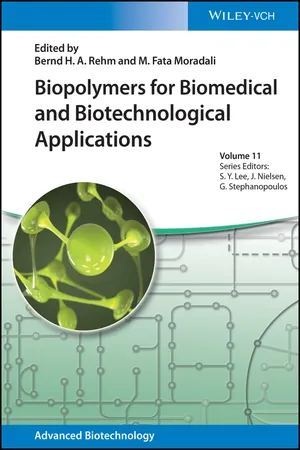
Provides insight into biopolymers, their physicochemical properties, and their biomedical and biotechnological applications
This comprehensive book is a one-stop reference for the production, modifications, and assessment of biopolymers. It highlights the technical and methodological advancements in introducing biopolymers, their study, and promoted applications.
"Biopolymers for Biomedical and Biotechnological Applications" begins with a general overview of biopolymers, properties, and biocompatibility. It then provides in-depth information in three dedicated sections: Biopolymers through Bioengineering and Biotechnology Venues; Polymeric Biomaterials with Wide Applications; and Biopolymers for Specific Applications. Chapters cover: advances in biocompatibility; advanced microbial polysaccharides; microbial cell factories for biomanufacturing of polysaccharides; exploitation of exopolysaccharides from lactic acid bacteria; and the new biopolymer for biomedical application called nanocellulose. Advances in mucin biopolymer research are presented, along with those in the synthesis of fibrous proteins and their applications. The book looks at microbial polyhydroxyalkanoates (PHAs), as well as natural and synthetic biopolymers in drug delivery and tissue engineering. It finishes with a chapter on the current state and applications of, and future trends in, biopolymers in regenerative medicine.
* Offers a complete and thorough treatment of biopolymers from synthesis strategies and physiochemical properties to applications in industrial and medical biotechnology
* Discusses the most attracted biopolymers with wide and specific applications
* Takes a systematic approach to the field which allows readers to grasp and implement strategies for biomedical and biotechnological applications
"Biopolymers for Biomedical and Biotechnological Applications" appeals to biotechnologists, bioengineers, and polymer chemists, as well as to those working in the biotechnological industry and institutes.
eBook - ePub
Biopolymers for Biomedical and Biotechnological Applications
- English
- ePUB (mobile friendly)
- Available on iOS & Android
eBook - ePub
Biopolymers for Biomedical and Biotechnological Applications
About this book
Trusted by 375,005 students
Access to over 1.5 million titles for a fair monthly price.
Study more efficiently using our study tools.
Information
1
Advances in Biocompatibility: A Prerequisite for Biomedical Application of Biopolymers
Matthew R. Jorgensen, Helin Räägel, and Thor S. Rollins
Nelson Laboratories, LLC, 6280 S Redwood Rd, Salt Lake City, UT, 84123, USA
1.1 Introduction
Biocompatibility is a concept that, in one form or another, has existed since the dawn of medicine. At the base of Vesuvius in ancient Rome was the house of a surgeon, home to an impressive collection of medical instruments that were preserved by ash when the mountain exploded. Without a doubt, patrons of the ancient surgeon subjected themselves to these devices with the expectation and trust that they would be getting better – not worse – due to the treatment they received. While biocompatibility has not always been explicitly defined through history, the safety of a tool in a doctor's hand is central to the mission of the doctor. Following the industrial revolution, instruments have become mass‐produced and marketed as effective tools for the practice of medicine, making doctors rely on the diligence of the manufacturer to ensure patient safety. Concurrently, our knowledge of toxicology has expanded through experience, and medical journals have become widely available to share clinical experiences. These platforms have been and are currently successfully used to notify doctors and also the public about medical instruments thought to be safe, but which actually did more harm than good, and discuss options for mitigating the risks associated with the use of these devices.
To protect patients from being harmed by medical devices, which for one reason or another might be unsafe due to negligence on the part of the device manufacturer, medical device safety has become regulated. These regulations require medical device manufacturers making a device or product to demonstrate that what they are producing performs appropriately when used as intended. Past experience and modern toxicology have identified what sorts of health risks are associated with the use of a given medical device. The most modern and comprehensive overview of biocompatibility is the suite of documents that make up the international standard ISO 10993; the first document in the series, ISO 10993‐1, provides the high‐level framework for evaluation of biocompatibility as a whole, while the other documents in the series explore specific topics in more detail.
The modern concept and definition of biocompatibility is the ability of a medical device (or material) to “perform with an appropriate host response” when used as intended. This means that the device or material should not cause an unacceptable biological risk when used, taking into account the nature of use in terms of contact site and duration, as well as the potential benefit of using the device. ISO 10993‐1, Annex A, lists several key biological risks associated with specific types and durations of patient contact. As the contact duration goes up, and the devices or materials become more invasive, the types of potential risks multiply. For example, a device that is used on an intact skin is not very invasive, and therefore the associated risks are minimal; the skin is an organ effective at protecting the body from our natural environment that is often replete with biological risks. In contrast, consider a neurological stent; this invasive device is in permanent contact with brain tissues. For such a device, risks range from immediate toxicity to thrombosis to more chronic systemic toxicities like cancer. Therefore, even the more modern concept of biocompatibility encompasses the broader idea well captured by the oft‐repeated phrase in medicine “First, do no harm,” which certainly applies to the materials used with the intention of healing.
1.2 Biocompatibility Evaluation of Biopolymeric Materials and Devices
Biopolymers represent a special subset of materials useful in medicine, being derived or produced by living organisms or synthesized from basic biological building blocks. Compared with synthetic polymers, the advantages from the perspective of biocompatibility are clear: because these materials are made by living systems, from building blocks ubiquitous to life, it would seem like the potential for adverse biological reactions would be reduced. For implants, like biocomposite bone anchors used by Arthrex® in hip arthroscopy procedures (Figure 1.1), if the goal is to mimic the tissue being replaced, using a material made from natural building blocks is logical. The scope and range of biopolymers has been discussed in detail within this text and elsewhere in literature [1,3]. Briefly, they include polysaccharides (such as chitin, hyaluronic acid, and cellulose), polyesters (such as polylactic acid [PLA]), proteins (such as silk, collagen, and casein), and others like latex rubber and shellac. As varied as the possible biopolymers are their individual chemical properties; therefore, broad grouping of biopolymers for biocompatibility is not possible. Rather, these materials should be considered without special allowance, in terms of their intended use and durability in the body.

Figure 1.1 BioComposite Knotless SutureTak® anchor used in hip arthroscopy procedures.
Source: Courtesy of Arthrex®.
The biocompatibility evaluation process, in general, begins by determining what potential biological risks the use of the material would present. Once risks are determined, a plan to evaluate those risks should be developed. Often, the risk identification process begins by answering the following questions:
- What is the intended use of the device (or material)?
- What tissues or fluids will it contact in the body (either directly or indirectly)?
- How long is the cumulative amount of time it may contact the body?
- Who will be exposed to the device (infants, pediatrics, adults)?
- What is known about the device materials and their fate in the body?
- What processing, packaging, and sterilization are the materials exposed to?
- Are the materials known to degrade over time?
- What previous clinical experience is there with the device (or materials)?
Annex A in ISO 10993‐1 contains a chart of biological risks for consideration, stratified by contact duration (limited ≤24 hours, prolonged >24 hours to 30 days, long term >30 days) and contact type. These risks can provide a starting point for understanding the risks presented by a device for both the device manufacturer and those who would in the ...
Table of contents
- Cover
- Table of Contents
- Title Page
- Copyright
- 1 Advances in Biocompatibility: A Prerequisite for Biomedical Application of Biopolymers
- 2 Advanced Microbial Polysaccharides
- 3 Microbial Cell Factories for Biomanufacturing of Polysaccharides
- 4 Exploitation of Exopolysaccharides from Lactic Acid Bacteria
- 5 Nanocellulose: A New Biopolymer for Biomedical Application
- 6 Advances in Mucin Biopolymer Research: Purification, Characterization, and Applications
- 7 Advances in the Synthesis of Fibrous Proteins and Their Applications
- 8 Microbial Polyhydroxyalkanoates (PHAs): From Synthetic Biology to Industrialization
- 9 Natural and Synthetic Biopolymers in Drug Delivery and Tissue Engineering
- 10 Biopolymers in Regenerative Medicine: Overview, Current Advances, and Future Trends
- Index
- End User License Agreement
Frequently asked questions
Yes, you can cancel anytime from the Subscription tab in your account settings on the Perlego website. Your subscription will stay active until the end of your current billing period. Learn how to cancel your subscription
No, books cannot be downloaded as external files, such as PDFs, for use outside of Perlego. However, you can download books within the Perlego app for offline reading on mobile or tablet. Learn how to download books offline
Perlego offers two plans: Essential and Complete
- Essential is ideal for learners and professionals who enjoy exploring a wide range of subjects. Access the Essential Library with 800,000+ trusted titles and best-sellers across business, personal growth, and the humanities. Includes unlimited reading time and Standard Read Aloud voice.
- Complete: Perfect for advanced learners and researchers needing full, unrestricted access. Unlock 1.5M+ books across hundreds of subjects, including academic and specialized titles. The Complete Plan also includes advanced features like Premium Read Aloud and Research Assistant.
We are an online textbook subscription service, where you can get access to an entire online library for less than the price of a single book per month. With over 1.5 million books across 990+ topics, we’ve got you covered! Learn about our mission
Look out for the read-aloud symbol on your next book to see if you can listen to it. The read-aloud tool reads text aloud for you, highlighting the text as it is being read. You can pause it, speed it up and slow it down. Learn more about Read Aloud
Yes! You can use the Perlego app on both iOS and Android devices to read anytime, anywhere — even offline. Perfect for commutes or when you’re on the go.
Please note we cannot support devices running on iOS 13 and Android 7 or earlier. Learn more about using the app
Please note we cannot support devices running on iOS 13 and Android 7 or earlier. Learn more about using the app
Yes, you can access Biopolymers for Biomedical and Biotechnological Applications by Bernd H. A. Rehm, M. Fata Moradali, Bernd H. A. Rehm,M. Fata Moradali in PDF and/or ePUB format, as well as other popular books in Biological Sciences & Biotechnology. We have over 1.5 million books available in our catalogue for you to explore.